
Did you know that recent regulatory shifts eliminated the mandatory audit requirement for roughly 20,000 small and mid-sized businesses? It's a massive change that many owners haven't fully realized yet. If you've been losing sleep over the administrative burden of your retirement plan, you aren't alone. We know that managing these benefits feels like a high-stakes balancing act, especially when you're trying to figure out exactly what triggers a 401k audit for your specific company. It's frustrating to deal with compliance confusion when you'd rather focus on your team's future growth.
The good news is that determining your audit status is much simpler than it used to be. In this guide, you'll learn the exact participant thresholds and regulatory rules that determine if your business needs a 401(k) audit this year. We'll break down the 80/120 rule and explain the new way to count participants so you can legally avoid unnecessary expenses. You'll walk away with a clear strategy to manage your plan and a reliable perspective to help you handle the filing with total confidence.
Key Takeaways
- Understand the 100-participant threshold that defines "Large Plans" and serves as the primary factor for what triggers a 401k audit this year.
- Learn how the 2023 rule change means you only count participants with actual account balances, which could exempt your business from an audit requirement.
- Discover how the 80/120 rule acts as a strategic buffer, allowing growing companies with up to 120 participants to stay in "Small Plan" status.
- Get a practical checklist for cleaning up your participant list, including how to use involuntary cash-outs to lower your count legally.
- See why an integrated approach to audits and wealth management can turn a regulatory chore into a strategic advantage for your business.
The 100-Participant Rule: The Primary 401(k) Audit Trigger
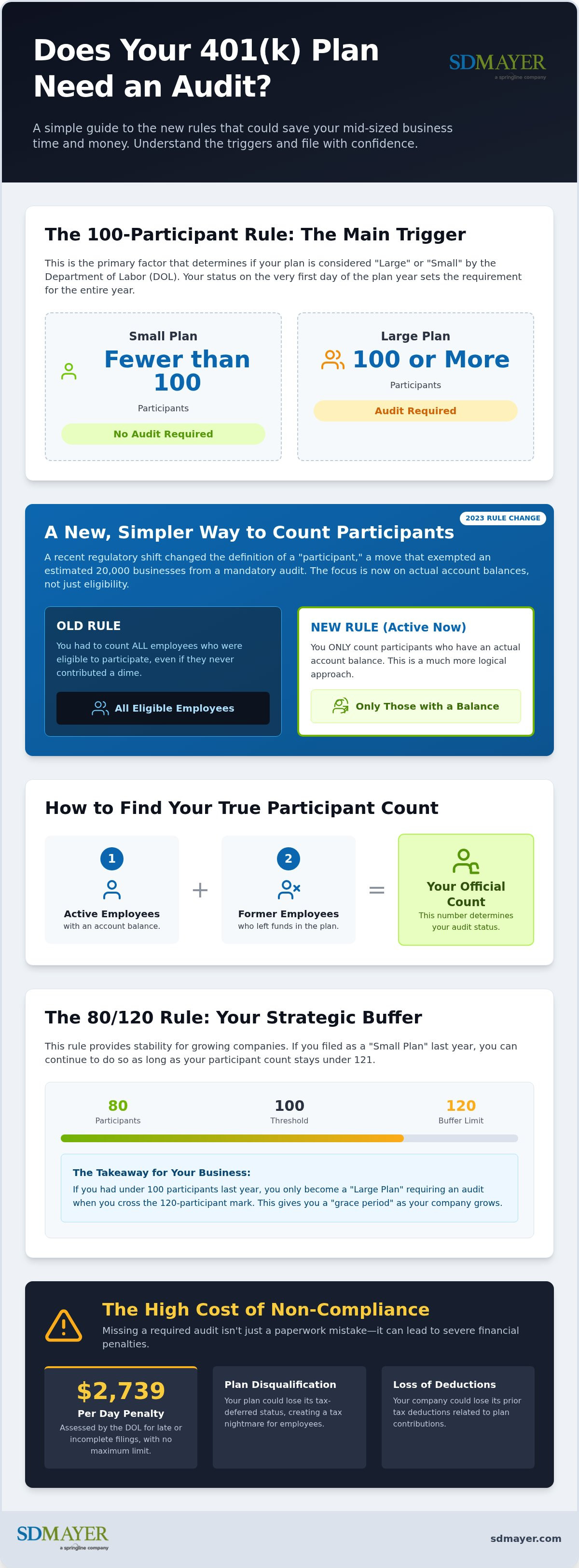
For most growing companies, the transition from a small business to a mid-sized powerhouse brings many milestones. One of the most significant is hitting the 100-participant mark in your retirement plan. This specific number is the primary factor for what triggers a 401k audit. When your plan reaches this threshold on the first day of the plan year, it's classified as a "Large Plan" for your Form 5500 filing. This isn't just a change in labels; it mandates an annual audit performed by an independent qualified public accountant. This professional must be completely separate from your daily operations to provide an unbiased look at your plan's health. For our clients in the Bay Area, keeping a close eye on these numbers through regular financial reporting is the best way to avoid being caught off guard by a sudden change in status.
Why the DOL Cares About Your Plan Size
The Department of Labor (DOL) uses the 100-participant rule as a safeguard under ERISA guidelines. Their goal is simple: they want to protect the retirement assets of employees. As your company scales, the volume of money and the number of families relying on that plan increase. This naturally leads to much higher scrutiny. ERISA was designed to ensure plan transparency and accountability. The government wants to ensure that every dollar withheld from a paycheck actually makes it into the plan and that the assets are managed with the employees' best interests in mind. When you cross that 100-person line, you're signaling to the DOL that your plan has reached a level of complexity that requires a formal "health check" to ensure everything is running as it should.
The Consequences of Missing an Audit
Overlooking this requirement can lead to a financial headache that far outweighs the cost of the audit itself. Understanding what triggers a 401k audit is your first line of defense against steep penalties. The DOL can assess penalties of up to $2,739 per day for late or incomplete filings, and there's no maximum limit on these fines. Beyond the immediate costs, failing to comply can lead to a full plan disqualification. This means your employees could lose the tax-deferred status of their savings, and your company could lose its prior tax deductions. Being proactive with your compliance is much easier than trying to fix a mess after the DOL sends a notice. We recommend mid-market leaders take these steps immediately:
- Review your participant count specifically as of January 1st for calendar-year plans.
- Determine if you've crossed the 100-person threshold to avoid last-minute filing stress.
- Consult with a professional to verify your "Large Plan" status before your Form 5500 is due.
- Establish a relationship with an independent auditor early in the year to ensure a smooth process.
The New Counting Rules: Who Actually Counts as a Participant?
Until recently, counting participants was a source of constant frustration for mid-sized employers. If an employee was simply eligible to join the plan, they counted toward your total, even if they hadn't saved a single cent. That changed significantly starting with the 2023 plan year. Under the new SECURE Act rules, only participants with an actual account balance are included in your count. This single shift in how we define what triggers a 401k audit has already helped approximately 20,000 small and mid-sized plans avoid the cost of a mandatory audit. It’s a much more logical approach that focuses on where the money actually is.
Step-by-Step: Determining Your Participant Count
To get an accurate picture, you must pull your data as of the first day of your plan year. For most companies, this is January 1st. You can’t just rely on a quick glance at your current office seating chart. Follow these steps to find your true number:
- Identify active employees with a balance: Check your records for every current staff member who has funds sitting in their 401(k) account.
- Include former employees: Look for retirees or terminated staff who haven't rolled their funds over to a new plan or IRA.
- Exclude zero-balance employees: If an employee is eligible to participate but has never contributed and has no balance, they don't count.
- Sum the totals: If your combined count of active and former employees with balances is 100 or more, you've likely crossed the threshold.
The Role of Former Employees in Your Audit Trigger
Former employees are often the "hidden" reason a plan moves into the large-plan category. These "zombie accounts" stay on your books long after the person has moved on to a new role. If you have 92 active participants and 10 former employees who left their money behind, you have 102 participants. That's exactly what triggers a 401k audit. It’s a common trap for businesses that are growing steadily but haven't cleaned up their plan records in a while.
Staying on top of these numbers is much easier when your records are organized. Using reliable small business bookkeeping services can help you track these balances with precision throughout the year. If you aren't sure where your count stands today, you can consult with our advisory team to get a clear answer before your next filing deadline.
The 80/120 Rule: How to Legally Avoid a 401(k) Audit
The transition from a small plan to a large plan doesn't have to be a sudden cliff. The Department of Labor provides a helpful buffer known as the 80/120 rule. This provision allows businesses that filed as a small plan in the previous year to continue doing so if they have between 80 and 120 participants at the start of the current year. It’s a strategic grace period designed to prevent companies from oscillating between audit requirements due to minor fluctuations in headcount or temporary growth spurts.
To see how this works in practice, imagine your company started last year with 95 participants and filed as a small plan. This year, your success led to new hiring, and you now have 105 participants with account balances. Under the standard 100-person rule, you've crossed the threshold. However, because you are under the 120-person cap and were a small filer last year, you can skip the audit for another year. Understanding what triggers a 401k audit and using this buffer effectively can save your business significant administrative costs while you continue to scale.
Strategic Planning for the 80/120 Buffer
Staying within this buffer zone requires active monitoring rather than passive observation. You should check your participant count quarterly to see how close you are to that 121-person hard line. This is especially important if you are planning a merger or acquisition. In those cases, you might choose to undergo an audit early to ensure your records are pristine for the transition, even if you technically fall within the buffer. A forward-thinking tax advisor can help you look at the big picture, ensuring your retirement plan compliance aligns with your broader corporate goals and long-term trajectory.
When the 80/120 Rule No Longer Applies
The buffer isn't infinite, and there are clear boundaries you must respect. Once you hit 121 participants on the first day of the plan year, an audit becomes mandatory. There’s also a "sticky" nature to large plan status that many leaders overlook. Once you cross into large plan territory and file as such, you can't simply slide back into the buffer zone the following year if your count drops to 115. You generally must stay in the large plan category until your participant count drops below 100. This is why proactive record-keeping is so vital. Knowing exactly what triggers a 401k audit allows you to make informed decisions about plan design and participant management before you're locked into a mandatory audit cycle.
Action Items: Preparing Your Plan for Audit Readiness
Understanding what triggers a 401k audit is only half the battle. Once you realize you're approaching the threshold, you need a proactive plan to manage your participant count and ensure your records are pristine. One of the most effective strategies for mid-sized businesses is the "involuntary cash-out" process. If your plan document allows it, you can distribute balances for terminated employees that fall below certain limits, typically $5,000 or $7,000 depending on your plan's specific provisions. By moving these small accounts out of the plan, you can often drop back below the 100-participant mark legally and ethically.
It's also worth encouraging former team members to roll their funds over into an IRA or their new employer's plan. Many people simply forget about these accounts, but for you, they represent a compliance risk and a potential audit trigger. A mid-year review with your cfo services for small business provider can help you identify these accounts early. This gives you plenty of time to take action before the January 1st snapshot that determines your audit status for the coming year.
The "Clean-Up" Checklist
A successful audit starts with clean data. If your records are a mess, the audit process will be slow, painful, and expensive. Use this checklist to stay ahead of the curve:
- Review plan documents: Look for mandatory distribution clauses that you might not be utilizing.
- Communicate early: Reach out to terminated employees to explain their rollover options before you initiate a cash-out.
- Sync payroll data: Ensure your internal payroll registers match the records held by your 401(k) provider down to the penny. Discrepancies here are a major red flag for auditors.
Organizing Your Documentation
When the auditor arrives, they will ask for a mountain of paperwork. Having this ready in advance shows that you are a responsible fiduciary. You'll need your plan documents, any recent amendments, and the latest SOC-1 reports from your service providers. Additionally, gather your payroll registers and proof that all employee contributions were deposited into the plan on time. Organized records can reduce your audit fees by 20% or more because the auditor spends less time hunting for information. If you're feeling overwhelmed by the paperwork, you can reach out to our audit experts to help you get organized and stay compliant.
Partnering with an Expert for Your Employee Benefit Plan Audit
Navigating the complexities of retirement plan compliance shouldn't be a solo journey. At SD Mayer, our specialized audit and assurance team views an Employee Benefit Plan Audit as more than just a regulatory hurdle. While we've already discussed what triggers a 401k audit, our goal is to help you use that requirement as a strategic tool for process improvement. We call this our "Simply Doing More" philosophy. It means we don't just check boxes; we look for ways to strengthen your internal controls and protect your fiduciaries from unnecessary risk.
Our approach is holistic and designed to reduce the administrative weight on your shoulders. Because we offer integrated services across Tax, Employee Benefit Plan Audits, and Wealth Management, we see the big picture of your business health. An audit shouldn't exist in a vacuum; it’s an opportunity to ensure your plan is performing at its best for your employees while remaining efficient for your bottom line. We work closely with your internal teams to ensure that your retirement offerings align with your long-term corporate strategy and financial goals. If your long-term strategy involves preparing the business for sale, you can discover High Mark Exit Advisors to help with valuation and M&A advisory.
The SD Mayer Difference: Beyond the Numbers
As a member of the BDO Alliance USA, we provide our clients with the global reach and technical resources of a massive firm while maintaining the warm, personal service of a San Francisco boutique. We understand the unique challenges of the Bay Area economy and the fast-paced nature of the mid-market. Whether you're a tech firm scaling from Series B to an IPO or an established local business, we've helped companies through every stage of growth. We pride ourselves on being your "first call" whenever a compliance question arises, offering a steady hand and a "trusted advisor" model that you can rely on year after year.
Next Steps for Your 2026 Filing
Procrastination is the enemy of a smooth audit. If you suspect your participant count is climbing toward the threshold, don't wait until the July 31st deadline is looming to find a partner. Getting a preliminary assessment now allows you to understand exactly what triggers a 401k audit for your specific situation and gives you time to implement the "clean-up" strategies we mentioned earlier. We can help you verify your count and prepare a roadmap for a stress-free filing season. Taking action today prevents the rush and potential penalties that come with late filings. Contact our audit team for a consultation today to secure your spot and gain peace of mind for your 2026 compliance.
Take Charge of Your Retirement Plan Compliance
Managing a retirement plan shouldn't feel like a constant battle with red tape. By mastering the nuances of the 100-participant rule and the strategic advantages of the 80/120 buffer, you can navigate your company's growth without unnecessary stress. It's helpful to remember that the current counting rules are in your favor, focusing only on employees with actual account balances. Staying proactive by cleaning up dormant accounts and syncing your payroll data ensures you're never surprised by what triggers a 401k audit for your business.
As an award-winning Bay Area accounting firm and a member of the BDO Alliance USA, SD Mayer brings specialized expertise to mid-market Employee Benefit Plan Audits. We're here to be your steady companion, helping you look beyond the numbers to the strategic future of your company. Don't leave your compliance to chance as you scale. Our team is ready to provide the clarity you need to move forward with total confidence.
Get a Professional 401(k) Audit Assessment today to see where you stand. You've worked hard to build your business, and we're here to help you protect it.
Frequently Asked Questions
Does my 401(k) plan need an audit if I have exactly 100 employees?
Yes, if all 100 individuals have an account balance on the first day of your plan year. The threshold is specifically based on participants with funds sitting in the plan, not just your total employee headcount. If you're at exactly 100, you've officially reached the "Large Plan" mark. We suggest a careful review of your specific balance counts to confirm your status.
What happens if I fail to file an audit with my Form 5500?
Failing to include a required audit leads to massive daily fines. The DOL can assess penalties up to $2,739 per day with no maximum limit. Beyond the financial cost, your plan could face disqualification, which negatively impacts your employees' tax status. It is always much safer to be proactive with your filing than to wait for a government notice to arrive in the mail.
Can I use the 80/120 rule if this is my first year having over 100 participants?
You can use the 80/120 rule if you filed as a small plan last year and currently have between 80 and 120 participants. This buffer is designed for companies crossing the 100-person mark for the first time. It allows you to stay in the small plan category until you hit 121 participants or choose to file as a large plan for other strategic reasons.
How much does a typical 401(k) audit cost for a mid-sized company?
Audit costs vary depending on the complexity of your plan and the organization of your records. Generally, first-year audits involve higher professional fees because the auditor must perform extra procedures on opening balances. Keeping your payroll data and plan documents well-organized is the best way to keep these costs manageable. Every plan is unique, so we recommend a consultation for a specific estimate.
Do eligible employees who do not contribute count toward the 100-participant trigger?
No, eligible employees with a zero balance no longer count toward the threshold. Under the 2023 rule change, only those with an actual account balance are included in your total count. This change is a significant part of what triggers a 401k audit today. It has helped many growing firms avoid the expense of an audit until their plan truly reaches a larger scale.
How long does a 401(k) audit usually take to complete?
A standard audit typically takes between six and twelve weeks to complete. This timeline depends on how quickly your team can provide the necessary documents, such as payroll registers and distribution reports. Starting the process early in the year ensures you meet your filing deadline without a last-minute rush. Clear communication between your staff and the audit team is the key to a smooth experience.
What is the deadline for filing a 401(k) audit with the DOL?
For calendar-year plans, the official deadline is July 31st. If you file for a 2.5-month extension, you have until October 15th to submit your Form 5500 and the audit report. Missing these dates is often what triggers a 401k audit scrutiny from the Department of Labor. We always suggest aiming for an early completion to avoid the stress of a tight deadline.
SECURITIES AND ADVISORY DISCLOSURE:
Securities offered through Valmark Securities, Inc. Member FINRA, SIPC. Fee based planning offered through SDM Advisors, LLC. Third party money management offered through Valmark Advisers, Inc a SEC registered investment advisor. 130 Springside Drive, Suite 300, Akron, Ohio 44333-2431. 1-800-765-5201. SDM Advisors, LLC is a separate entity from Valmark Securities Inc. and Valmark Advisers, Inc. Form CRS Link
DISCLAIMER:
This material has been prepared for informational purposes only, and is not intended to provide, and should not be relied on for, accounting, legal or tax advice. The services of an appropriate professional should be sought regarding your individual situation.
HYPOTHETICAL DISCLOSURE:
The examples given are hypothetical and for illustrative purposes only.