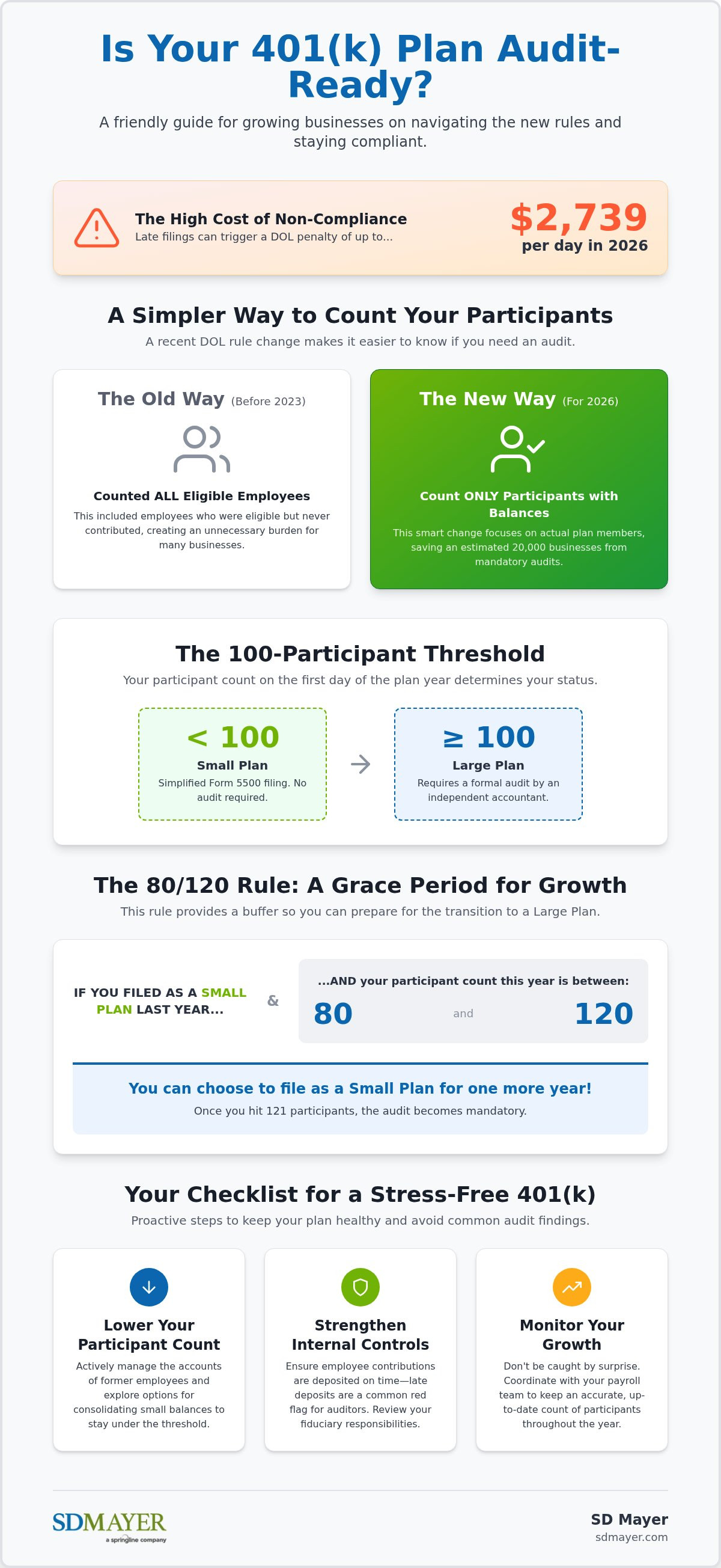
Did you know that a recent regulatory shift saved roughly 20,000 small businesses from the stress of a mandatory audit? By changing how we count participants to focus only on those with account balances, the Department of Labor has made it easier for growing companies to stay compliant without unnecessary overhead. However, for mid-market firms that still cross that threshold, understanding common 401k audit findings is the best way to avoid a penalty of up to $2,739 per day for late filings in 2026.
We understand that the thought of an auditor digging through your records is enough to cause any plan sponsor a bit of anxiety. It's a time-consuming process, and the fear of expensive penalties or confusing rule changes can feel overwhelming. You want to focus on your business and your people, not on chasing down paperwork or worrying about technical red flags that might be hiding in your files.
This guide will help you move from feeling reactive to feeling prepared. You'll discover the specific triggers that lead to an audit, learn practical ways to lower your participant counts, and get a jargon-free checklist for a stress-free preparation process. By the end, you'll have a clear roadmap to keep your plan healthy and your business protected.
Key Takeaways
- Understand how the updated counting rules for 2026 focus only on participants with account balances, potentially exempting your business from an audit.
- Leverage the 80/120 rule as a strategic grace period to maintain your small-plan status even as your workforce grows.
- Identify and resolve common 401k audit findings, such as late employee contributions, to prevent costly Department of Labor penalties.
- Implement proactive steps to lower your participant count by managing the accounts of former employees and consolidating small balances.
The 100-Participant Rule: Is Your Plan a "Large Plan" in 2026?
Crossing the 100-participant threshold is a major milestone for any growing business, but it also triggers new regulatory responsibilities. For 2026 reporting, the distinction between a "small" and "large" plan dictates whether you must hire an independent auditor. This requirement stems from the Employee Retirement Income Security Act of 1974 (ERISA), which ensures that retirement assets are managed transparently. If your plan is misclassified, you might overlook the very issues that lead to common 401k audit findings during a Department of Labor (DOL) inspection.
Counting Your Participants Correctly
Identifying who counts toward that 100-person limit is simpler than it used to be, but it still requires precision. For 2026 reporting purposes, a "Large Plan" is any retirement plan that begins the plan year with 100 or more participants who hold an account balance. This snapshot happens on the "First Day" of your plan year. For most businesses, that's January 1st, 2026.
When you sit down to do the math, remember to include more than just your current payroll. You must count:
- Active employees who are currently deferring part of their paycheck.
- Retired members who haven't yet moved their funds out of the plan.
- Former staff who left the company but chose to keep their money in your plan.
In fast-paced tech hubs like San Francisco, a sudden hiring surge in late December could unexpectedly push you over the limit just as the new year begins. It's vital to coordinate with your payroll team to ensure your headcount data is accurate before the clock strikes midnight on New Year's Eve.
The Impact of the 2023 DOL Rule Change
Before 2023, the counting method was much more inclusive. You had to count every single employee who was eligible to join the plan, regardless of whether they actually contributed a dime. This created a significant burden for mid-market employers with high turnover or large part-time workforces who had many "eligible" employees but very few actual participants. It often led to common 401k audit findings related to administrative errors for people who weren't even using the plan.
Now, the DOL only cares about participants who actually have assets in the plan. This change has been a massive win for scaling firms, as it prevents "empty" accounts from triggering an expensive audit requirement. However, you shouldn't get complacent. Many businesses fail to monitor their growth throughout the year, only realizing they've crossed the 100-balance threshold when it's too late to prepare. Even if you feel safe today, keeping a close eye on your participant data ensures you aren't caught off guard by a mandatory filing change.
The 80/120 Rule: A Strategic Grace Period for Growing Firms
The 80/120 rule acts as a valuable buffer for businesses that are quickly expanding. Transitioning from a small plan to a large plan brings new complexities, and this rule gives you the breathing room to get your house in order. Essentially, if your plan had between 80 and 120 participants with balances at the start of the year, you can choose to file as a "small plan" provided you filed as one in the previous year. This allows you to scale your internal financial systems without the immediate pressure of a full-scale audit.
How the 80/120 Transition Works
To use this grace period, you must satisfy the "look back" requirement. You must have filed as a small plan in the prior year to qualify for the exception. Consider a professional services firm in San Mateo that started last year with 90 participants. They've had a great year and now have 115 participants with account balances. Under the standard 100-participant rule, they'd be looking at an audit. However, because they filed as a small plan last year and remain under the 120-person cap, they can stay in the small-plan category for 2026.
This grace period is helpful, but it's not infinite. Once your participant count hits 121 on the first day of the plan year, the audit is no longer optional. It's best to use this time to identify any issues that might lead to common 401k audit findings before the official auditors arrive. Remember that once you file as a large plan, you'll need to keep filing that way until your participant count drops below 100.
Small Plan vs. Large Plan Filing
The primary benefit of filing as a small plan is the simplified Form 5500. Small plans generally aren't required to attach an independent auditor's report, which saves both time and significant expense. But don't let the "small" label lead to a lack of oversight. Even without a mandatory audit, you still have a duty to manage the plan effectively. Reviewing the Department of Labor's guide on Meeting Your Fiduciary Responsibilities is a great way to ensure your internal controls are strong and to prevent common 401k audit findings from surfacing later.
Maintaining high standards now prevents headaches later. If you're unsure where you stand, take a moment to review your historical status with a professional who understands the mid-market landscape. Checking your last three Form 5500 filings will show you exactly how close you're getting to that 121-participant hard limit. Identifying these trends early allows you to plan for future audit costs well before they become a requirement.
Beyond Size: Common Administrative Red Flags
While size is a primary trigger, the Department of Labor (DOL) and IRS don't just look at headcounts. They look for patterns of neglect. Even if your plan is well under the 100-participant mark, administrative sloppy work can put you in the crosshairs. One of the most visible signals is your fidelity bond. This bond protects the plan against losses from fraud or dishonesty. If your Form 5500 shows a bond amount that doesn't cover at least 10% of your plan assets, it's an immediate red flag that suggests your oversight might be lacking.
The Late Contribution Trap
This is the most frequent of all common 401k audit findings. The DOL expects you to deposit employee deferrals into the plan as soon as they can be reasonably segregated from your general assets. If you've shown you can do it in two days, doing it in ten days during a busy month looks like you're using employee money to fund business operations. One late payroll cycle can lead to a full plan investigation that spans multiple years and requires expensive corrective interest payments.
For mid-market plans, the 7-day safe harbor rule specifies that deposits made within seven business days of the pay date are considered timely by the DOL. Staying within this window is the easiest way to keep your plan off the government's radar. If you miss this window, don't just hope nobody notices. Addressing it immediately through a voluntary correction program is much cheaper than waiting for an auditor to find it.
Form 5500 Errors and Omissions
Your annual filing is essentially a compliance test. Many plan sponsors treat it as a routine administrative task, but answering "No" to a compliance question when the reality is "Yes" can trigger an inquiry. Missing schedules or mismatched financial data across different sections of the form act as secondary triggers for a review. These inconsistencies suggest that your internal record-keeping isn't as tight as it needs to be.
While many companies rely on their payroll provider's automated tools, your plan administrator’s software is not a substitute for expert financial reporting compliance services Bay Area. Software can track numbers, but it doesn't understand the nuances of your specific plan document. If you find an error before the government does, use the IRS 401(k) Plan Fix-It Guide to understand your correction options. Taking proactive steps to fix mistakes shows a good faith effort to stay compliant, which can significantly reduce potential penalties during a formal review.
Action Plan: 5 Steps to Prepare for a 401k Audit
Preparation is the most effective way to turn a high-stress regulatory requirement into a routine administrative checkup. By the time an auditor requests your files, your records should already be organized and verified. Taking a proactive stance allows you to identify and fix common 401k audit findings before they ever reach a government report. Follow these five steps to ensure your mid-market plan is ready for the 2026 filing season.
- Step 1: Clean up former employee balances. Reducing your headcount isn't just about efficiency; it's about staying under the mandatory audit threshold whenever possible.
- Step 2: Organize your plan documents. Gather your latest Summary Plan Description (SPD) and any recent amendments. Auditors will check if your daily operations actually match these written rules.
- Step 3: Conduct a self-audit of payroll. Look closely at your contribution timing. If you find a late deposit, it's better to document and correct it now than to have an auditor discover it later.
- Step 4: Verify your ERISA Fidelity Bond. Ensure your coverage is at least 10% of your plan assets for 2026. A bond that's too low is a frequent trigger for deeper investigations.
- Step 5: Select a mid-market auditor. Choose a partner who understands the scale of your business. You need someone who provides clear guidance, not just a list of mistakes.
Cleaning Up the Participant List
Managing the accounts of former employees is a strategic move that many scaling firms overlook. If a former staff member has a balance under $7,000, you can often "cash out" that account or roll it into an IRA, depending on your plan’s specific language. This effectively lowers your participant count. Staying under the 100-person mark can save your business thousands in annual audit fees and hundreds of hours of administrative work. Our small business bookkeeping services can help you track these metrics throughout the year so you aren't surprised by your headcount on January 1st.
The Internal Control Checklist
Auditors don't just look at numbers; they look at your process. They'll want to see your Plan Committee meeting minutes to confirm that you're regularly reviewing the plan’s performance and compliance. If your plan document says you allow loans but you haven't been documenting the approval process, that's a problem. Consistency is your best defense against common 401k audit findings related to operational failures.
Success starts with a timeline. Set a calendar reminder 90 days before your July 31, 2026, filing deadline to start your preparation. This gives you enough time to gather documents and clean up data without the last-minute scramble. If you're feeling unsure about your plan's health, you can reach out to our team for an audit readiness review to ensure your internal controls are as strong as they need to be.
Why SD Mayer is Your First Call for 401k Compliance
SD Mayer doesn't just check boxes. Our "Simply Doing More" philosophy means we're deeply invested in your plan's health. We don't just identify common 401k audit findings; we provide the clear, practical roadmap to fix them. As a San Francisco-based firm, we understand the fast-paced tech and professional services sectors. We know that scaling a mid-market business in the Bay Area brings unique compliance pressures, from rapid hiring to complex equity compensation. Being a member of the BDO Alliance gives us access to global resources, but our approach remains partner-led and approachable.
We believe compliance should be a byproduct of good management, not a yearly crisis. By integrating your audit services with CAAS, we help you build financial systems that are audit-ready from the start. This holistic view ensures that your bookkeeping, payroll, and financial reporting work together. When your internal data is clean and your processes are documented, you naturally avoid the red flags that catch the attention of the Department of Labor.
A Partnership, Not Just a Service
We view our clients as long-term partners rather than just another file on a desk. We aren't just here to file a return and disappear until the next cycle. Having your audit and tax advice under one roof creates a seamless flow of information that benefits your entire organization. It reduces the administrative burden on your internal team and ensures that every piece of your financial strategy is aligned. When common 401k audit findings surface in the industry, we act as your first call to ensure your plan remains protected. Our goal is to reduce the stress of complex financial compliance by projecting an image of calm, capable stewardship through every stage of your business journey.
Getting Started with Your 2026 Audit
The best time to prepare for an audit is well before you're required to have one. We recommend requesting a preliminary review of your plan’s status to see if you're approaching the 100-participant threshold. During our first meeting, we'll discuss your plan document, review your current internal controls, and identify potential areas of concern. This proactive approach turns a potentially overwhelming process into a manageable project with clear next steps.
- Locate your records: Gather your most recent Form 5500 and your current plan document.
- Review your headcount: Confirm your participant count as of the first day of your 2026 plan year.
- Schedule a review: Contact SD Mayer today for a consultation on your employee benefit plan audit.
Taking Control of Your 2026 Audit Readiness
Managing a mid-market retirement plan doesn't have to be a source of constant anxiety. By proactively managing your participant lists and tightening your internal payroll controls, you can effectively eliminate the most common 401k audit findings that lead to expensive penalties. Whether you're navigating the 80/120 rule or preparing for your very first large-plan filing, the right preparation turns a regulatory hurdle into a strategic advantage for your business.
As a Bay Area firm with founder-level expertise since 2012, SD Mayer brings a local touch backed by the global resources of the BDO Alliance USA. We're proud to be a recipient of "Best Place to Work" awards, which reflects the same holistic care we put into every client partnership. We're here to help you move beyond simple reporting toward a financial strategy that supports your long-term growth and protects your employees.
Schedule your 401k audit consultation with SD Mayer today to ensure your plan is compliant and your team is ready. You've built a great company, and we're here to help you protect its future with confidence.
Frequently Asked Questions
What is the exact deadline for filing a 401k audit in 2026?
For calendar-year plans, the deadline to file Form 5500 and the accompanying audit report is July 31, 2026. If you need more time, you can file Form 5558 to request an automatic 2.5-month extension. This moves your final deadline to October 15, 2026. It's best to start your preparation at least 90 days before these dates to ensure all documents are ready for your auditor.
Can my company be audited if we have fewer than 100 employees?
A mandatory annual audit usually only applies to "large plans" with 100 or more participants holding account balances. However, the Department of Labor can still investigate smaller plans if they notice red flags like late contribution deposits or employee complaints. Staying proactive with your internal controls helps you avoid the common 401k audit findings that typically trigger these unwanted government inquiries for smaller Bay Area firms.
What happens if we miss the Form 5500 filing deadline?
Missing the deadline can be incredibly expensive, with penalties reaching up to $2,739 per day for late Form 5500 filings in 2026. If you realize you've missed a date, don't wait for a notice to arrive. Programs like the Delinquent Fiduciary Filer Voluntary Compliance Program can help you resolve the issue with significantly lower fines. Taking immediate action shows a good-faith effort to maintain your plan's compliance.
Does the 80/120 rule apply to new 401k plans?
The 80/120 rule does not apply to brand-new 401k plans. This specific grace period is only available to plans that filed as a "small plan" in the previous year. If your new plan starts its very first year with 100 or more participants who have account balances, you'll likely need to hire an independent auditor immediately. It's a good idea to track your hiring closely during your plan's first few months.
How much does a typical mid-market 401k audit cost?
Audit costs for mid-market plans depend on several factors, including the number of participants, the complexity of your investments, and the quality of your internal record-keeping. While we don't provide a flat industry average, plans with well-organized payroll records and clean contribution histories often require less time to review. Investing in high-quality bookkeeping throughout the year is a practical way to keep your professional service fees as manageable as possible.
What is a limited scope audit, and can my business use one?
Most mid-market businesses can use what was previously called a "limited scope audit," now officially known as a Section 103(a)(3)(C) audit. This is possible if your plan assets are held and certified by a qualified institution like a bank or insurance company. This type of audit focuses on the plan's administrative operations rather than re-verifying the value of the assets themselves, which often streamlines the overall review process.
How do I cash out former employees to avoid an audit trigger?
Under the SECURE 2.0 Act, you can cash out former employees with balances up to $7,000 as of 2026, provided your plan document allows it. This is a strategic way to keep your participant count below the 100-person audit threshold. You should review your participant list quarterly and coordinate with your payroll team to identify eligible accounts. Consolidating these small balances helps reduce your administrative burden and potential audit exposure.
Will the Department of Labor fine me for a late 401k audit?
Yes, the Department of Labor can and will issue fines for a late or incomplete 401k audit report. Because the audit is a mandatory attachment to your Form 5500 for large plans, failing to include it means your filing is considered incomplete. This can trigger the same daily late-filing penalties mentioned earlier. Ensuring your auditor has everything they need well in advance is the best way to keep your business in good standing.
SECURITIES AND ADVISORY DISCLOSURE:
Securities offered through Valmark Securities, Inc. Member FINRA, SIPC. Fee based planning offered through SDM Advisors, LLC. Third party money management offered through Valmark Advisers, Inc a SEC registered investment advisor. 130 Springside Drive, Suite 300, Akron, Ohio 44333-2431. 1-800-765-5201. SDM Advisors, LLC is a separate entity from Valmark Securities Inc. and Valmark Advisers, Inc. Form CRS Link
DISCLAIMER:
This material has been prepared for informational purposes only, and is not intended to provide, and should not be relied on for, accounting, legal or tax advice. The services of an appropriate professional should be sought regarding your individual situation.
HYPOTHETICAL DISCLOSURE:
The examples given are hypothetical and for illustrative purposes only.