
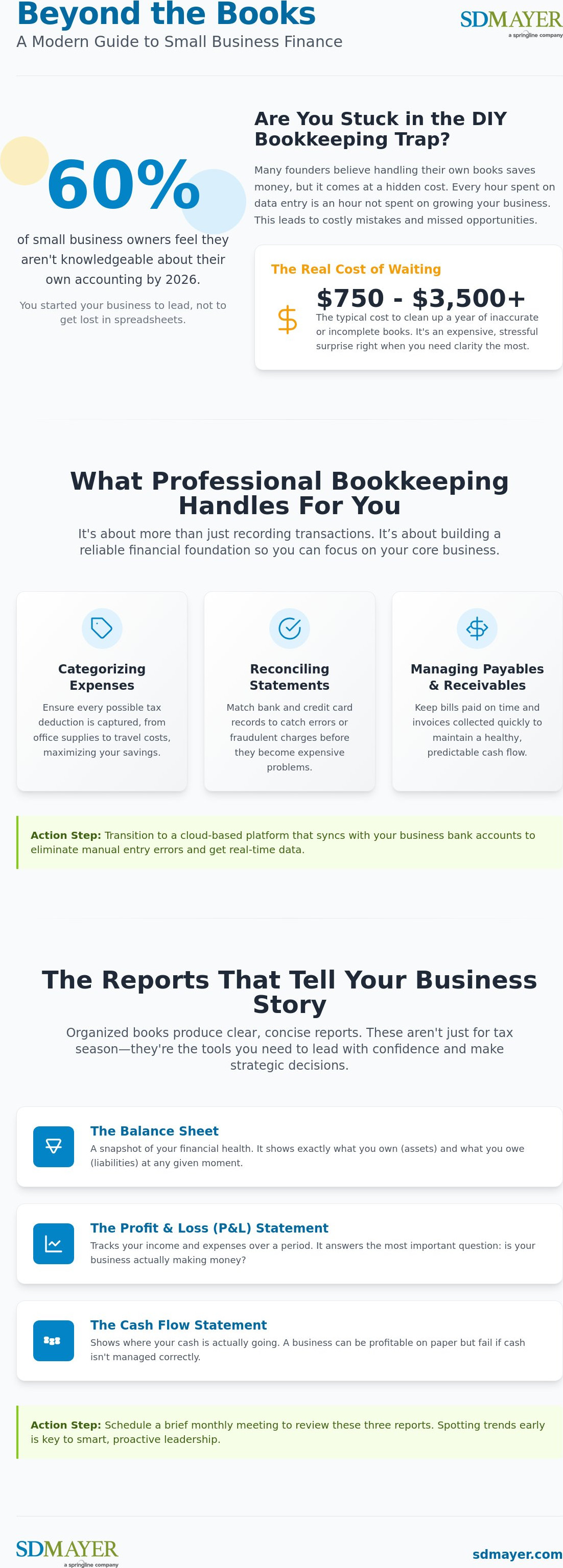
Did you know that as of 2026, 60% of small business owners still feel they aren't knowledgeable about their own accounting? It's a frustrating reality for many entrepreneurs who started their companies to innovate and lead, not to spend their Saturday nights buried in bank reconciliations. If you've felt the anxiety of a looming tax deadline or struggled to find reliable small business bookkeeping services to manage California's new $16.90 hourly minimum wage, you aren't alone. Managing your books often feels like a chore that pulls you away from your actual work; it shouldn't be a source of constant stress.
We believe that professional bookkeeping should do much more than just record transactions. It's time to stop viewing your finances as a historical report and start seeing them as the strategic foundation for your future growth. By moving beyond simple data entry, you can gain the clear visibility needed to make smart hiring and investment decisions without the guesswork. This guide explores how a modern approach to your records can provide clean, tax-ready files and create the space you need to focus on your core business operations. We'll show you how to transform your financial data into a roadmap for success with clear, actionable steps you can take today.
Key Takeaways
- Learn how daily transaction tracking serves as the essential starting point for every informed financial decision your company makes.
- Identify the hidden opportunity costs of managing your own records and how professional small business bookkeeping services prevent expensive clean-up fees later.
- Explore how modern cloud-based tools and integrated payroll systems streamline your daily operations and eliminate manual data entry.
- Discover how to transition from basic recording to strategic forecasting using advisory services that turn your financial data into a growth roadmap.
- Identify the specific criteria for selecting a Bay Area partner who understands California’s unique tax landscape and local labor regulations.
What Are Small Business Bookkeeping Services?
At its heart, Bookkeeping is the steady, daily process of recording and categorizing every financial transaction your company makes. Think of it as the pulse of your business; it tracks the movement of every cent so you never have to wonder where your money went. While many people use the terms interchangeably, there's a vital difference between bookkeeping and accounting. Bookkeeping focuses on the organized entry of data, while accounting takes that data to interpret your financial health and provide high-level tax strategy. You can't have one without the other, but the foundation always starts with the numbers.
In 2026, the standard for small business bookkeeping services has shifted entirely toward real-time digital tracking. Relying on paper receipts or monthly manual entries is no longer enough to keep up with the fast-paced regional economy. Modern systems allow you to see your financial position instantly, rather than waiting weeks for a report. Clean, accurate books are the non-negotiable prerequisite for securing any business loan or attracting outside investment.
The Daily Tasks of a Professional Bookkeeper
A professional bookkeeper acts as a guardian of your financial data. They handle the repetitive but essential tasks that keep your business running smoothly. By delegating these duties, you gain back hours of your time while ensuring your records are audit-ready. Their work typically includes:
- Categorizing expenses: This ensures you capture every possible tax deduction, from your office supplies and travel costs to specialized business expenses like vehicle maintenance from Mad Auto Design.
- Reconciling statements: By matching your bank and credit card records with your internal books, a professional catches errors or fraudulent charges before they become expensive problems.
- Managing accounts payable and receivable: Keeping your bills paid on time and your invoices collected quickly is the secret to maintaining a healthy cash flow.
Action Step: Transition to a cloud-based platform that syncs directly with your business bank accounts to eliminate manual entry errors.
Financial Statements 101: What You Get
The goal of organized bookkeeping is to produce reports that tell the story of your business. These documents aren't just for tax season; they're the tools you need to lead with confidence. You should expect three primary reports:
- The Balance Sheet: This gives you a clear snapshot of your assets and liabilities. It shows exactly what you own and what you owe at any given moment.
- The Profit and Loss (P&L) Statement: This report tracks your income and expenses over a specific period. It helps you see if your business is actually making money after all costs are considered.
- The Cash Flow Statement: This shows where your actual cash is going. It's vital because a business can be profitable on paper but still run out of cash if timing isn't managed correctly.
Action Step: Schedule a brief meeting at the end of every month to review these three reports and spot financial trends early.
The Real Cost of DIY Bookkeeping for Growing Teams
Many founders think they're saving money by handling their own books. It's a common trap. You might save a few hundred dollars a month initially, but the opportunity cost is massive. If you're spending your weekends on spreadsheets instead of growing your team or refining your product, you're actually losing revenue. Every hour you spend on data entry is an hour you aren't spending on high-level strategy. Your time is your most valuable asset; don't waste it on tasks that don't scale with your vision.
Waiting too long to hire professional small business bookkeeping services can lead to a painful reality check. The cost of cleaning up inaccurate books at the end of the year often ranges from $750 to $3,500 or more. That's a high price for "saving money." In the fast-paced Bay Area economy, these errors aren't just expensive; they're distracting. When you're trying to close a seed round or a series A, you don't want to be stuck explaining why your records don't match your bank statements. Clean data is the language of trust for investors and lenders alike.
Common Pitfalls of Managing Your Own Books
Mixing personal and business expenses is a nightmare during an audit. It's easy to use the wrong card for a quick lunch, but those small errors add up. California's regulatory environment is also notoriously strict about classifying contractors and employees. With the 2026 salary threshold for exempt employees now at $70,304, getting these classifications wrong can lead to heavy fines and back-pay issues. If you fall behind on reconciliations, you create a "black hole" of financial data where you don't truly know if your business is profitable or just surviving on cash float.
When "Good Enough" Isn’t Enough for Growth
Software like QuickBooks or Xero is great, but it's just a tool. It doesn't replace professional oversight. This Small Business Bookkeeping Guide highlights how modern systems still need a expert's touch to remain accurate. Without it, you risk a "garbage in, garbage out" scenario. Automated tools can easily miscategorize a large purchase, throwing off your entire budget for the quarter. Having a professional provides a second set of eyes, which is one of the best ways to prevent internal fraud and ensure your records are audit-ready. If you're worried about your current setup, it might be time to reach out for a professional financial review.
Complexities like stock option tax planning require precise records from day one. In tech hubs like San Francisco and San Jose, offering equity is a standard way to attract talent. If your bookkeeping is messy, you'll likely miss out on major tax optimization opportunities that could save you and your employees significant money. Professional services ensure these details are tracked correctly, allowing you to focus on building your legacy instead of fixing old mistakes.
Core Components of Modern Bookkeeping Services
Modern small business bookkeeping services rely on a robust technology stack. It's not just about spreadsheets anymore. Cloud-based platforms allow you to access your financial data from anywhere, whether you're in a coffee shop in San Francisco or traveling for a conference. This real-time access ensures that your financial records are always current, which is vital for making quick decisions. When your software syncs directly with your bank accounts, the manual labor of data entry disappears, leaving room for more meaningful analysis.
Digital document management is another pillar of a contemporary setup. Instead of keeping a shoebox of paper receipts, modern firms use digital tools to capture and store every invoice. This creates a permanent, searchable trail that's essential for audits and internal reviews. This Small Business Bookkeeping Guide highlights how these digital records feed directly into your annual tax preparation. When your books are updated daily, your tax professional won't have to spend hours digging through old emails to find missing information in April.
Action Step: Transition to a cloud-based accounting platform and set up a digital receipt capture tool to eliminate paper clutter and ensure your records are audit-ready from day one.
Seamless Payroll Integration
Payroll is more than just cutting checks to your team. It involves complex tax filings and benefit tracking that must be handled with precision. A professional service ensures your payroll taxes are filed accurately and on time, which is crucial given California's strict labor laws and the 2026 minimum wage of $16.90 per hour. They also track 401(k) contributions and other employee benefits so your records stay balanced. If you're looking to scale your workforce, you might want to learn How to Find the Right Tax Professional for Your Bay Area Business in 2026 to ensure your entire financial team is aligned.
Accounts Payable and Receivable Management
Maintaining healthy cash flow requires a two-pronged approach. First, you need to manage what you owe. Streamlining your bill payments helps you avoid late fees and keeps your professional relationships with vendors strong. Second, you need to manage what's owed to you. Automating your invoicing ensures you get paid faster, which keeps cash moving through the business. Timely financial communication with your clients shows that you're a professional, well-organized partner.
Action Step: Review your accounts receivable aging report every two weeks to identify any overdue invoices and follow up with clients before they become a cash flow problem.
From Data Entry to Strategic Advisory: The CAAS Connection
Many founders view bookkeeping as a backward-looking chore. It's often seen as something you do after the money is spent just to satisfy the tax office. But when you partner with expert small business bookkeeping services, those records become a window into your future. This shift from simple data entry to high-level strategy is the core of What is CAAS? A Strategic Guide to Client Accounting Advisory Services in 2026. By integrating your daily transactions with professional oversight, you move from just knowing what happened to knowing what should happen next.
This is where the role of an outsourced controller becomes vital. They don't just record the numbers; they verify the accuracy of the entire bookkeeping process and ensure your financial architecture is sound. This oversight allows for forward-looking financial forecasting. Instead of guessing how much cash you'll have in six months, you'll have data-backed projections to guide your hiring and investment decisions. It turns your financial department from a cost center into a growth engine.
How Advisory Services Help You Scale
Scaling a business requires more than just a gut feeling. You need historical data to build realistic 12-month budgets that account for seasonal dips and growth spurts. Advisory services take your clean books and turn them into detailed reports that identify your highest-margin products or services. If you're preparing for a major milestone like an IPO or an acquisition, having this level of financial clarity is non-negotiable. It proves to potential partners and investors that your business is built on a stable, transparent foundation.
Action Step: Ask your financial partner for a product-margin report to see which parts of your business are actually driving profit versus just generating revenue.
The Holistic Mentor Approach
Your financial team should feel like a partner, not just a vendor you hear from once a year. A holistic mentor provides proactive advice that helps you avoid pitfalls before you fall into them. This means discussing how your business performance impacts your personal wealth management and long-term succession planning. When your small business bookkeeping services are integrated with a broader advisory plan, every transaction becomes a brick in the foundation of your legacy. If you're ready to move beyond basic data entry and start planning for the big picture, schedule a strategic advisory session with our team to see how we can support your journey.
Action Step: Set up a quarterly "big picture" meeting with your advisor to discuss long-term goals that go beyond the current month's profit and loss statement.
How to Choose a Bookkeeping Service in the Bay Area
Choosing a partner for your small business bookkeeping services is one of the most important decisions you'll make for your company's longevity. It's not just about finding someone to categorize transactions; it's about finding a team that understands the pulse of your specific industry. A tech startup in San Jose has vastly different reporting needs than a non-profit in San Francisco. You need a firm that has already navigated the challenges you're about to face, whether that's managing complex stock options or tracking grants with precision. Your bookkeeper should feel like a steady companion who's genuinely invested in your success.
In specialized sectors like construction and engineering, industry expertise also means understanding how technical project data impacts your financial health; to see how Virtual Design Construction can optimize your firm's workflows, check out CRAYDL.
Beyond industry experience, you must verify their grasp of California's unique regulatory environment. For example, starting in 2026, the state's Pay Transparency Law (SB 642) and new Beneficial Ownership Disclosure rules (SB 1201) add layers of complexity to your financial reporting. A generic, national firm might miss these nuances, but a local partner will ensure your Statement of Information is accurate and compliant with these new public search requirements. You also want to evaluate how they communicate. Do they hide behind an automated portal, or are they available for a conversation when you have a question about a sudden shift in your cash flow?
Key Questions to Ask Potential Partners
When you start interviewing firms, don't be afraid to dig into the details. You want to ensure they can handle your needs today and your ambitions for tomorrow. Consider asking:
- "How do you handle State & Local Tax (SALT) compliance?" This is vital for avoiding penalties related to California's specific and often changing tax codes.
- "What technology stack do you recommend for my industry?" They should be able to suggest tools that integrate seamlessly with your existing workflow rather than forcing a one-size-fits-all solution.
- "Can you support my growth from basic bookkeeping to full CFO advisory?" As your revenue increases, you'll eventually need higher-level insights that go beyond daily data entry.
Why Local Expertise Matters in San Francisco
Operating in the Bay Area comes with unique financial pressures. The high cost of living affects everything from your payroll tax obligations to your office lease negotiations. A local advisor understands these regional nuances and can help you benchmark your spending against other successful businesses in the area. They're also familiar with the regional banking and investment landscape, which is incredibly helpful if you're looking to secure a line of credit or prepare for a funding round with Silicon Valley investors. For entrepreneurs looking to transition their business success into home ownership or residential property, you can visit Robert Caicedo Real Estate for specialized guidance.
For those expanding their portfolio into the Sacramento and Elk Grove regions, Home Showings Property Management provides the professional oversight needed to manage residential assets efficiently while you focus on your primary business.
Action Item: Take a moment to schedule a consultation to discuss your specific 2026 growth goals and see how a local partner can provide the stability you need to scale with confidence.
Build Your Strategic Foundation for 2026
Professional bookkeeping is about much more than just keeping the tax office happy; it's the engine that drives your business forward. By choosing high-quality small business bookkeeping services, you're investing in clean data that allows for real forecasting and smarter hiring. Whether you're navigating San Francisco's latest payroll rules or preparing for a major investment round, having a solid financial foundation is what separates growing companies from those that stay stuck in the daily grind.
At SD Mayer, we don't just record your past. We help you plan your future. Our team brings deep expertise in Bay Area business dynamics, offering scalable solutions that grow with you from basic bookkeeping to full CFO advisory. We're here to act as your holistic mentor, taking the stress out of compliance so you can focus on your vision. If you're ready to transform your finances into a strategic asset, partner with SD Mayer for holistic bookkeeping and advisory services today. You've built a great business, and we're excited to help you take it to the next level.
Frequently Asked Questions
What is the difference between a bookkeeper and an accountant?
A bookkeeper focuses on the daily recording of transactions, ensuring your records are organized and accurate. An accountant takes that data to analyze your financial health and provide high-level tax strategy. Think of the bookkeeper as the person building the foundation and the accountant as the one designing the rest of the house. You need both to maintain a healthy financial ecosystem.
How much do small business bookkeeping services typically cost?
The cost of small business bookkeeping services varies based on your transaction volume and the complexity of your financial needs. Factors like how many bank accounts you have, your employee count, and whether you need integrated payroll management will influence the final price. Investing in professional oversight is a strategic move that helps you avoid expensive clean-up fees and missed tax deductions later.
Do I need to hire a local bookkeeping service in San Francisco?
Hiring a local partner is highly recommended because they understand the specific labor laws and tax regulations that affect Bay Area companies. Local firms are familiar with San Francisco's unique ordinances and California's strict salary thresholds for exempt employees. This regional expertise ensures you stay compliant with state-specific rules that a national, software-only provider might easily miss during their daily recording.
Can bookkeeping services help with my business taxes?
Yes, organized bookkeeping is the single most important factor in ensuring your business taxes are filed accurately and on time. By keeping your records updated throughout the year, you'll have a clear trail for every deduction and credit. This preparation makes tax season much smoother and allows your tax professional to focus on saving you money rather than fixing old errors.
What software do most professional bookkeeping services use?
Most professional firms use cloud-based platforms like QuickBooks Online or Xero to provide real-time financial visibility. These tools allow for seamless integration with your bank accounts and other business apps, which eliminates the need for manual data entry. Using modern software ensures your data is backed up securely and accessible from anywhere, whether you're at the office or working remotely.
How often should I receive financial reports from my bookkeeper?
You should receive financial reports at least once a month to stay on top of your cash flow and profitability. Many modern services also provide real-time dashboards so you can check your numbers whenever you need to. Reviewing your balance sheet and profit and loss statement monthly helps you spot financial trends and make adjustments before small issues become big problems.
Can a bookkeeping service help with my payroll?
Many bookkeeping firms offer integrated payroll services to manage your employee payments and tax filings. This includes tracking benefits, 401(k) contributions, and ensuring you meet California's specific labor requirements. Combining these tasks under one roof reduces errors and gives you a more holistic view of your total labor costs. It's an efficient way to streamline your back-office operations.
Is it safe to outsource my bookkeeping to a third party?
It's very safe to outsource your bookkeeping if you choose a reputable firm that uses bank-level encryption and strict internal controls. Professional small business bookkeeping services actually provide better protection against fraud than doing it yourself because they have multiple people reviewing every transaction. This partnership gives you access to high-level security protocols and expertise that are difficult to maintain in-house.
SECURITIES AND ADVISORY DISCLOSURE:
Securities offered through Valmark Securities, Inc. Member FINRA, SIPC. Fee based planning offered through SDM Advisors, LLC. Third party money management offered through Valmark Advisers, Inc a SEC registered investment advisor. 130 Springside Drive, Suite 300, Akron, Ohio 44333-2431. 1-800-765-5201. SDM Advisors, LLC is a separate entity from Valmark Securities Inc. and Valmark Advisers, Inc. Form CRS Link
DISCLAIMER:
This material has been prepared for informational purposes only, and is not intended to provide, and should not be relied on for, accounting, legal or tax advice. The services of an appropriate professional should be sought regarding your individual situation.
HYPOTHETICAL DISCLOSURE:
The examples given are hypothetical and for illustrative purposes only.