
What if the most useful question isn’t “What does outsourced accounting cost?” but “What will the fee cover for my business?” The cost of outsourced accounting for small business depends on more than a price list can show. A growing company with multiple entities, high transaction volume, or books that need cleanup may need a different level of support than a business looking for routine bookkeeping.
It’s understandable to want a clear number before comparing proposals. But when service boundaries are vague, two quotes can look similar while covering very different work. A useful comparison starts with the tasks, reporting, and financial guidance your team needs, then checks who is responsible for each part.
This article explains the main factors that shape a tailored fee, from transaction volume and business complexity to the mix of bookkeeping, payroll, Controller support, and CFO guidance. You’ll also learn how to compare proposals by scope and deliverables, then identify a practical next step for budgeting. With a well-defined scope, accounting support can keep pace as your business grows, rather than leaving you to revisit the decision every time your needs change.
Key Takeaways
- The cost of outsourced accounting for small business depends on the work and guidance your company needs, not just its size or revenue.
- Transaction volume, multiple entities, and locations can affect the effort required to keep records and reporting on track.
- Compare proposals by scope, frequency, deliverables, review responsibilities, and how additional work is handled.
- Before budgeting, list your current finance tasks, internal time demands, reporting gaps, and recurring deadlines.
- SD Mayer’s CAAS can bring bookkeeping, payroll, and outsourced CFO or Controller support together in a scope tailored to your business.
What determines the cost of outsourced accounting for a small business?
Outsourced accounting is an agreed scope of recurring financial work and related guidance handled by an outside accounting team. The cost of outsourced accounting for small business depends on what that scope includes, how complex the company’s finances are, and which deliverables it needs. A useful estimate starts with those details, not a universal fee or generic price list.
The work may range from recording transactions and preparing reports to providing ongoing financial guidance. A general overview of Accounting outsourcing describes the range of activities that can be handled externally. For budgeting, define which activities your company needs, how often they happen, and who is responsible for reviewing the results. For example, a proposal should distinguish between preparing a report and reviewing it with leadership.
What can outsourced accounting include?
Routine bookkeeping can include recording income and expenses, matching account records against bank activity, and preparing the books for month-end close, the process of organizing and reviewing financial activity for a period. Financial reporting turns those records into regular summaries that help leaders understand the company’s financial position. Useful scope details include which accounts are reconciled, how often the books are closed, and which reports are prepared.
Payroll, cash management, and budgeting may be separate parts of the scope. Controller support generally adds oversight of accounting processes, reporting, and financial controls. CFO-level guidance focuses more on planning and using financial information to inform business decisions. These responsibilities go beyond routine bookkeeping, so make sure a proposal distinguishes them clearly. For instance, “financial reporting” should specify the reports, their frequency, and whether review or discussion is included.
Why there is no one-size-fits-all accounting fee
Two businesses with similar revenue can have different accounting needs. Transaction activity affects the volume of recording and reconciliation work, while multiple entities can require additional coordination and separate reporting. Expectations matter as well: a company seeking regular financial statements has a different scope from one that needs those reports reviewed and discussed with leadership.
Existing records and processes shape the work, too. Organized books and consistent procedures may make it easier to establish recurring responsibilities. Incomplete records or unclear handoffs may require extra setup or cleanup before the ongoing work can follow a steady rhythm. When defining a scope, separate one-time catch-up tasks from the recurring work you expect each month.
Outsourced accounting fees reflect agreed responsibilities, complexity, and reporting needs. Before comparing estimates, write down the work your team handles now, the information leaders need, and the areas where support or clearer oversight would help. That gives you a practical starting point for defining a scope that can adapt as the business changes.
Which business factors change an outsourced accounting estimate?
The estimate reflects the work needed to keep records current, review activity, and deliver useful financial information. Transaction count matters, but so do the way a business is organized and the decisions its leaders need to make. Looking at these factors together gives a clearer picture than treating any one item as a standalone cost driver.
How volume, entities, and reporting needs affect scope
A business with a straightforward ledger may need regular transaction recording and account reconciliations. A company with several entities or locations may also need financial information separated by business unit, along with coordination to bring the results together. That changes both the work and the reporting deliverables. When reviewing a proposed scope, check whether it describes reporting by entity or location, rather than just consolidated results.
More activity can mean more items to classify, questions to resolve, and records to match before the books are ready for review. For example, a month-end close involving many purchases and deposits may require more follow-up than one with fewer, simpler transactions. The effort depends on the details of the activity and the condition of the records, not just a raw transaction count. The number of accounts, how transactions are documented, and how consistently information reaches the accounting team can also affect the workflow.
How a growing company’s finance needs evolve
As a mid-sized business adds employees, opens locations, or expands operations, its accounting needs can shift. Payroll may become a more involved part of the monthly process. Cash management may matter more as leaders coordinate incoming and outgoing funds across the business. Accounting-system needs can also affect the agreed scope, especially when records must support more detailed reporting.
Growth can change what leadership needs from its numbers, too. A team planning expansion or managing financing activity may need clearer cash visibility and forecasts, while a board may need consistent, decision-ready reports. Those needs call for more oversight and forward-looking guidance than routine bookkeeping alone. Be specific about who will use the reports and what decisions they need to support.
Consider which changes are already underway and which are likely to affect the next budgeting cycle. A company might begin with recurring bookkeeping and financial reporting, then revisit its scope as it adds a location or needs more detailed forecasts. Payroll, cash management, and accounting-system support should be described as distinct responsibilities so the estimate reflects the actual work.
For a useful discussion, outline your current activity, organizational structure, reporting audiences, and near-term plans. SD Mayer’s CAAS support can be scoped around a business’s current needs and revisited as those needs change. Discuss your accounting support needs as part of planning for the next stage.
How do outsourced accounting pricing models and service scopes compare?
A billing model tells you how work is charged, not everything you’ll receive. Two proposals may both use a recurring monthly fee, for example, while one covers bookkeeping and reconciliations and the other also includes payroll coordination, management reports, and review by a Controller. To compare the cost of outsourced accounting for small business, look at the responsibilities and deliverables behind the billing format.
Hourly, recurring-scope, and project-based arrangements
Hourly billing ties charges to time spent, so the amount can change as the work changes. A recurring arrangement defines ongoing responsibilities and can support budgeting when the work, timing, and deliverables are clear. Project-based work is different: it addresses a defined need, such as organizing past records, rather than ongoing accounting operations and reporting. The best fit depends on the work to be done and how predictable it is.
None of these approaches guarantees better value on its own. An hourly arrangement may suit work that varies, while recurring support may be easier to plan around. A project fee can clarify a one-time task, but it doesn’t describe what happens after the project ends. Check whether proposals separate setup or cleanup work from ongoing services, and note how changes in workload are treated.
What to compare beyond the quoted fee
Build a comparison table so each proposal answers the same questions. Include the scope, how often each task happens, expected deliverables, who reviews the work, and how additional work or changes in scope are handled. Then compare the details side by side:
- Timing: When are reconciliations and month-end close expected to be completed?
- Outputs: Which management reports are prepared, and how often?
- Responsibilities: Who handles payroll tasks, supplies information, and reviews completed work?
- Communication: What is the expected meeting or update cadence?
- Boundaries: What’s excluded, what information must your team provide, and how is additional work addressed?
A lower initial quote isn’t automatically the better value if it leaves important work with your staff or excludes reports leadership relies on. On the other hand, added services only make sense if they address a real business need. Compare proposals against your current workload and decision-making needs, not just the total at the bottom. A simple side-by-side checklist can make differences in timing, review, and exclusions easier to spot.
For a closer look at what ongoing bookkeeping can involve, read this guide to small business bookkeeping services. Use it to identify which recurring tasks belong in your scope and which reporting or review responsibilities need separate definition.
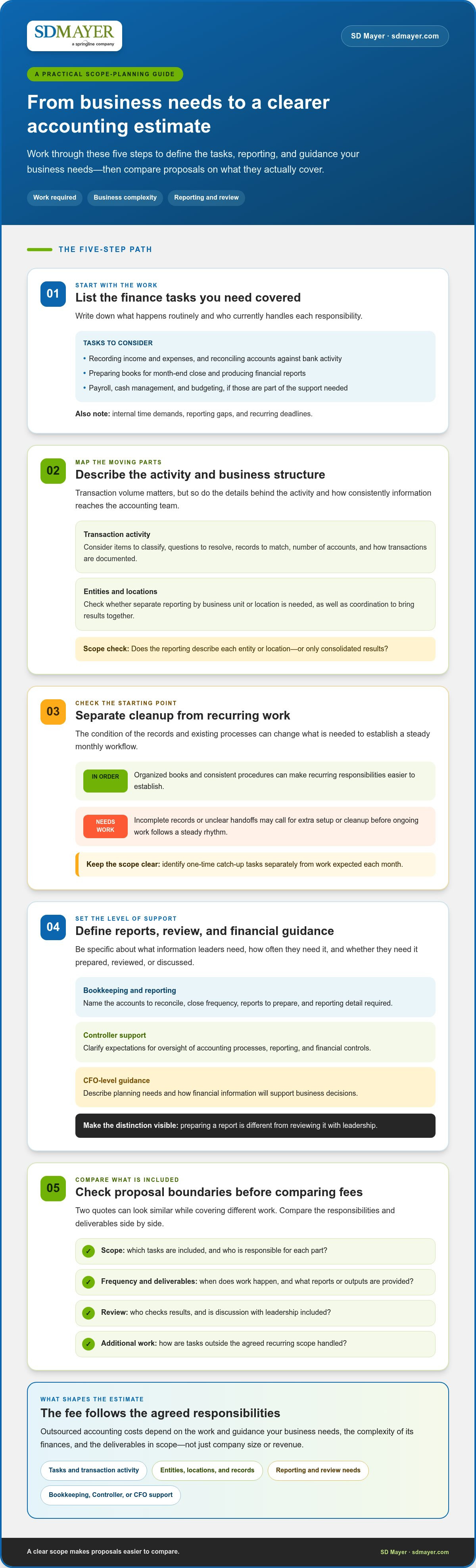
How can a mid-sized business budget for outsourced accounting?
A useful budget starts with a clear picture of the work your finance team needs handled, not a rule based on revenue or an assumed saving. For a mid-sized company, the cost of outsourced accounting for small business is best assessed against its actual responsibilities, reporting needs, and deadlines. A little preparation makes proposals easier to compare and helps keep the scope grounded in what the business needs now.
A simple process for planning the accounting budget
Start by mapping recurring work: who handles each task, which systems they use, when work is due, and what reports leaders need. Include the time employees spend collecting information, correcting records, and preparing updates. Then separate essential operational support from advisory work that may be useful later. With that picture in hand, request a proposal that spells out responsibilities, deliverables, and how the team will communicate.
- Map the current process: List bookkeeping, reconciliations, payroll, reporting, internal owners, systems, and recurring deadlines.
- Identify gaps: Note late or missing reports, repeated manual steps, and information leadership needs but doesn’t receive consistently.
- Set priorities: Distinguish work that must be covered now from future needs such as forecasts or added leadership support.
- Define the scope: Use those priorities to describe expected tasks, review responsibilities, communication, and deliverables.
How to assess value without assuming savings
Compare each proposed deliverable with the current workload and the decisions leaders need to make. Consider whether reports arrive in time to inform planning, whether cash activity is easier to understand, and whether staff spend less effort chasing information or resolving avoidable process snags. These are practical ways to assess fit, not guaranteed financial savings.
For example, a leadership team preparing for expansion may value consistent reporting and clearer cash visibility, while a company with a stable operation may prioritize an accurate, predictable month-end process. The right scope should address the business’s real needs without adding services simply because they appear in a proposal. As those needs evolve, the scope and budget can be revisited.
If your planning needs include forecasts, cash flow insight, or support for major business decisions, explore CFO services for small business to understand how strategic finance support can complement recurring accounting work. To discuss a scope aligned with your company’s priorities, connect with SD Mayer.
How SD Mayer scopes outsourced accounting support for growing businesses
Growing companies often need more than transaction recording. SD Mayer’s Client Accounting Advisory Services (CAAS) can bring bookkeeping and payroll together with outsourced Controller and CFO support. That coordinated approach connects day-to-day accounting with financial reporting and guidance, so leaders can consider both current operations and future priorities.
The scope is tailored to the business, rather than built around a standard package. A company may need help keeping records current and producing regular reports, while another may also need cash management, Controller oversight, or CFO-level support for planning. The cost of outsourced accounting for small business depends on the responsibilities and deliverables agreed for that company.
A coordinated accounting relationship as the business grows
Connecting operational accounting with reporting and guidance can give leadership a more useful view of the business. Accurate, timely records provide a foundation for financial reports, while added advisory support can help leaders use that information to plan. As a company adds locations, expands operations, or faces new reporting needs, its accounting scope can be revisited to reflect those changes.
Headquartered in San Francisco, SD Mayer works with businesses across the Bay Area, including San Mateo, San Jose, Walnut Creek, Santa Rosa, San Leandro, and Menlo Park, as well as Sacramento. Its integrated tax, audit, and advisory capabilities can support a coordinated relationship when those needs fit the business. CAAS brings accounting operations and financial guidance into a connected scope shaped around the company’s needs.
What to bring to an initial scope discussion
A short overview helps make a scope conversation practical. Gather details about your company’s structure and current finance routines, then note where work slows down or leadership needs better information. It’s fine if the process isn’t fully documented. Even a working list can help clarify priorities.
- Business structure: List entities and locations that may affect accounting and reporting.
- Current setup: Note the accounting systems in use, recurring tasks, and who currently handles them.
- Reporting priorities: Identify the reports leaders rely on, when they need them, and any gaps.
- Upcoming changes: Flag expected growth, new locations, or other shifts that could change the work.
- Decision support: Describe where forecasts, cash visibility, or financial guidance would help.
With those details in hand, you can discuss goals, current processes, and a scope shaped around your business. Discuss your accounting needs with SD Mayer.
Build an Accounting Scope That Can Grow With You
The cost of outsourced accounting for small business is shaped by the responsibilities, complexity, and reporting your company needs, not by a universal price list. To budget with confidence, document current tasks, deadlines, and reporting gaps, then compare proposals by deliverables and review responsibilities as well as billing model.
As your business grows, the right support may extend beyond bookkeeping to payroll, financial reporting, Controller oversight, or CFO guidance. SD Mayer’s CAAS brings these capabilities together in a scope tailored to your needs, with integrated tax, audit, and advisory services when they fit your priorities. Rooted in the Bay Area, SD Mayer takes a trusted-advisor approach and was named one of Accounting Today’s Top 25 Fastest-Growing Firms in 2025.
Your next step can be a practical conversation about your goals, current processes, and where your finance support should go next. Discuss your accounting needs with SD Mayer, and take a thoughtful step toward support that can evolve with your business.
Frequently Asked Questions
How much does outsourced accounting cost for a small business?
There isn’t one standard fee because the cost of outsourced accounting for small business depends on the work and reporting your company needs. Transaction activity, entities, recordkeeping processes, and the level of financial guidance all shape the scope. SD Mayer tailors support to each business rather than using a universal price list. The firm is rooted in San Francisco and works with businesses in San Mateo, San Jose, Walnut Creek, Santa Rosa, San Leandro, Menlo Park, and Sacramento.
What factors affect the cost of outsourced accounting?
The main factors are the volume and complexity of the work, the number of entities or locations, and the services included. A company may need transaction recording and reconciliations, while another also needs payroll, cash management, detailed management reports, or Controller oversight. Existing records and processes matter, too. Clear, organized information can make recurring work different from a situation that needs catch-up or process setup first.
Is outsourced accounting cheaper than hiring an in-house accountant?
It depends on the role, workload, and support your business needs, so outsourcing isn’t automatically cheaper. Compare the full cost and responsibilities of an in-house position, including salary and benefits, with the outsourced scope and deliverables. Also consider whether one employee could provide the range of support you need. A clear comparison should weigh coverage, review responsibilities, reporting, and guidance, not just the monthly fee or salary.
What is usually included in outsourced accounting services?
The scope may include recording transactions, reconciling accounts, closing the books each month, and preparing financial reports. Payroll and cash management can also be included, depending on the agreed responsibilities. Some businesses add Controller oversight for accounting processes and reporting, or CFO guidance for planning and financial decisions. Spell out each task, deliverable, review responsibility, and frequency so you know exactly what the arrangement covers.
Do outsourced accountants charge hourly or a monthly fee?
Both approaches are possible. Hourly billing connects charges to time spent, so the total may change with the work performed. An ongoing arrangement may use a recurring fee tied to a defined scope, while a separate project engagement can cover a one-time need such as organizing past records. The billing format alone doesn’t tell you what’s included. Compare responsibilities, deliverables, timing, and terms for additional work.
Can a small business start with bookkeeping and add CFO support later?
Yes. A business can scope support around current bookkeeping needs and revisit it as operations or leadership priorities change. For example, a growing company may later need forecasts, clearer cash visibility, or help interpreting financial reports. These needs differ from routine transaction work. Discuss current responsibilities alongside anticipated changes so the scope can reflect what the business needs now and what may become useful as it grows.
How should I compare outsourced accounting proposals?
Compare proposals using the same scope checklist. Note which tasks are covered, how often work and reports are delivered, who reviews the results, and what your team must provide. Include month-end close timing, reconciliations, management reports, payroll responsibilities, communication cadence, exclusions, and how changes or additional work are handled. A proposal with a lower initial fee may leave important tasks with your staff, so weigh deliverables and responsibilities alongside price.
SECURITIES AND ADVISORY DISCLOSURE:
Securities offered through Valmark Securities, Inc. Member FINRA, SIPC. Fee based planning offered through SDM Advisors, LLC. Third party money management offered through Valmark Advisers, Inc a SEC registered investment advisor. 130 Springside Drive, Suite 300, Akron, Ohio 44333-2431. 1-800-765-5201. SDM Advisors, LLC is a separate entity from Valmark Securities Inc. and Valmark Advisers, Inc. Form CRS Link
DISCLAIMER:
This material has been prepared for informational purposes only, and is not intended to provide, and should not be relied on for, accounting, legal or tax advice. The services of an appropriate professional should be sought regarding your individual situation.
HYPOTHETICAL DISCLOSURE:
The examples given are hypothetical and for illustrative purposes only.