
What if your CPA could turn accurate books and timely tax work into clearer decisions about hiring, investment, and growth? For mid-sized companies, business CPA services San Francisco firms provide can go beyond reporting and deadlines. The right support helps leaders understand what the numbers mean, spot financial issues sooner, and make decisions with better context.
As a company grows, bookkeeping, payroll, taxes, audits, and financial planning can become harder to coordinate across internal teams and separate providers. You need reliable compliance support, but you also need timely information that helps guide decisions and keeps strategic priorities in view.
This guide explains what CPA support can cover, how to assess what fits your company’s size and complexity, and how connected accounting, tax, audit, and advisory services can support growth. You’ll also see how a San Francisco-rooted firm such as SD Mayer can provide continuity as your needs change, linking day-to-day reporting with a broader view of your business’s financial direction.
Key Takeaways
- Look beyond tax preparation to identify the ongoing reporting, accounting, assurance, and advisory support your company needs.
- Connect bookkeeping and reliable financial reports with tax planning and business decisions to get more value from your company’s numbers.
- Use your company’s size, stage, and complexity to assess business CPA services San Francisco firms provide, including how well related services work together.
- Consider how Bay Area growth and operations across locations may shape your reporting and compliance needs.
- Prepare for a productive CPA relationship by outlining priorities, reviewing current processes, defining responsibilities, and planning the transition.
San Francisco CPA Services Beyond Tax Preparation
Business CPA services are ongoing professional support that helps a company manage financial reporting, taxes, assurance, and other business needs. Tax preparation focuses on organizing information and completing returns. Broader accounting and advisory support can also help owners understand financial performance, maintain useful records, and plan next steps. A Certified Public Accountant may support different parts of this work, depending on the company’s needs and the services involved.
For a mid-sized business, accurate financial information is useful well beyond tax season. Clear reports can help leaders monitor cash flow, compare performance with plans, prepare for board discussions, and make day-to-day choices with better context. The numbers don’t make decisions for you, but consistent, timely information makes trade-offs easier to evaluate.
Which business finance needs can a CPA firm support?
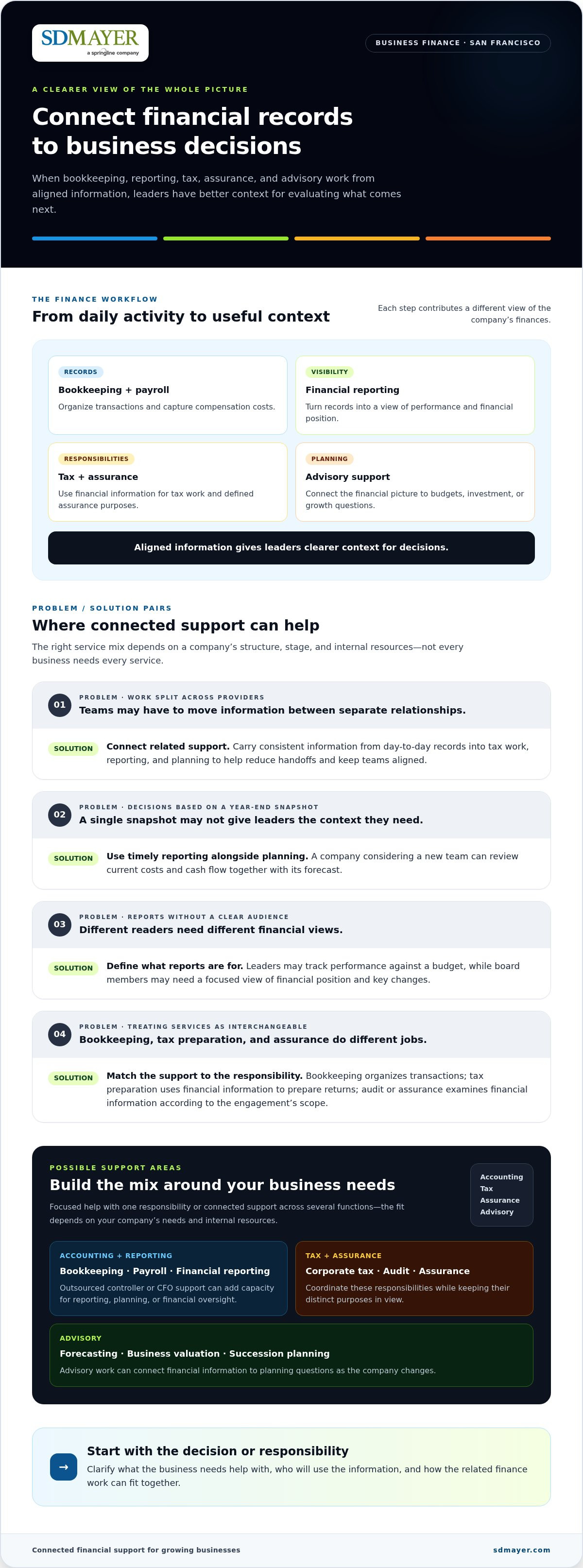
Support may include corporate tax, bookkeeping, payroll, financial reporting, and audit or assurance work. Outsourced CFO or controller support can complement an internal finance team by adding capacity for reporting, planning, or financial oversight as the business changes. Advisory work can also help with forecasting, business valuation, and succession planning. The right mix depends on the company’s structure, stage, and internal resources.
Some businesses need focused help with a specific responsibility; others benefit from connecting several functions. For example, a company preparing for a major growth phase may need regular reporting and forecasting alongside tax planning. Another may need assurance work for a particular reporting purpose. Start by identifying the business decision or responsibility you need help with, rather than assuming every company needs every service.
Why growing San Francisco companies often need connected support
As a company adds employees, entities, or reporting responsibilities, finance work can become harder to coordinate. A mid-sized business might rely on one provider for bookkeeping, another for tax, and a separate advisor for forecasting. Each relationship may work well on its own, but leaders and internal staff can spend time moving information between teams and reconciling different views of the same financial picture.
Connected support helps carry consistent information from day-to-day records into tax work, reporting, and planning. For companies seeking business CPA services San Francisco-wide, SD Mayer coordinates tax, audit and assurance, advisory, and Client Accounting Advisory Services (CAAS), which provide ongoing accounting and financial support. This continuity helps keep compliance responsibilities in view while giving leaders a clearer foundation for business decisions.
How integrated CPA services connect reporting, tax, and business decisions
Integrated accounting support links the work that creates financial records with the work that uses them. Bookkeeping captures transactions, payroll records compensation costs, and regular reporting organizes the information into a view of business performance. Tax planning can draw on those records and anticipated changes, while assurance work examines or reviews financial information for a defined purpose. Advisory support connects the financial picture to questions about budgets, investment, or growth.
Timely reporting turns financial activity into information leaders can use to make informed decisions. For example, a mid-sized company considering a new team can review current costs and cash flow alongside its forecast, rather than relying only on a year-end snapshot.
From bookkeeping and reporting to a clearer financial picture
Consistent bookkeeping helps keep income and expenses organized, while payroll information gives leaders a clearer view of employment costs. Cloud-based accounting tools can help authorized team members and advisors work from current records, depending on how the company’s systems are set up. The value comes from accurate entries, timely review, and reports that answer practical questions, not simply from using a particular tool.
For reporting prepared under GAAP, the generally accepted accounting principles used as a financial reporting framework, consistency helps readers understand how financial information is presented. Clarify which reports the company needs, who will use them, and how often they should be reviewed. For example, leaders may need regular reports to track performance against a budget, while board members may need a focused view of financial position and key changes. Defining the audience makes reporting more purposeful.
When tax, audit, and advisory work need to align
Tax planning is more useful when it reflects current records and forward-looking information, such as expected revenue, expenses, or business changes. The IRS Tax Guide for Small Business offers background on federal tax topics, while a CPA can connect a company’s records and circumstances to its tax work.
Audit and assurance work serves a different purpose from bookkeeping or tax preparation. Bookkeeping organizes transactions, and tax preparation uses financial information to prepare returns. Audit or assurance work examines financial information according to the engagement’s scope. Coordinating these responsibilities can reduce handoffs and help teams work from aligned information, without treating each service as interchangeable.
Businesses exploring outsourced accounting can also read a CAAS strategic guide to understand how ongoing accounting support may fit alongside internal staff. For mid-sized companies, business CPA services San Francisco can bring bookkeeping, reporting, tax, assurance, and advisory into a more connected process. If your team is considering how those needs fit together, discuss your accounting priorities with SD Mayer.
How to evaluate business CPA services for a San Francisco company
The right level of CPA support depends on how your company operates today and what’s changing next. A growing business with a small finance team may need help building a regular reporting process, while an established mid-market company may need added oversight across departments, entities, or locations. Use the comparison below to define the work you need, who will use it, and what a working relationship should cover.
| Business need | Relevant CPA support | Scope question to discuss |
|---|---|---|
| Organized books and regular reports | Bookkeeping, CAAS, and financial reporting | Which reports will leaders receive, and how often? |
| More finance work than the internal team can manage | Outsourced controller or CFO support | Which responsibilities stay with staff, and which need outside support? |
| Operations across states or multiple entities | Corporate tax and state and local tax support | How will records and reporting needs be coordinated across the business? |
| External reporting or assurance needs | Audit and assurance services | What is the purpose and scope of the engagement? |
| Planning for growth or ownership changes | Business advisory, forecasting, valuation, or succession planning | Which decisions should the financial analysis help inform? |
Match the scope to your company’s stage
As a company grows, new employees, entities, and reporting demands can stretch an internal finance team. CAAS can support ongoing accounting work, while controller support can add capacity for financial oversight and reporting. Outsourced CFO support can suit businesses that need help with broader financial planning. For multi-state operations, clarify how tax and reporting responsibilities fit together. The California business tax and fee requirements resource can help identify state-level topics to consider.
Assess communication, continuity, and technology
Define who handles each responsibility, how often the team will review reports, and how questions will be addressed. Cloud-based accounting and reporting tools can help internal staff and advisors work from shared, current information, depending on the company’s setup. A transition plan should cover records, processes, and key dates so responsibilities are clear as work shifts. Before work begins, make sure everyone understands which tasks remain with your staff and how information will move between the teams.
As you compare business CPA services San Francisco companies may need, consider industry familiarity and experience with businesses at a similar stage, along with the ability to coordinate tax, accounting, assurance, and advisory work. These are practical fit criteria, not guarantees of a particular outcome. SD Mayer brings these services together for Bay Area businesses. To discuss your company’s accounting priorities and support needs, connect with the SD Mayer team.
San Francisco and Bay Area considerations for business CPA support
Location can shape a company’s financial needs, but it doesn’t determine them. A San Francisco technology company preparing investor reports may need a different reporting rhythm than a professional-services firm adding employees across several states. For mid-sized businesses, useful CPA support starts with how the company is growing, where it operates, and what information its leaders need to make decisions.
What local business context can change the finance conversation?
Growth can bring new demands: more hires to account for, more detailed reporting for owners or investors, or added complexity as operations expand. A Bay Area tech company may need financial information that helps leadership assess hiring plans and operating costs. A professional-services firm might focus on tracking performance across teams or locations. These are possibilities, not a checklist every San Francisco business must follow.
Before discussing support, outline the decisions and responsibilities that are becoming harder to manage. Note where employees work, whether the business operates through multiple entities, which reports leaders rely on, and how often they need an updated view. If operations extend beyond California, consider how state and local tax responsibilities and reporting fit into the company’s overall process. This gives the CPA relationship a practical starting point.
How regional experience and network resources can work together
SD Mayer is headquartered at The Russ Building in San Francisco, with additional offices in San Mateo, Menlo Park, and San Leandro. The firm supports businesses in San Francisco, San Mateo, San Jose, Walnut Creek, Santa Rosa, San Leandro, Menlo Park, and Sacramento. A San Francisco base provides local context, while the company’s needs should guide the scope of accounting, tax, reporting, and advisory support.
SD Mayer is also a member of BDO Alliance USA, providing access to network resources and specialist expertise when relevant. For companies reviewing reporting responsibilities, start by listing who uses each report, what decisions it supports, and how frequently it’s needed. That gives your team a practical way to identify gaps and prioritize improvements.
To prepare for a conversation, gather a recent set of financial reports, list upcoming business changes, and identify where your current process feels stretched. Then discuss how local context and coordinated support could fit your company’s situation. Discuss your business CPA needs with SD Mayer.
Starting a business CPA relationship with SD Mayer
A productive CPA relationship starts with a clear picture of what your company needs now and where added support could help. For a mid-sized business, that might mean improving monthly reporting, coordinating tax and audit work, or adding finance capacity as the company grows. SD Mayer brings tax, audit and assurance, business advisory, CAAS, and wealth management practices together, helping address connected needs through a relationship built around your business.
What to prepare before an initial conversation
You don’t need a perfect set of documents to explain what’s happening. Start with a brief overview of your priorities and current processes. It can help to note:
- Which reporting, tax, audit, payroll, or planning responsibilities need attention.
- How finance work is divided between internal staff and outside support.
- Where the current process feels strained, such as delayed reports or unclear ownership.
- Upcoming decisions, such as hiring, expansion, new reporting needs, or a change in business structure.
Share relevant context in conversation, but don’t send confidential records through an unsecured channel. The initial discussion can establish what information is needed and how to share it appropriately.
What a thoughtful transition and ongoing relationship can include
Once priorities are clear, define the scope of support and who is responsible for each task. Agree on how communication will work, which reports leaders need, and how often they’ll review them. A transition plan can address current processes, key dates, and the handoff of accounting responsibilities, helping internal staff understand what changes and what remains with them.
Keep expectations transparent as the relationship develops. If the business adds an entity, hires across locations, or changes its reporting needs, revisit the scope and responsibilities together. Coordinated tax, audit, advisory, CAAS, and wealth support can be useful when business and financial priorities overlap, while the specific mix should reflect your company’s circumstances.
To explore business CPA services San Francisco companies can tailor to their reporting, compliance, and planning needs, identify your most pressing priorities and the decisions ahead. Connect with SD Mayer to discuss your business and the support that fits its next stage.
Build a Stronger Financial Foundation for What’s Next
Choosing business CPA services San Francisco companies can rely on means looking beyond annual tax work. The right support should fit your company’s size and complexity, connect accurate reporting with tax and assurance needs, and help leaders make informed decisions. Before starting a relationship, identify your priorities, review how finance work is handled today, and agree on responsibilities, communication, and transition steps.
SD Mayer is headquartered in San Francisco, with additional offices in San Mateo, Menlo Park, and San Leandro. Its integrated tax, audit and assurance, business advisory, CAAS, and wealth management practices can support related business needs through a coordinated relationship. SD Mayer was named one of Accounting Today’s Top 25 Fastest-Growing Firms in 2025, reflecting its place among growing firms in the profession.
As your company evolves, clear financial information and a trusted advisory relationship can help you approach new decisions with greater perspective. Discuss your business CPA needs with SD Mayer and take a practical next step toward support that fits your company’s path forward.
Frequently Asked Questions
What do business CPA services include?
Business CPA services can include tax support, bookkeeping, payroll, financial reporting, audit and assurance, and business advisory. Some companies also use outsourced CFO or controller support for added planning and financial oversight. The right combination depends on the company’s size, structure, internal finance capacity, and goals. To identify a useful starting point, list the responsibilities that need regular attention and separate them from specialized projects, such as an audit or business valuation.
How do I choose a CPA firm for my San Francisco business?
Start by listing your priorities, such as tax work, reporting, bookkeeping, audit support, or financial planning. Then consider whether the firm understands your company’s stage and can coordinate the services you need. Clear communication, defined responsibilities, and a practical transition plan matter too. When comparing business CPA services San Francisco firms provide, look at the proposed scope and working relationship, not just the names of services on a page.
Can a CPA firm provide outsourced CFO and accounting support?
Yes. A firm can combine ongoing accounting support with outsourced CFO or controller services. Bookkeeping and payroll help maintain organized records, while CFO or controller support can add financial oversight, planning, and reporting guidance. The right division of work depends on your internal team, current processes, and business goals. SD Mayer provides CAAS, outsourced CFO and controller support, bookkeeping, and payroll for companies seeking coordinated financial support.
When should a mid-sized business hire a CPA firm?
A mid-sized business may consider outside CPA support when its team struggles to keep up with reporting, tax work, audit needs, or routine accounting responsibilities. Growth, additional entities, or more complex operations can also prompt a review. Start by identifying the work causing the most friction and the decisions your leaders need better financial information to support. Then consider whether ongoing help, specialized project support, or a combination fits best.
What is the difference between a CPA and an outsourced CFO?
A CPA is a licensed accounting professional, while outsourced CFO describes a financial leadership service. The responsibilities can overlap, but they aren’t the same. CPA services may include tax, accounting, and assurance work; CFO support generally focuses on financial oversight, planning, and helping leaders understand business performance. A firm that provides both can coordinate these capabilities around the company’s needs and internal finance team.
Does a San Francisco business CPA firm support companies outside the city?
Yes. SD Mayer is headquartered in San Francisco and has additional offices in San Mateo, Menlo Park, and San Leandro. The firm supports businesses in San Francisco, San Mateo, San Jose, Walnut Creek, Santa Rosa, San Leandro, Menlo Park, and Sacramento. A company’s operating locations and financial needs help shape the appropriate support.
How much do business CPA services cost?
The cost depends on the work involved, your company’s structure, the level of ongoing support, and the complexity of its financial needs. Bookkeeping, tax preparation, audit work, and outsourced CFO support each have different scopes, so a single figure may not reflect what your business requires. A practical next step is to outline the responsibilities you want covered and discuss a scope tailored to your company.
SECURITIES AND ADVISORY DISCLOSURE:
Securities offered through Valmark Securities, Inc. Member FINRA, SIPC. Fee based planning offered through SDM Advisors, LLC. Third party money management offered through Valmark Advisers, Inc a SEC registered investment advisor. 130 Springside Drive, Suite 300, Akron, Ohio 44333-2431. 1-800-765-5201. SDM Advisors, LLC is a separate entity from Valmark Securities Inc. and Valmark Advisers, Inc. Form CRS Link
DISCLAIMER:
This material has been prepared for informational purposes only, and is not intended to provide, and should not be relied on for, accounting, legal or tax advice. The services of an appropriate professional should be sought regarding your individual situation.
HYPOTHETICAL DISCLOSURE:
The examples given are hypothetical and for illustrative purposes only.