
What if the right exit isn’t the offer with the biggest headline number? For mid-sized business owners, choosing among business exit planning strategies means weighing more than price. Company value, financial readiness, timing, employee impact, and the future of the business all matter. The options can be difficult to compare, especially when your personal finances and the company’s next chapter are closely connected.
A thoughtful plan starts with your goals and the business’s readiness, then helps you assess which transition paths may fit. This article compares internal options, such as a family succession or management buyout, with external paths, including a sale to a strategic or financial buyer. You’ll also find practical steps to strengthen financial reporting, reduce dependence on the owner, prepare leadership, and clarify what you may need from the proceeds.
Use these insights to build a transition plan around what matters most to you, whether that’s liquidity, continuity for employees, or preserving the company’s legacy. When business valuation, tax strategy, succession planning, and personal wealth planning come together, integrated advisory guidance can help you make informed decisions at each stage.
Key Takeaways
- Start planning before a transition is imminent so today’s business decisions can support your future goals.
- Compare internal transitions, external transactions, and wind-down options by control, continuity, timing, and complexity.
- Use business exit planning strategies to assess how your company’s leadership depth, financial visibility, and size affect the paths available to you.
- Set your priorities, review financial records and forecasts, identify readiness gaps, and revisit your plan as the business changes.
- Bring business valuation, tax, succession, and personal wealth considerations together to make more informed transition decisions.
Why business exit planning strategies matter before a transition is imminent
A future ownership transition can shape decisions long before an owner is ready to leave. Exit planning is the process of preparing a company’s ownership, operations, and finances for a possible transition. It can help a mid-sized business owner make clearer choices about investment, leadership development, financial reporting, and personal finances, even when there’s no sale date on the calendar.
The starting point is the owner’s preferred outcome, not a transaction. Do you want to step back gradually, keep the company operating under new leadership, or eventually transfer ownership? Consider those goals alongside the company’s ability to operate smoothly through change and your personal financial needs. Understanding Business Exit Strategies offers background on common approaches, but a useful plan connects the options to the people and business involved.
What does a business exit plan cover?
A plan turns a preferred outcome into practical steps. It considers timing, who may take on ownership and leadership, what the company needs to be ready, and how the transition fits your personal financial priorities. Business valuation is one planning input. It can help establish a clearer view of the company’s value and inform decisions, but it isn’t a guaranteed sale price.
Why start planning before you are ready to leave?
Time creates room to spot and address gaps before a transition becomes urgent. For example, an owner reviewing a mid-sized company’s records may find that reporting supports day-to-day needs but doesn’t provide enough detail for forecasting or evaluating performance. Leadership responsibilities may also need attention. Identifying these issues early gives the owner time to decide what to strengthen and track progress.
Regular forecasting and reliable financial reporting make current decisions more informed, too. Owners can use them to consider how a major investment, changing customer mix, or leadership shift might affect the business and their future plans. Start by writing down your preferred outcome, reviewing the reports and forecasts you rely on, and listing responsibilities that depend heavily on you. Then revisit those priorities as the company changes.
Exit readiness is an ongoing process: build it into how you lead the business, not just into the moment you decide to leave. For mid-market companies, this steady approach can connect business continuity with personal financial planning, helping owners make deliberate choices without assuming they must commit to a specific exit path today.
The main business exit planning strategies and how each works
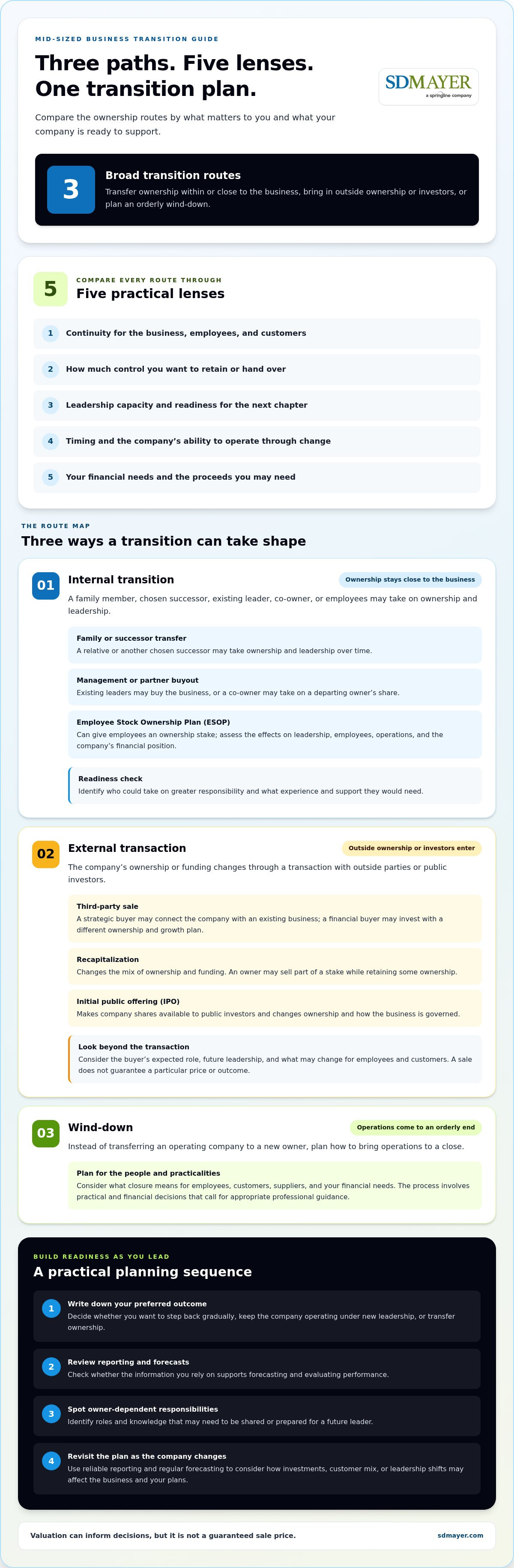
Mid-sized business owners can group the main exit paths into three broad categories: transferring ownership within or close to the company, completing an external transaction, or closing the business. Each route affects who owns the company, who leads it, and how much of its current operations may continue. The right fit depends on the owner’s goals and the company’s readiness, not on a single route being best for everyone.
Internal transitions: succession, management, partners, and employees
An internal transition keeps ownership closer to the business. In a family or successor transfer, a relative or another chosen successor may take ownership and leadership over time. A management buyout shifts ownership to existing leaders, while a partner buyout can allow a co-owner to take on a departing owner’s share. Consider whether the next owners have the experience, resources, and support to lead the company. A useful first step is to identify the people who could take on greater responsibility and the experience they would need.
An Employee Stock Ownership Plan (ESOP) is a structure that can give employees an ownership stake. It may support continuity and employee participation, but it brings planning and operational considerations of its own. Assess how the structure could affect leadership, employees, and the company’s financial position before treating it as a fit.
External paths: third-party sale, recapitalization, IPO, or closure
A third-party sale transfers ownership to an outside buyer. A strategic buyer may connect the company with an existing business, while a financial buyer may invest with a different ownership and growth plan. Consider the buyer’s expected role, the company’s future leadership, and what may change for employees and customers. A sale does not guarantee a particular price or outcome.
A recapitalization changes the company’s mix of ownership and funding. An owner might sell part of their stake while retaining some ownership, so it can represent a partial transition rather than a complete exit. An initial public offering (IPO) makes company shares available to public investors and brings a significant change in ownership and how the business is governed. It is distinct from a private sale and may not suit every mid-sized company.
Closure or wind-down is another path. Rather than transfer an operating company to a new owner, the owner plans to bring operations to an orderly end. Consider what this means for employees, customers, suppliers, and the owner’s financial needs. The process involves practical and financial decisions that should be planned with appropriate professional guidance.
Internal transitions change who leads and owns the business from within; external transactions bring in outside ownership or investors. These categories aren’t always separate, and a company may combine or sequence approaches as its circumstances evolve. For example, a staged ownership transfer may precede a broader transaction. Compare potential paths by continuity, control, leadership capacity, timing, and financial needs, then identify what information would help you assess each one. SD Mayer’s advisory team works with Bay Area businesses on accounting and advisory considerations connected to transition planning.
How to compare business exit strategies against your goals
A useful comparison starts with what you want from the transition, then tests that preference against what the company can support today. A sale isn’t the only meaningful exit path. Some owners value continued involvement or preserving the company’s culture; others prioritize a clean handoff or bringing ownership to a close. Use the table to spot trade-offs, not to select a route automatically.
| Exit path | Control | Continuity | Timing and complexity | May suit owners who prioritize |
|---|---|---|---|---|
| Family or successor transfer | Can shift gradually | May retain familiar leadership and culture | Needs time to prepare successors | Legacy and continued operations |
| Management or partner buyout | Moves to current leaders or co-owners | Existing relationships may support continuity | Depends on leadership readiness and resources | An internal handoff |
| Third-party sale | Typically transfers to an outside buyer | Future operations depend on the buyer’s plans | Requires preparation and transaction work | A broader ownership change |
| Recapitalization | May involve shared or partial ownership | Can leave the owner involved | Requires evaluating a more involved structure | Liquidity while retaining some involvement |
| Closure or wind-down | Ends the owner’s operating role | Company operations don’t continue as an ongoing business | Requires an orderly plan for winding down | Bringing operations to a close |
Which questions help narrow the right exit path?
Ask what you most want to preserve: decision-making control, company culture, your legacy, or an ongoing role. Then assess whether a successor or management team could sustain operations without relying on you for key decisions. Consider your personal financial priorities, too, and how different paths may affect your need for liquidity and future involvement. These are planning questions, not individualized investment advice.
How do company conditions change the comparison?
Company size matters, but so do leadership depth and the clarity of financial information. Reliable reporting and cash-flow forecasts help you understand what the business can support, while a credible valuation process can inform expectations without settling the final terms of a transaction. Buyer interest and market conditions also change, so compare the company’s readiness with your preferred outcome rather than treating either as fixed.
For forecasting context, SD Mayer’s small business CFO growth guide explores how financial planning can support business decisions. A practical next step is to score each plausible route against the table, then note the gaps between your preferred outcome and current capabilities. For example, if preserving continuity is a priority but leadership is concentrated with the owner, that gap deserves attention before choosing a path.
Use your business exit planning strategies comparison as a working document. Revisit it as the company’s leadership, financial visibility, and your personal priorities change. The goal isn’t to force a decision early; it’s to make the trade-offs clear enough to choose deliberately when the time comes.
Actionable steps to prepare a mid-market business for an exit
Exit preparation works best as a steady sequence, not a last-minute document sprint. For a mid-market company, the aim is to align the owner’s goals with what the business can support, then close gaps as the company continues to operate. Use these steps to turn broad intentions into practical work.
- Set your goals. Write down what you want the transition to achieve, including your preferred timing, future role, financial priorities, and hopes for employees and the company. Note which priorities are firm and where you may be flexible.
- Assess readiness. Review leadership depth, customer concentration, owner dependencies, financial reporting, and the company’s ability to operate without your daily involvement. Identify what is already strong and what could make a transition harder.
- Organize financial records. Bring together consistent financial statements, budgets, cash-flow forecasts, tax information, and supporting records. Make sure the numbers tell a clear story over time. Reliable information helps inform valuation work and transaction planning.
- Close the gaps. Assign owners and target dates to improve reporting processes, document key responsibilities, develop leadership coverage, or understand customer concentration. Consider sustained outsourced CFO or controller support if the business needs ongoing financial oversight.
- Revisit the plan. Review your goals, readiness, and progress regularly. Update the plan when financial performance, leadership, customer relationships, or personal priorities change.
Build financial and operational readiness
Look beyond whether statements are prepared. Ask whether your team can explain key changes, connect budgets to actual results, and use cash-flow forecasts to guide decisions. Document how financial information is produced and who reviews it. At the same time, map responsibilities across the leadership team. If customer relationships, approvals, or operating knowledge rest mainly with one person, decide how to share that knowledge and build continuity.
Clear financial records also make it easier to assess the company consistently over time. For practical context on reporting readiness, review this financial reporting guidance.
Coordinate valuation, tax, and transition planning
Valuation, tax planning, and the structure of a potential transition are connected. A valuation helps inform planning, while the way a transaction is structured can affect the owner’s financial and tax considerations. The right questions depend on the company and the owner’s circumstances, so coordinate these areas rather than treating them as separate tasks. For broader context, the strategic tax advice guide explores how tax planning can support business decisions.
Keep a shared planning record with your goals, open questions, key decision-makers, and upcoming milestones. That simple habit can help everyone stay focused as business exit planning strategies develop. SD Mayer’s accounting and advisory services bring financial reporting, tax, valuation, and transition considerations into the planning conversation.
How integrated advisors can support your business exit plan
An ownership transition connects decisions that are often handled in separate parts of a business. Financial reporting affects how clearly the company’s performance can be understood. Tax considerations can shape how an owner evaluates potential transition structures. Succession planning and personal wealth planning bring leadership continuity and the owner’s next chapter into view. For a mid-market business, coordinating these questions can help keep the company’s needs and the owner’s priorities in the same conversation.
What coordinated exit-planning support can address
Accounting and advisory support can help owners build a more consistent picture of company performance and cash flow. That information can inform forecasting, valuation discussions, and preparation for a potential transaction. Outsourced CFO or controller support can also provide ongoing financial oversight, help maintain reporting routines, and give leadership a clearer basis for decisions as the company prepares for change.
Business valuation is one input to planning, not a promise of what a buyer will pay. Succession planning looks at leadership and continuity, while tax planning considers how potential transition choices may affect the business and owner. Wealth management can help connect business decisions with personal financial priorities, including how the owner expects to use or manage proceeds. These conversations are most useful when they reflect the owner’s goals and the company’s actual circumstances.
SD Mayer works with Bay Area and mid-market businesses through business advisory, Client Accounting & Advisory Services (CAAS), outsourced CFO and controller support, tax, business valuation, succession planning, and wealth management. Bringing these perspectives together can help owners see how operating readiness, financial information, and personal priorities relate without assuming that one path or outcome is right for every company.
Start a conversation about your next transition
You don’t need a fixed exit date to begin a useful discussion. Start by sharing what you hope to preserve, what stage the company is in, and the questions that feel most pressing. For example, you might want to understand how prepared your leadership team is, what your financial reports can tell you, or how a possible transition fits your broader financial plans. These priorities can help shape the next steps and identify where more clarity is needed.
An integrated, relationship-led approach keeps the discussion grounded in your business and personal goals. SD Mayer supports mid-market owners in connecting accounting, tax, valuation, succession, and wealth-planning considerations.
If you’re ready to talk through your priorities, Talk with SD Mayer about exit planning.
Make your next step a clearer one
You don’t need every transition decision settled before you begin. Choose one practical next step: write down what you want your next chapter to look like, or identify a business question you need clearer information to answer. That gives your planning a useful starting point and helps keep the company’s future connected to your own priorities.
The right business exit planning strategies should reflect both your goals and what your company can support. SD Mayer brings accounting, tax, audit, business advisory, CAAS, and wealth management perspectives together for Bay Area and mid-market businesses. With roots in San Francisco and offices in San Mateo, Menlo Park, and San Leandro, the firm offers a relationship-led approach to planning through a transition.
When you’re ready to talk through your priorities, discuss your business exit planning goals with SD Mayer. A thoughtful conversation can help you identify the questions to address next and move forward with greater clarity.
Frequently Asked Questions
When should a business owner start exit planning?
Start while you still have time to shape the business, rather than waiting until you’re ready to leave. A leadership change, a shift in your energy or priorities, or increased reliance on a few customers can all prompt a planning conversation. Reviewing business exit planning strategies early can help you identify what needs attention while keeping options open. Begin by recording your goals and the questions you want your financial reports to answer.
What are the most common business exit strategies for a mid-sized company?
Common paths include a family or successor transfer, a management or partner buyout, employee ownership, a sale to an outside buyer, recapitalization, and closing the business. Each changes ownership and leadership differently. To narrow your options, first decide whether you want to remain involved after the transition and how important continued operations are to you. Then consider whether your current leadership team and financial position could support each path.
Can a business owner combine more than one exit strategy?
Yes. An owner may plan a gradual transition rather than a single handoff. For instance, they might bring a successor into leadership first, then transfer ownership in stages as the successor takes on more responsibility. Another owner might explore a partial sale while staying involved for a period. These are possibilities, not guaranteed outcomes. Write down the proposed stages, decision points, and what would need to be true before moving forward.
How does a business valuation support exit planning?
A valuation provides a structured view of the company based on its financial information and relevant business factors. It can help owners examine whether their expectations align with the company’s current position and identify areas to understand more closely, such as customer concentration, recurring revenue, or reliance on the owner. Treat it as a planning tool, not a promise of a buyer’s offer. Ask what assumptions inform the valuation and how changes could affect it.
What financial records should a company organize before a sale?
Organize recent financial statements, tax returns, budgets, cash-flow forecasts, and records that explain significant changes in performance. It can also help to gather details on money customers owe the company, bills the company needs to pay, debt, major customers, and key revenue sources. Keep supporting documents easy to match to the figures they explain. For a Northern California mid-sized company, a consistent record set can help its leadership respond clearly when reviewing the business with advisors or prospective buyers.
How can succession planning help a business transition?
Succession planning helps prepare people to take on leadership responsibilities, so key decisions and relationships don’t depend on a single owner. Identify roles that would be difficult to cover, then choose who could step in and what experience or support they may need. You can also gradually delegate recurring decisions and observe where additional training is needed. This gives the company a practical way to build leadership capacity before ownership changes.
What role can tax planning play in a business exit?
Tax planning helps owners understand how different transition structures and timing may affect the business and their personal financial picture. The considerations can differ depending on the transaction and the owner’s circumstances, so avoid relying on a generic estimate. Gather information about the company’s current tax position and discuss how potential paths might compare with your financial goals. An integrated review can help surface tax questions early enough to inform planning.
Can outsourced CFO support help prepare a business for an exit?
Yes. Outsourced CFO support can help a mid-sized company strengthen financial oversight by supporting forecasts, budgets, reporting, and analysis of business performance. A consistent view of cash flow and results can help leadership make decisions and explain the company’s financial story. It may be especially useful when the existing team needs added finance capacity or a more regular planning process. Consider which reporting or forecasting tasks would benefit most from sustained support.
SECURITIES AND ADVISORY DISCLOSURE:
Securities offered through Valmark Securities, Inc. Member FINRA, SIPC. Fee based planning offered through SDM Advisors, LLC. Third party money management offered through Valmark Advisers, Inc a SEC registered investment advisor. 130 Springside Drive, Suite 300, Akron, Ohio 44333-2431. 1-800-765-5201. SDM Advisors, LLC is a separate entity from Valmark Securities Inc. and Valmark Advisers, Inc. Form CRS Link
DISCLAIMER:
This material has been prepared for informational purposes only, and is not intended to provide, and should not be relied on for, accounting, legal or tax advice. The services of an appropriate professional should be sought regarding your individual situation.
HYPOTHETICAL DISCLOSURE:
The examples given are hypothetical and for illustrative purposes only.