What if your tax professional spent more time looking through your windshield than your rearview mirror? For many Bay Area business owners, the standard experience is a reactive one. You send over your documents in March, pay your bill in April, and hope you don't get a dreaded notice from the IRS or the Franchise Tax Board. It's frustrating to feel like you're only getting half the story, especially when you're dealing with complex stock options or the high costs of doing business in San Francisco.
We understand that you want more than just a compliance checker; you want a strategist who helps you keep more of what you earn. In this article, you'll discover how to choose a partner who provides a clear financial roadmap and proactive planning for 2026. We'll cover how to evaluate local expertise, the impact of the new $40,000 SALT deduction cap, and the specific steps you can take to lower your tax liability through the extended California Pass-Through Entity elective tax. By the end, you'll have a concrete list of action items to ensure your business is both compliant and positioned for growth.
Key Takeaways
- Learn why shifting from a reactive preparer to a strategic tax professional is essential for navigating the complex 2026 regulations.
- Understand the specific differences between CPAs, EAs, and tax attorneys to select the right level of support for your business needs.
- Discover how outsourced CFO services and proactive planning can transform tax compliance from a yearly headache into a growth strategy.
- Use our five-step checklist to vet potential partners on their local industry experience and modern technology standards.
- Explore how a holistic approach that connects tax strategy with wealth management provides a more secure financial roadmap for your future.
Why Finding a Tax Professional is Your Most Important 2026 Business Move
The year 2026 isn't just another tax cycle; it's a turning point for Bay Area businesses. With the federal "One Big Beautiful Bill Act" making many tax provisions permanent and the SALT deduction cap jumping from $10,000 to $40,000, the rules of the game have changed. You can't afford to treat your taxes like a once-a-year chore anymore. A modern tax professional acts as a strategic guide, helping you understand how these shifts impact your specific bottom line. In a region as expensive and regulated as Northern California, simply checking boxes is a recipe for overpayment.
The Difference Between Filing and Strategy
Most people think of tax season as a look back at the previous year. While that's part of it, true strategy looks forward to your 2026 and 2027 goals. A basic return preparer tells you what you owed; a strategist tells you how to change your trajectory. They spot deductions that automated software often misses, like specific nuances in the California Pass-Through Entity (PTE) elective tax. This is where tax advisor credentials really matter. Having a partner who understands the big picture means you aren't surprised by a massive bill in April. Consistent, year-round communication is the only way to catch these opportunities before the window closes on December 31.
The High Cost of the "Wrong" Tax Pro
Choosing the wrong help can be more expensive than paying for the right expert. "Ghost preparers" or uncertified data entry services might seem cheaper upfront, but they often leave you vulnerable. If you're hit with a surprise audit from the IRS or an inquiry from the Franchise Tax Board (FTB), you need an advocate who knows your books inside and out. Poor planning often leads to cash flow crises because you didn't set aside enough for your quarterly estimates. A dedicated tax professional ensures you have a clear financial roadmap so you can reinvest in your business with confidence.
With that confidence, you can focus on other growth drivers like your online visibility; SACHScom specializes in building accessible websites and digital marketing strategies that help businesses, particularly those in the trade industries, stand out in competitive markets.
Action Item: Pull out your 2025 tax return and look at the cover letter or notes. Did your accountant suggest specific changes to your business structure or payroll for the following year, or did they just hand you a finished folder? If there was no conversation about future growth or risk mitigation, your current approach is likely just compliant rather than strategic.
Decoding Credentials: CPA vs. EA vs. Tax Attorney
Choosing a tax professional often feels like deciphering alphabet soup. You see CPAs, EAs, and tax attorneys, and it's easy to assume they all do the same thing. They don't. While each can technically sign your tax return, their training and daily focus vary wildly. If you're looking for basic safety, following the IRS tips for choosing a tax professional is a smart first step. However, for a growing business in the Bay Area, you need to look deeper at what these credentials actually mean for your bank account.
Enrolled Agents (EAs) are federally licensed and focus heavily on IRS rules. They're great for specific audit representation. Tax attorneys are your go-to for legal disputes or criminal issues. But for most business owners, a Certified Public Accountant (CPA) provides the most comprehensive support for day-to-day growth and long-term planning.
Why CPAs are the Backbone of Business Growth
CPAs are generally the best fit for business owners because their education is broad and rigorous. They don't just study tax law; they study business as a whole. A CPA understands how your business structure affects your personal wealth. Many modern firms now offer Client Accounting Advisory Services (CAAS), which means they act like a part-time CFO. Instead of just hearing from them in April, you get year-round guidance on everything from bookkeeping to long-term succession planning. This partnership approach turns a "cost center" into a growth engine.
Specialized Expertise for Tech and Startups
The Bay Area has unique financial hurdles that a generalist might miss. If your company offers equity, you need a pro who lives and breathes stock option tax planning. There's a massive difference between Incentive Stock Options (ISOs) and Non-Qualified Stock Options (NSOs). Getting the timing wrong on these can trigger huge tax bills you weren't expecting.
Local expertise is just as vital. Operating across San Francisco, San Jose, and Sacramento means dealing with different local taxes. A strategist who understands State and Local Tax (SALT) can help you navigate these overlapping rules without overpaying. They can also help you claim R&D tax credits that startups often leave on the table. If you're ready to move beyond basic filing, finding a partner who understands the nuances of the local tech economy is essential.
Action Item: Don't take a preparer's word for it. Head over to the California Board of Accountancy website and use their "License Lookup" tool. It only takes a minute to verify that your potential pro is in good standing and licensed to practice in our state.
Beyond the Return: How Strategic Tax Advice Drives Business Growth
Most business owners view their tax professional as a necessary expense, much like a utility bill or an insurance premium. It's time to shift that narrative. When you move beyond basic filing, your tax preparer becomes a strategic partner who generates a real return on investment. This isn't just about saving a few dollars on April 15; it's about building a more profitable, resilient company throughout the entire year. By integrating services like outsourced CFO and controller roles with your tax planning, you gain a high-level view of your financial health that most small businesses lack.
When your tax strategy is connected to your broader wealth management goals, you aren't just staying compliant; you're actively growing your net worth. A true advisor looks at whether you're taking enough out of the business to fund your personal life while ensuring the company remains healthy. These are the types of questions to ask a tax preparer if you want them to act as a mentor rather than just a historian of your past spending.
Optimizing Your Business Structure
The business structure you chose three years ago might not be the right one for 2026. As federal rules evolve and the California tax landscape shifts, you need to know if an S-Corp, LLC, or C-Corp still offers the best protection and savings. If you're expanding your operations from San Francisco into Sacramento or even out of state, a tax professional helps you navigate the overlapping local tax requirements. They also provide essential guidance for succession planning. If you plan to sell your business in the next five years, the steps you take today will determine how much of that final check you actually get to keep.
Managing Cash Flow and Payroll Compliance
Surprises are great for birthdays, but they're a nightmare for your bank account. Clean, professional bookkeeping is the only way to prevent year-end tax shocks. When your records are accurate and up to date, your advisor can spot cash flow trends and warn you about upcoming liabilities before they become a crisis. This is particularly vital for payroll in California, where rules regarding employee benefits and local withholdings change frequently. To stay ahead, many firms are adopting CAAS (Client Accounting Advisory Services). This model provides the steady, intentional oversight needed to manage complex payroll and benefits without losing focus on your daily operations.
Action Item: Reach out to your current accountant and ask for a mid-year tax projection. A proactive partner should be able to show you exactly where you stand right now and what your estimated liability looks like for the end of the year. If they can't provide this roadmap, it's a clear sign they're only looking through the rearview mirror.
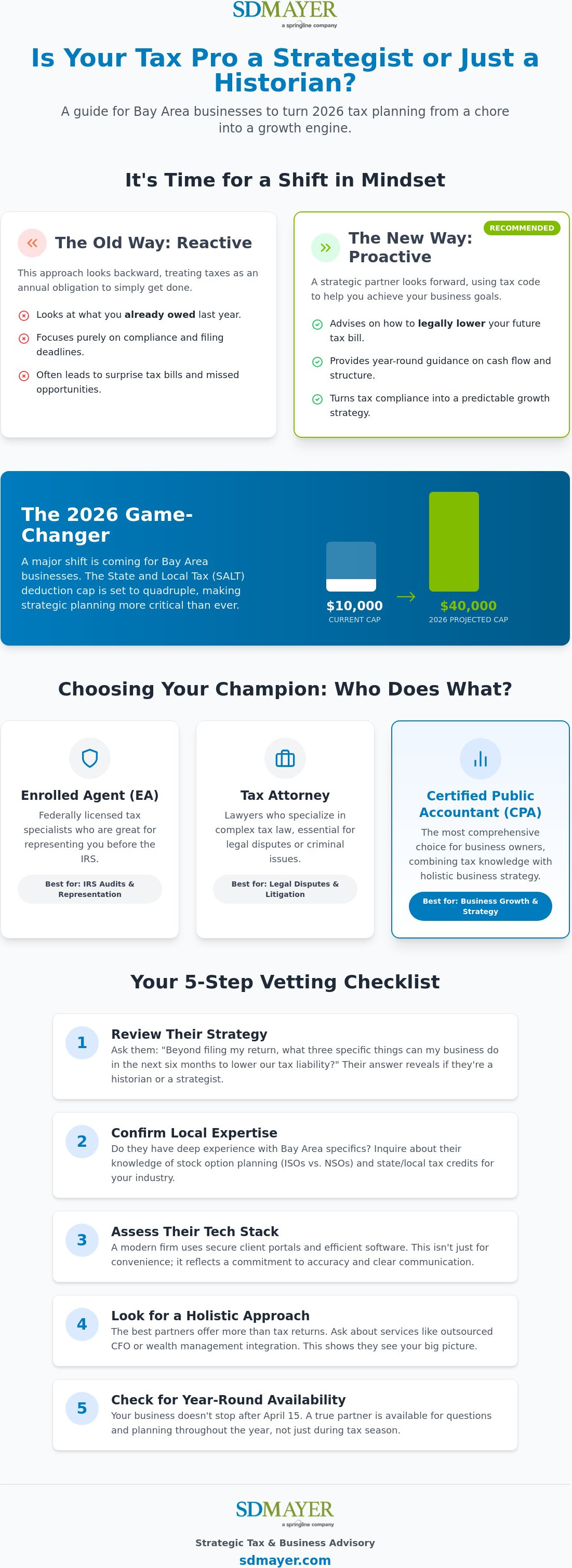
The 5-Step Checklist for Vetting a San Francisco Tax Expert
Finding a tax professional who understands the specific heartbeat of the Bay Area requires more than a quick search for a local office. You need a partner who can navigate the unique economic pressures of San Francisco while keeping a steady eye on your long-term growth. Use this five-step checklist to ensure your next advisor is a true mentor rather than just a data entry clerk.
- Verify industry-specific experience: A firm that primarily handles retail might not be the best fit for a tech startup or a complex nonprofit. Ask for specific examples of how they've helped businesses in your niche.
- Assess their technology stack: In 2026, security is non-negotiable. Your advisor should use modern, encrypted portals for document sharing rather than relying on unsecured email.
- Evaluate their communication rhythm: If they only reach out once a year, they aren't a strategist. Look for a firm that prioritizes regular check-ins to catch tax triggers before they happen.
- Confirm their local Bay Area presence: California tax laws, like the potential Proposition 40 "Billionaire Tax" on the November 2026 ballot, require a deep understanding of local politics and compliance.
- Inquire about holistic services: A great advisor looks at the big picture. Ask if they offer integrated wealth management or succession planning to ensure your business success translates into personal security.
Questions You Must Ask During the First Meeting
When you sit down with a potential tax professional, come prepared with questions that test their proactive mindset. Ask how they handle stock option planning for founders, especially regarding the timing of exercises. Inquire about their approach to the $40,000 SALT deduction cap and how it impacts your specific liability. Finally, ask if they provide outsourced controller services. As your business scales, you'll need more than just tax help; you'll need someone to manage the day-to-day financial complexities of a growing firm. If you're looking for this level of partnership, contact our experts today to see how a strategic approach can benefit your business.
Red Flags to Watch Out For
Be wary of any professional who promises "guaranteed" huge refunds before they've even seen your books. Real tax strategy is about accuracy and mitigation, not magic tricks. Watch out for "ghost preparers" who refuse to sign the return; this is a major compliance risk that leaves you solely responsible for any errors. Finally, look for transparency in pricing. While fees vary, a reputable firm should be able to explain their billing structure clearly without hiding behind vague estimates or sudden surcharges.
Partnering for the Big Picture: The SD Mayer Difference
At SD Mayer, we believe the best financial advice doesn't come from a spreadsheet; it comes from a genuine partnership. We've spent years evolving beyond the role of a traditional accounting firm to become a holistic mentor for our clients. We understand that your business isn't just a series of transactions; it's your life's work. That's why our approach to being your tax professional involves looking at the entire picture, from your daily operations to your long-term retirement goals. We don't just hand you a finished return; we help you understand the "why" behind every number so you can make informed decisions for the future.
A Full-Service Suite for Scaling Businesses
Scaling a business in the Bay Area is a high-stakes journey. You need more than just a tax return; you need a full-service suite that grows with you. We offer everything from basic bookkeeping and payroll to complex CFO advisory services. If your company has grown to the point of needing specialized oversight, we handle high-level requirements like Employee Benefit Plan Audits and single audits with precision. Having your tax strategy and wealth management under one roof means your personal and professional finances are always in sync. This integration prevents the "silo effect" where your accountant and your financial planner aren't on the same page. It ensures that every dollar you save on taxes is immediately working toward your broader wealth goals.
Your Strategic Partner in the Bay Area
We aren't just a voice on a video call; we're part of your community. With a strong presence in San Francisco, San Mateo, San Jose, Walnut Creek, and Sacramento, we understand the local nuances that impact your bottom line. We've seen how the regional economy shifts, and we're here to help you navigate those waves with confidence. We pride ourselves on a conversational, jargon-free style. We want you to feel empowered by your finances, not confused by them. Our goal is to make complex financial planning feel like a clear, manageable roadmap. This approach helps reduce the stress of compliance and lets you focus on what you do best: running your company and serving your customers.
Action Item: Are you ready to stop reacting to tax season and start planning for your future? Schedule a consultation to discuss your 2026 tax strategy today. A quick conversation can be the first step toward a more secure and predictable financial future. Connect with an SD Mayer tax professional today to see the difference a holistic partner can make.
Secure Your Financial Future in the Bay Area
Finding the right tax professional is about more than just surviving April; it's about setting a course for long-term prosperity. You now have the tools to move beyond reactive filing and find a partner who looks through the windshield rather than the rearview mirror. Remember to prioritize credentials like a CPA for business growth and verify local expertise in complex areas like stock options and SALT planning. These steps ensure your business remains compliant while you focus on scaling your vision.
As a top-named Bay Area accounting firm, SD Mayer is dedicated to providing expert guidance without the confusing jargon. We specialize in the high-stakes strategies that local founders and business owners need to thrive in 2026. We don't just work for you; we grow with you as a supportive mentor and steady companion. You deserve a clear financial roadmap and the peace of mind that comes with proactive planning.
Let’s build your 2026 tax strategy together-Contact SD Mayer
Your business journey is unique, and we're excited to help you navigate the road ahead with confidence and clarity.
Frequently Asked Questions
What is the difference between a tax preparer and a tax professional?
A tax preparer typically focuses on the past by entering your data into forms, while a tax professional acts as a year-round strategic partner. Preparers are often seasonal workers who look at what you've already spent. Professionals look at your future goals to find savings and growth opportunities before the year ends. It's the difference between a data clerk and a mentor who understands your business structure.
How much does a professional tax accountant cost in San Francisco?
Costs in San Francisco vary based on how complex your business is and the level of support you need. While basic filings are more straightforward, businesses with complex payroll or equity plans require more specialized expertise. Instead of focusing only on the price, consider the return on investment. A good advisor often pays for themselves by finding deductions and preventing expensive compliance mistakes that a generalist might miss.
Do I really need a CPA for a small business in 2026?
Yes, having a CPA is vital for most Bay Area small businesses because of the complex tax landscape in 2026. A CPA does much more than just file your taxes; they provide essential advice on business structure and help you navigate new rules like the increased SALT deduction cap. Their rigorous training ensures your financial roadmap is built on a solid foundation that supports your long-term growth.
Can a tax professional help with California SALT deductions?
A skilled tax professional is essential for maximizing your State and Local Tax (SALT) deductions under the $40,000 cap. They can help you decide if the California Pass-Through Entity (PTE) elective tax is the right move for your business. This strategy allows many business owners to work around federal limitations, potentially saving thousands of dollars in state taxes that would otherwise be capped and lost.
What should I bring to my first meeting with a tax expert?
You should bring your 2025 tax return, your current financial statements, and any documents related to stock options or recent business changes. It's also helpful to have a clear list of your 2026 goals and any specific concerns about your payroll or cash flow. Being organized from day one allows your advisor to spot opportunities for proactive planning and strategic growth during your very first conversation.
How does stock option planning change my tax liability?
Strategic planning for stock options can significantly lower your tax bill by helping you time your exercises and sales to avoid expensive tax triggers. Without a plan, you could accidentally trigger the Alternative Minimum Tax (AMT) or face high capital gains taxes. A specialist helps you understand the nuances of your equity package, ensuring you keep more of your hard-earned wealth rather than losing it to poor timing.
Is it better to hire a local Bay Area firm or a national one?
Hiring a local firm is usually the better choice because they have firsthand knowledge of the specific tax burdens and trends in Northern California. National firms often miss local details, like San Francisco's unique business tax structure or specific Sacramento compliance rules. A local partner provides a more personal, supportive relationship and truly understands the fast-paced regional economy where you live and work every day.
What happens if my tax professional makes a mistake on my return?
If a mistake occurs, a reputable professional will help you file an amended return and represent you before the IRS or Franchise Tax Board if necessary. While you are still responsible for the tax owed, a dedicated advisor will work to mitigate any penalties or interest caused by the error. This is why it's so important to choose a licensed CPA who stands by their work and offers year-round support.
SECURITIES AND ADVISORY DISCLOSURE:
Securities offered through Valmark Securities, Inc. Member FINRA, SIPC. Fee based planning offered through SDM Advisors, LLC. Third party money management offered through Valmark Advisers, Inc a SEC registered investment advisor. 130 Springside Drive, Suite 300, Akron, Ohio 44333-2431. 1-800-765-5201. SDM Advisors, LLC is a separate entity from Valmark Securities Inc. and Valmark Advisers, Inc. Form CRS Link
DISCLAIMER:
This material has been prepared for informational purposes only, and is not intended to provide, and should not be relied on for, accounting, legal or tax advice. The services of an appropriate professional should be sought regarding your individual situation.
HYPOTHETICAL DISCLOSURE:
The examples given are hypothetical and for illustrative purposes only.