
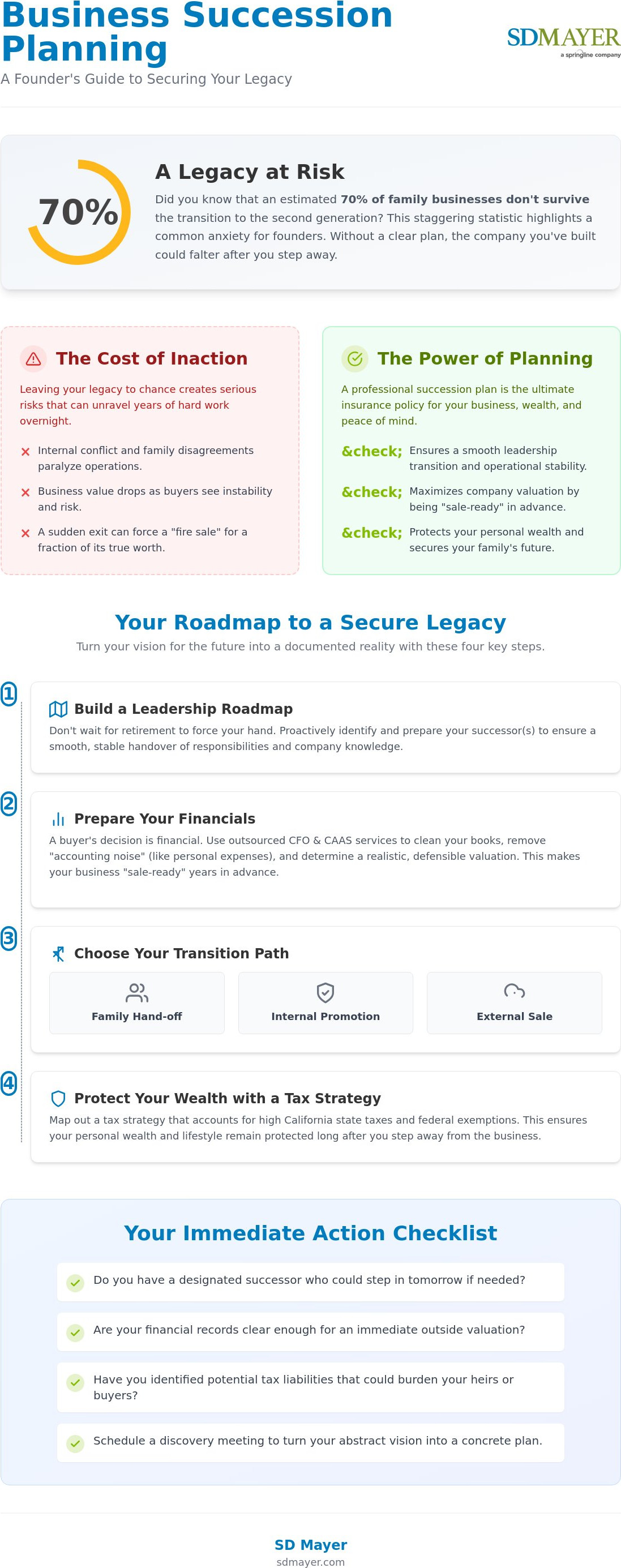
Did you know that roughly 70% of family businesses don't survive the transition to the second generation? It's a sobering statistic that highlights why so many founders feel a mix of pride and deep-seated anxiety as they look toward retirement. You've spent years building your company in the Bay Area's fast-paced economy, and the thought of it faltering after you step away is a heavy burden to carry. It's common to worry about whether your successors are truly prepared or if California’s complex tax environment will strip away the wealth you intend to leave behind.
The good news is that you don't have to leave your legacy to chance. By utilizing professional business succession planning services, you can secure your company's future while protecting your personal financial interests. In this article, you'll learn how to transition your business smoothly, manage the impacts of the $15 million federal tax exemptions, and navigate new state requirements like SB 1201. We’ll provide a clear path to ensure your company thrives for decades to come, giving you the peace of mind you've earned.
Key Takeaways
- Start building a leadership roadmap today to ensure a smooth transition rather than waiting for retirement to force your hand.
- Use outsourced CFO services to clean up your books and determine a realistic valuation that makes your business "sale-ready" years in advance.
- Evaluate whether a family hand-off, internal promotion, or external sale fits your specific goals through professional business succession planning services.
- Map out a tax strategy that accounts for high California state taxes to ensure your personal wealth and lifestyle remain protected after you step away.
- Schedule a discovery meeting as your first concrete step toward turning your abstract vision for the future into a secure, documented reality.
Why Business Succession Planning is Your Most Important Strategic Move
Succession planning isn't just about what happens when you turn off the lights for the last time. It's actually a proactive roadmap for how leadership and ownership will shift over time. Many owners think of it as a retirement task, but waiting until you're ready to leave is a risk-heavy approach. Think of Succession planning as the ultimate insurance policy for everything you've built. Engaging professional business succession planning services early on ensures that your company's value stays high and your legacy remains intact. When you have a clear plan, you aren't just protecting your own wealth; you're providing stability for your employees and a future for the brand you've worked so hard to establish.
The Cost of Doing Nothing
If you don't have a plan, you're leaving your business vulnerable to what's often called the "Smith Family Dilemma." This is a situation where family members or partners disagree on the company's direction, leading to internal conflict that can paralyze operations. Without a clear path, the value of your business can drop overnight during an unplanned exit because buyers see instability as a major risk. A sudden departure without a written strategy can force a "fire sale" where you receive only a fraction of what the company is actually worth.
- Check if you have a designated successor who can step in tomorrow if needed.
- Review your financial records to see if they're clear enough for an outside valuation.
- Identify potential tax liabilities that could burden your heirs or buyers.
Succession as a Growth Engine
When you look at your company through the lens of a future owner, you start to see where the gears are grinding. This "sale-ready" mindset forces you to tighten up your operations and improve your financial reporting. It turns your business into a more profitable, efficient machine today, not just at the time of sale. This is why we often recommend starting with strategic CAAS support. High-quality accounting and advisory services provide the clean data you need to prove your business's worth to a buyer or a bank. By using business succession planning services, you aren't just planning an ending; you're building a stronger, more resilient organization for right now.
Preparing Your Financials: The Role of CAAS and CFO Services
While your vision for the future sets the direction, your financial records provide the proof that your business can actually get there. Transitioning a company is an emotional journey, but for a buyer or a successor, it's a financial transaction. Clean books are the absolute foundation of any successful hand-off. If your records are disorganized, potential buyers see risk, and risk always leads to a lower valuation. By utilizing professional business succession planning services, you can ensure your financial house is in order long before you sit down at the negotiating table.
This is where Client Accounting Advisory Services (CAAS) and outsourced CFOs become your most valuable allies. CAAS isn't just about basic bookkeeping; it's about building an automated reporting system that gives you real-time insights. When your financial data is clear and accessible, you can stop worrying about daily entries and start focusing on the high-level strategy needed for a smooth exit. An outsourced CFO then takes that data and turns it into a compelling story of growth, proving to future owners that the company's success isn't just a fluke, but a repeatable process.
Getting the Numbers Right
Potential buyers or successors generally want to see three to five years of consistent, clear financial data. One of the biggest hurdles for many Bay Area business owners is "accounting noise." These are owner-discretionary expenses, like personal travel or family member salaries, that can cloud your true bottom line. To get a realistic valuation, you need to "normalize" your earnings by stripping away these extras. Proactive Succession Planning for Small Business involves identifying these items early so they don't cause red flags during a due diligence review.
- Review your last three years of profit and loss statements for personal expenses.
- Identify any "one-time" costs that might artificially lower your perceived profit.
- Ensure your balance sheet accurately reflects all current debts and assets.
The Outsourced CFO Advantage
An outsourced CFO acts as a neutral third party, which is especially helpful during family negotiations where emotions can run high. They provide an objective perspective on what the business is actually worth, helping to bridge the gap between your current operations and what a future leader will need to succeed. They also help prepare you for the financial reviews or Single Audits that often precede a major sale, ensuring there are no surprises that could derail the deal. If you're unsure where your financials stand, it's a good idea to reach out to our team for a preliminary review of your current reporting structure.
Financial forecasting is another critical piece of the puzzle. A buyer isn't just paying for what you did last year; they're paying for the future viability of the company. Your CFO can help create detailed projections that show how the business will continue to thrive under new leadership. This level of preparation shows that you're a serious seller who has invested in the long-term health of the organization, making your business succession planning services investment pay for itself many times over.
Choosing Your Path: Family, Insiders, or an External Sale
Deciding who will take over your business is one of the most personal choices you'll ever make. In the Bay Area, we typically see owners take one of three routes: passing the torch to family members, selling to trusted employees, or finding an external buyer. Each path requires a unique strategy and a different set of priorities. While our business succession planning services provide the technical framework for all three, the right choice depends on your specific goals and the legacy you want to leave behind. It's about finding the balance between your financial needs and the long-term health of the company you've built.
The Family Transition
Many owners dream of their children taking over the family legacy. However, you have to be honest about whether the next generation is actually ready and, more importantly, if they even want the responsibility. It's not just about leadership skills; it's about managing family dynamics. One of the toughest parts is the "fair vs. equal" dilemma. If one child works in the business and two don't, giving everyone an equal share can lead to resentment and stall the company's growth. A formal training period is essential. It lets the successor earn the respect of the team while you're still there to mentor them and smooth out any leadership wrinkles.
Selling to Insiders or Employees
If your family isn't the right fit, your current team might be. A management buyout or an Employee Stock Ownership Plan (ESOP) can be a fantastic way to preserve your company culture. An ESOP essentially turns your employees into owners over time, which can offer significant tax benefits for both you and the business. The key is to structure the deal so it doesn't strap the company with too much debt. You want the business to remain healthy enough to pay you out while still having the cash flow to grow under new leadership.
- Identify the top three people in your current leadership team who have the potential to lead.
- Write down the specific skills they're currently missing and what training they'd need to step up.
- Assess if these individuals have the financial interest or the desire to participate in a buyout.
The external sale is often the path for those looking to maximize their immediate payout. To attract a third-party buyer, your business needs to be a "plug-and-play" operation. As we discussed in the previous section, this means clean financials and a leadership team that can function without you. If the business relies entirely on your personal relationships or technical expertise, it's a much harder sell. Professional business succession planning services help you identify these "owner-dependencies" early so you can fix them before you go to market, ensuring you get the highest possible value for your life's work.
Navigating the Tax Landscape: Protecting Your Wealth in the Bay Area
Living and working in the Bay Area means dealing with the "California Factor." It's no secret that our state has some of the highest tax rates in the country. If you don't plan for this, a significant chunk of your hard-earned sale proceeds could disappear before they ever hit your personal account. Integrating business succession planning services with a sharp tax strategy is the only way to ensure your post-exit lifestyle looks exactly how you've imagined it. This is especially true for tech-enabled service firms where stock option planning can make or break the financial success of an exit.
Effective planning also means staying ahead of new regulations. As of January 1, 2026, California's Senate Bill 1201 requires most corporations and LLCs to publicly disclose their beneficial owners. This shift toward transparency means you can't rely on old methods of anonymity. You need a modern approach that balances compliance with wealth protection, ensuring that your transition doesn't trigger unnecessary audits or penalties.
Tax Strategies for the Transition
One of the first big decisions is whether to structure your exit as an asset sale or a stock sale. Buyers usually prefer asset sales because they can step up the basis of the equipment and property they're buying. However, as a seller, a stock sale might be more attractive because it's often taxed at lower capital gains rates. In 2026, you have a unique opportunity to use the federal estate and gift tax exemption, which sits at $15 million per individual or $30 million for married couples. You can also leverage the $19,000 annual gift tax exclusion to transfer portions of your business to heirs over time without tapping into your lifetime limit. Strategic SALT compliance acts as a safeguard for your sale proceeds, ensuring you don't lose a larger portion of your wealth to California's unique tax requirements than is absolutely necessary.
Wealth Management Post-Exit
Your personal financial plan has to be in perfect sync with your business exit. A common mistake is focusing so much on the business sale that you forget to plan for the "liquidity event" itself. When that check clears, you need a plan for managing that sudden influx of cash to avoid a massive tax bill in a single year. This might involve setting up specific trusts or reinvesting in ways that defer taxes. If you're worried about how much Uncle Sam or the state of California will take from your exit, it’s time to consult with our tax strategy team to build a protective shield around your wealth.
- Review your current State & Local Tax (SALT) exposure with a consultant to identify potential savings before the sale.
- Check your 2026 quarterly estimated tax payment deadlines to avoid late-payment penalties during the transition.
- Evaluate your trust structures to see if they meet the new 2026 federal limitations on itemized deductions.
Taking the First Step: How to Start Your Succession Journey Today
The best time to start your succession plan was yesterday; the second best time is right now. It's a common feeling among founders: you know you need a plan, but the daily demands of running the business keep pushing it to the back burner. However, as we've discussed throughout this guide, waiting too long is the biggest risk you can take. Succession is ultimately about building a future, not just leaving the past behind. It's a journey that turns your hard work into a lasting legacy.
Our business succession planning services start with a simple, high-level Discovery Meeting. This isn't a high-pressure conversation. It's an intentional session where we listen to your goals, your fears, and your vision for the company. From there, we act as the central hub. We coordinate with your lawyers, family members, and other advisors to ensure every piece of the puzzle fits together perfectly. You don't have to manage these complex relationships alone; we're here to facilitate the dialogue and keep the process moving forward.
Your 90-Day Succession Kickoff
You don't have to finish the plan in three months, but you can certainly build a massive amount of momentum. We recommend a structured 90-day kickoff to get the ball rolling. In the first thirty days, the focus is on a total financial cleanup to establish a baseline valuation. By the second month, you'll shift your energy to goal setting and identifying which potential successors are the best fit for your vision. In the final thirty days of the kickoff, we'll review the tax implications and set clear wealth management targets for your post-exit life.
Partnering with SD Mayer
At SD Mayer, we take a "Holistic Mentor" approach to your business and personal finances. We aren't just here to crunch numbers; we're here to guide you through the emotional and financial complexities of a transition. We serve the entire region, from the tech hubs of San Francisco to the growing markets in Sacramento and everywhere in between. We understand the nuances of the local economy and the specific hurdles Bay Area owners face. Our professional business succession planning services provide the steady, capable stewardship you need to transition with confidence.
- Gather your last three years of tax returns and financial statements.
- Think about your "ideal" exit date and what you want your life to look like the day after.
- Book a consultation with our succession experts to turn your vision into a reality.
Your Legacy is Worth the Effort
Securing your life's work doesn't have to be an overwhelming or clinical process. By focusing on clean financials through outsourced CFO services and mapping out a tax-smart exit strategy, you're doing more than just retiring. You're ensuring that your employees, your family, and your brand continue to thrive in the Bay Area's competitive landscape for years to come. Whether you choose to pass the torch to a family member or seek an external buyer, the clarity you gain today will pay dividends the moment you decide to step away and perhaps explore Residential Listing Services to prepare your personal estate for the next chapter of your life.
At SD Mayer, we've provided deep local expertise to business owners from San Francisco to Sacramento since our inception. Our integrated team handles everything from complex tax strategy and wealth management to high-level CFO support, all delivered with conversational, jargon-free advisory. We're here to be your steady companion through every stage of this transition. If you're ready to turn your vision into a concrete, actionable roadmap, secure your business legacy with a free succession consultation. Professional business succession planning services are the essential bridge between the company you built and the future you've earned. You've done the hard work of building it; now let's make sure it lasts.
Frequently Asked Questions
When is the best time to start business succession planning?
You should ideally begin the process five to ten years before your anticipated departure. This lead time is necessary to develop a successor, clean up your financial records, and implement tax-saving strategies. Starting early prevents the need for a rushed "fire sale" and gives you the flexibility to adjust if your original transition goals change over time.
What is the difference between an exit strategy and a succession plan?
An exit strategy focuses on your personal departure and the financial payout you'll receive, while a succession plan focuses on the leadership and operational continuity of the business. While they work together, the succession plan is broader. It ensures the company has the right talent and systems in place to thrive long after you've cashed your final check.
How much does business succession planning typically cost?
The total investment varies based on the complexity of your business structure and the specific goals you want to achieve. Rather than a simple one-time fee, think of it as a strategic investment in protecting the millions of dollars in value you've built. The cost typically covers business valuations, tax strategy, and the coordination of leadership transitions.
Can I stay involved in the business after I sell it?
Yes, many owners choose to remain involved as a consultant, board member, or mentor for a set period. This phased approach is very common in the Bay Area, especially in tech-enabled service firms. It allows you to transfer your specialized knowledge to the new leader gradually, which often makes the buyer feel more secure about the transition.
How do I value my business for a family transition?
You need a professional valuation that looks at your historical earnings and future growth potential while remaining objective. In family transitions, using a "fair market value" is essential to avoid conflict among heirs. It provides a clear, defensible number that helps you balance the interests of children working in the business versus those who are not.
What are the tax implications of selling my business in California in 2026?
You'll need to navigate California's high state income tax alongside a federal estate tax exemption that sits at $15 million per individual in 2026. This high exemption provides a significant window for lifetime gifting. Additionally, assets transferred at death currently receive a "stepped-up" basis, which can eliminate capital gains taxes that would have been due if sold earlier.
What happens if I don't have a successor identified?
If there's no clear internal successor, our business succession planning services will focus on preparing your company for an external sale or an Employee Stock Ownership Plan (ESOP). We'll work to make the business a "plug-and-play" operation. This ensures it's attractive to third-party buyers who want a stable company that doesn't rely entirely on the original founder.
Does SD Mayer work with my existing legal team?
Absolutely, we act as the financial architects and coordinate closely with your attorneys—including specialized business law and estate planning firms like Massingill Attorneys & Counselors at Law—to ensure every detail is covered. While your lawyers handle the legal documents, we provide the tax strategy, wealth management integration, and financial data they need. This collaborative approach ensures that your legal structures and financial goals are perfectly aligned for a smooth transition.
SECURITIES AND ADVISORY DISCLOSURE:
Securities offered through Valmark Securities, Inc. Member FINRA, SIPC. Fee based planning offered through SDM Advisors, LLC. Third party money management offered through Valmark Advisers, Inc a SEC registered investment advisor. 130 Springside Drive, Suite 300, Akron, Ohio 44333-2431. 1-800-765-5201. SDM Advisors, LLC is a separate entity from Valmark Securities Inc. and Valmark Advisers, Inc. Form CRS Link
DISCLAIMER:
This material has been prepared for informational purposes only, and is not intended to provide, and should not be relied on for, accounting, legal or tax advice. The services of an appropriate professional should be sought regarding your individual situation.
HYPOTHETICAL DISCLOSURE:
The examples given are hypothetical and for illustrative purposes only.