
Your mid-market business is likely leaving significant capital on the table because of a common myth: that R&D only happens in sterile labs with scientists in white coats. In reality, the daily technical hurdles your team overcomes to improve a product or refine a process are often the exact activities needed for qualifying for R&D tax credit California. While the state's rules have historically been a headache to navigate, recent shifts like the 2025 adoption of the Alternative Simplified Credit method mean there are now more streamlined ways to claim the money you have earned.
We understand that the gap between federal incentives and California's unique requirements feels like a regulatory minefield. It is exhausting to manage technical teams while worrying about a potential FTB audit or the high cost of specialized consultants. This guide is designed to remove that stress. You will discover how to unlock cash flow to reinvest in your growth without getting bogged down in technical jargon. We will provide a clear yes or no framework for eligibility, explain the strategic choice between the new 3% ASC rate and the 15% regular credit, and show you how to build audit-proof documentation that protects your bottom line.
Key Takeaways
- Learn how to turn everyday technical problem-solving into a dollar-for-dollar reduction in your state tax liability.
- Use a simplified framework to determine if your product development activities meet the specific criteria for qualifying for R&D tax credit California.
- Discover the strategic benefits of claiming both state and federal credits simultaneously to maximize your business cash flow.
- Implement a "record-as-you-go" documentation system that builds an audit-proof trail without slowing down your technical teams.
- Understand how an integrated financial approach helps your mid-market firm identify and capture R&D opportunities all year long.
Understanding the California R&D Tax Credit in 2026
The California R&D tax credit is one of the most effective ways for mid-market businesses to fuel their growth. In simple terms, this credit is a dollar-for-dollar reduction in your state tax liability. It isn't just a "nice to have" perk; it's a powerful financial engine. While many states offer incentives for businesses, California's program is uniquely attractive because it rewards companies that keep their technical talent and operations right here in the state. For a growing firm, this credit represents a significant opportunity to reclaim capital that would otherwise be lost to taxes.
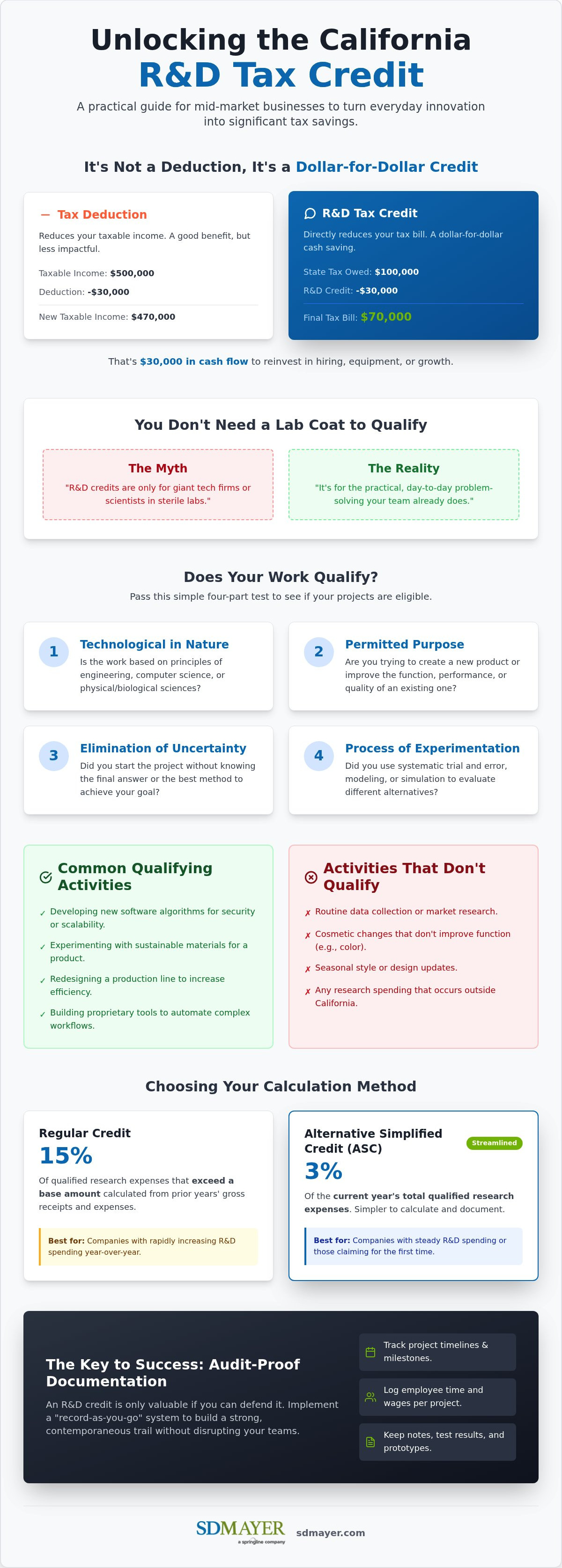
It's helpful to understand the difference between a tax deduction and a tax credit. A deduction reduces the amount of income the government can tax, which is helpful, but a credit is far superior. A credit directly lowers your tax bill. If your company owes $100,000 in state taxes and you qualify for a $30,000 R&D credit, your final bill drops to $70,000. For mid-market firms, this isn't just about compliance; it's about direct cash flow. That extra capital can be used to hire new engineers, purchase specialized equipment, or accelerate a product launch, making the process of qualifying for R&D tax credit California a vital part of your business strategy.
Why Mid-Market Firms Often Miss Out
A common misconception is that R&D credits are only for biotech giants or massive Silicon Valley tech firms. This myth often prevents mid-market leaders from claiming what they've earned. You don't need a lab full of scientists to qualify. In fact, the credit often rewards the practical, day-to-day troubleshooting your team already does. If you are refining a software algorithm, testing new materials to make a product more durable, or solving a complex manufacturing bottleneck, you're likely performing qualifying research. We look at your business through a holistic lens, seeing your company not just as a service or product provider, but as an innovation hub where technical challenges are actually financial assets.
The Long-Term Value of a Permanent Credit
One of the best things about California’s R&D credit is that it's permanent. Unlike federal incentives that sometimes face expiration dates or legislative uncertainty, California’s credit is a stable fixture of the state tax code. This permanence allows you to build a predictable, multi-year financial strategy. By integrating this credit into your broader CAAS strategy, you can ensure that tax planning isn't an afterthought. Instead, it becomes a proactive part of your financial health, helping you forecast cash flow and reinvestment opportunities with much higher accuracy. This long-term approach transforms a yearly tax task into a strategic advantage for your firm's future.
The Four-Part Test: Does Your Work Qualify?
To determine if your activities meet the standard for qualifying for R&D tax credit California, you need to pass a specific four part evaluation. This isn't a complex legal barrier. It's a logical framework to see if your team is truly innovating. Understanding these rules is the first step in qualifying for R&D tax credit California and securing the funding your business deserves.
The first requirement is that the work must be technological in nature. This means your team is relying on principles of physical or biological science, engineering, or computer science. Second, your project must have a permitted purpose. You are aiming to create a new product or improve the function, performance, or quality of an existing business component. Third, you must address the elimination of uncertainty. This means you didn't know the final answer or the best method to get there when you started. Finally, you must engage in a process of experimentation, which involves systematic trial and error to evaluate different alternatives.
For a detailed look at how the state defines these requirements, you can refer to the official instructions for the California R&D Tax Credit in 2026. This document outlines the specific boundaries that the Franchise Tax Board uses to evaluate claims.
Real-World Examples in the Bay Area
Mid-market firms in our region often qualify in ways they don't expect. Software companies pass the test when they develop new algorithms to improve data security or system scalability. Local manufacturers often qualify when they experiment with sustainable materials or redesign production lines to increase efficiency. Even professional service firms can meet these standards if they are building proprietary technical tools to automate complex, data heavy workflows for their clients.
Activities That Usually Do Not Qualify
It is just as helpful to know what to leave out of your claim. Routine data collection, market research, or seasonal style changes do not count because they don't involve technical uncertainty. Cosmetic changes that only alter the appearance of a product without improving its function are also excluded. Most importantly, any research spending that occurs outside of California state lines is ineligible for this specific credit. If you have questions about a specific project, reaching out to a strategic financial partner can help you filter your activities before you invest time in documentation.
California vs. Federal R&D Credits: What You Need to Know
Many business owners ask if they have to choose between state and federal incentives. The short answer is no. You should absolutely claim both to maximize your cash flow. While the process for Federal R&D Credits provides a strong foundation, California has its own set of rules that you must follow to get the state-level benefit. This means qualifying for R&D tax credit California requires a local focus. The biggest hurdle for many mid-market firms is the "California-Only" rule. To qualify for the state credit, all research expenses, including payroll and supplies, must be tied to activities performed within California borders. If your engineering team is split between San Jose and an out-of-state hub, only the San Jose portion of their time counts toward the state credit.
The Permanency Factor
One major advantage of the state program is its stability. While federal tax laws often face "sunset" provisions where they might expire or change significantly, California's R&D credit is permanent. This makes it a much safer bet for your long-term budgeting. You can plan your next three years of innovation knowing this support will be there. Managing these two layers of compliance can be tricky, which is why getting strategic tax advice is essential. We help you align your federal and state claims so you don't miss out on either, even when federal provisions shift.
Calculating Your Potential Savings
California offers two main ways to calculate your credit: the Regular method and the Alternative Simplified Credit (ASC). Modeling both methods is a critical step in qualifying for R&D tax credit California, as the choice you make can significantly impact your total savings. The Regular credit rate is 15% of your qualified expenses above a "base amount," which is essentially your typical research spending from previous years. Starting in 2025, the state also adopted the ASC method with a 3% rate. This is often easier for mid-market firms because it focuses on your average spending over the last three years. When you're estimating your 2026 savings, look at these specific costs:
- Technical Wages: The portion of salary paid to employees performing or directly supervising research in California.
- Testing Supplies: Materials used and consumed during the experimentation process.
- Contractor Fees: Costs for third-party research, though these are typically calculated at a reduced rate.
Beginning in 2025, the state repealed the old Alternative Incremental Credit (AIC). This change makes it even more important to evaluate whether the Regular or ASC method fits your 2026 filing strategy. By modeling both scenarios, you can ensure you are putting the most cash back into your business.
Action Items: Building an Audit-Proof Claim
The biggest mistake companies make when qualifying for R&D tax credit California is waiting until the end of the year to start their paperwork. While retroactive claims are possible, they are much harder to defend if the Franchise Tax Board (FTB) asks for proof. You need a contemporaneous system, which means recording your research as it happens. When your engineers solve a scaling issue or test a new manufacturing material, that is the exact moment to capture the data. It's much easier to document a challenge while you're in the middle of solving it than to try and remember the details twelve months later.
Bridging the gap between your technical team and your accounting department is essential for mid-market success. Engineers often don't think like tax professionals, and accountants might not understand the nuances of a software sprint. By implementing project-based accounting, you create a shared framework. Every technical challenge is assigned a project code, which makes it simple to track hours and supplies without disrupting the creative workflow. This level of detail is more important than ever. In early 2026, new instructions for IRS Form 6765 began requiring project-level expense disclosure, and California's requirements often follow this federal lead for consistency.
What the FTB Looks For in 2026
In 2026, the FTB is looking for a clear connection, or nexus, between an employee's daily tasks and a specific technical problem. They want to see documented evidence of your process of experimentation. This means keeping logs of what didn't work just as much as what did. A major red flag for auditors is using "round numbers" for time estimates, such as claiming every developer spent exactly 25% of their year on R&D. Real innovation is naturally variable. Your documentation should reflect the actual peaks and valleys of your development cycle to remain audit-proof.
Practical Tools for Documentation
You don't need to purchase expensive, proprietary software to stay compliant. Often, your existing bookkeeping system can be configured to flag R&D expenses as they occur. For technical leads, simple habits like adding a "technical uncertainty" tag to project management tickets or Jira boards can save dozens of hours during tax preparation. These small, consistent actions turn a daunting audit risk into a manageable administrative task.
An outsourced CFO can act as a strategic guide here. They oversee the claim process so your internal team can stay focused on building products. This partnership ensures that the link between your spending and your technical work is clearly defined long before you file your return. If you want to ensure your documentation is audit-proof and your claim is maximized, reach out to our team today to start building your strategic R&D roadmap.
Strategic Integration: How SD Mayer Simplifies R&D
We believe that qualifying for R&D tax credit California shouldn't be a once-a-year scramble. Our "Full Circle" approach integrates tax, audit, and advisory services to ensure that innovation is a core part of your financial strategy. Unlike software platforms that rely on automated data, we act as your "first call" advisor. This means we're in the room when you are planning new projects. This proactive partnership allows us to identify R&D opportunities as they happen rather than trying to find them in the rearview mirror months later.
As a member of the BDO Alliance USA, we combine our deep roots in the San Francisco economy with the specialized knowledge of a global network. If your mid-market firm operates in a niche technical field, we have the resources to provide industry-specific guidance that smaller firms simply can't match. We handle the heavy lifting of compliance and documentation. This approach lets your technical team stay focused on what they do best: creating the next breakthrough for your industry.
Beyond the One-Off Credit
A successful R&D claim isn't just a tax win; it's a growth catalyst. When you unlock significant cash flow through the California credit, that capital can be strategically reinvested into your next stage of development. For founders, this also opens doors for long-term wealth management. We look at how these credits impact your personal financial goals and the longevity of your business. Being based in the Bay Area, we understand the unique rhythm of the local innovation economy and how to position your firm for sustained success.
Your First Step Toward Recovery
If you're unsure where to start, our team provides a preliminary eligibility review to determine the best path for qualifying for R&D tax credit California. We work alongside your existing technical and accounting teams to find missed opportunities from previous years and set a course for the future. We don't just look at the numbers; we look at the human effort behind them. Our goal is to make the process as smooth and transparent as possible. Ready to see if you qualify? Contact our Bay Area team today to schedule a conversation about your firm's innovation potential.
Fueling Your Firm’s Future Growth
Securing the capital your business has earned through innovation shouldn't be an uphill battle. By mastering the four part eligibility test and establishing a simple, project based documentation system, you can turn technical challenges into a predictable source of cash flow. Remember that the process of qualifying for R&D tax credit California is a year round strategy, not just a tax season task. It requires a partner who understands the unique pace of the Bay Area innovation economy and the nuances of state specific regulations.
As a member of the BDO Alliance USA and recently named a Top 25 Fastest-Growing Firm in 2025, SD Mayer is trusted by Bay Area growth-stage tech firms to handle the heavy lifting of compliance. We're here to ensure your documentation is audit proof while you stay focused on your next breakthrough. Don't let valuable credits sit on the table because of complex state rules. It's time to see exactly how much capital you can reclaim for your business. Get Your Free R&D Eligibility Review today and take the first step toward a more resilient financial future. We're ready to help you thrive.
Frequently Asked Questions
What exactly is the California R&D tax credit?
It is a dollar-for-dollar reduction in state tax liability for businesses conducting qualified research in the state. Unlike a deduction, which only lowers your taxable income, a credit comes straight off your final tax bill. It is designed to keep innovation in California by rewarding technical risks. It supports businesses of all sizes, especially mid-market firms in San Francisco and San Jose looking to reinvest in their own growth.
Do software companies qualify for the California R&D credit?
Yes, software development is one of the most common ways of qualifying for R&D tax credit California. If your team is building new algorithms, improving system scalability, or solving technical uncertainties in code, those activities likely count. It doesn't matter if the software is for internal use or a commercial product; the technical challenge is what matters. We see this often with our tech clients in the Bay Area innovation economy.
Can I claim the R&D credit for research done outside of California?
No, the California credit specifically requires that all qualified research expenses, such as technical wages and supplies, occur within the state. If you have a team in San Francisco and another in Austin, only the San Francisco portion counts toward the state credit. This is a key difference from the federal credit, which covers work done anywhere in the United States. We help you isolate these state-specific costs to ensure compliance.
What is the difference between the Regular and Alternative Incremental Credit?
For tax years beginning in 2025 and 2026, the Alternative Incremental Credit (AIC) has been repealed and replaced by the Alternative Simplified Credit (ASC). The Regular method offers a 15% credit rate against a historical base amount. The new ASC method uses a 3% rate and is often easier for mid-market firms to manage. It focuses on your average spending over the three previous years, which simplifies the process of qualifying for R&D tax credit California.
How far back can I go to claim missed R&D tax credits in California?
You can typically file amended returns to claim missed credits for the last four tax years. This look-back period is a great way for mid-market firms to unlock immediate cash from past innovation. However, documentation requirements for prior years are strict. Our team helps you reconstruct these records to ensure your retroactive claims are audit-proof. We look at your past payroll and project data to find every dollar you earned.
Is the R&D tax credit only for large corporations with laboratories?
Not at all. Many of our growth-stage tech and manufacturing clients in San Jose and Sacramento qualify without owning a single lab coat. If you are solving a technical problem using engineering or computer science, you are likely doing R&D. The credit is built for any business that takes technical risks to improve their products or processes. It rewards practical problem-solving just as much as lab-based science.
What happens if our company is audited by the Franchise Tax Board?
An audit involves a review of your technical records and financial data to verify your claim. If you have a contemporaneous documentation system in place, the process is much smoother. We act as your first call during these reviews, using our BDO Alliance resources to provide the rigorous support and independent reporting needed to defend your credit. Our goal is to reduce your stress by projecting an image of calm, capable stewardship.
How does the R&D credit affect our company’s net operating losses (NOLs)?
The credit doesn't expire, so if your company isn't currently profitable or is using NOLs to offset income, you can carry the R&D credit forward indefinitely. This makes it a valuable asset for growth-stage firms in the Bay Area. You can build up your credit balance now and use it to wipe out tax bills once the business becomes profitable. It provides a long-term benefit that supports your multi-year financial strategy.
SECURITIES AND ADVISORY DISCLOSURE:
Securities offered through Valmark Securities, Inc. Member FINRA, SIPC. Fee based planning offered through SDM Advisors, LLC. Third party money management offered through Valmark Advisers, Inc a SEC registered investment advisor. 130 Springside Drive, Suite 300, Akron, Ohio 44333-2431. 1-800-765-5201. SDM Advisors, LLC is a separate entity from Valmark Securities Inc. and Valmark Advisers, Inc. Form CRS Link
DISCLAIMER:
This material has been prepared for informational purposes only, and is not intended to provide, and should not be relied on for, accounting, legal or tax advice. The services of an appropriate professional should be sought regarding your individual situation.
HYPOTHETICAL DISCLOSURE:
The examples given are hypothetical and for illustrative purposes only.