
What if the most stressful part of your next board meeting wasn't the growth projections, but the fear that a director might ask to see the logic behind your spreadsheets? This is a common reality for Bay Area founders who've outgrown their early-stage startup accounting services or DIY workarounds. You're likely feeling the weight of messy data, worrying about missed R&D tax credits, or losing sleep over the tax implications of your team's stock options. It's hard to focus on the big picture when you're stuck in the weeds of manual entry.
We believe your finances should be a source of clarity, not a source of dread. This guide provides a practical, jargon-free checklist to help you transition from reactive bookkeeping to a professional financial engine that scales with you into 2026. You don't need more complexity; you need a system that works as hard as your engineering team does.
We'll walk through how to automate your tech stack, stay on the right side of California SALT compliance, and produce the kind of board-ready reports that prove you're ready for the next level of growth.
Key Takeaways
- Shift your perspective from historical record-keeping to a forward-looking strategy that treats your finances as a primary growth engine.
- Build a scalable tech stack that automates manual data entry and integrates professional startup accounting services into your daily operations.
- Extend your company's cash runway by identifying often-overlooked R&D tax credits and avoiding costly California SALT compliance penalties.
- Learn how to produce board-ready financial reports that provide the clarity, accuracy, and professionalism your investors expect.
- Understand the value of a local partner who can align your business's financial health with your personal wealth management and stock option goals.
Why Startups Need Strategic Accounting Services (Not Just Bookkeeping)
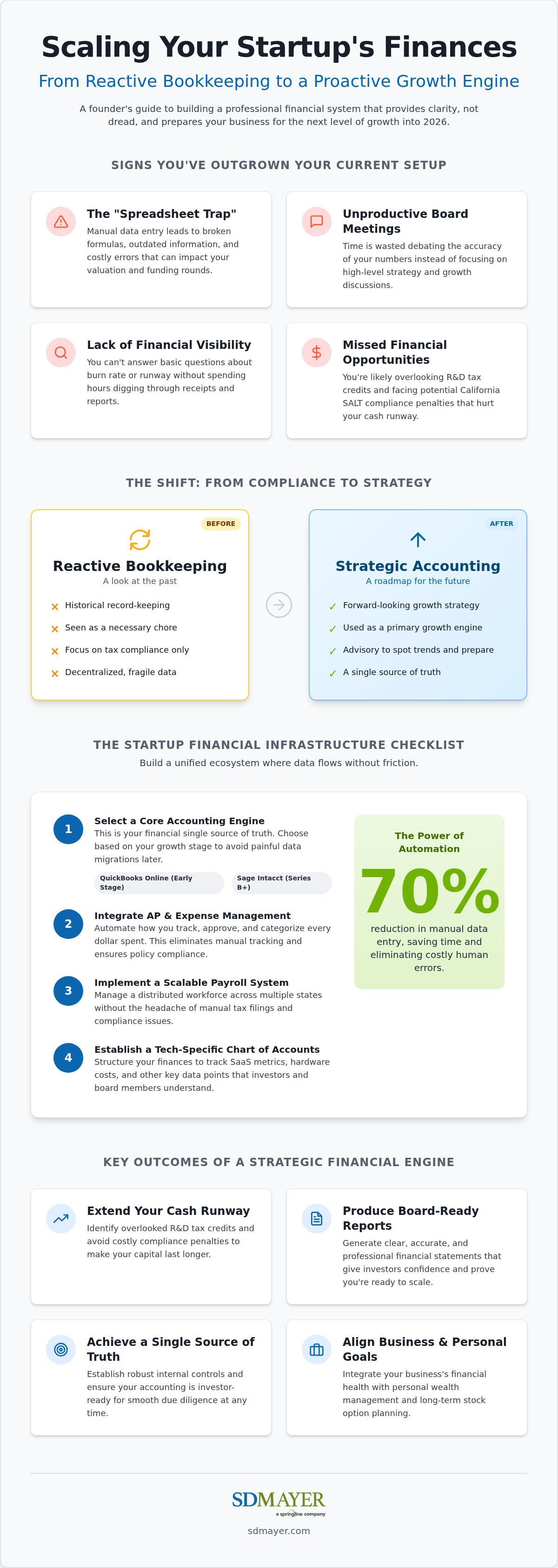
Many founders view accounting as a chore to be completed just before tax season. While basic bookkeeping records what happened in the past, professional startup accounting services focus on what is coming next. For startup companies, financial data isn't just a record of expenses; it's a strategic roadmap. It tells you how long your runway actually is and where you can afford to double down on growth.
Reliance on manual spreadsheets often leads to the "Spreadsheet Trap." In this scenario, manual data entry leads to broken formulas and outdated information. When your financial data is decentralized, small errors can snowball into expensive mistakes that impact your valuation or your ability to close a funding round. Moving to a professional service means replacing these fragile sheets with a robust, automated financial engine that provides a single source of truth for your entire team.
The Shift from Compliance to Advisory
Advisory services go beyond simply balancing the books. They help you spot cash flow trends months before they become a crisis. By utilizing an outsourced Controller, you establish the internal controls necessary to protect your assets. This oversight ensures your accounting is investor-ready at all times, making due diligence a smooth process rather than a frantic scramble. It’s about having a partner who understands the big picture of your business and helps you prepare for the next stage of growth.
Signs You’ve Outgrown Your Current Setup
If your board meetings are spent debating the accuracy of your numbers instead of discussing strategy, you've outgrown your current setup. You might also find yourself unable to answer basic questions about your burn rate or runway without spending hours digging through receipts. This lack of visibility is a major red flag for investors. To understand how a more comprehensive approach can help, explore our guide on What is CAAS? A Strategic Guide to Client Accounting Advisory Services in 2026.
For Series A and B startups in San Francisco and Silicon Valley, the stakes are high. You're no longer just managing a small team; you're managing significant capital and complex stock option structures. Professional startup accounting services bridge the gap between your current runway and your long-term goals. You need a partner who can integrate business accounting with wealth management and long-term planning.
- Review your current financial reports: Are they backward-looking or forward-looking?
- Audit your spreadsheets for manual entry points that could be automated.
- Evaluate if your current bookkeeper can provide strategic advice for your next funding round.
- Check if your financial data is ready for a surprise audit or due diligence request today.
The Startup Financial Infrastructure Checklist: Building Your Tech Stack
For mid-market companies, building a financial infrastructure isn't just about picking an app; it's about creating a unified ecosystem where data flows without friction. Most startup accounting services recommend starting with a core engine like QuickBooks Online or Sage Intacct. While QuickBooks serves many early-stage firms, Sage Intacct often becomes the preferred choice for startups moving toward Series B and beyond due to its advanced multi-entity reporting and automation capabilities. Selecting the right core software early prevents the painful process of migrating data during a critical growth phase.
Beyond the core ledger, you need integrated tools for Accounts Payable (AP) and expense management. These tools ensure that every dollar spent is tracked, approved, and categorized automatically. When combined with a scalable payroll system, you can manage a distributed workforce across multiple states without the headache of manual tax filings. A clean, tech-specific Chart of Accounts is also vital. It allows you to track software-as-a-service (SaaS) metrics or hardware costs in a way that investors and board members actually understand. Without this structure, your financial data remains a confusing blur rather than a strategic asset.
Automating the Back Office
A Tech Stack is the digital foundation of your finance department. By implementing integrated fintech tools, many businesses can reduce manual data entry by as much as 70%. This efficiency doesn't just save time; it eliminates the human error that often plagues manual spreadsheets. Real-time data sync is essential for multi-entity businesses, ensuring that your consolidated reports are always accurate. If you're feeling overwhelmed by these choices, consider discussing your specific tech needs with our team to find the right balance for your growth stage.
Ensuring Data Integrity from Day One
Standardizing how you categorize expenses is critical for meeting IRS tax requirements for new businesses. Without a consistent process, your financial reports become a maze of 'miscellaneous' entries that make tax season a nightmare. Implementing a strict monthly close procedure ensures that your books are locked and verified every thirty days. This discipline provides the confidence to present your numbers to the board, knowing that every transaction is reconciled. For a deeper dive into the mechanics of this process, see our guide on How to Set Up Financial Reporting for Startups: A 2026 Growth Guide.
Tax Strategy and Compliance Checklist: Protecting Your Runway
Tax strategy is often the difference between a startup that thrives and one that runs out of cash unexpectedly. While your tech stack handles the day-to-day transactions, professional startup accounting services ensure you aren't blindsided by California's complex State and Local Tax (SALT) requirements. In San Francisco and San Jose, local payroll taxes and gross receipts taxes can vary significantly from one block to the next. Staying compliant isn't just about avoiding penalties; it's about following small business financial management best practices to keep your runway as clear as possible.
As you scale toward a larger team, you'll likely face new requirements like employee benefit plan audits or even a Single Audit if you've accepted specific types of government grants. These aren't just bureaucratic hurdles. They are markers of a maturing business. Handling these early prevents the frantic "clean up" phase that often happens right before a major acquisition or funding round. By integrating your tax strategy with your overall business accounting, you move from reactive filing to proactive wealth preservation.
Stock Options and Founder Equity
For your San Jose tech team, the distinction between Incentive Stock Options (ISOs) and Non-Qualified Stock Options (NSOs) is more than just a technicality. It has massive implications for their personal tax bills. Early-stage planning prevents your employees from facing life-altering tax liabilities during an exit. As a holistic mentor to your team, you should consider how equity structures impact their long-term loyalty. Don't wait for an IPO to think about your tax liability; by then, your options for optimization will be severely limited.
R&D Credits and Sales Tax Nexus
Identifying qualifying activities for R&D credits in the 2026 tax year is one of the most effective ways to extend your company's cash runway. Many founders assume R&D credits are only for laboratory work, but software development often qualifies. Simultaneously, you must understand 'Nexus.' Even if you don't have a physical office in another state, having remote employees or reaching certain sales thresholds can trigger tax obligations there. Ignoring these can lead to years of back taxes and interest that could have been easily managed with the right startup accounting services partner.
- Schedule a quarterly tax nexus review to identify new state filing requirements.
- Document all R&D-related projects and payroll costs in real-time to simplify credit claims.
- Review your stock option plan with a tax advisor to ensure it aligns with your 2026 growth goals.
- Verify your California SALT status to ensure all local San Francisco or San Jose filings are current.
The Strategic Growth Checklist: Board-Ready Reporting
Reporting is about more than just looking in the rearview mirror; it’s about proving to your investors that you have a firm grip on the steering wheel. Board members don't want to see a static wall of numbers. They want a narrative that explains where the business is going and how you plan to get there. Professional startup accounting services provide the dynamic financial models you need to simulate different growth scenarios. If you decide to double your sales team or pivot your product strategy, you need to know exactly how those choices impact your runway and cash flow in real-time.
Mastering Your Financial Story
Trust with your board of directors is built on transparency and consistency. This is where "Variance Analysis" becomes your most important tool. It’s not enough to simply report that you missed your budget; you have to explain why. Perhaps a marketing campaign over-performed, or a key engineering hire took longer than expected. Explaining these deviations shows that you are a proactive leader who understands the nuances of the business. To find a partner who can help you tell this story, read our guide on the Best Accounting Firms for Startups in 2026: A Founder’s Guide to Strategic Growth.
Fundraising and Due Diligence Readiness
Before you even begin your next funding round, your "Data Room" needs to be spotless. This digital vault contains your entire financial history, and investors will scrutinize every folder. This is often the stage where founders transition from a Controller to a Fractional CFO. An outsourced CFO doesn't just manage the books; they act as a strategic advisor who helps you navigate term sheets and valuations. They ensure that when an investor asks a difficult question, the answer is already documented and verified. To further optimize your business for a potential exit, you can discover Evans & Company and their specialized M&A advisory services.
- Conduct a "mock due diligence" audit every six months to catch errors before investors do.
- Automate your KPI dashboard to ensure you have a real-time view of your Burn Multiple.
- Standardize your board deck to focus on the three most impactful metrics for your current stage.
- Review your financial models monthly to adjust for shifting market conditions in the Bay Area.
If you're ready to move beyond basic bookkeeping and start building a board-ready financial engine, reach out to our team today to discuss how we can support your 2026 growth goals.
Finding Your Bay Area Partner: The SD Mayer Difference
Selecting the right startup accounting services in a competitive market like San Francisco or Silicon Valley requires more than just a software subscription. It requires a partner who understands the local ecosystem. While high-volume, software-first firms might handle basic data entry, they often lack the high-touch advisory needed to navigate complex growth. We believe in being a steady companion throughout your journey, from the initial scaling phases to a successful exit or succession. Our approach isn't just about balancing the books; it's about providing the strategic oversight that mid-market founders need to make confident decisions.
One major gap in the industry is the separation of business health from founder wealth. Most firms treat these as two different silos, but for a startup founder, they are deeply linked. We integrate business accounting with personal wealth management to ensure that your company's success translates into personal security. This "Big Picture" perspective allows us to spot opportunities for optimization that others might miss, especially when it comes to the long-term impact of your stock options and individual tax planning.
Local Expertise, Global Vision
Navigating the unique regulatory environment of the San Francisco Bay Area is a full-time job. From local gross receipts taxes to the nuances of California SALT compliance, having a local partner ensures you aren't blindsided by regional requirements. Beyond compliance, we offer access to a deep network of local VCs, lawyers, and industry experts who can help accelerate your growth. To see how this high-touch model compares to basic services, check out our guide on San Francisco Bookkeeping vs. Strategic CAAS: A 2026 Comparison for Mid-Market Growth.
Holistic Care for the Founder
We manage your individual tax planning alongside your company’s payroll and corporate filings. This holistic care reduces the friction of managing multiple advisors and ensures that your personal financial goals are always in sync with your business strategy. Whether you are navigating a Series B round or planning for the next five years of growth, we act as a mentor and strategist. SD Mayer is dedicated to providing mid-market startups with the sophisticated financial engine and personalized guidance they need to thrive in the modern economy.
- Assess if the firm offers both business accounting and personal wealth management.
- Verify their experience with Bay Area-specific tax regulations and SALT compliance.
- Ask about their network: Can they introduce you to local VCs or legal experts?
- Determine if they provide a dedicated Controller or CFO-level advisor, not just a help desk.
Ready to Build Your 2026 Growth Engine?
Professionalizing your financial infrastructure is one of the most significant steps you can take as a founder. By moving away from manual spreadsheets and adopting a scalable tech stack, you gain the clarity needed to lead with confidence. We've explored how strategic startup accounting services do more than just record history; they provide the board-ready reporting and tax compliance necessary to protect your runway and your team's equity.
At SD Mayer, we pride ourselves on being a steady companion through every stage of your business journey. Our local expertise in Bay Area tech compliance, combined with our unique ability to integrate business accounting with personal wealth management, ensures that no detail is overlooked. We specialize in providing the scalable, mid-market solutions that turn financial data into a strategic advantage. You deserve a partner who understands the big picture of your life and your business.
Ready to professionalize your finances? Schedule a consultation with SD Mayer today.
You've done the hard work of building a vision. Now, let's work together to ensure your financial foundation is strong enough to support your most ambitious goals for 2026 and beyond.
Frequently Asked Questions
What exactly are startup accounting services?
Startup accounting services are specialized financial solutions that go beyond simple bookkeeping to support the rapid scaling of a business. These services include everything from setting up your initial tech stack to managing complex stock option plans and providing board-ready reports. By focusing on both historical accuracy and future strategy, they help founders make informed decisions about their runway and growth potential.
When should a startup move from a basic bookkeeper to a professional firm?
You should consider making the switch when your financial needs move beyond simple expense tracking. This often happens as you approach a Series A funding round, start hiring employees in multiple states, or need to provide detailed reports to a board of directors. If you're spending more time fixing spreadsheet errors than leading your team, it's time for professional oversight.
How much do startup accounting services typically cost in the Bay Area?
The cost of startup accounting services in the Bay Area varies based on the size of your team and the complexity of your financial needs. Most firms offer tiered pricing or an advisory model that scales as you grow. This approach ensures you only pay for the level of support you currently need while maintaining the ability to add more advanced services later.
What is the difference between a Controller and a Fractional CFO?
A Controller focuses on the day-to-day accuracy of your financial records and ensures that internal controls are in place. A Fractional CFO takes a more strategic role, helping you with long-term financial modeling, valuation analysis, and fundraising support. While the Controller keeps your books clean, the CFO uses those numbers to help you navigate your company's future growth.
Can an accounting firm help with R&D tax credits?
Yes, a professional accounting firm can identify qualifying development activities and help you claim R&D tax credits to extend your cash runway. Since these credits often apply to software development and engineering, they're a vital resource for tech startups. Your advisor will document your projects and payroll costs to ensure your claim meets all federal and state requirements.
Do I need a local San Francisco accountant if my team is remote?
Having a local San Francisco partner is highly beneficial even for remote teams because California has some of the most complex tax laws in the country. This includes unique local gross receipts taxes and specific payroll requirements. A local firm understands these nuances and can help you navigate the specific regulatory environment of the Bay Area while managing your national compliance needs.
How do startup accounting services help with fundraising due diligence?
Professional startup accounting services play a critical role in fundraising by ensuring your data room is organized and your financial reports are accurate. When investors see a clean history of reconciliations and professional board packages, it builds immediate trust in your leadership. Your accounting team can also help you answer difficult technical questions during the due diligence process, making the entire round move faster.
What is SALT compliance and why does it matter for my startup?
SALT stands for State and Local Tax compliance, and it's essential for startups with remote employees or national sales. Even if you don't have a physical office in another state, your business activities might trigger a tax obligation there. Ignoring these local requirements can lead to significant penalties and interest that drain your company's valuable runway and complicate future audits.
SECURITIES AND ADVISORY DISCLOSURE:
Securities offered through Valmark Securities, Inc. Member FINRA, SIPC. Fee based planning offered through SDM Advisors, LLC. Third party money management offered through Valmark Advisers, Inc a SEC registered investment advisor. 130 Springside Drive, Suite 300, Akron, Ohio 44333-2431. 1-800-765-5201. SDM Advisors, LLC is a separate entity from Valmark Securities Inc. and Valmark Advisers, Inc. Form CRS Link
DISCLAIMER:
This material has been prepared for informational purposes only, and is not intended to provide, and should not be relied on for, accounting, legal or tax advice. The services of an appropriate professional should be sought regarding your individual situation.
HYPOTHETICAL DISCLOSURE:
The examples given are hypothetical and for illustrative purposes only.