
The very bookkeeping process that helped your San Francisco business reach its current success might be the exact thing preventing you from scaling further. It’s a common realization for mid-market leaders in the Bay Area. You’ve built a solid foundation, but the simple data entry and basic san francisco bookkeeping routines that worked yesterday now feel reactive and thin. You might even feel a growing sense of anxiety as you face California's 2026 tax landscape, specifically the suspension of Net Operating Loss deductions for companies with income exceeding $1 million.
We understand that you need more than just a list of past transactions; you need a financial partner who looks through the windshield rather than the rearview mirror. In this comparison, you'll discover whether your company is ready to transition from basic record-keeping to strategic Client Accounting and Advisory Services (CAAS). We'll break down how to gain clear reporting that guides your strategy and provides peace of mind regarding complex SALT rules and Gross Receipts Tax deadlines. This guide provides a clear roadmap for choosing a scalable partner that supports your big-picture goals and handles the heavy lifting of compliance.
Key Takeaways
- Recognize why traditional record-keeping is no longer enough to manage the unique economic pressures of the San Francisco market in 2026.
- Distinguish between tactical data entry and the strategic advisory focus of CAAS to determine which model fits your current growth stage.
- Identify the specific red flags that signal your business has outgrown standard san francisco bookkeeping and needs more sophisticated financial reporting.
- Gain a practical framework for vetting potential accounting partners, including the right questions to ask about their technology stack and cloud integration.
- Learn how a holistic approach to financial stewardship can turn your accounting department into a driver for long-term strategy rather than just a compliance center.
The Landscape of San Francisco Bookkeeping in 2026
Running a business in San Francisco has always been a unique challenge, but 2026 has introduced a new level of complexity. Between the high cost of talent and the intricate web of local taxes, the margin for error has never been thinner. Most mid-market firms are finding that standard methods of bookkeeping, which focus purely on recording past transactions, simply can't keep up with the pace of the Bay Area economy. You need more than a historian; you need a strategist.
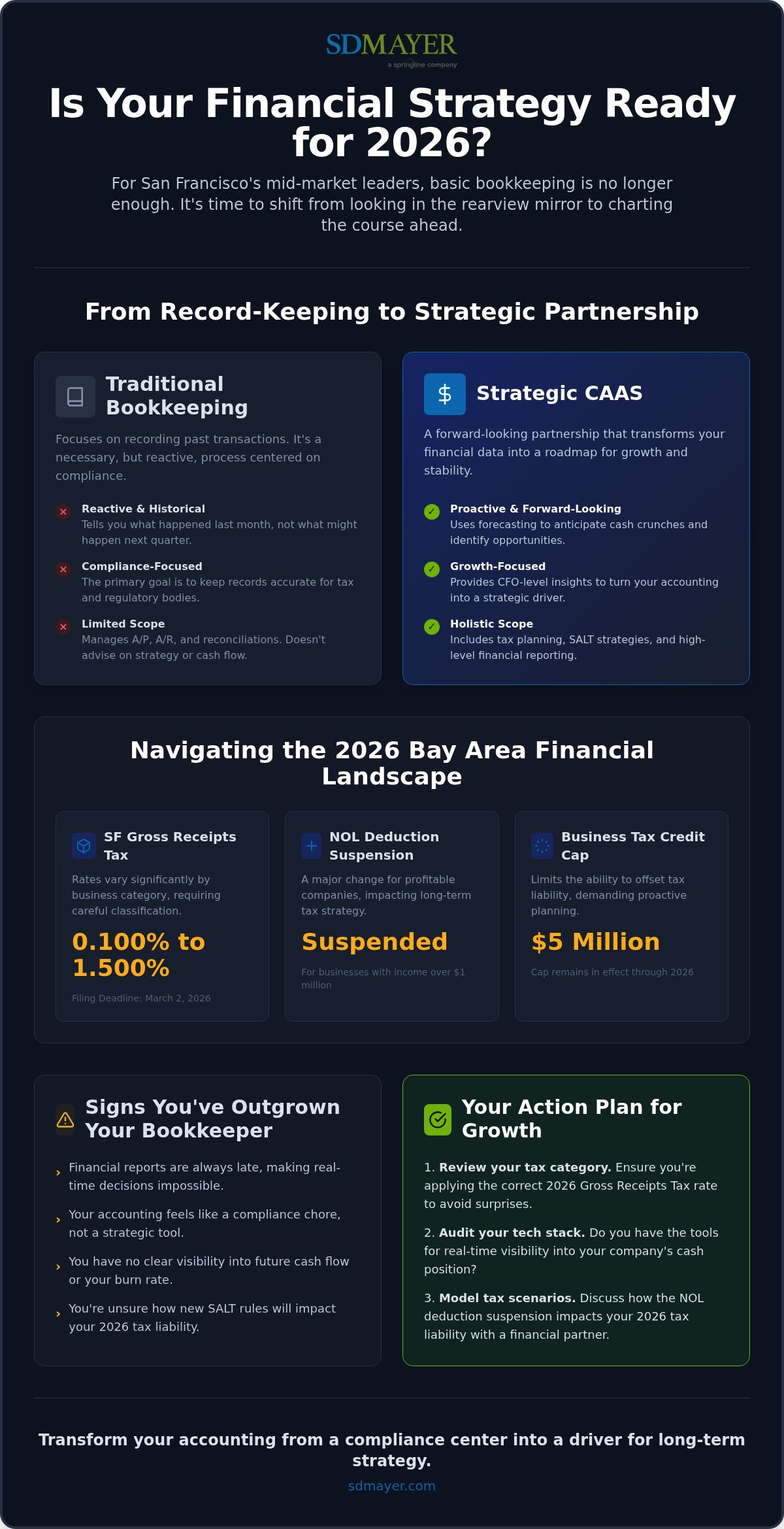
Today, san francisco bookkeeping is no longer just about balancing the books at the end of the month. It's about navigating the San Francisco Gross Receipts Tax, which features rates ranging from 0.100% to 1.500% depending on your specific business category. With the March 2, 2026, filing deadline always looming, reactive accounting is a recipe for stress. Mid-sized firms are shifting their focus toward forward-looking financial strategy to stay ahead of these pressures and maintain a competitive edge.
The Evolving Role of the Modern Bookkeeper
The image of a bookkeeper sorting through a shoebox of receipts is a relic of the past. Modern financial stewardship is digital-first. Automation tools now handle the repetitive tasks of data entry, which has effectively commoditized basic services. What matters now is real-time data access. In a market where decisions happen in minutes, waiting two weeks for a profit and loss statement is a liability. You need a partner who uses technology to provide an instant snapshot of your cash flow and burn rate.
San Francisco’s Competitive Financial Environment
Operating in the city means managing some of the highest overhead costs in the country. Complex payroll requirements and city-specific mandates add layers of difficulty that a generalist might miss. For companies looking to attract Bay Area investors, having pristine, high-level financial data is non-negotiable. Investors in 2026 expect to see more than just the numbers; they want to see the story those numbers tell about your future growth and stability.
Local expertise is also vital for State and Local Tax (SALT) compliance. For instance, the current suspension of Net Operating Loss deductions for businesses with income over $1 million means you can't rely on old tax strategies. You need a proactive approach to manage the $5 million cap on business tax credits that remains in effect through 2026. Understanding these nuances is the difference between scaling and stalling.
- Review your 2025 Gross Receipts Tax category to ensure you're applying the correct 2026 rate.
- Audit your current accounting tech stack to ensure you have real-time visibility into your cash position.
- Schedule a strategy session to discuss how the NOL deduction suspension affects your 2026 tax liability.
Traditional Bookkeeping vs. Strategic CAAS: A Comparison
Understanding the difference between a record keeper and a strategic partner is crucial for any mid-market leader. While many providers offer san francisco bookkeeping, the actual value they deliver varies significantly. Traditional bookkeeping is primarily tactical. It focuses on the "what" and "when" of your financial history. Strategic CAAS, on the other hand, focuses on the "how" and "why" of your future growth. This isn't just a difference in service levels; it's a fundamental shift in mindset from historical reporting to forward-thinking stewardship.
The Tactical Scope: Traditional Bookkeeping
Traditional bookkeeping is the engine room of your financial department. It keeps the lights on by managing accounts payable, handling receivables, and ensuring bank reconciliations are accurate. The primary goal is compliance; you need to know your numbers are correct to stay in the good graces of the IRS and local regulatory bodies. For small and medium-sized businesses, specialized firms like RBW & Associates provide the dedicated remote bookkeeping and IRS representation needed to maintain this essential financial health.
These tasks have clear limitations as you scale. A traditional bookkeeper likely won't tell you if your current burn rate will cause a cash crunch in six months. They aren't typically equipped to build complex financial models or advise on business structure. For a scaling firm in the Bay Area, staying "compliant" is the bare minimum. It isn't a strategy for winning in a competitive market.
The Strategic Scope: Client Accounting Advisory Services (CAAS)
CAAS represents the natural evolution of financial support for the mid-market. It bridges the gap by providing outsourced controller and CFO-level insights without the overhead of a full-time executive hire. This model integrates several functions, including proactive tax planning and high-level financial reporting for startups and established companies alike.
Instead of just looking at where your money went, a strategic partner helps you see where it's going. This proactive approach includes several key components:
- Detailed cash flow forecasting to prepare for seasonal shifts or market volatility.
- Proactive SALT strategies to manage California’s unique tax credits and the $5 million limitation cap.
- Integrated wealth management and succession planning to protect the business owner's long-term interests.
When you evaluate the ROI of higher-level support, consider the cost of missed opportunities or regulatory penalties. A strategic advisor identifies inefficiencies that a record keeper might overlook. The U.S. Small Business Administration offers foundational guides to help you Manage your finances, but a CAAS partner applies those principles specifically to your unique situation. If you aren't sure where your current support falls on this spectrum, it might be time to start a conversation about your growth goals.
Key Indicators: When Your Firm Outgrows Basic Support
Every growing company eventually reaches a stage where yesterday's solutions become today's bottlenecks. For a mid-market firm in the Bay Area, this tipping point usually happens when the leadership team realizes they have plenty of data but almost no actionable information. If you're still relying on basic san francisco bookkeeping to manage multiple product lines, regional offices, or complex intercompany transfers, you're likely flying blind. The transition from a small business to a mid-market player requires a fundamental shift in how you view your financial department.
One of the biggest red flags is a growing sense of anxiety as tax deadlines approach. In 2026, the regulatory landscape in California is more demanding than ever. With the suspension of Net Operating Loss (NOL) deductions for businesses with income exceeding $1 million, your tax strategy can't be an afterthought. If your current support is struggling to reconcile intercompany accounts or if your month-end close is stretching into the third week of the following month, you've officially outgrown basic record-keeping. You need a partner who can prepare you for audits before they become a crisis.
Scaling Pains and Financial Visibility
"I think we're profitable" is a dangerous phrase for a scaling business. As you expand, you need to know exactly which departments are driving growth and which are draining resources. This level of clarity requires granular cost analysis that a traditional bookkeeper isn't typically trained to provide. This is exactly where CAAS changes the narrative. It provides the high-level financial visibility needed for confident expansion by turning raw numbers into a strategic roadmap.
Regulatory and Compliance Complexity
California's specific tax codes require a level of specialization that goes far beyond data entry. Managing multi-state nexus or complex payroll structures for a remote workforce involves significant risk. You need small business bookkeeping services that have evolved into comprehensive advisory roles. For example, staying under the $5 million business tax credit cap while managing stock option tax planning for key employees requires a "big picture" approach that protects both the company and its stakeholders.
- Your financial reports are consistently delivered more than 10 days after month-end.
- You have multiple entities but no clear process for intercompany reconciliations.
- You're unsure how the 2026 California tax changes will impact your cash flow.
- Investors or board members are asking for forward-looking forecasts you can't provide.
Selection Guide: Evaluating SF Accounting Partners
Choosing a financial partner in the Bay Area is a high-stakes decision that goes far beyond checking a box for compliance. While many firms offer san francisco bookkeeping, you need a partner who views your success as their own. In the 2026 market, the right choice is a firm that acts as a steady companion, guiding you through growth with both technical expertise and a mentor's perspective. It's about finding someone who doesn't just record what happened last month but helps you plan for the next three years.
A true partnership-oriented firm understands that mid-market growth requires a "big picture" approach. They should be as invested in your long-term wealth management and succession planning as they are in your monthly reconciliations. This cultural fit is the foundation of a relationship that can withstand the fast-paced regional economy and the evolving regulatory climate of California.
Technical Capabilities and Technology
A modern accounting partner must do more than just use software; they must master it. Ask potential partners about their technology stack and how it integrates with your existing operations. In 2026, real-time collaboration and high-level data security are non-negotiable. You should look for a firm that supports cloud-based platforms allowing for instant financial visibility from any location. Experience in your specific industry is also vital. A firm that understands the nuances of San Francisco tech startups, non-profits, or local real estate will provide much more value than a generalist who doesn't know your market's specific pressures.
The "Beyond the Books" Checklist
As your business scales, your needs will naturally shift from basic data entry to high-level strategy. This is why evaluating a firm’s ability to provide cfo services for small business and mid-market firms is essential. You want a partner who can handle complex modeling, integrated tax strategy, and even wealth management under one roof. This holistic approach ensures that your business decisions always align with your personal financial goals.
- Request a sample reporting package to see if their insights are deep enough to guide your strategic decisions.
- Ask how they handle California-specific compliance, like the Gross Receipts Tax or the March 2, 2026, filing deadline.
- Confirm they have experience with mid-market challenges, such as multi-entity accounting or board reporting.
- Verify their data security protocols to ensure your sensitive financial data is protected during remote collaboration.
Finding the right fit is about more than just a list of services. It's about a shared vision for your company's future. If you're ready to move beyond reactive record-keeping and embrace a more strategic approach, schedule a strategy session with our team to see how a dedicated partnership can transform your financial outlook.
The SD Mayer Approach: Integrated Financial Stewardship
At SD Mayer, we believe that your financial foundation should do more than just balance. While reliable san francisco bookkeeping is essential, it's merely the first step in a much larger journey. We position ourselves as a "Holistic Mentor," bridging the gap between daily transaction recording and the high-level strategy required to thrive in the Bay Area. By bringing tax strategy, audit readiness, and wealth management under one roof, we ensure that every financial decision you make today is aligned with where you want to be in five years. This integrated approach is what sets us apart from siloed service providers.
Our local presence from San Francisco to Sacramento gives us a unique perspective on the regional economy. We aren't just a remote service provider; we're a team that understands the specific pressures of the city's Gross Receipts Tax and the 2026 regulatory shifts. This local expertise, combined with modern digital agility, allows us to provide a level of stewardship that a standard bookkeeping firm simply can't match. We're here to be a steady companion through every stage of your business journey.
From Data Entry to Strategic Advisory
Our CAAS model is designed to evolve alongside your business lifecycle. In the early stages, we focus on clean data and efficient payroll. As you scale toward the mid-market, our outsourced CFOs step in to provide the board reporting and investor-grade insights you need. We don't believe in one-size-fits-all reporting. Instead, we customize your financial dashboards to highlight the metrics that matter most to your specific stakeholders, whether they're focused on burn rates, departmental costs, or long-term profitability. This ensures you always have the "big picture" view necessary for confident decision making.
Your Next Steps Toward Financial Clarity
Transitioning from a legacy bookkeeper can feel like a daunting task, but it's a necessary step for a growing firm. We've refined our onboarding process to make this shift as smooth as possible, handling the data migration and process updates so you can stay focused on your operations. The goal is to move you from a state of reactive "firefighting" to a place of calm, capable stewardship. Investing in a strategic partnership today is the best way to protect your wealth tomorrow.
- Schedule a discovery call to audit your current financial processes and identify gaps in your reporting.
- Review your 2026 tax strategy in light of the $5 million credit limitation to ensure you're maximizing your available benefits.
- Discuss how integrated wealth management can protect the value you're building in your business for the long term.
Ready to level up your financial strategy? Contact us today to start the conversation and discover how integrated stewardship can drive your mid-market growth.
Securing Your Financial Future in the Bay Area
Your business has evolved, and your financial support should too. Moving beyond basic san francisco bookkeeping is about more than just staying compliant; it's about gaining the clarity needed to lead with confidence. By shifting to a strategic CAAS model, you gain a partner who understands the nuances of SALT planning and stock option management, ensuring your growth isn't hindered by regulatory surprises.
At SD Mayer, we offer full-service advisory across eight Bay Area locations, providing a seamless integration of tax, audit, and wealth management services. Our team is dedicated to being your steady companion, helping you navigate the complexities of the 2026 landscape while protecting the wealth you've worked so hard to build. You don't have to manage these transitions alone.
If you're ready to transform your accounting department into a strategic asset, Partner with a Strategic San Francisco Accounting Firm Today. We're excited to help you write the next chapter of your success story.
Frequently Asked Questions
What is the average cost of bookkeeping in San Francisco for a mid-sized firm?
Hourly rates for professional bookkeeping in California typically range from $30 to $90, with San Francisco often seeing rates at the higher end of that scale. For mid-sized businesses with revenues between $500,000 and $2 million, monthly retainers generally fall between $1,000 and $2,500. These figures represent market averages for basic record-keeping; more strategic advisory services vary based on the complexity of your financial needs.
How does CAAS differ from traditional accounting services?
CAAS represents a shift from looking at the past to planning for the future. Traditional accounting focuses on historical reporting and compliance, essentially recording what has already happened. CAAS integrates high-level financial reporting with strategic guidance, such as cash flow forecasting and outsourced CFO insights. It’s designed to help mid-market firms make data-driven decisions rather than just checking boxes for tax season.
Do I need a local San Francisco bookkeeper if my business is remote?
While digital tools allow for remote collaboration, having a partner with local expertise is vital for navigating the specific regulatory environment of the city. San Francisco has unique requirements like the Gross Receipts Tax and specific business filing deadlines. A partner familiar with san francisco bookkeeping nuances ensures you stay compliant with local mandates that a generalist in another state might overlook.
Can SD Mayer help with stock option tax planning and payroll?
Yes, we provide specialized stock option tax planning and comprehensive payroll services. Managing equity compensation requires a deep understanding of both corporate and individual tax implications to avoid costly mistakes for you and your employees. We integrate these services into your broader financial strategy, ensuring that your payroll processes and tax planning work together to support your long-term wealth goals.
What is the main goal of an audit for a mid-market company?
The primary goal of an audit is to provide stakeholders, such as investors or lenders, with independent assurance that your financial statements are accurate. For a mid-market company, an audit also helps identify internal control weaknesses and improves the overall quality of financial reporting. It’s a critical step for businesses looking to secure funding or prepare for a potential merger or acquisition.
How often should I receive financial reports from my accounting partner?
At a minimum, you should receive detailed financial reports once a month. However, in the fast-paced 2026 economy, many mid-market firms now expect real-time access to their data through cloud-based dashboards. Your accounting partner should provide a monthly deep dive into your profit and loss, balance sheet, and cash flow statement while offering on-demand visibility for daily decision-making.
What are the risks of using a basic bookkeeper for a scaling startup?
The biggest risk of relying on basic san francisco bookkeeping during a growth phase is the lack of forward-looking insight. Scaling startups often face complex issues like multi-state nexus and burn rate management that a standard record-keeper isn't trained to handle. Without strategic oversight, you might miss red flags in your cash flow or fail to optimize your tax position before it’s too late.
Does SD Mayer work with specific accounting software like QuickBooks or Sage?
We work with modern, cloud-based platforms like QuickBooks Online and Xero to ensure our clients have real-time visibility into their finances. These tools allow for seamless integration with other business systems and facilitate efficient remote collaboration. We help you choose and implement the software that best fits your operational needs, ensuring your technology stack supports your growth rather than hindering it.
SECURITIES AND ADVISORY DISCLOSURE:
Securities offered through Valmark Securities, Inc. Member FINRA, SIPC. Fee based planning offered through SDM Advisors, LLC. Third party money management offered through Valmark Advisers, Inc a SEC registered investment advisor. 130 Springside Drive, Suite 300, Akron, Ohio 44333-2431. 1-800-765-5201. SDM Advisors, LLC is a separate entity from Valmark Securities Inc. and Valmark Advisers, Inc. Form CRS Link
DISCLAIMER:
This material has been prepared for informational purposes only, and is not intended to provide, and should not be relied on for, accounting, legal or tax advice. The services of an appropriate professional should be sought regarding your individual situation.
HYPOTHETICAL DISCLOSURE:
The examples given are hypothetical and for illustrative purposes only.