
What if the financial systems you rely on to protect your business are actually the very things slowing your expansion? It's a common paradox for mid-market leaders who find that as they scale toward $100 million in revenue, the spreadsheets that worked yesterday suddenly feel like they're lagging behind. Many executives tell us they feel like they're flying blind while managing cash flow across multiple entities, especially when trying to stay ahead of complex Bay Area regulations. Utilizing professional business financial oversight services isn't just about catching errors or staying compliant; it's about gaining the clarity you need to make bold moves with confidence.
We know you're looking for more than just a history report. You need a partner who acts as your first call for strategy and understands the nuances of our regional economy. This guide will show you how to move from reactive accounting to proactive strategy. You'll learn how to protect your assets from fraud, streamline your compliance process, and generate the kind of actionable data that makes your next board meeting a success. We're going to dive into the specific steps you can take to turn your financial department into a high-performing growth engine for 2026.
Key Takeaways
- Shift your mindset from reactive accounting to proactive health management by treating financial oversight as a growth engine rather than a safety net.
- Discover how modern business financial oversight services build strong internal controls and strategic reporting that translate complex data into clear stories for your board.
- Compare the practical benefits of hiring a full-time executive versus partnering with an outsourced advisory team to access founder-level expertise.
- Identify immediate steps to strengthen your business today, including how to perform a safety audit on your current payment approval processes.
- Learn why a holistic approach that integrates tax, audit, and wealth management is the most effective way to navigate the unique regulatory environment of the Bay Area.
What is Business Financial Oversight in 2026?
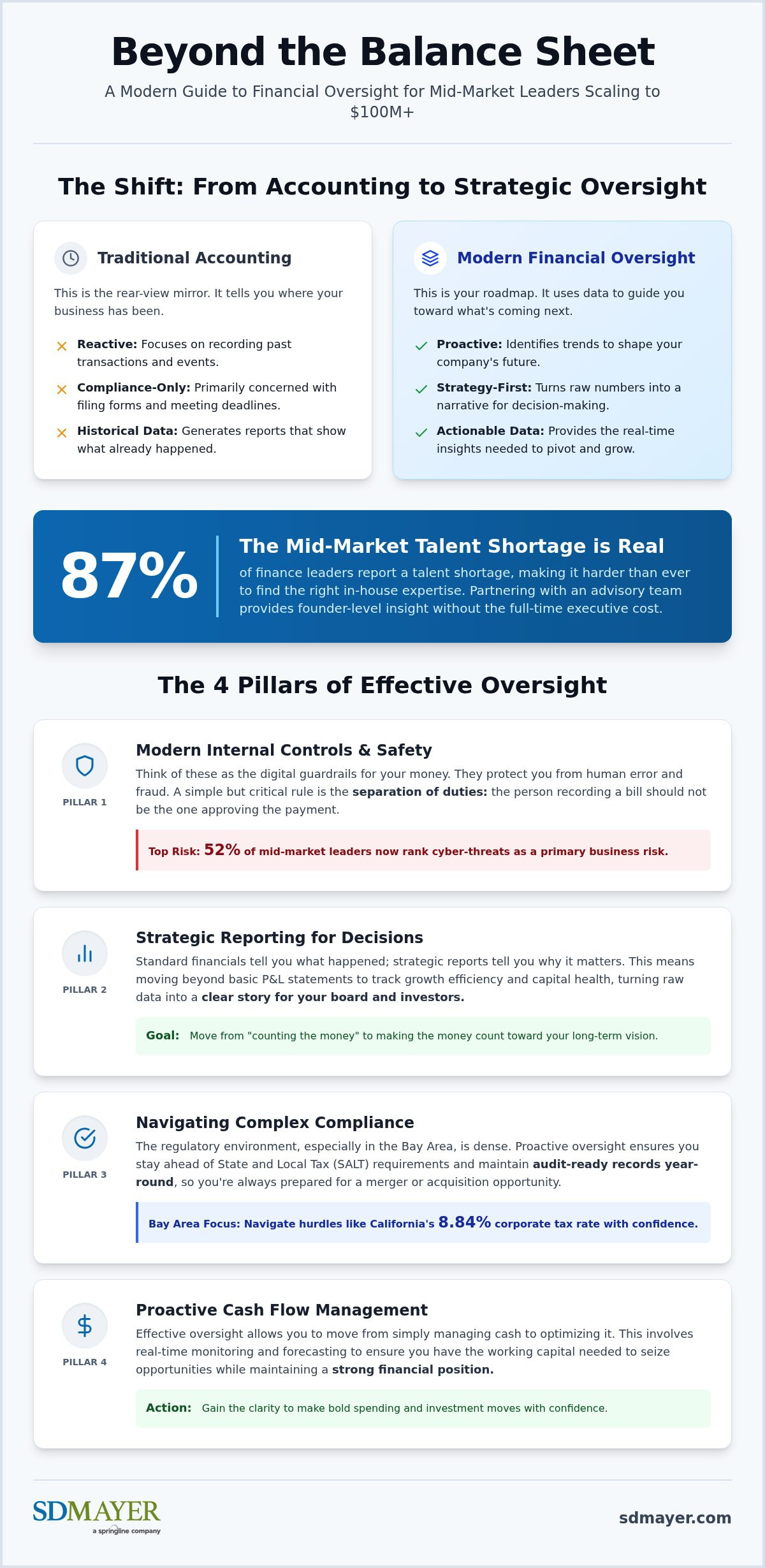
Financial oversight is the proactive management of your company’s financial health and safety. It isn't just about checking boxes or filing forms on time; it's a collaborative partnership between your leadership and your advisory team. In 2026, the speed of business requires moving beyond the "rear-view mirror" approach. Relying on monthly reviews is no longer enough when markets shift in days. Effective oversight involves real-time data monitoring that allows you to see problems while they're still small enough to fix. By utilizing business financial oversight services, you transition from simply recording history to actively shaping your future.
Understanding the broader context of What is Financial Regulation helps clarify why these systems are vital. Oversight ensures your company stays compliant with evolving rules while protecting your assets from internal and external threats. It's the difference between being reactive and being ready.
The Difference Between Oversight and Basic Accounting
Accounting tells you what happened; oversight tells you what's coming next. Basic accounting is essential for compliance, but it's often limited to historical reporting. Oversight takes that data and applies strategic analysis to identify trends before they become expensive problems. It shifts your mindset from a "compliance-only" focus to a "strategy-first" approach. For instance, while an accountant might record a dip in cash reserves, an oversight strategy analyzes why it's happening and how to pivot your spending to maintain growth. It turns raw numbers into a narrative that guides your decisions.
Why Mid-Market Companies Need a Dedicated Oversight Strategy
Scaling brings unique challenges. A business generating $20 million in revenue can't rely on the same informal accounting processes it used when it was a $2 million startup. As your organization grows, "founder-only" oversight becomes a significant risk. It's easy for details to slip through the cracks when one person tries to manage every financial lever. With 87% of finance leaders reporting a talent shortage in 2026, finding the right internal expertise is harder than ever. Investing in tailored business financial oversight services provides the stability needed to fuel your next stage of expansion. Professional oversight builds the credibility you need with investors and bank lenders who want to see sophisticated, reliable reporting. It gives you the peace of mind to focus on your vision instead of worrying about the fine print.
The Four Pillars of Effective Financial Oversight
Building a resilient business requires more than just a talented team and a great product. It requires a structural framework that protects your assets while providing the fuel for expansion. For mid-market companies, business financial oversight services focus on four specific areas: internal controls, strategic reporting, compliance, and cash flow management. When these pillars are strong, you don't just stay in business; you gain the freedom to innovate without the constant fear of a hidden financial crisis.
Pillar 1: Modern Internal Controls and Safety Measures
Pillar 2: Strategic Reporting for Better Decisions
Standard financial statements often tell you what happened, but strategic reporting tells you why it matters. To scale effectively, you need to look beyond the basic profit and loss statement. You need metrics that track your growth efficiency and capital health. Our approach to CAAS streamlines this process by turning raw data into clear stories. When you can present a transparent financial narrative to your board or investors, you build the confidence needed to secure new funding or approve major capital expenditures. It's about moving from "counting the money" to making the money count toward your long-term goals.
Pillar 3: Navigating Complex Compliance
Operating in the Bay Area brings a unique set of hurdles. From navigating California's 8.84% corporate tax rate to managing payroll taxes for a hybrid workforce, the regulatory environment is dense. Utilizing specialized Financial Reporting Compliance Services ensures you stay ahead of State and Local Tax (SALT) requirements without the typical year-end panic. We help you maintain audit-ready records year-round, so when an opportunity for a merger or acquisition arises, your books are already in perfect order. If you're feeling overwhelmed by these shifting rules, you might want to start a conversation with a strategic advisor to see where your current gaps might be.
The final pillar is active cash flow management. It's the lifeblood of your operations. By forecasting your needs and identifying potential bottlenecks early, you ensure that you always have the liquidity to seize a new opportunity or weather an unexpected market shift. Together, these pillars create a foundation of stability that supports everything else you do.
Internal vs. Outsourced Financial Oversight: Which Fits Your Business?
Deciding how to structure your leadership team is one of the most consequential choices you'll make as you scale toward that $100 million revenue mark. With 87% of finance leaders currently reporting a talent shortage in the accounting field, finding a full-time executive who fits both your budget and your culture is increasingly difficult. This is where business financial oversight services provide a strategic advantage. You gain access to high-level expertise without the heavy overhead of a C-suite salary and benefits package. Mid-market firms often thrive with a hybrid approach.
The choice isn't always binary. Many successful organizations combine the strengths of an agile internal team with the deep specialized knowledge of an external partner. This ensures that while your daily transactions are handled by people who know your office culture, your high-level strategy is guided by experts who understand the broader economic shifts in the Bay Area and beyond.
When to Keep Oversight In-House
Keeping your financial management entirely in-house makes sense when your internal team is already demonstrating a high level of strategic thinking. If your accounting department does more than just process invoices and actually provides insights into your operational efficiency, they might be ready to lead. A strong internal culture of accountability is the foundation here. You need people who feel ownership over the data. Even in this scenario, many businesses find value in building a bridge between their internal bookkeeper and an external advisor. This ensures your daily operations stay smooth while an outside perspective keeps you focused on the big picture.
The Benefits of the Outsourced Advisory Model
The primary draw of an outsourced model is the "founder-level" expertise it brings to the table. You aren't just hiring a service; you're gaining a partner who has seen how dozens of other businesses handled the exact growth stage you're in now. This cross-industry perspective is invaluable when navigating complex events like M&A or implementing stock option plans. It's difficult for a single internal hire to match the collective wisdom of a team that manages financial health for a diverse portfolio of clients.
By leveraging CFO Services for Small Business, you can tap into specialist knowledge that would be too expensive to hire full-time. This model is built for scalability. As your revenue grows, your oversight grows with you. You can dial the support up or down based on your current projects, such as a major audit or a new business structure. This flexibility is a core component of modern business financial oversight services, allowing you to stay agile in a fast-paced regional economy without being weighed down by fixed costs.
Five Actionable Steps to Strengthen Your Oversight Today
Understanding the theory of financial health is a great start, but mid-market leaders need a day-one action plan to see real results. Strengthening your business financial oversight services doesn't require a total overhaul of your department overnight. Instead, it's about identifying the small gaps that could lead to significant leaks. By focusing on these five practical steps, you can move from a state of worry to a position of calm, capable stewardship.
Step 1: The One-Hour Approval Review
Take sixty minutes this week to map out exactly who can move money in your company. You're looking for "single points of failure." This is a scenario where one person has the sole authority to initiate and approve a significant transaction without a second set of eyes. If your current system relies on a single signature for wires over $20,000, it's time to implement digital checks and balances. Using cloud-based tools allows you to set up automated workflows where any payment above a certain threshold requires a second approval from a different executive. This simple change reduces fraud risk and ensures that no single error can derail your cash flow.
Step 2: From Data Entry to Data Analysis
Your financial records shouldn't just be a list of past events. By moving your bookkeeping from a chore to a strategic asset, you gain a forward-looking tool. Start by identifying the three metrics that matter most for your 2026 growth. For most mid-market firms, this includes your gross margin, your cash runway, and your days sales outstanding. A quick action item is to set an automated alert in your software for any budget variance over 10%. This allows you to catch overspending or revenue dips in real-time, rather than waiting for a monthly report that arrives too late to act on.
Beyond these reviews, you should also focus on these three critical areas:
- Review User Access Levels: Audit your accounting software to ensure employees only see the data necessary for their specific roles. Excessive access is a common security loophole.
- Establish a "First Call" Protocol: Decide now who gets the first call when a financial surprise happens, whether it's a bank notification or a vendor dispute. Having a designated strategic advisor prevents panic.
- Perform a Tax Risk Consultation: The Bay Area regulatory environment is complex. Meet with a professional to identify hidden risks in your state and local tax strategy before they become audit triggers.
Taking these steps creates a culture of accountability that protects your assets and fuels your growth. If you're ready to see how these strategies fit your specific business model, you can schedule a strategy session with our team to begin building your custom oversight roadmap.
How SD Mayer Integrates Oversight into Your Growth Strategy
Software tools can track your data, but they can't tell you how to navigate a shifting local market or when to pivot your strategy. Our business financial oversight services are built on a philosophy we call "Simply Doing More." This means we don't just look for errors in your books; we actively look for opportunities. Whether it's identifying a tax credit you might have missed or spotting a trend in your cash flow that suggests it's time to expand, we act as a forward-thinking strategist for your business.
Based in the heart of the Bay Area, we understand the unique innovation economy that stretches from San Francisco to San Jose. We know the specific hurdles mid-market firms face when scaling in this region. Our reach isn't limited to Northern California, though. As a member of the BDO Alliance USA, the fifth largest global network, we provide you with massive global resources while maintaining the personal, local touch of a dedicated partner. This gives you the best of both worlds: deep regional expertise and a global perspective.
What truly sets us apart is how our teams work together. Your tax strategy shouldn't exist in a vacuum, separate from your audit results or your wealth management goals. We provide integrated guidance where our tax, audit, and wealth management experts collaborate on your behalf. This ensures every part of your financial life is moving in the same direction, protecting your assets while fueling your next stage of growth.
The "First Call" Partner for Mid-Market Leaders
Many of our clients think of us as their first call when a major business event happens. If you're considering an acquisition, preparing for an exit, or restructuring your business for 2026, we're there to help. We bridge the gap between where you are today and where you want to be in the future. Our commitment to the Bay Area community means we're invested in your long-term success, not just your next quarterly report. We're here to provide the steady, capable stewardship that reduces your stress and lets you focus on your vision.
Ready to Secure Your Financial Future?
Modern oversight is about more than just protection; it's about empowerment. Our CAAS and outsourced CFO services provide the specialized business financial oversight services you need to lead with absolute clarity. We encourage you to reach out for a tailored financial health check to see how your current systems compare to industry best practices. It's time to move from "flying blind" to having a clear, data-driven roadmap for your expansion. Schedule a consultation with our San Francisco team today to start building a more resilient, growth-oriented foundation for your business.
Securing Your Next Stage of Growth
Taking control of your financial future isn't just about avoiding mistakes; it's about building a foundation for bold expansion. We've explored how modern business financial oversight services turn raw data into strategic stories that help your board make better decisions. By strengthening your internal controls and choosing a flexible advisory model, you move away from "flying blind" and toward a clear, data-driven roadmap. You've seen the five steps to start today, from reviewing approval workflows to analyzing the metrics that actually matter for your scale.
As a Top 25 Fastest-Growing Firm in 2025, we understand what it takes to scale effectively in the competitive Bay Area economy. We combine deep local roots with the global reach of the BDO Alliance, the 5th-largest network in the world. This blend of founder-level expertise and massive resources ensures you're never navigating complex regulations alone. It's time to stop worrying about the fine print and start focusing on your vision. If you're ready to see how our integrated approach can fuel your success, Partner with SD Mayer for Full Circle Financial Guidance. Your business deserves a partner that's as invested in your future as you are.
Frequently Asked Questions
What is the main goal of a financial oversight service?
The main goal of business financial oversight services is to create a secure foundation for growth by protecting assets and providing clear financial visibility. It isn't just about catching errors; it's about transforming raw data into actionable insights for your leadership team. By establishing these guardrails, you ensure that every dollar is accounted for and that your organization is ready to seize new opportunities without the fear of hidden risks or cash flow surprises.
How does financial oversight differ from a standard annual audit?
While an annual audit is a retrospective look at your past year's performance, financial oversight is a proactive and continuous process. An audit confirms that your historical records are accurate for external stakeholders. In contrast, oversight focuses on the present and future, managing your daily financial health and strategic planning. It ensures that you aren't just filing reports on time but are actively using your financial data to guide your business decisions throughout the entire year.
Can my business afford outsourced CFO or oversight services?
Most mid-market firms find that they can't afford not to have these services. Research shows that companies moving to a full-service outsourcing model can see a 25% to 40% reduction in total operational costs. By utilizing business financial oversight services, you gain access to founder-level expertise on a scalable basis. This allows you to pay only for the high-level strategy you need as your revenue grows, making it a highly cost-effective investment. Firms like KHT Accounting & Wealth demonstrate how this model helps businesses and investors achieve better financial performance through strategic advisory.
Financial controls protect your business by creating a system of checks and balances that makes it difficult for unauthorized transactions to occur. A primary method is the separation of duties, ensuring the person who initiates a payment isn't the one who approves it. In 2026, we also use digital approval workflows that require multiple signatures. These layers of security significantly reduce the risk of internal fraud and catch human errors before they become expensive problems.
What specific Bay Area tax rules affect financial oversight in 2026?
In 2026, Bay Area businesses must navigate California's 8.84% corporate income tax rate and evolving State and Local Tax (SALT) requirements. Oversight services help you track these obligations in real-time to avoid penalties. Specifically, we monitor the current status of the SALT deduction limits to ensure your filings are optimized. Having a local advisor who understands the regional regulatory environment is vital for maintaining compliance while protecting your company's profitability in a fast-paced economy.
How often should a mid-market company review its financial controls?
You should establish a rhythm of regular reviews to ensure your safety measures stay effective as you scale. We recommend a monthly Big Picture meeting to analyze variances and a more comprehensive Safety Audit of your approval processes at least once a year. If your business is growing rapidly or undergoing a major change like an acquisition, these reviews should happen more frequently. Regular check-ins prevent your processes from becoming outdated as your organization's complexity increases.
What role does technology play in modern financial oversight?
SECURITIES AND ADVISORY DISCLOSURE:
Securities offered through Valmark Securities, Inc. Member FINRA, SIPC. Fee based planning offered through SDM Advisors, LLC. Third party money management offered through Valmark Advisers, Inc a SEC registered investment advisor. 130 Springside Drive, Suite 300, Akron, Ohio 44333-2431. 1-800-765-5201. SDM Advisors, LLC is a separate entity from Valmark Securities Inc. and Valmark Advisers, Inc. Form CRS Link
DISCLAIMER:
This material has been prepared for informational purposes only, and is not intended to provide, and should not be relied on for, accounting, legal or tax advice. The services of an appropriate professional should be sought regarding your individual situation.
HYPOTHETICAL DISCLOSURE:
The examples given are hypothetical and for illustrative purposes only.