
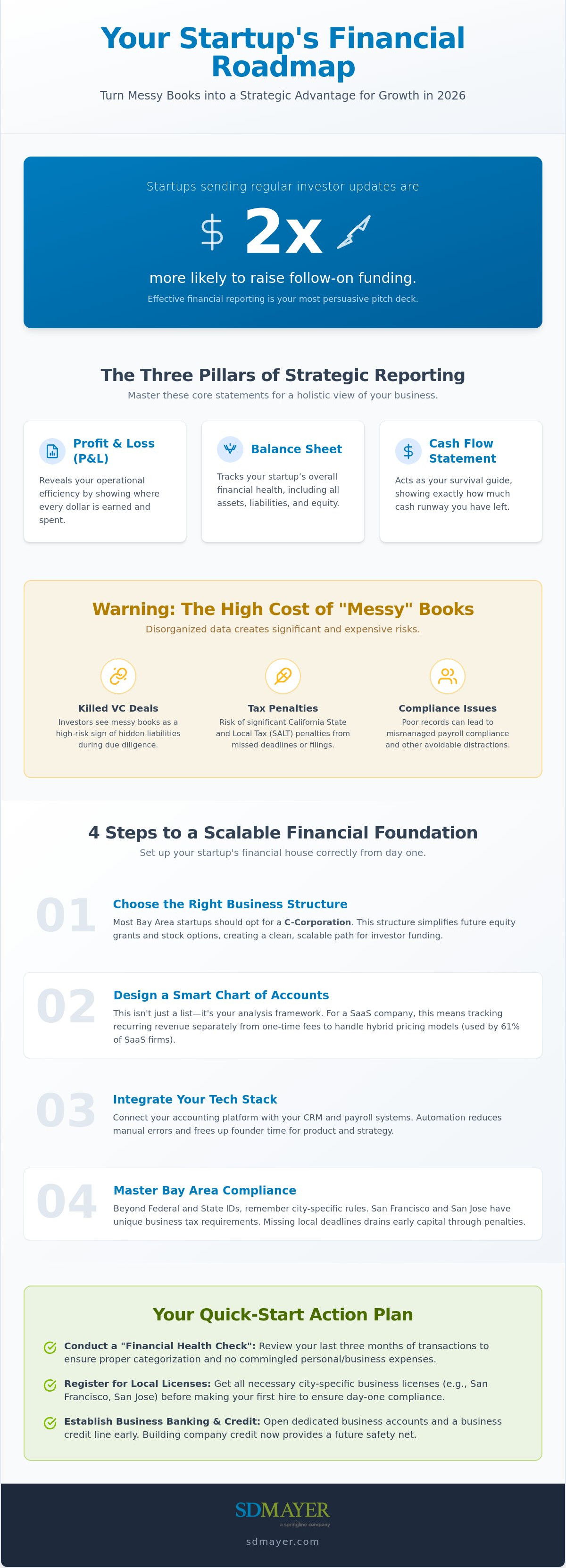
Did you know that startups sending regular updates to their investors are roughly twice as likely to raise follow-on funding in 2026? It's a striking figure that proves effective financial reporting for startups is far more than a compliance chore. It is actually your most persuasive pitch deck. We understand that as a Bay Area founder, you're likely feeling the pressure of complex equity reporting and the fear of missing California specific tax deadlines while trying to scale your product.
It's exhausting to feel like you're drowning in spreadsheets instead of leading your team. You deserve a clear path forward that turns messy books into a strategic advantage. This guide provides a practical, step by step roadmap to help you achieve audit ready books and a clean cap table. We will explore the latest 2026 GAAP amendments for software capitalization and show you how to gain deep insights into your cash flow. By the end of this article, you will have the tools to move from basic bookkeeping to high level strategic growth.
Key Takeaways
- Move beyond simple record-keeping by learning how real-time data acts as a heartbeat for your 2026 strategy and investor relations.
- Build a scalable foundation by choosing a business structure that simplifies financial reporting for startups and future equity management.
- Avoid the software trap by understanding how outsourced CAAS provides the strategic oversight and mentorship that basic bookkeeping tools lack.
- Protect your growth by mastering Bay Area specific tax requirements and stock option planning to attract and retain elite Silicon Valley talent.
- Transform your financial relationship into a partnership that integrates daily business accounting with your personal wealth management and exit strategy.
Why Financial Reporting is Your Startup’s Strategic Growth Engine
Many founders view accounting as a necessary evil reserved for tax season. However, in 2026, waiting until April to look at your numbers is a recipe for stagnation. Robust financial reporting for startups transforms your data from a static record into a dynamic roadmap for growth. It moves your focus from what happened last month to what is possible next quarter. When you have real time data at your fingertips, you aren't just guessing; you're leading with precision, often by leveraging professional bookkeeping services to maintain a flawless financial foundation.
Accurate reporting is also the most effective way to reduce founder stress. There is a specific kind of anxiety that comes from not knowing your exact cash runway. By shifting from historical bookkeeping to forward looking financial reporting, you replace that uncertainty with a clear view of your operational limits. This clarity allows you to build deep trust with lenders and investors. In an environment where the median pre-Series-B funding round now closes in just 7 days, having professional, audit-ready statements is the difference between securing capital and missing the window entirely.
The Three Pillars of Startup Reporting
To build this strategic engine, you need to master three core financial statements. The Profit and Loss (P&L) statement reveals your operational efficiency by showing where every dollar goes. The Balance Sheet tracks your startup’s overall health, including debt and equity. Finally, the Cash Flow Statement acts as your survival guide; it tells you exactly how much time you have left before the bank account hits zero. Together, these reports provide a holistic view of your business that goes far beyond simple bank balances.
The Cost of "Messy" Books
Disorganized data is the fastest way to kill a venture capital deal during due diligence. Investors look for patterns of discipline; if your books are a mess, they see a high risk of hidden liabilities. Beyond funding, messy records invite significant risks like California State and Local Tax (SALT) penalties or mismanaged payroll compliance. By prioritizing financial reporting for startups early on, you protect your company from these expensive, avoidable distractions. You ensure that when an opportunity for an exit or a major partnership arises, your finances are an asset rather than a hurdle.
Action Item: Conduct a "Financial Health Check" this week. Review your last three months of transaction categorizations to ensure they align with your current business model and that no personal expenses are commingled with business accounts.
Step 1: Building a Scalable Financial Foundation in the Bay Area
Setting up your financial house is about more than just staying legal; it is about preparing for the day you pitch to a Series A investor. Choosing the right business structure is your first major hurdle. Most Bay Area startups opt for a C-Corp to simplify future equity grants and stock options. This structure creates a clear path for growth, making financial reporting for startups much cleaner as you scale. It ensures that when you're ready for complex equity rounds, your foundation is already in place.
Your Chart of Accounts should be your next priority. This isn't just a list of categories; it is the framework that allows you to analyze and report your financial results with precision. For a SaaS company, this means tracking recurring revenue separately from one-time implementation fees. In 2026, we see 61% of SaaS companies using hybrid pricing models. Your system must be flexible enough to handle both base fees and usage-based variables without creating a mess of manual adjustments.
Modern software integration is equally vital. Your accounting platform should talk to your CRM and payroll systems automatically. This reduces manual entry errors and frees up your time for product development. Most importantly, you must keep your personal and business finances entirely separate. Mixing funds is the fastest way to lose your liability protection, making you personally responsible for company debts. If you're feeling overwhelmed by these technical requirements, it might be time to reach out for a professional perspective on your specific setup.
Local Compliance and Registration
Operating in the Bay Area involves layers of local requirements. You will need Federal and State tax IDs, but don't forget city-specific obligations. San Francisco and San Jose have their own business tax rules that differ significantly from Walnut Creek or Sacramento. Missing these local deadlines can lead to frustrating penalties that drain your early capital.
Action Item: Register for all necessary local business licenses before you make your first hire to ensure you're compliant from day one.
Banking and Internal Controls
Protect your corporate veil by establishing dedicated business bank accounts. Once these are set up, implement internal controls by giving your advisors "read-only" access. This maintains transparency without giving up control of your funds. It also makes your year-end review much smoother and builds trust with your board of directors.
Action Item: Open a business credit line early. Even if you don't need the cash today, building company credit now provides a safety net for future expansion.
Step 2: Choosing Your Model: DIY vs. Outsourced CAAS
Many founders fall into what we call the "QuickBooks Trap." You sign up for a subscription, connect your bank feeds, and assume your financial reporting for startups is handled. While modern software is excellent at categorizing transactions, it cannot tell you if your burn rate is sustainable or if your pricing model needs a pivot. Software is a tool; it is not a strategy. To truly move the needle, you need a partner who can interpret the data and offer a holistic perspective on your company’s health.
This is where Client Accounting Advisory Services (CAAS) come in. Unlike a traditional bookkeeper who looks backward at what you spent, a CAAS team acts as a forward-thinking strategist. They bridge the gap between simple data entry and the high-level insights you need to impress your board. As your startup grows, you will eventually reach a point where your financial complexity outpaces your available time. Moving to a fractional CFO or Controller allows you to access executive-level expertise without the burden of a full-time Silicon Valley salary.
Comparing Your Options
Choosing between DIY and professional oversight depends on your stage and complexity. A solo founder with no employees and a simple product might manage with a DIY approach for a few months, though the time cost is often higher than expected. However, once you start hiring or preparing for a seed round, the risk of errors increases. For most mid-sized startups, What is CAAS? A Strategic Guide to Client Accounting Advisory Services in 2026 provides a more reliable path to scaling without the overhead of a full internal department.
The Value of Fractional Leadership
An outsourced CFO does more than just balance the books. They prepare professional board reports and help you tell a compelling story during fundraising rounds. They also improve your cash flow visibility by creating three to five year projections that investors now expect to see in 2026. This level of professional financial reporting for startups ensures you aren't caught off guard by a sudden cash crunch. You gain a steady companion who is as invested in your long-term success as you are.
Action Item: Calculate your "founder hourly rate" by dividing your desired annual salary by 2,000 hours. If you are spending five hours a week on accounting, compare that cost to the price of professional outsourcing. You will likely find that your time is significantly more valuable when spent on product growth and customer acquisition.
Navigating Complex Bay Area Financial Challenges
Operating a startup in the Bay Area feels different because the regulatory environment is uniquely dense. You aren't just dealing with federal standards; you are managing city-specific taxes that shift as you move from San Francisco to San Mateo or San Leandro. With the rise of hybrid work, your payroll and benefits compliance now spans multiple jurisdictions. In 2026, effective financial reporting for startups must account for these geographical nuances to protect your company from unexpected local audits.
State and Local Tax (SALT) compliance is often where founders face their biggest surprises. If your lead engineer works from a home office in one city while your headquarters is in another, your tax footprint changes. Professional reporting helps you track these obligations in real time, ensuring you don't fall behind on city-level filings. This level of detail is vital for mid-market firms that are scaling quickly across the region and need to maintain a clean record for future investors.
Stock Option and Equity Planning
Talent is your most valuable asset, and in Silicon Valley, a competitive salary is only half the story. Your team expects equity. However, mismanaging your cap table can create "tax traps" where early employees face massive tax bills on shares they cannot yet sell. Regular 409A valuations and transparent equity reporting are essential to maintain team trust and avoid legal hurdles. By integrating equity tracking into your financial reporting for startups, you ensure that every stock grant is documented and compliant with current 2026 standards.
Action Item: Review your stock option plan with a tax expert before your next significant hire. Ensure your current 409A valuation is up to date to avoid future penalties during an acquisition or IPO.
The 2026 California Tax Landscape
The California tax environment remains one of the most complex in the country. Many founders miss out on valuable R&D tax credits because their internal data isn't organized enough to support a claim. Additionally, staying ahead of SALT deduction limits requires a strategic partner who understands the local landscape. For a deeper look at how to choose a partner for this journey, see our guide on the Best Accounting Firms for Startups in 2026.
If you're concerned about how local tax changes might impact your runway, contact our Bay Area tax specialists today for a comprehensive compliance review. We can help you navigate these hurdles so you can stay focused on building your product.
Building a Long-Term Partnership for Sustainable Success
Your financial reports aren't just for the IRS or your investors; they're for you. As a founder, your business is likely your largest asset. This means your financial reporting for startups should serve as the bridge between your daily operations and your long-term personal goals. A truly effective accountant acts as a strategic business advisor who understands the big picture. They don't just hand you a balance sheet; they help you interpret what those numbers mean for your future exit. This partnership turns raw data into a narrative of success.
At SD Mayer, we believe in a partnership that lasts from your initial launch all the way to your legacy. This requires a steady rhythm of board and quarterly reporting cycles. These cycles ensure that everyone is aligned on the company's trajectory and that there are no surprises during an audit or acquisition. By maintaining this discipline, you build a track record of reliability that is incredibly attractive to future buyers. It shows that you lead with intention and that your business is built on a foundation of transparency.
Beyond the Numbers: Holistic Financial Health
Personal wealth management and business success should never be siloed. If your startup hits a major milestone, you need a plan to protect that wealth and ensure your family is secure. Succession planning and wealth protection are vital components of a mature financial strategy. It's about looking forward to the day you step away and ensuring the transition is as smooth as possible. When your financial reporting for startups is integrated with your personal goals, you gain a sense of security that allows you to focus on your next big innovation.
Action Item: Schedule a quarterly strategy session with your advisor that goes beyond the P&L. Use this time to discuss how your business performance impacts your personal financial roadmap and exit timeline.
Taking the Next Step
Transitioning your current books to a professional advisory firm might feel like a daunting task, but it is often the most rewarding move you can make for your sanity. During the first 90 days of a CAAS partnership, the focus is on cleanup and integration. We work to align your systems, verify your data accuracy, and establish the reporting cadence that fits your specific needs. It's a period of transformation where messy spreadsheets become a clear, strategic engine. You'll move from wondering where the cash went to knowing exactly how to deploy it for growth.
If you're ready to move from basic bookkeeping to high-level strategy, Partner with SD Mayer for Strategic Startup Accounting. Let's build a foundation that supports your growth and your future legacy.
Empowering Your Startup’s Journey with Strategic Clarity
The transition from messy spreadsheets to a sophisticated growth engine is a defining moment for any founder. By establishing a scalable foundation and choosing the right advisory model, you move beyond simple compliance. You gain the power to make data-driven decisions that protect your runway and impress your board. Mastering financial reporting for startups isn't just about the numbers; it's about building the narrative that secures your future exit and protects your team's equity.
At SD Mayer, we bring specialized CAAS and outsourced CFO expertise directly to the San Francisco, San Jose, and Silicon Valley communities. Our holistic approach integrates tax strategy, audit readiness, and wealth management to support you from launch to legacy. It's time to stop worrying about local tax deadlines and start focusing on your product. Partner with SD Mayer for Strategic Startup Accounting today to see how we can serve as your steady companion through every stage of growth. You have the vision to change the world; let us provide the financial roadmap to get you there.
Frequently Asked Questions
What are the most essential financial reports for a new startup?
The three essential reports you need are the Profit and Loss statement, the Balance Sheet, and the Cash Flow statement. While the P&L tracks your operational efficiency, the cash flow statement is your survival guide; it shows exactly how much runway you have left. Reviewing these monthly allows you to make informed hiring and spending decisions rather than relying on guesswork.
How much should a startup spend on financial reporting services in 2026?
Do I need a local San Francisco CPA or can I use a national firm?
A local firm is generally better because of the dense city-specific tax requirements across the Bay Area. National firms often miss the nuances of San Francisco's gross receipts tax or the specific business license rules in San Jose and Walnut Creek. Having a local partner ensures you have a guide who understands the regional economy and can offer in person mentorship when needed.
What is the difference between simple bookkeeping and CAAS?
Bookkeeping is the historical recording of what you've already spent, while CAAS provides forward-looking strategic advice. Financial reporting for startups under a CAAS model includes deep forecasting, board reporting, and mentorship. It bridges the gap between simply having data and actually knowing how to use that data to scale your business and impress investors.
How does stock option planning affect my startup’s financial reporting?
Stock option planning requires regular 409A valuations and meticulous cap table management to remain compliant. If your reporting doesn't account for these equity grants, you could create "tax traps" that leave your employees with massive, unexpected tax bills. Accurate reporting ensures every grant is documented correctly, which is vital for maintaining team trust and attracting top Silicon Valley talent.
When is the right time to hire an outsourced CFO for my startup?
You should consider a fractional CFO when your financial complexity begins to take too much time away from product development. With the median pre-Series-B funding round now closing in just 7 days, you need a professional who can produce audit-ready books instantly. If you are preparing for a significant raise or managing a hybrid workforce, a fractional CFO provides the executive level oversight you need.
What is SALT, and why does it matter for my California business?
SALT stands for State and Local Tax, and it is critical because your tax obligations change based on where your employees actually work. In the Bay Area, hiring a remote engineer in a different city can trigger new local filing requirements and nexus issues. Effective financial reporting for startups tracks these city level obligations to prevent expensive penalties and ensure you're taking advantage of available local credits.
Can I use automated software instead of hiring an accounting firm?
Software is an excellent tool for transaction categorization, but it cannot replace the strategic advice of a professional firm. You can use automated platforms to handle basic data entry, but you still need a human expert to interpret that data and ensure your business structure is sound. A firm acts as a holistic mentor, helping you navigate complex challenges that software isn't built to handle.
SECURITIES AND ADVISORY DISCLOSURE:
Securities offered through Valmark Securities, Inc. Member FINRA, SIPC. Fee based planning offered through SDM Advisors, LLC. Third party money management offered through Valmark Advisers, Inc a SEC registered investment advisor. 130 Springside Drive, Suite 300, Akron, Ohio 44333-2431. 1-800-765-5201. SDM Advisors, LLC is a separate entity from Valmark Securities Inc. and Valmark Advisers, Inc. Form CRS Link
DISCLAIMER:
This material has been prepared for informational purposes only, and is not intended to provide, and should not be relied on for, accounting, legal or tax advice. The services of an appropriate professional should be sought regarding your individual situation.
HYPOTHETICAL DISCLOSURE:
The examples given are hypothetical and for illustrative purposes only.