
The era of growth at all costs has officially been replaced by a mandate for capital efficiency. For founders in 2026, the difference between securing a successful Series B and prematurely hitting a wall often rests on a partnership that isn't even on your internal payroll. You already know that managing a burn rate requires more than just basic bookkeeping; it demands real-time data and a clear, strategic view of your financial runway.
Identifying the best accounting firms for startups means looking beyond simple tax filings to find a partner that provides holistic, CFO-level leadership. It's about ensuring you're audit-ready for VC due diligence while navigating the high-stakes tax implications of founder stock options and complex GAAP compliance. You need a mentor who understands the nuances of the current market, from the $1 million Single Audit threshold to the long-term impact of R&D expense amortization on your bottom line.
In this guide, we'll show you how to vet a firm for both technical proficiency and strategic alignment. You'll learn how to transition from historical reporting to forward-thinking advisory, ensuring your startup remains agile, compliant, and attractive to investors as you scale into your next stage of growth.
Key Takeaways
- Learn why modern startup accounting must shift from historical reporting to forward-looking strategic advisory to manage burn rate and runway effectively.
- Discover the essential criteria for selecting the best accounting firms for startups, including seamless integration with your existing tech stack and niche industry expertise.
- Understand how Client Accounting Advisory Services (CAAS) provide the high-level CFO insights necessary to navigate complex stock option planning and investor due diligence.
- Explore the strategic advantage of local Bay Area expertise in identifying California-specific tax credits and managing regional regulatory compliance.
- Gain actionable steps for ensuring audit readiness and GAAP compliance to streamline future funding rounds and minimize long-term tax liabilities.
Why Startups Require More Than Traditional Accounting Services
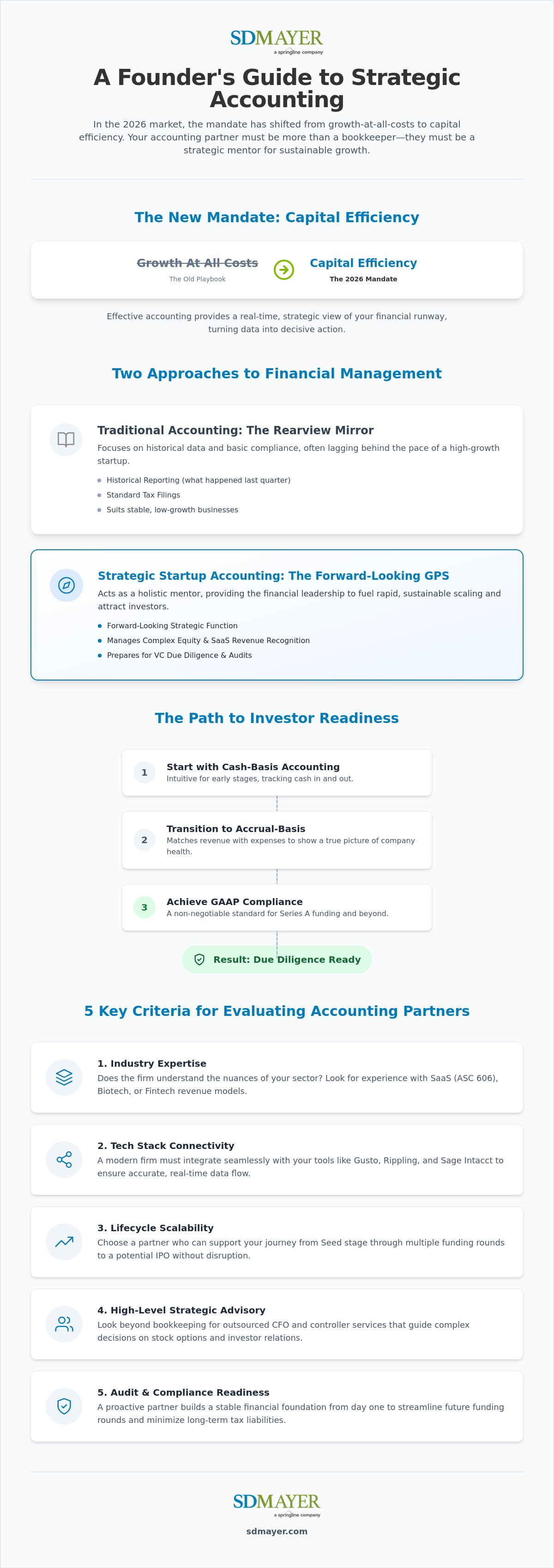
Traditional accounting often feels like a rearview mirror. For a local retail shop, knowing what happened last quarter is usually enough to keep the doors open. However, understanding the unique financial landscape of startups requires a completely different perspective. Startup accounting isn't just about historical reporting; it's a forward-looking strategic function designed to fuel rapid scale. While a "mom-and-pop" CPA might excel at standard tax filings, they often struggle with high-growth tech models, complex equity structures, and the intense pressure of venture capital cycles. They might miss the nuances of software-as-a-service (SaaS) revenue recognition or the specific tax implications of early-exercise stock options that founders face.
The best accounting firms for startups act as a "Holistic Mentor." They don't just enter data; they provide the financial leadership needed to bridge the gap between a great idea and a fundable enterprise. This partnership is vital because venture capitalists look for more than just a high growth rate. They look for financial integrity and a clear narrative. If your books are messy or inconsistent, it signals a lack of operational control that can kill a deal during due diligence. A strategic partner helps you present a professional, transparent financial story that builds trust with investors and stakeholders alike.
The Shift from Cash to Accrual Accounting and GAAP Compliance
Many founders start with simple cash-basis accounting because it's intuitive. You track what comes in and what goes out. But as you eye Series A funding, GAAP (Generally Accepted Accounting Principles) compliance becomes non-negotiable. Professional firms guide you through the transition to accrual-based reporting, which matches revenue with the expenses incurred to earn it. This transition ensures your financial statements provide a true picture of your company’s health, making your books "due diligence" ready at a moment's notice. It’s about building a stable foundation today so you don't have to rebuild it under the scrutiny of an audit later.
Managing Burn Rate, Runway, and Cash Flow Volatility
In the 2026 market, capital efficiency is the primary metric for success. High-touch advisory services help you use financial data to predict your runway and inform critical hiring or pivot decisions. Instead of reacting to a low bank balance, you gain the foresight to identify cash flow leaks before they turn into crises. Runway is the lifeblood of startup survival in the 2026 market. Partnering with the best accounting firms for startups ensures you have a steady companion to navigate the volatility of early-stage growth while maintaining a clear path toward profitability. This strategic oversight reduces the stress of financial management, allowing you to focus on innovation and market expansion.
5 Key Criteria for Evaluating Startup Accounting Partners
Selecting a financial partner is a high-stakes decision that influences your trajectory for years. The best accounting firms for startups don't just record transactions; they integrate into your operations as a strategic extension of your team. While you can find foundational guidance from the Small Business Administration on managing finances, high-growth entities require a more specialized framework to navigate the complexities of 2026. You should evaluate potential partners based on these five pillars:
- Industry Expertise: Does the firm understand the specific revenue recognition rules (ASC 606) for SaaS, or the R&D capitalization requirements for Biotech and Fintech?
- Tech Stack Connectivity: A modern firm must offer seamless integration with tools like Rippling, Gusto, and Sage Intacct to ensure data flows without manual entry errors.
- Lifecycle Scalability: Your needs will evolve. Ensure the firm can support you from your initial Seed stage through to a potential public offering without a disruptive change in providers.
- High-Level Strategic Advisory: Look for firms that offer outsourced CFO and controller services to provide the "big picture" insights that a standard bookkeeper cannot.
- Multidimensional Tax Strategy: Effective partners manage more than just federal filings; they provide deep expertise in stock options and State & Local Tax (SALT) to protect both the company and the founders.
The Importance of Tech Stack Agility
In 2026, efficiency is driven by automation. However, relying solely on "Agentic AI" tools carries significant risks without expert human verification. The right partner balances automated bookkeeping with professional oversight, ensuring your payroll and expense management are integrated into a unified, accurate financial dashboard. This hybrid approach allows you to maintain speed while ensuring your data remains reliable for board reporting. If you're ready to move beyond simple spreadsheets, exploring outsourced CFO and controller services can help stabilize your financial future.
Specialized Knowledge in Stock Option Tax Planning
For tech founders, equity is often the most significant asset. You need an accountant who understands the nuances of ISOs, NSOs, and RSUs to avoid devastating tax surprises. Strategic tax planning is essential for preserving founder wealth during a liquidity event. SD Mayer approaches this by integrating corporate tax strategy with personal wealth management, ensuring that your business success translates into long-term personal financial security. This holistic view is what distinguishes a mere vendor from a true mentor in the startup ecosystem.
The Strategic Advantage of Outsourced CFO and Advisory Services
Building a high-growth company requires a specialized financial architecture that evolves alongside your product. Many founders mistakenly view accounting as a commodity, yet the best accounting firms for startups differentiate themselves by offering more than just data entry. Through Client Accounting Advisory Services (CAAS), your business gains access to enterprise-level talent at a fraction of the cost of a full-time executive hire. This model allows you to follow essential accounting best practices while maintaining the lean operation necessary for early-stage survival.
Understanding the hierarchy of financial support is key to your growth. A bookkeeper maintains the ledger, while a controller manages the accuracy and reporting process. A strategic CFO, however, focuses on the future, helping you navigate complex fundraising rounds and board reporting. A fractional CFO from one of the best accounting firms for startups provides the high-level authority needed to negotiate with VCs while ensuring your financial model is robust enough to withstand intense scrutiny. This partnership ensures that your financial narrative is as compelling as your product roadmap.
Advanced Audit and Assurance for Scaling Teams
As your team expands, compliance requirements shift dramatically. For instance, once your 401(k) plan hits the "100-participant" threshold, an Employee Benefit Plan Audit becomes a legal necessity. Beyond mandatory filings, many founders utilize Agreed-Upon Procedures to provide internal transparency or satisfy specific investor requests. If your startup is fortunate enough to receive federal grants, you must be prepared for a Single Audit, as the threshold for organizations expending federal funds rose to $1 million as of October 1, 2024. These specialized services protect the long-term interests of both founders and early employees by ensuring every financial claim is backed by rigorous verification.
Minimizing Liability through SALT and Stock Option Strategy
The shift toward remote-first teams has complicated the tax landscape, making State & Local Tax (SALT) strategy a critical priority. Managing SALT compliance ensures your startup doesn't accidentally create a "nexus" in a state where you have employees but no physical office, which could lead to significant back-tax penalties. Strategic stock option planning is equally vital; without it, founders and employees can face devastating Alternative Minimum Tax (AMT) hits during a liquidity event. Proactive SALT compliance prevents unforeseen liabilities from surfacing during an acquisition, protecting your valuation when it matters most. Additionally, for firms leveraging European contractors, it's essential to visit scaliify to navigate the complexities of pseudo-self-employment regulations.
Navigating the Bay Area Ecosystem: Why Local Expertise Matters
While digital tools make geography feel irrelevant, the regulatory reality of Northern California tells a different story. The best accounting firms for startups in the Bay Area understand that San Francisco, San Jose, and Menlo Park each present unique compliance hurdles. A national firm might handle your federal taxes perfectly but could overlook the intricacies of the San Francisco Gross Receipts Tax or specific California-specific tax credits that significantly impact your bottom line. Local expertise ensures you're leveraging every available deduction while remaining compliant with the state's rigorous labor and tax laws.
Partnering with a firm that speaks the language of Sand Hill Road is a strategic advantage. Investors in the SF/SJ corridor expect a certain level of financial sophistication and transparency. When your accounting partner understands the lifecycle of a Silicon Valley tech company, they can better prepare you for the specific demands of local venture capitalists. Beyond the numbers, local firms provide a vital network effect, offering trusted referrals for payroll, legal counsel, and insurance providers who are also specialized in the high-growth startup space.
San Francisco and Silicon Valley Tax Compliance
Managing a business in the Bay Area requires navigating a dense web of local assessments. For instance, the San Francisco Gross Receipts Tax is notoriously complex, requiring precise calculations that vary based on your industry and headcount. If your startup has offices or remote employees spread across San Mateo, Santa Rosa, and San Leandro, your payroll challenges multiply. Local firms are deeply familiar with the California labor market, ensuring your payroll and State & Local Tax (SALT) filings are accurate across every jurisdiction where you operate.
The Bay Area Network Effect
Success in "Cerebral Valley" and the broader Bay Area ecosystem often depends on who you know and how quickly you can move. An agile, modern accounting partner acts as a steady companion through the fast-paced regional economy. SD Mayer serves as a holistic mentor, guiding you through the transition from early-stage bookkeeping to complex corporate tax strategy. By staying rooted in the local community, we provide the stability and insight needed to navigate a market where AI-driven growth and capital efficiency are the primary benchmarks of success. If you want to ensure your financial infrastructure is built for the local landscape, partner with SD Mayer to secure your startup’s growth.
SD Mayer: The Strategic Choice for Bay Area Startups
Choosing between the best accounting firms for startups isn't just about finding someone to balance the books. It’s about finding a guide who understands that your personal financial health and your company’s success are inextricably linked. SD Mayer operates as a "Holistic Mentor," providing the steady, capable stewardship needed to navigate the complexities of the Bay Area’s high-pressure economy. Our approach combines high-level professional authority with a deeply supportive undertone, ensuring you never feel like just another account number. We provide a comprehensive range of services, moving seamlessly from Bookkeeping to Wealth Management to protect your interests at every turn.
As a "Forward-Thinking Strategist," we help you plan for your eventual exit from day one. Whether you're eyeing an IPO or a strategic acquisition, your financial infrastructure must be built to withstand the most rigorous scrutiny. Our team doesn't just react to changes; we anticipate them, helping you minimize tax liabilities through sophisticated stock option planning and proactive SALT management. A financial health assessment is the first step in identifying where your current systems might be leaking value or creating unnecessary risk. This proactive approach ensures that when the time comes for a liquidity event, your books are as ready as your product.
A Full-Service Suite for Every Stage of Growth
Scaling a startup requires a partner that can grow with you. Many firms specialize only in the early stages, forcing you to switch providers just as your operations become complex. SD Mayer offers a full-service suite that allows you to transition from basic CAAS to complex audit and tax engagements without the friction of a disruptive data migration. Having tax, audit, and wealth management under one roof provides a "big picture" view that siloed firms simply cannot match. This integrated model is why we're the preferred choice for founders in Sacramento, Walnut Creek, and the broader San Francisco region who demand more from their financial partners.
Ready to Scale? Take the Next Step
The volatility of the 2026 market demands a partner who projects calm and capable stewardship. If you're currently managing complex stock options or need to elevate your financial reporting through CAAS, we're here to provide the clarity you need. We invite you to schedule a consultation to discuss your specific scaling needs and discover how a strategic partnership can transform your financial data into a competitive advantage. Don't leave your financial future to chance. Contact SD Mayer today to optimize your startup's financial future and ensure your growth is built on a foundation of integrity and strategic insight.
Securing Your Startup’s Financial Future
The journey from a seed-stage idea to a market-leading enterprise requires a financial foundation that is both robust and flexible. We've explored how identifying the best accounting firms for startups involves looking for specialized stock option tax planning and full-service audit capabilities that ensure you're always ready for investor scrutiny. It's clear that local expertise in the San Francisco Bay Area provides a distinct advantage in navigating the regional regulatory landscape and managing the complexities of California's tax requirements.
At SD Mayer, we act as your holistic mentor, integrating wealth management with business accounting to protect both your company and your personal future. Our team is deeply rooted in the San Francisco Bay Area tech ecosystem, providing the calm, capable stewardship you need during periods of rapid growth and market volatility. We're ready to help you transition from simple data entry to high-level strategic advisory through our full-service audit and CAAS capabilities.
Schedule a Strategic Financial Consultation with SD Mayer today to leverage our specialized stock option tax planning and secure your path toward sustainable growth. Your vision deserves a partner who is as invested in your long-term success as you are.
Frequently Asked Questions
What is the difference between a bookkeeper and a startup accounting firm?
A bookkeeper primarily focuses on recording historical transactions and ensuring your ledger is accurate for tax season. In contrast, the best accounting firms for startups provide a comprehensive suite of strategic services, including forward-looking financial modeling, complex tax planning, and audit readiness. They act as a holistic mentor, helping you manage your burn rate and prepare for future funding rounds rather than just documenting past spending.
When should a startup transition from DIY accounting to a professional firm?
You should transition when your financial needs move beyond simple cash tracking and basic expense management. This shift typically happens when you hire your first employees, issue stock options, or prepare for your first institutional funding round. Professional oversight ensures your books are GAAP-compliant from the start, which prevents costly clean-up projects during venture capital due diligence.
How much do accounting services for startups typically cost in 2026?
In 2026, the cost of professional accounting depends on your startup's transaction volume, the complexity of your equity structure, and the level of advisory support you require. Fees scale as you move from basic bookkeeping to specialized Client Accounting Advisory Services (CAAS) or fractional CFO leadership. Most firms offer tiered structures that grow alongside your company's revenue and headcount to remain capital-efficient.
Do I need an audit before my Series A funding round?
While a full audit isn't always a legal requirement for a Series A, it's a powerful tool for building investor trust. Many venture capital firms prefer or require audited financial statements to verify your valuation and ensure there are no hidden liabilities. Starting the process early demonstrates professional stewardship and can significantly streamline the due diligence process for your scaling team.
What is stock option tax planning and why is it important for founders?
Stock option tax planning involves strategically managing the timing and exercise of equity to minimize your personal and corporate tax burden. For founders, this is vital for avoiding heavy Alternative Minimum Tax (AMT) hits and maximizing long-term capital gains. A firm that specializes in this area helps you preserve the wealth you've built through your company's growth during a future liquidity event.
Can a national accounting firm handle California SALT compliance effectively?
National firms often lack the granular knowledge required to navigate the specific regulatory environment of Northern California. State & Local Tax (SALT) requirements, including the San Francisco Gross Receipts Tax, are notoriously complex and vary by city. Local expertise ensures you don't overlook specific regional credits or accidentally trigger nexus-related liabilities in multiple jurisdictions where your remote team might reside. This need for specialized local knowledge is even more pronounced when expanding into international markets, where Italian fiscal representation services may be required to handle VAT and regulatory compliance for entities operating in Italy.
What are the benefits of an outsourced CFO for a Seed-stage startup?
An outsourced CFO provides Seed-stage startups with enterprise-level financial strategy without the high expense of a full-time executive hire. They help with sophisticated financial modeling, runway projections, and board-level reporting. This allows founders to focus on product development and innovation while knowing their financial infrastructure is being managed by a forward-thinking strategist.
How does GAAP compliance affect my startup's valuation?
GAAP compliance provides a standardized language that investors use to evaluate your company's performance across the best accounting firms for startups. By following these principles, you provide a clear, transparent view of your revenue and expenses, which reduces the perceived risk for investors. This transparency often leads to a more efficient fundraising process and supports a higher valuation during competitive negotiations.
SECURITIES AND ADVISORY DISCLOSURE:
Securities offered through Valmark Securities, Inc. Member FINRA, SIPC. Fee based planning offered through SDM Advisors, LLC. Third party money management offered through Valmark Advisers, Inc a SEC registered investment advisor. 130 Springside Drive, Suite 300, Akron, Ohio 44333-2431. 1-800-765-5201. SDM Advisors, LLC is a separate entity from Valmark Securities Inc. and Valmark Advisers, Inc. Form CRS Link
DISCLAIMER:
This material has been prepared for informational purposes only, and is not intended to provide, and should not be relied on for, accounting, legal or tax advice. The services of an appropriate professional should be sought regarding your individual situation.
HYPOTHETICAL DISCLOSURE:
The examples given are hypothetical and for illustrative purposes only.