
What if the most expensive "check-the-box" exercise on your calendar was actually your most powerful tool for securing next year’s expansion capital? For many mid-market leaders, the annual audit feels like a stressful disruption designed to catch mistakes rather than create value. You might find yourself asking, what is the main goal of an audit, and is it really worth the investment beyond simple compliance? It's easy to feel like you're paying a premium just to prove you aren't breaking the rules, especially with 2026 standards like the CPRA cybersecurity mandates and updated PCAOB quality controls adding more layers to the process.
We understand that the line between a simple tax review and a full financial audit often feels blurred, leading to unnecessary anxiety about finding errors. However, an audit is far more than a safety net or a hurdle to clear. This guide will show you how to transform these results into a strategic asset that builds long-term credibility with lenders and investors. You'll discover the real purpose of an audit, how it can streamline your operations, and get a clear checklist to ensure your team is prepared for a smooth, productive experience.
Key Takeaways
- Learn exactly what is the main goal of an audit and why an independent expert’s opinion is the gold standard for your company’s financial credibility.
- Discover how to use audit results as a strategic lever to secure expansion capital from lenders or increase your valuation for a future exit.
- Identify the difference between simple bookkeeping errors and material misstatements that could impact your stakeholders’ biggest decisions.
- Follow our practical readiness checklist to organize your permanent files and conduct a pre-audit review that saves your team time and stress.
- See how shifting from a compliance mindset to a partnership-driven approach helps you use audit data for better long-term strategic planning.
Defining the Main Goal of a Financial Audit
When you strip away the spreadsheets and the long lists of document requests, an audit is an independent examination of your company’s financial records to ensure everything is accurate and fair. But if you ask a business owner what is the main goal of an audit, the answer isn't just "finding errors." The primary objective is for an independent expert to express a formal opinion on whether your financial statements truly reflect your business's health. This opinion acts as a bridge of trust between your internal numbers and the outside world, from your board of directors to your local San Francisco bank.
To provide this trust, auditors work toward a specific standard called "reasonable assurance." This standard means the auditor has gathered enough evidence to be confident that the financial statements are free from big mistakes, though it isn't an absolute guarantee of 100% perfection. The real value for mid-market firms lies in the auditor’s independence. Because the auditor doesn't have a stake in your company's daily wins or losses, their report carries a level of credibility that your internal reports simply can't match. It’s the "secret sauce" that gives lenders the confidence to approve expansion capital or credit lines.
The Difference Between an Audit and a Review
Many mid-market leaders start with a financial review, which offers "limited assurance." In a review, the accountant performs analytical procedures and asks questions, but they don't do the deep testing or physical inspections required in an audit. You should consider moving to a full audit when your bank requires it for a loan, or if you're preparing for a transition like an IPO or a sale. Be prepared; this shift means your internal accounting team will need to provide much more detailed backup for every transaction, from inventory counts to vendor contracts.
The Auditor’s Opinion: What You Are Actually Paying For
The final product of this process is the auditor’s report. You are aiming for an "unmodified opinion," which is the professional way of saying you've received a clean bill of health. If the auditor finds issues they can't resolve, they might issue a "qualified" opinion, which means your records are mostly good except for one specific area. An "adverse" opinion is a major red flag, suggesting the financial statements are misleading. For California firms, a less-than-clean opinion can instantly stall a funding round or lead to a breach of loan covenants with your lender.
- Review your current loan agreements to see if they specifically require an audit or just a review.
- Ask your controller if your current digital filing system can handle the increased documentation requests of a full audit.
- Schedule a pre-audit meeting with your board to discuss the expected timeline and any known accounting complexities.
The Secondary Goals: Accuracy, Compliance, and Fraud Detection
While expressing an opinion on your financial health is what is the main goal of an audit, several secondary objectives provide the practical value your team sees every day. One of the most critical is verifying that your books follow Generally Accepted Accounting Principles (GAAP). For a growing mid-market company, consistency in how you report revenue or value inventory isn't just about rules; it's about ensuring your financial story remains readable to future investors or buyers. Auditors look specifically for "material misstatements." These aren't just minor typos; they are errors or omissions large enough to change a stakeholder's decision about your business.
An audit also acts as a rigorous stress test for your internal controls. By examining how money moves through your organization, an audit identifies where your "financial engine" might be leaking oil. It's also important to clarify a common misconception: an audit is not a dedicated fraud hunt. While auditors are trained to spot red flags, their primary job is not to find every instance of petty theft. Instead, the audit process serves as a powerful deterrent. Knowing that an independent expert will be scrutinizing the books encourages a culture of accountability and precision across your entire accounting department.
Specialized Goals for Single Audits and Benefit Plans
For many Bay Area organizations, generic financial reporting isn't enough. If your non-profit or business receives significant federal funding, you'll likely need a "Single Audit." This specialized process focuses on compliance with specific federal grant requirements to ensure funds are used exactly as intended. Similarly, if your firm has grown to the point of offering a 401(k) or other retirement options, an Employee Benefit Plan Audit becomes necessary. The goal here is purely protective, ensuring that plan participants are treated fairly and that the plan's assets are managed according to ERISA standards. You can explore these requirements further in our guide to Specialized Audit and Assurance.
Improving Internal Financial Processes
The real "hidden gem" of the audit process is the Management Letter. This is a document where the auditor points out bottlenecks in your current bookkeeping and suggests ways to upgrade your accounting software or workflows. It’s a chance to turn a compliance requirement into a blueprint for efficiency. Many of our clients use these findings to refine their Small Business Bookkeeping Services strategy, ensuring their daily data entry supports their long-term audit goals. If you're feeling overwhelmed by these requirements, you might want to reach out to a specialist who can help you bridge the gap between daily tasks and audit readiness.
- Ask your auditor for a draft of the Management Letter early so you can begin addressing process weaknesses immediately.
- Ensure your internal team understands the "materiality threshold" used for your audit to prioritize their cleanup efforts.
- Review your Employee Benefit Plan's internal controls at least once a quarter to simplify the year-end audit process.
Why Mid-Market Firms in California Need a Strategic Audit
In the high-stakes California economy, looking at an audit as a yearly chore is a major missed opportunity. While we've established that what is the main goal of an audit involves expressing a professional opinion on your health, the strategic value for a mid-market firm is about opening doors. For companies based in hubs like San Francisco, San Jose, or Sacramento, audited financials are often the price of admission for securing expansion capital. Most major lenders in the Bay Area require at least two to three years of audited statements before they'll approve significant credit lines or growth loans.
If you're eyeing an exit, the stakes are even higher. Whether you're looking at a potential IPO or positioning for a strategic acquisition, having a history of clean audits directly increases your business valuation. It tells a buyer that your reported revenue is a verified fact, not just an internal estimate. In our era of decentralized work, these reports also build vital trust with remote board members and stakeholders who aren't on-site to see your daily operations. Additionally, staying compliant with California specific mandates, such as the CPRA cybersecurity audits required for businesses hitting the inflation adjusted $26,625,000 revenue threshold, protects your reputation and your bottom line. For organizations in the healthcare sector, this often involves implementing healthcare managed it services to ensure that data integration and interoperability meet the rigorous standards of modern financial and privacy oversight.
Audits as a Bridge to Fractional CFO Insights
Audit data shouldn't just be a look in the rearview mirror. For high growth firms, this verified data serves as the foundation for CFO services for small business. By starting with a clean audit, your fractional CFO can build forward-looking financial forecasts with much higher accuracy. It transforms historical reporting into a strategic roadmap that helps you decide when to hire, when to scale, and when to pivot based on numbers you know are 100% reliable.
The Role of Audits in Wealth Management
There's a deeply personal side to this transparency as well. For many mid-market owners, their business is their most significant personal asset. A strategic audit protects your personal wealth by confirming that your business is operating on stable ground. This clarity is essential for estate planning and succession strategies. It provides a clear, undisputed valuation that simplifies the process of passing the torch to the next generation or new leadership, linking corporate transparency directly to your individual financial security.
- Meet with your lender to confirm exactly how many years of audited financials they require for your next stage of funding.
- Schedule a strategy session with your CFO to turn your latest audit findings into a 12-month growth forecast.
- Review your business valuation every year following your audit to ensure your personal wealth management plan stays on track.
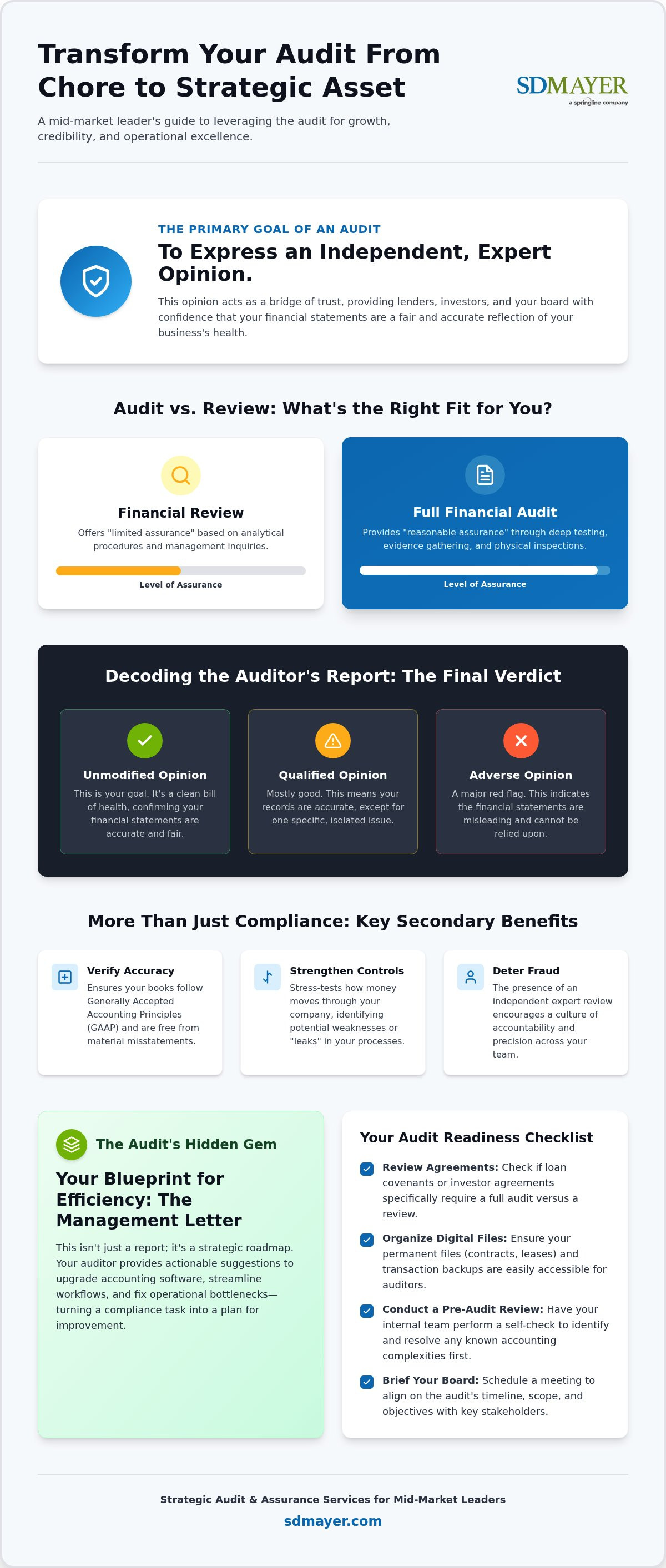
The Audit Readiness Checklist: How to Achieve Your Goals
Preparing for an audit shouldn't feel like a last-minute scramble. If you keep in mind that what is the main goal of an audit is to provide a clear, independent opinion on your financial health, then your preparation should focus on making that health easy to see. A smooth audit starts months before the auditors actually arrive. By conducting a "Pre-Audit" internal review, you can catch obvious discrepancies in your revenue recognition or expense categorization before they become formal findings. This proactive approach saves your team time and reduces the stress of answering unexpected questions during the peak of the engagement.
One of the most effective ways to simplify the process is by organizing your permanent file. This includes your articles of incorporation, long-term leases, and major contracts that span multiple years. When these documents are digitized and ready to go, you eliminate the "treasure hunt" that often slows down the fieldwork. You should also ensure that all bank accounts and credit cards are reconciled through the end of the 2026 fiscal year. Having a clean CAAS framework in place ensures your daily records are already audit-ready, making the transition from bookkeeping to reporting much more natural.
Documentation You Must Have Ready
Your auditors will need a comprehensive data dump to begin their testing. Ensure you have the general ledger and trial balance for the 2026 fiscal year fully closed and finalized. Beyond the high-level numbers, they will look for detailed accounts receivable and payable aging reports to verify your cash flow timing. If your business carries physical products, have your inventory records and physical count documentation organized. Discrepancies in inventory are one of the most common causes for audit delays, so double-check these figures early.
Testing Your Internal Controls
Auditors don't just look at the numbers; they look at the processes that created them. You'll need to document exactly who has access to your financial systems and bank accounts. Review your approval process for large expenses and payroll to ensure no single person has too much control. Even in smaller mid-market teams, practicing a "segregation of duties" is vital. This means the person who cuts the checks shouldn't be the same person who reconciles the bank statements. If you're unsure if your current setup meets these standards, it's a good idea to speak with an audit specialist to conduct a quick readiness assessment.
- Confirm that your controller and head bookkeeper have blocked out time to be available for auditor questions during fieldwork.
- Verify that all 2026 board meeting minutes are signed and filed, as auditors often review these for major business decisions.
- Perform a spot check on your largest vendor invoices to ensure the physical documents match the digital ledger entries.
Navigating the 2026 Audit Landscape with SD Mayer
Choosing an audit partner is about more than just finding someone to sign off on your financial statements. At SD Mayer, we believe that understanding what is the main goal of an audit, which is validating your financial narrative, is just the starting point for a deeper business partnership. We combine high-level technical expertise with a supportive approach that feels more like a collaboration than a clinical review. For mid-market firms across the San Francisco Bay Area, from the tech corridors of Menlo Park to the state offices in Sacramento, we act as a steady companion through the complexities of financial compliance. Our "No-Surprises" philosophy means we keep you informed at every stage, ensuring that potential issues are discussed and resolved long before the final report is issued.
An audit shouldn't be a standalone event that ends when the auditors leave your office. We focus on how to use those findings to fuel your future growth. By treating the audit as a strategic tool, we help you identify operational gaps and strengthen your internal controls. This holistic mentor approach ensures that you aren't just compliant for 2026; you're prepared for whatever challenges the following years might bring. Whether you are managing a fast-paced tech startup or a stable regional non-profit, our goal is to reduce the stress of the process through calm, capable stewardship that values your time and your team's effort.
Specialized Expertise in California Regulations
Operating in California brings a unique set of challenges that require specialized knowledge of local and federal mandates. We help you manage the complexities of Strategic Tax Advice alongside your audit, ensuring that your tax strategy and financial reporting are perfectly aligned. Our team has extensive experience with Single Audits for California-based non-profits receiving federal funds, as well as Employee Benefit Plan Audits for growing teams. For tech founders, we integrate stock option planning and tax strategy directly into our advisory services, ensuring that your personal financial security is protected as your company scales toward an exit or IPO.
Ready to Secure Your Financial Future?
Selecting a local partner like SD Mayer makes the entire audit process smoother and more efficient. We understand the nuances of the regional economy and provide jargon-free reporting that your board and stakeholders can actually use to make informed decisions. We're committed to clear communication and practical results, helping you turn a compliance requirement into a foundation for long-term success. If you're ready to move beyond basic number-crunching and find a vital advisor for your business journey, we're here to guide you. Schedule your 2026 audit consultation with SD Mayer today.
- Identify any specialized audit needs, such as Single Audits or Employee Benefit Plan Audits, for the upcoming fiscal year.
- Review your current tax and audit integration to ensure no opportunities for operational savings are being missed.
- Contact our team to discuss a customized audit timeline that fits your specific 2026 business cycle and reporting deadlines.
Transforming Compliance into Strategy for 2026
An audit doesn't have to be a source of anxiety. When you shift your perspective, you'll see that what is the main goal of an audit is to provide the independent validation you need to unlock new opportunities. By using the findings to sharpen your operations and strengthen your internal controls, you move from simply following rules to building a more resilient, valuable company. Whether you're looking to secure a loan in San Jose or prepare for a transition in Sacramento, a clean audit is your most powerful calling card.
SD Mayer brings decades of experience in Bay Area mid-market auditing to your team. Our specialized experts for Single Audits and Employee Benefit Plans provide holistic advisory that goes far beyond the balance sheet. We focus on long-term partnerships, helping you turn historical data into a forward-looking strategy for growth. This approach ensures you have a steady companion to help navigate complex regulations and local market challenges.
Take the first step toward a more insightful reporting season. Partner with SD Mayer for a strategic, stress-free audit experience. We look forward to helping you navigate the year ahead with confidence and clarity.
Frequently Asked Questions
What is the primary difference between a financial audit and a tax audit?
A financial audit focuses on the overall fairness and accuracy of your financial statements for stakeholders like banks or investors. It follows GAAP rules to ensure your business health is reported correctly. In contrast, a tax audit is a specific review by the IRS or California Franchise Tax Board to verify that you have followed tax laws and paid the correct amount of tax owed.
How long does a typical mid-market business audit take to complete?
Most mid-market audits involve four to eight weeks of active fieldwork where auditors test your data. However, the entire cycle usually spans about three months when you include the initial planning phase and the final report drafting. Keeping your digital files organized and your team available for questions is the best way to ensure the process stays on the shorter end of that window.
Can an audit help my business get a bank loan in San Francisco?
Yes, an audit is often a mandatory requirement for securing a significant commercial loan or line of credit from Bay Area lenders. Banks use these reports to verify your cash flow and collateral before approving expansion capital. When you understand that what is the main goal of an audit is to build trust through independent verification, it is clear why local lenders rely on them so heavily.
What are the three main types of audit opinions?
The three most common results are unmodified, qualified, and adverse opinions. An unmodified opinion is the clean bill of health that every business wants. A qualified opinion means your records are mostly accurate but have specific areas that don't quite meet standards. An adverse opinion is a red flag indicating that your financial statements are materially misstated and cannot be relied upon by outside parties.
Is an audit required for all California businesses in 2026?
California does not mandate an audit for every private company, but specific triggers exist for many mid-market firms. As of 2026, the California Privacy Rights Act requires independent cybersecurity audits for businesses with gross annual revenue exceeding $26,625,000. Additionally, most non-profits receiving federal funds or companies with large employee benefit plans are legally required to undergo specialized annual audits to remain compliant.
How much does a financial audit cost for a mid-sized company?
The investment for an audit depends on your company's transaction volume, the complexity of your industry, and the quality of your internal record-keeping. Specialized requirements, such as Single Audits for non-profits, also impact the total effort required. Generally, firms with well-organized digital ledgers and strong internal controls experience a more efficient process, which helps manage the overall cost of the engagement.
What happens if the auditor finds a mistake in our books?
If an auditor identifies an error, they will propose an adjusting journal entry to correct the mistake in your financial statements. Most of these findings are caught during the testing phase and can be resolved before the final report is signed. This collaborative correction process ensures your statements are accurate and helps you see what is the main goal of an audit in a practical, helpful way.
How often should a mid-market company perform an internal audit?
Most mid-market firms should perform an internal review at least once a year to prepare for their external audit. High-growth companies often choose a quarterly schedule to catch process weaknesses or bookkeeping bottlenecks before they snowball into larger issues. This regular check-up ensures your internal controls remain strong and keeps your accounting team ready for the rigors of a full annual examination.
SECURITIES AND ADVISORY DISCLOSURE:
Securities offered through Valmark Securities, Inc. Member FINRA, SIPC. Fee based planning offered through SDM Advisors, LLC. Third party money management offered through Valmark Advisers, Inc a SEC registered investment advisor. 130 Springside Drive, Suite 300, Akron, Ohio 44333-2431. 1-800-765-5201. SDM Advisors, LLC is a separate entity from Valmark Securities Inc. and Valmark Advisers, Inc. Form CRS Link
DISCLAIMER:
This material has been prepared for informational purposes only, and is not intended to provide, and should not be relied on for, accounting, legal or tax advice. The services of an appropriate professional should be sought regarding your individual situation.
HYPOTHETICAL DISCLOSURE:
The examples given are hypothetical and for illustrative purposes only.