What if your 401(k) audit wasn't a "gotcha" moment, but a strategic tool to protect your business and your people? For many mid-market leaders, the mere mention of an audit feels like an invitation for stress and a massive drain on internal resources. It's perfectly normal to feel a bit uneasy about the prospect of Department of Labor penalties or the technical complexity of the 80-120 rule. You likely want to ensure your plan stays compliant without letting the process take over your entire work week. Learning how to prepare for a 401k audit doesn't have to be a solo struggle, and it definitely shouldn't feel like a clinical exercise in number-crunching.
We're here to help you manage this transition with the steady hand of a partner who cares about your long-term success. This guide provides everything you need to navigate the process with confidence, ensuring you meet all compliance standards while protecting your employees' futures. We'll walk you through the 2026 participant counting rules, explain the critical July 31 filing deadlines, and share a practical roadmap for achieving a clean audit report. By the end, you'll have the peace of mind that comes from knowing your fiduciary duties are fully covered.
Key Takeaways
- Determine your audit status using the updated 2026 participant counting rules and see if the "80-120 rule" applies to your specific situation.
- Learn exactly how to prepare for a 401k audit by building a dedicated readiness team and starting your internal document cleanup at least three months in advance.
- Identify the high-risk areas auditors prioritize, such as the timing of employee contributions, to prevent common compliance errors and protect your business from penalties.
- Streamline your internal processes by leveraging integrated advisory services that keep your retirement plan records organized and accurate year-round.
- Secure your business and your employees' assets by meeting the July 31 filing deadline to avoid costly daily fees and ensure long-term plan health.
What is a 401(k) Audit and Why Does Your Company Need One?
A 401(k) audit is essentially a comprehensive check-up for your retirement plan. It's an independent review performed by a qualified CPA firm to verify that your plan is healthy, compliant, and operating exactly as your plan document dictates. While many business owners view it as a bureaucratic hurdle, it's actually a vital safety net for fiduciaries. It helps you catch small errors before they escalate into expensive problems. We believe in "Simply Doing More" for our clients, which means we use these audits to look beyond the numbers and identify ways to make your internal operations more efficient. Learning how to prepare for a 401k audit early on helps you manage growth without disrupting your daily operations.
The primary goal is twofold: protecting the assets of your participants and keeping government regulators satisfied. Think of the audit as a proactive measure that confirms you're fulfilling your promises to your team. When you understand how to prepare for a 401k audit effectively, you transform a required task into a strategic opportunity to strengthen your business's financial foundation. It provides an objective look at your plan’s health, giving you the confidence that your employees' futures are secure.
The Role of the Department of Labor and the IRS
Two main government bodies keep a close eye on your retirement plan, each with a different focus. The Department of Labor (DOL) is primarily concerned with protecting participants and their assets. They want to ensure employees receive the benefits they've earned. Conversely, the IRS focuses on the tax-exempt status of the plan and ensures all tax laws are followed. The foundational standards for these reviews were established by the Employee Retirement Income Security Act of 1974 (ERISA). A clean audit report serves as your best defense; it significantly reduces the risk of a more intrusive government investigation or audit.
Why Mid-Market Companies Face Unique Audit Challenges
Mid-market companies often hit a compliance wall when they reach the 100-participant mark. This growth is exciting, but it triggers a shift from "small plan" to "large plan" status, requiring a new level of rigor. You've likely spent years focused on rapid growth, and now you must pivot toward formal internal controls and detailed record-keeping. This transition is where specialized financial reporting compliance services in the Bay Area become vital. We understand the local economy and the specific pressures businesses in San Francisco, San Jose, and San Mateo face during this stage of their journey.
The 2026 Audit Thresholds: Do You Actually Need an Audit?
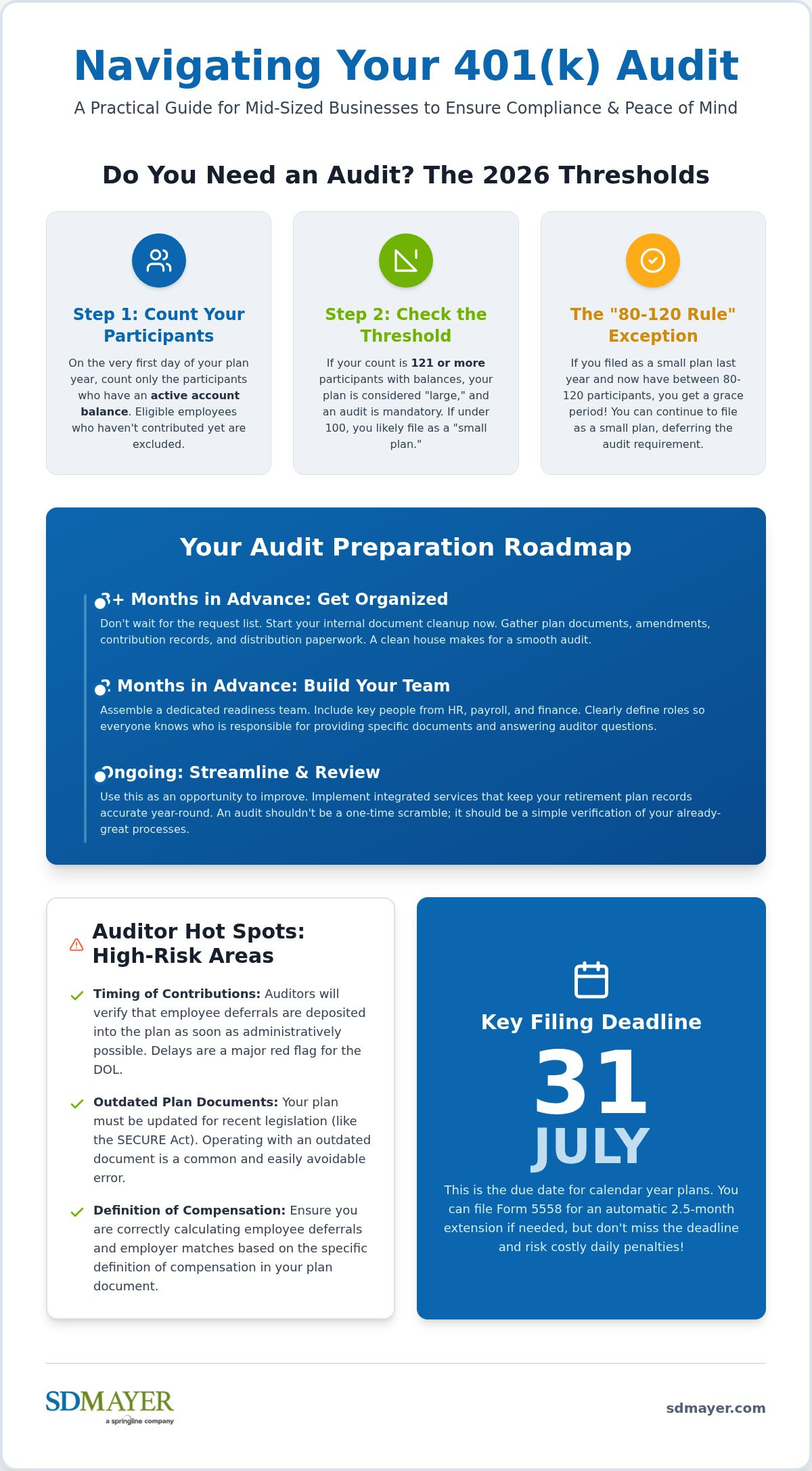
Not every growing company with a retirement plan is required to undergo an annual audit. The requirement depends on whether your plan is classified as "large" or "small" for Form 5500 filing purposes. For the 2026 filing season, the Department of Labor continues to use the methodology established in 2023. You only count participants who actually hold an account balance on the first day of the plan year. This is a significant advantage for mid-market firms because it excludes eligible employees who haven't yet started contributing. This rule change removed an estimated 18,699 plans from the audit requirement nationwide, saving those businesses considerable time and expense. If you're wondering how to prepare for a 401k audit, your very first step is verifying that first-day participant count.
Understanding the 80-120 Rule for Scaling Firms
The "80-120 Rule" offers much-needed flexibility for firms hovering right at the edge of the threshold. If you filed as a small plan in the previous year and your participant count with balances stays between 80 and 120 on the first day of the current plan year, you can typically continue to file as a small plan. For example, a Bay Area tech firm that grew to 110 participants with balances can forgo the audit requirement for another year if they were a small plan previously. It acts as a grace period, allowing you to refine your internal controls before an audit becomes mandatory at the 121-participant mark.
- Action Item: Pull your participant report for the first day of your plan year and count only those with a balance to confirm your filing status.
New for 2026: Key Regulatory Updates
While the counting rules are stable, 2026 requires strict adherence to recent SECURE Act changes. Your plan documents must be updated to reflect current legislative requirements to avoid operational failures. In our experience, outdated plan documents are the single most common cause of negative audit findings because they lead to "off-script" plan administration. Utilizing the IRS 401(k) Fix-It Guide can help you identify and correct these document gaps before an auditor arrives.
For calendar year plans, the Form 5500 and the accompanying audit report are due by July 31. If you need more time, you can file for an automatic 2.5-month extension using Form 5558, moving your deadline to October 15. Don't take these dates lightly; the penalty for late filing can reach up to $2,739 per day. If you are unsure where your plan stands today, it may be time to reach out for a quick compliance check to ensure you're on the right path.
The Auditor’s Checklist: What Records and Controls Matter Most
When an auditor steps into your office, they aren't just looking at bank statements. They're evaluating the integrity of your plan through three specific pillars: Financials, Operations, and Plan Documents. Financials focus on the flow of money, Operations look at how you follow your own rules, and Plan Documents serve as the "law" of your specific 401(k). If you're learning how to prepare for a 401k audit, you'll soon find that the most scrutinized area is "Timely Remittances." The Department of Labor expects you to deposit employee contributions as soon as they can reasonably be segregated from general assets. For mid-market firms, this usually means within a few business days of the pay date. Even a single late deposit can trigger a requirement to calculate and pay lost earnings to employees.
Another common trap is the "Definition of Compensation." It sounds simple, but your plan document might define pay differently than your payroll software. Does your plan include bonuses, overtime, or fringe benefits when calculating deferrals? If your payroll system excludes bonuses but your plan document says they should be included, you've got an operational failure. Auditors also look for evidence of internal controls. It's not enough to perform a task correctly; you need to document who signed off on the payroll and who verified the deposit. This "paper trail" proves your oversight is intentional rather than accidental.
Operational Compliance: Eligibility and Distributions
Auditors pay close attention to "excluded employees." It's easy to accidentally overlook part-time staff or contractors who have met the eligibility requirements. If someone should have been invited to the plan but wasn't, you may owe a "missed deferral opportunity" payment. Similarly, every hardship withdrawal or loan needs a complete folder of supporting documentation. You must prove the participant met the specific criteria outlined in your plan before the funds were released.
- Action Item: Run a mini-census audit. Compare your full payroll list against your plan's participant list to ensure every eligible person was offered the chance to join.
Data Integrity and Payroll Syncing
Your payroll system and your 401(k) recordkeeper must always "speak the same language." Data mismatches are often the root cause of audit findings. This is why many firms find that small business bookkeeping services are a vital part of a clean audit strategy. Accurate books ensure that "reconciliation"—the process of matching payroll withholdings to the actual deposits in the plan trust—happens flawlessly every pay period. When your records are synchronized, you can answer auditor questions in minutes rather than days. Knowing how to prepare for a 401k audit effectively means ensuring your data flow is automated and double-checked before the plan year even ends.
A Step-by-Step Readiness Plan: Your Audit Preparation Timeline
Successful audits are won in the months leading up to the engagement, not during the week the auditor is in the building. When you're figuring out how to prepare for a 401k audit, a chronological approach is your best friend. Breaking the process into manageable chunks prevents your internal team from burning out while ensuring no detail is overlooked. Timing is everything; starting just a few months early can be the difference between a stressful scramble and a routine check-up.
Phase 1 (3 Months Out): Start by assembling your "Audit Readiness Team." This group should include your HR manager, your finance controller, and your Third-Party Administrator (TPA). Clear communication between these three parties is essential for a smooth experience. Phase 2 (2 Months Out): Conduct an internal document clean-up and gap analysis. Review your files for missing employee signatures on election forms or incomplete termination paperwork. Phase 3 (1 Month Out): Perform your final reconciliations. Ensure that the total deferrals on your payroll reports match the total deposits shown on your trust statements. Phase 4 (Audit Week): Designate a quiet workspace for the auditor and ensure your primary contact is available to answer questions. Aim for a 24-hour turnaround on document requests to maintain momentum.
Assembling Your Internal and External Team
Identify a single point of contact within your company to manage the flow of information. This person acts as the gatekeeper for all auditor requests. It's often helpful to have a "First Call" advisor who understands your business and can mediate technical discussions between you and the auditor. Our firm’s membership in the BDO Alliance USA allows us to provide the specialized technical support usually reserved for much larger corporations, giving you confidence in even the most complex mid-market scenarios.
Organizing the "Audit Room" (Digital or Physical)
Efficiency is built on organization. Most modern audits are conducted through secure digital portals, which save time and reduce the risk of lost paperwork. Setting up a structured folder system early prevents the last-minute stress of hunting for PDFs. Your "Must-Have" folders should include:
- Plan Documents and all signed amendments
- Payroll Journals and Year-End Reports
- Participant Files (hiring, termination, and birth dates)
- Trustee Reports and Bank Statements
As a practical action item, create your secure digital portal today and begin uploading your foundational plan documents. We also recommend drafting a brief "Internal Controls Memo" that explains your payroll and 401(k) oversight process. Handing this to the auditor on day one provides a clear map of your operations and establishes immediate credibility. If you're ready to start your timeline today, reach out to our team for hands-on support.
Beyond Compliance: How Integrated Advisory Simplifies Your Audit
Integrated advisory isn't just a convenience; it's a strategic advantage for scaling firms. When your tax advisor and your auditor operate under the same roof, you benefit from a "Full Circle" view of your financial health. This unified perspective means your internal team doesn't have to explain the same business nuances to different firms. Instead, your advisors already understand your growth trajectory and your unique operational challenges. Learning how to prepare for a 401k audit becomes much simpler when your financial data is already organized with the end goal in mind. It transforms a mandatory check-up into a valuable strategic review.
The CAAS Advantage: Audit-Ready Books 365 Days a Year
Our Client Accounting Advisory Services (CAAS) take the stress out of audit season by keeping your records in a constant state of readiness. When you utilize CFO services for small business, you ensure that your payroll systems and benefit plans are always perfectly synchronized. This proactive management eliminates the frantic year-end reconciliations that many mid-market firms dread. You get a "no-surprises" audit experience because your advisors have been watching your books every single day. It's about moving from reactive compliance to proactive stewardship.
- Action Item: Schedule a consultation with our team to review your current administrative burden and see how integrated CAAS can streamline your 401(k) oversight.
Why Bay Area Firms Choose SD Mayer
We're deeply committed to "Simply Doing More" for our local communities in San Francisco, San Jose, and Sacramento. Our approach is intentionally conversational and supportive because we believe that demystifying complex audits is the best way to empower business owners. We've also partnered with Springline Advisory to provide even deeper support for middle-market firms as they scale. This partnership ensures you have the technical depth of a national firm with the personal touch of a local mentor who understands the fast-paced regional economy.
We want to be your "First Call" for everything from tax planning to wealth management and employee benefit plan audits. Think of your annual audit not as a hurdle, but as an opportunity to refine your talent retention strategy. A well-run 401(k) plan is a powerful tool for keeping your best people; a clean audit proves to your employees that you're looking out for their future. When you know how to prepare for a 401k audit with the right partners, you can stop worrying about compliance and start focusing on your next stage of growth.
Secure Your Plan's Future with Proactive Stewardship
Navigating the shift from a small plan to a large plan status is a significant milestone for any growing Bay Area firm. By mastering the 2026 participant counting rules and establishing a clear timeline for document cleanup, you've already taken the hardest steps toward compliance. A clean audit report isn't just about avoiding penalties; it's a testament to how much you value your employees' long-term financial security. As an IPA Top 400 firm and a member of the BDO Alliance USA, we're here to provide the local expertise and technical depth your business deserves.
Learning how to prepare for a 401k audit is much easier when you have a partner committed to "Simply Doing More" for your success. We're ready to help you integrate your accounting and advisory needs so that audit season becomes a routine part of your strategic growth rather than a source of stress. Ready to streamline your 401(k) audit? Let’s talk about a stress-free compliance strategy. You've built a great company; let's make sure your retirement plan stays just as strong and secure as the rest of your business.
Frequently Asked Questions
How much does a 401(k) audit typically cost for a mid-market company?
Audit fees depend on the complexity of your plan and the quality of your internal record-keeping. Factors like the total number of investment options and the volume of participant loans can influence the effort required. While we don't quote flat fees here, choosing a firm with specialized experience often saves money by preventing costly compliance errors. It is best to request a custom proposal based on your specific plan documents.
What is the deadline for filing the Form 5500 with an audit report in 2026?
For calendar-year plans, your Form 5500 and the required audit report are due by July 31, 2026. If you need additional time to gather documents, you can file Form 5558 before that date to receive an automatic 2.5-month extension. This moves your final filing deadline to October 15, 2026. Missing these dates can trigger daily penalties of up to $2,739, so staying on schedule is vital.
Can we use our regular tax accountant to perform our 401(k) audit?
You can use your regular firm as long as they maintain strict independence according to Department of Labor rules. However, many mid-market firms prefer a specialized auditor who understands the nuances of benefit plans. Using a firm that offers integrated advisory services can make the process smoother because they already understand your business structure. This helps when you are deciding how to prepare for a 401k audit without disrupting operations.
What happens if the auditor finds a mistake in our 401(k) contributions?
If an auditor identifies an error, such as a late deposit, you'll need to use the IRS or DOL correction programs. This typically involves calculating and paying lost earnings to the affected participants to make them whole. Finding these errors during an audit is actually a positive step because it allows you to fix them voluntarily before a government agency discovers them during a more intrusive investigation.
Do we need an audit if we have exactly 100 employees but only 80 participate?
No, you likely don't need an audit in this specific scenario. Under the current rules, you only count participants who hold an actual account balance on the first day of the plan year. Since only 80 employees have balances, you are still classified as a small plan. This methodology provides significant relief for growing companies that have many eligible employees who haven't yet started their retirement savings journey.
How long does the average 401(k) audit take from start to finish?
A typical audit takes between four and eight weeks from the time you provide the initial documents to the issuance of the final report. The timeline depends heavily on how quickly your team responds to follow-up questions and provides payroll records. When you know how to prepare for a 401k audit by organizing your files in advance, you can significantly shorten this window and keep your internal staff focused on their core duties.
What is a "limited scope" audit vs. a "full scope" audit?
Most mid-market plans now undergo an ERISA Section 103(a)(3)(C) audit, which replaced the old limited scope terminology. This allows the auditor to rely on the certification of the plan's assets from a qualified institution like a bank. A full scope audit is much more intensive because the auditor must independently verify the value of every investment held within the plan trust, which is rarely required for standard plans.
How does the SECURE 2.0 Act affect our 2026 audit requirements?
The SECURE 2.0 Act requires several administrative updates that auditors will verify during the 2026 cycle. Key areas include new eligibility rules for long-term, part-time workers and updated age requirements for required minimum distributions. You should review your plan amendments immediately to ensure your operations match these legislative changes. Auditors will specifically look for these document updates to confirm your plan remains in good standing with the IRS.
SECURITIES AND ADVISORY DISCLOSURE:
Securities offered through Valmark Securities, Inc. Member FINRA, SIPC. Fee based planning offered through SDM Advisors, LLC. Third party money management offered through Valmark Advisers, Inc a SEC registered investment advisor. 130 Springside Drive, Suite 300, Akron, Ohio 44333-2431. 1-800-765-5201. SDM Advisors, LLC is a separate entity from Valmark Securities Inc. and Valmark Advisers, Inc. Form CRS Link
DISCLAIMER:
This material has been prepared for informational purposes only, and is not intended to provide, and should not be relied on for, accounting, legal or tax advice. The services of an appropriate professional should be sought regarding your individual situation.
HYPOTHETICAL DISCLOSURE:
The examples given are hypothetical and for illustrative purposes only.