
Most mid-market leaders treat their annual tax filing like a necessary penalty for doing business, but your tax return should actually be your company's most valuable strategic roadmap. You've likely felt the sting of a surprise California SALT bill or the nagging worry that your current small business tax services aren't quite scaling with your success. It's frustrating to feel like you're overpaying simply because your planning hasn't kept pace with your expansion. We understand that as your business grows, the complexity of staying compliant while trying to fuel that growth can feel overwhelming.
In this guide, we'll show you how a strategic partnership can protect your hard-earned assets and significantly reduce your liability through proactive planning. You'll learn the difference between reactive filing and a forward-thinking strategy that masters multi-state compliance and local California regulations. We're going to break down the specific service models, from outsourced controller support to specialized stock option planning, that provide the clarity and confidence you need to lead your company into 2026 and beyond.
Key Takeaways
- Learn why mid-market growth requires moving beyond basic data entry to a comprehensive strategy that treats tax as a growth driver rather than just a chore.
- Identify the core components of professional small business tax services, including how proactive planning and liability minimization can protect your company's future.
- Understand the long-term cost benefits of choosing a full-service advisory firm over a seasonal preparer so you don't miss out on vital tax savings.
- Gain clarity on navigating California’s specific tax landscape, including how to manage state and local tax deduction caps and local regulatory requirements.
- Discover practical steps to modernize your financial data and transition to a year-round partnership model for better decision-making.
What Do Small Business Tax Services Actually Include for Mid-Sized Firms?
Many leaders think of small business tax services as a once-a-year administrative burden; a necessary box to check before the April or October deadlines. However, for a mid-market company with scaling operations, this narrow view is a missed opportunity. Professional tax support at this level isn't just about data entry or filling out the right forms. It's about building a framework that protects your cash flow and ensures you are taking full advantage of every preferential tax policy available to your specific entity type.
A true partnership involves a deep understanding of your specific industry. For example, a San Francisco tech firm dealing with R&D credits has vastly different requirements than a Sacramento-based logistics company managing a large fleet and multi-county payroll taxes. A generic service provider might miss these nuances, but a strategic partner integrates them into your long-term business plan. This ensures that every dollar you spend on taxes is optimized, leaving more capital available for reinvestment and growth.
The Shift from Compliance to Strategy
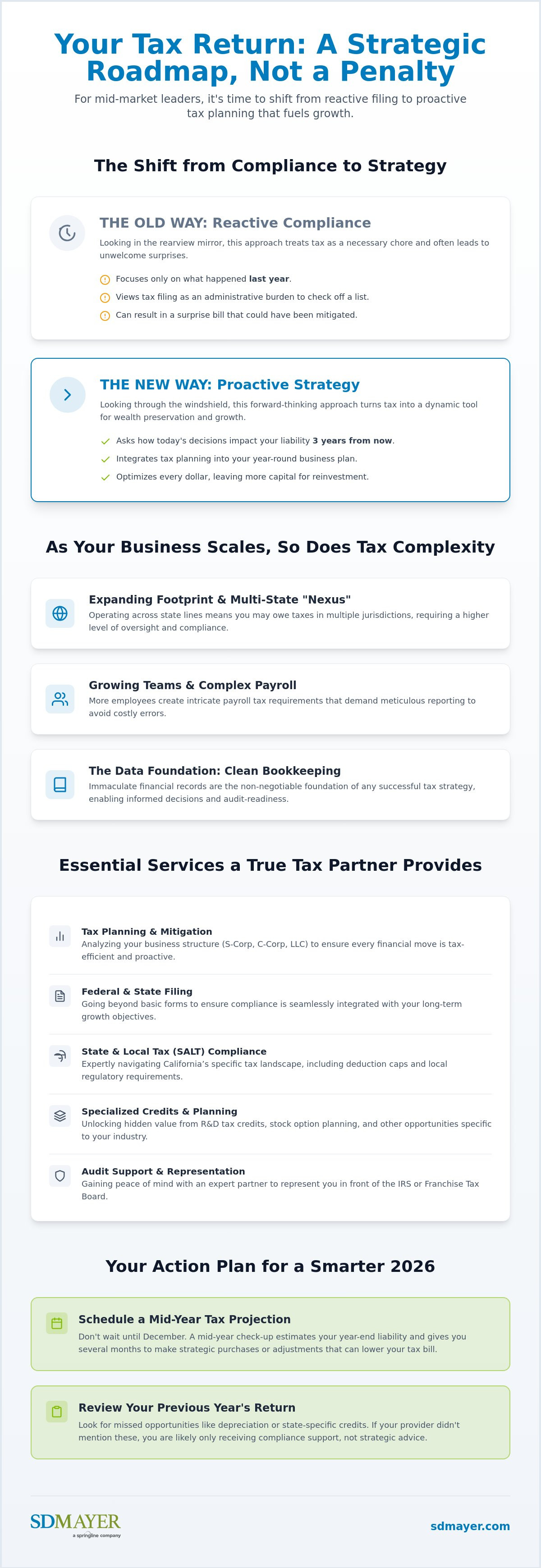
Compliance is looking in the rearview mirror. It tells you what happened last year and ensures you stay out of trouble with the IRS or the Franchise Tax Board. Strategy, on the other hand, looks through the windshield. It asks how your current decisions will impact your tax liability three years from now. Proactive advisory prevents the "tax season surprise" where you realize you owe a significant sum that could have been mitigated with a simple mid-year adjustment. It turns tax from a static report into a dynamic tool for wealth preservation.
Action Item: Take a moment to review your previous year’s tax return. Look for missed opportunities in areas like depreciation or state-specific credits. If your current provider didn't mention these during the year, you are likely only receiving compliance support, not strategic advisory.
Why Mid-Market Scale Changes the Requirements
As your business grows, your tax footprint expands. You likely have more employees, more complex payroll requirements, and perhaps operations across state lines. This creates "nexus," which means you may owe taxes in multiple jurisdictions. Managing these moving parts requires a higher level of oversight. Your daily financial records must be immaculate to support this growth, which is why high-quality small business bookkeeping services are the foundation of any successful tax strategy.
When your books and your tax planning are in sync, you gain a clear view of your financial health. You aren't just reacting to deadlines. You are using your financial data to make informed decisions about hiring, expansion, and capital investments. This integrated approach is what separates a thriving mid-market firm from one that is constantly playing catch-up with the tax man. It provides a sense of security that allows you to focus on leading your team rather than worrying about audit risks.
A Roundup of Essential Tax Services You Should Expect
When you outgrow basic filing, your needs shift toward a comprehensive suite of small business tax services that address both daily operations and long-term goals. While the IRS Small Business and Self-Employed Tax Center provides the foundational rules for compliance, a mid-market firm requires a more nuanced approach. This includes managing federal and state filing, but also looking closely at State and Local Tax (SALT) compliance; especially in a high-regulation environment like California. You should expect your tax partner to handle payroll tax reporting and identify specialized opportunities like R&D tax credits or stock option planning that can significantly impact your bottom line.
A holistic approach means your tax strategy isn't siloed. It should work in tandem with your broader financial planning. For instance, stock option tax planning is vital for retaining top talent in competitive markets like the Bay Area, while R&D credits can provide the cash flow needed to fund your next innovation. By integrating these specialized small business tax services into your year-round routine, you turn tax season from a period of dread into a period of strategic review.
Tax Planning and Mitigation
Effective tax planning is about more than just finding an extra deduction in April. It's an ongoing process where experts analyze your business structure to ensure you aren't paying more than necessary. Whether you're an S-Corp, C-Corp, or LLC, the way you're organized dictates your tax burden. A forward-thinking strategist will look for credits you might miss, such as those for energy efficiency or job creation, ensuring every financial move you make is tax-efficient.
Action Item: Don't wait until December to look at your numbers. Schedule a mid-year tax projection to estimate your year-end liability. This gives you time to make strategic purchases or adjust your payroll before the calendar flips.
Audit Support and Representation
The thought of an IRS or Franchise Tax Board (FTB) audit can be a major source of anxiety for any business owner. However, having the right tax professional by your side changes the dynamic completely. When your documentation is clean and professional, you reduce your overall risk profile. If an inquiry does happen, your partner acts as your designated representative; handling the correspondence and technical explanations so you can keep running your business without distraction.
Building this level of security starts with a simple conversation about your current situation. If you're feeling unsure about your 2026 compliance, it might be time to discuss your specific needs with a dedicated advisor who understands the mid-market landscape.
Comparing Service Models: CPA Firms vs. Tax Preparers
Choosing the right partner for your small business tax services is one of the most consequential decisions you'll make for your company's financial health. It’s tempting to look for the most affordable option, especially when you're managing the overhead of a mid-market firm. However, the "cheapest" tax preparation often proves to be the most expensive in the long run. A seasonal preparer typically focuses on a high volume of transactions during the spring, which means they might only look at your books once a year. This reactive approach leads to missed deductions, overlooked credits, and a lack of the strategic oversight needed to protect your assets as you scale.
In contrast, a full-service advisory firm acts as a steady companion throughout your business journey. They don't just record history; they help you write it. When you're interviewing a new tax partner, look for red flags that suggest a "factory" model. If they don't ask about your three year growth plan, your exit strategy, or how you might explore Business Acquisition and M&A, they aren't providing the level of care a mid-sized business requires. You need an advocate who understands how your corporate structure, payroll, and personal wealth all intersect to create a single, cohesive financial picture.
The Integrated Advisory Advantage
Data silos are the enemy of effective tax planning. When your bookkeeping is handled by one person and your taxes by another, errors are almost inevitable. This is why many successful firms are moving toward CAAS (Client Accounting Advisory Services). By integrating your daily accounting with your tax strategy, you ensure that your advisor has real-time financial data at their fingertips. This allows for agile decision-making rather than waiting until the end of the year to see where you stand.
Action Item: During your next consultation, ask potential firms if they offer outsourced CFO or controller support. A firm that can step into these leadership roles is better equipped to provide the high-level strategy your growth demands.
Local Expertise vs. National Platforms
While national tax software platforms and "big box" services offer convenience, they often lack the "boots on the ground" perspective required in complex markets like San Francisco, San Jose, or Sacramento. California’s regulatory environment is notoriously intricate, with specific local taxes and state-level nuances that generic platforms frequently miss. Investing in professional small business tax services with a local presence gives you access to advisors who understand the regional economic landscape. They know the specific Franchise Tax Board (FTB) triggers and local compliance hurdles that a national provider might overlook, providing a layer of security that software simply can't replicate.
Navigating California’s Unique Small Business Tax Challenges
Operating a business in California brings unique rewards and equally unique hurdles. If you are looking for small business tax services, you need a partner who understands that a San Francisco address comes with different rules than one in Austin or Nashville. One of the biggest challenges for mid-market firms is managing the intersection of high state taxes and federal limits on deductions. This is especially true as we look toward 2026, where staying ahead of regulatory shifts is the only way to protect your bottom line.
Mid-market firms are often hit the hardest by local tax complexity. You have enough volume to trigger various city-level requirements, but you might not have the massive internal tax departments of enterprise-level corporations. This is where a strategic partnership becomes vital. You need an advisor who can look at the big picture, ensuring that your state obligations don't cannibalize the capital you need for growth. A proactive approach to California state and local tax compliance is no longer optional; it is a requirement for survival in this regional economy.
Mastering the SALT Landscape
SALT stands for State and Local Tax. It’s the combination of what you pay to the state of California and your specific city or county. For many business owners, the federal $10,000 cap on deducting these taxes has been a significant pain point. However, there are strategic ways to navigate this, such as the Pass-Through Entity (PTE) tax. This allows certain businesses to pay state taxes at the entity level, effectively working around the individual deduction cap. Managing multi-city compliance in the Bay Area requires this kind of specialized oversight to avoid overpayment and penalties.
Action Item: Verify your nexus in other states. If you have remote employees working from home outside of California, you might unknowingly be creating a "nexus" that requires you to file and pay taxes in those jurisdictions. A quick audit of your employee locations can prevent a major headache later.
Stock Options and Equity Compensation
In the Bay Area, equity is the lifeblood of a growing company. Whether you're a founder or a key executive, the tax implications of stock grants can be massive if not handled correctly. Waiting until an IPO or an exit to think about taxes is a recipe for a huge bill. You need to plan for the "spread" between your grant price and the market value to avoid Alternative Minimum Tax (AMT) traps. Small business tax services that include specialized equity planning ensure that your team actually keeps the wealth they've worked so hard to build.
Action Item: Review your equity plan with a tax expert before your next vesting date. Understanding your liability now allows you to set aside the necessary funds or choose the most tax-efficient time to exercise your options.
If you're feeling the weight of California's regulatory landscape, reach out to our team today to secure your 2026 tax strategy.
Next Steps: How to Modernize Your Tax Strategy for 2026
Moving your business forward requires a fundamental shift in how you view your financial obligations. If you still treat tax season as a stressful sprint to the finish line, you are likely leaving money on the table. Modernizing your strategy means transitioning from a reactive, once-a-year mindset to a proactive partnership model. This approach relies on clean, real-time data and modern accounting software that provides a clear window into your company's health. When your financial records are accurate and up to date, small business tax services become a powerful tool for informed decision-making rather than just a compliance chore.
A strategic partnership is about more than just numbers on a page; it is about the holistic health of your organization. It means having an advisor who understands how your business decisions today will impact your personal wealth and your company's growth potential years down the road. By integrating your tax planning with your broader business goals, you create a stable foundation that can weather regulatory shifts and economic changes with confidence.
For leaders whose growth plans include global operations or personal relocation, Salior Ben Hamou Law Office provides practical legal representation for English-speaking clients navigating life in Israel.
Conducting a Tax Health Check
The first step in modernizing your approach is to understand exactly where you stand. A professional review of your recent history can often uncover immediate "low-hanging fruit" for savings that were previously overlooked. This process helps you set clear, achievable goals for the 2026 fiscal year, ensuring that your tax strategy is aligned with your operational needs. It turns a backward-looking report into a forward-looking roadmap for success.
Action Item: Gather your returns from the last two years and schedule a professional review. Look for inconsistencies in how credits were applied or missed opportunities for state-level deductions that could provide an immediate boost to your cash flow.
Why SD Mayer is the Strategic Partner for the Mid-Market
At SD Mayer, we pride ourselves on being more than just accountants; we act as a "Holistic Mentor" to the businesses we serve. Our local presence across San Francisco, San Jose, and Sacramento gives us a unique perspective on the regional economy that national platforms simply cannot match. We understand the nuances of the California regulatory landscape and how to navigate it effectively for mid-market firms. By integrating wealth management with our small business tax services, we ensure that your business success translates into long-term personal security for you and your family.
As you evaluate your options for the coming year, use this final checklist to ensure you choose a partner who can truly support your growth:
- Does the firm offer year-round strategic planning, or just seasonal filing?
- Are they deeply familiar with California’s specific SALT and payroll requirements?
- Can they integrate tax strategy with broader wealth management and succession planning?
- Do they prioritize clean data and the use of modern accounting software?
- Do they have a local presence and a proven track record in the mid-market space?
Choosing the right partner is the most important step you can take to protect your assets and fuel your business growth in 2026. With the right support, you can stop worrying about audit risks and start focusing on the future of your company.
Building a Resilient Path for Your Mid-Market Business
Securing the future of your company requires more than just meeting deadlines; it demands a shift toward a holistic partnership that treats tax as a strategic pillar. By moving away from reactive filing and embracing year-round advisory, you can confidently navigate California's intricate SALT landscape and optimize complex equity compensation plans. Integrating your daily financial data with long-term wealth goals ensures that your small business tax services are actively fueling your growth rather than just recording your history.
As a top-rated Bay Area accounting firm, SD Mayer provides the specialized expertise needed to manage everything from detailed bookkeeping to high-level wealth management. Our team excels in state and local tax compliance and stock option planning, offering the steady stewardship your business deserves. Ready to move beyond tax prep? Schedule a strategic consultation with SD Mayer today. You've worked hard to build your business, and we're here to help you protect it and watch it thrive.
Frequently Asked Questions
What is the difference between a tax preparer and a tax advisor?
A tax preparer focuses on historical data to fill out your forms accurately, while a tax advisor looks forward to create a proactive strategy. Advisors help you make decisions throughout the year to reduce your future liability. It's the difference between simply recording what happened and actively influencing what will happen next for your business.
How much should a mid-sized business spend on tax services?
Investment in small business tax services varies based on your company's complexity and the level of advisory you need to scale safely. Instead of looking at it as a flat cost, consider the value of the tax savings and risk reduction provided. A good partner often saves you more in deductions and avoided penalties than the cost of their professional fees.
What are the most common tax mistakes small businesses make in California?
Many California businesses fail to account for local city taxes or miss the chance to use the Pass-Through Entity tax election. Another common error is ignoring "nexus" rules when hiring remote staff in other states. These oversights can lead to surprise bills from the Franchise Tax Board or other state agencies that could have been avoided with better planning.
Do I need a local tax accountant if my business is fully remote?
Local expertise is vital even if your team is remote because your business is still subject to the laws of the state where you're registered. California's tax environment is particularly complex. A local professional understands the specific nuances of the Franchise Tax Board that a national platform might miss, providing a layer of security for your home base.
How often should I meet with my tax professional throughout the year?
You should ideally meet with your advisor at least once a quarter to review your financial health and adjust your projections. These check-ins allow you to pivot your strategy based on your actual revenue and any new tax laws. Waiting until the end of the year often means it's too late to take advantage of specific credits or deductions.
Can tax services help with my business succession planning?
Yes, tax-efficient succession planning is a key part of holistic advisory for mid-market firms. Your partner can help you structure the transfer of your business to minimize the tax hit for both you and your successors. This ensures the legacy you've built remains intact and financially viable for whoever takes the reins next.
What documents do I need to prepare for a mid-market tax audit?
You'll need organized records of all income, expenses, and payroll, along with specific documentation for any credits you've claimed, like R&D. Having clean, professionally managed books is your best defense. It's much easier to handle an audit when your data is already structured and supported by clear evidence of every business transaction.
Is stock option planning included in standard small business tax services?
Stock option planning isn't typically part of a basic filing package, but it's a vital component of specialized small business tax services for growth-oriented firms. Handling equity correctly is essential for attracting talent and protecting wealth. You should look for a firm that integrates this specialized planning into your broader corporate strategy to avoid Alternative Minimum Tax traps.
SECURITIES AND ADVISORY DISCLOSURE:
Securities offered through Valmark Securities, Inc. Member FINRA, SIPC. Fee based planning offered through SDM Advisors, LLC. Third party money management offered through Valmark Advisers, Inc a SEC registered investment advisor. 130 Springside Drive, Suite 300, Akron, Ohio 44333-2431. 1-800-765-5201. SDM Advisors, LLC is a separate entity from Valmark Securities Inc. and Valmark Advisers, Inc. Form CRS Link
DISCLAIMER:
This material has been prepared for informational purposes only, and is not intended to provide, and should not be relied on for, accounting, legal or tax advice. The services of an appropriate professional should be sought regarding your individual situation.
HYPOTHETICAL DISCLOSURE:
The examples given are hypothetical and for illustrative purposes only.