
What if the greatest risk to your company's future isn't a market shift or a competitor, but the silence surrounding its next chapter? For many mid-market leaders, starting the process of succession planning for family business feels less like a well-earned retirement and more like a high-stakes gamble with their family's harmony. You've worked incredibly hard to build something that lasts, so it's completely understandable to feel anxious about potential estate taxes or whether the next generation is truly prepared to lead. You want your life's work to thrive long after you leave, but the path often feels cluttered with complex financial obstacles.
This article provides a clear, jargon-free guide for owners who value both their legacy and their peace of mind. We'll show you how to navigate these sensitive conversations while protecting your assets and minimizing tax liabilities. You'll learn how to create a structured roadmap that addresses leadership readiness and ownership transitions. We'll explore the best practices and expert advice that transform a stressful exit into a celebrated new beginning for your family and your firm.
Key Takeaways
- Learn why building a proactive roadmap today is the best way to handle the upcoming 2026 tax shifts and keep your business stable.
- Discover the five pillars of a successful transition, from checking the health of your company to setting clear rules for family roles.
- Find out how to decide between keeping leadership in the family or bringing in a professional manager to protect the company's future.
- See how succession planning for family business can help you use smart gifting strategies to lower your tax bill and keep more of your wealth.
- Understand the value of having your tax, audit, and wealth advisors on the same team to make your transition as smooth as possible.
Why Succession Planning is the Ultimate Gift to Your Family Business
Think of Succession planning as more than just a legal document tucked away in a drawer; it's a proactive roadmap that ensures your business thrives even when you aren't at the helm. For many mid-market firms in the Bay Area, this process is the ultimate gift to the next generation. It replaces uncertainty with a clear strategy for leadership and ownership, allowing you to step away with confidence. By defining these paths early, you give your successors the time they need to grow into their roles without the pressure of a sudden crisis.
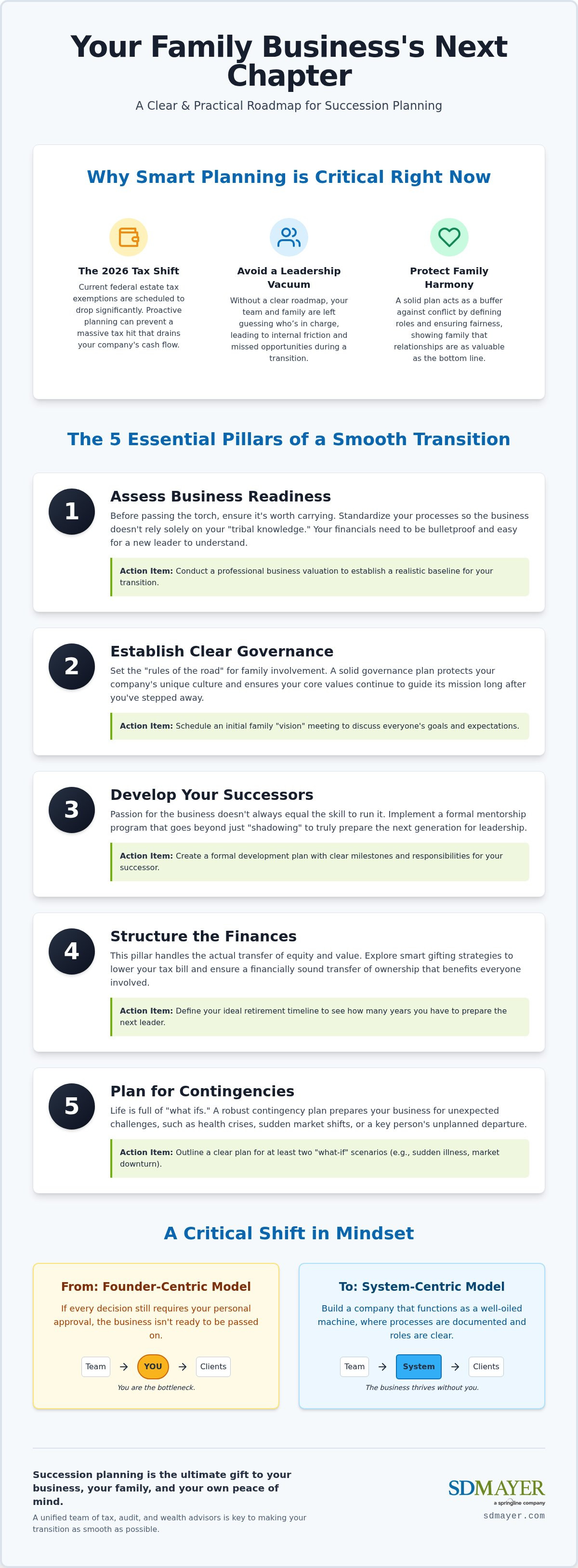
The timing is particularly critical right now. Many tax professionals are looking toward 2026 because that's when current federal estate tax exemptions are scheduled to drop significantly. Waiting until the last minute could lead to a massive tax hit that drains the company's cash flow or forces a premature sale. Beyond the money, waiting often creates a leadership vacuum. Without a plan, your team and family are left guessing who's in charge, which can lead to missed opportunities and internal friction during a transition.
Successful succession planning for family business involves moving from a "founder-centric" model to a "system-centric" one. If every decision still requires your personal approval, the business isn't ready to be passed on yet. You want to build a company that functions as a well-oiled machine, where processes are documented and leadership roles are clearly mapped out. This transition is how you protect the legacy you've spent decades creating, ensuring the brand's reputation remains solid in the competitive regional market.
The Emotional and Financial Stakes
Money's rarely the only thing at risk. Family harmony often takes the biggest hit when roles aren't clearly defined or when siblings feel the division of assets is unfair. A solid plan acts as a buffer against these conflicts. It protects the unique culture you've built and ensures your core values continue to guide the company's mission. By addressing these sensitive topics early, you show your family that their relationships are just as valuable as the company's bottom line.
- Action Item: Schedule an initial family "vision" meeting to discuss everyone's individual goals and expectations for the future.
Succession vs. Selling: Understanding Your Goals
Sometimes the best way to protect your legacy isn't passing it to a child who doesn't have the passion to lead. You need to determine if your goals are best served by keeping things in the family or finding an outside buyer. Using financial reporting compliance services Bay Area helps you determine the true value of your firm, giving you a realistic starting point for negotiations or gifting. Knowing your numbers allows you to make a choice based on facts rather than just feelings.
- Action Item: Define your ideal retirement timeline to see how many years you have to prepare the next leader or find a buyer.
Building Your Roadmap: The 5 Essential Pillars of a Smooth Transition
Creating a transition plan isn't a one-time event; it's a structural overhaul that ensures your company's longevity. To make succession planning for family business work, you need to focus on five core pillars: assessment, governance, development, financial structuring, and contingency. Each pillar supports the others, creating a stable foundation that prevents the business from wobbling when leadership changes. Without this structure, even the most profitable companies can struggle with internal friction or operational stalls.
Assessment involves looking honestly at the company's health, while governance sets the "rules of the road" for family involvement. Development focuses on the people, and financial structuring handles the actual transfer of equity and value. Lastly, contingency planning prepares you for the "what ifs" of life, such as health crises or sudden market shifts. Together, these pillars transform a vague idea of retirement into a concrete, actionable strategy.
Assessing Business Readiness
Before you can pass the torch, you've got to make sure the torch is worth carrying. This means standardizing your processes so the business doesn't rely solely on your personal relationships or "tribal knowledge." Your financials need to be bulletproof and easy to understand for an outsider or a new leader. Many mid-market firms utilize cfo services for small business to clean up their reporting and ensure their growth strategy is sustainable for the next decade. A clean set of books is the best way to prove the company's value to both family members and potential lenders.
- Action Item: Conduct a professional business valuation to establish a realistic baseline for your transition.
Training Your Successors
Passion for the business doesn't always equal the skill to run it. To make family business succession successful, you must implement a formal mentorship program. This shouldn't just be "shadowing" the boss. Instead, create a rotation where successors spend time in every department, from sales to operations. Setting clear performance benchmarks ensures that family members earn their leadership roles rather than just inheriting them. This builds respect among long-term employees and gives the successor the confidence they need to lead effectively.
- Action Item: Identify three key leadership skills your successor currently lacks and create a training timeline to bridge those gaps.
Managing the transfer of equity takes time, and starting these conversations now prevents rushed decisions later. If you're feeling overwhelmed by the moving parts, speaking with an advisor can help you organize these pillars into a manageable schedule that protects your legacy.
Keeping it in the Family vs. Selling to an Outsider: How to Choose
Deciding who takes over your company is a deeply personal choice. It's not just about money. It's about your mission. A successful succession planning for family business strategy starts with an honest look at your talent pool. While many founders hope their children will take the reins, forced leadership rarely ends well for the business or the family. You've got to honestly evaluate if the next generation has the genuine passion to lead. If they're only showing up out of a sense of obligation, it might be time to consider an external sale or professional management. Bringing in an outside CEO doesn't mean you're abandoning your legacy; it often means you're protecting it by putting the right skills in the right seats.
Effective succession planning for family business also means tackling the difficult fairness issue. If you have three children but only one works in the firm, giving everyone an equal share of the equity can create massive friction. The active child might feel resentful about doing the heavy lifting while the others collect dividends. An Employee Stock Ownership Plan (ESOP) can sometimes serve as a smart middle ground. It rewards your loyal employees and provides a way for the family to exit gradually without disrupting the company culture or causing a rift at the dinner table.
When the Next Generation Isn’t Ready
Sometimes the desire is there, but the experience is lacking. You don't have to rush your exit in these situations. You can hire outside talent to mentor your successors or manage operations while the family keeps ownership. Consulting with a strategic tax advisor helps you build compensation packages for these outside hires that won't create future tax headaches. This interim phase is the perfect time to build a viable succession plan that includes clear milestones for your family members to hit before they take full control.
- Action Item: Interview your key non-family employees about their own future goals to see how they fit into a new leadership structure.
Maximizing Value for an External Sale
If an external sale is the better path, treat your business like a house you're getting ready to list. Buyers in the Bay Area look for high market multiples and rock-solid financials. You need to clean up the books and remove any owner bloat from your expenses to ensure maximum curb appeal. Reviewing your small business bookkeeping services now ensures that when a buyer starts their due diligence, they won't find any errors that could lower your valuation.
- Action Item: Audit your last three years of financial statements to ensure they're ready for a rigorous external review.
Protecting Your Wealth: Navigating Taxes and Estate Planning in 2026
Many business owners treat their company and their personal wealth as two separate worlds. However, in the context of succession planning for family business, these two worlds are completely linked. The upcoming 2026 tax law changes mean that current estate tax exemptions are set to drop, potentially exposing more of your hard-earned assets to the IRS. If you don't act before this sunset, your family could face a significant financial burden that forces them to liquidate parts of the company just to pay the tax bill. You've spent years building this value; it's vital to ensure it isn't eroded by preventable tax hits.
Transferring value slowly through gifting strategies is one of the most effective ways to lower your taxable estate. By moving minority interests or non-voting shares to the next generation now, you lock in today’s valuations and take advantage of the higher current exemptions. Trusts also play a vital role here. They don't just help with taxes; they protect your assets from future creditors and ensure that the wealth stays within the family line. It's about finding a balance between the business's need for liquidity and your own need for a secure retirement.
A secure future also means being prepared for life's unexpected challenges; for those needing legal guidance in personal matters, the Law Offices of Michael D. Payne provides the dedicated support necessary to protect your family’s well-being.
Integrated Tax Strategies
Having a "big picture" view of your finances is essential as you prepare for the next chapter. Utilizing strategic tax advice 2026 allows you to look ahead at how your income will shift. You're moving from active business income to passive wealth, and that transition requires a different set of tax tools. Proactive planning helps you avoid common pitfalls like double taxation on dividends or unexpected capital gains hits during a buyout. This integrated approach ensures that every dollar works toward your long-term goals.
- Action Item: Review your current estate plan with a tax expert to ensure it accounts for the 2026 sunset and lower exemption limits.
The Family Office Approach
For mid-market leaders, a family office approach consolidates wealth management and business advisory under one roof. This ensures that your personal lifestyle is fully funded once you step away from daily operations. It's not just about the business's survival; it's about your freedom to enjoy retirement without worrying about cash flow. By looking at your business assets and personal investments as a single ecosystem, you can create a more resilient financial future for your entire family.
- Action Item: Create a post-succession personal budget to determine exactly how much liquidity you need from the business transition to maintain your lifestyle.
If you want to see how these upcoming tax changes affect your specific situation, contact our team to start a conversation about your wealth protection strategy.
Taking the First Step: How SD Mayer Simplifies Your Legacy Planning
Navigating a leadership transition is one of the most significant milestones a founder will ever face. At SD Mayer, we've positioned ourselves as the first call for mid-market firms because we handle the complex intersection of business advisory and personal wealth. We don't just look at the tax return; we look at the family dinner table. Our team understands that effective succession planning for family business requires a balance of technical expertise and human empathy. By keeping your tax, audit, and wealth management under one roof, we eliminate the friction that happens when different advisors aren't on the same page. We're deeply committed to the Bay Area community, and we've spent years helping local families protect what they've built.
Our Collaborative Planning Process
We believe that a successful plan starts with your vision, not just the numbers on a spreadsheet. We take the time to understand what you want your legacy to look like before we ever suggest a specific trust or tax strategy. While we're a local firm with deep roots in San Francisco, our membership in the BDO Alliance gives you access to global resources if your business footprint extends beyond the region. This combination of personal attention and international reach ensures you're prepared for any challenge. We prioritize clarity so that you can make decisions without feeling overwhelmed by technical details.
- Action Item: Contact our team for a confidential consultation to discuss your specific goals.
The SD Mayer Difference
What sets us apart is the level of personal investment we bring to every client relationship. You'll receive founder-level attention from experts like Stephen D. Mayer, ensuring that your transition gets the sophisticated oversight it deserves. Our culture is built on the philosophy of "Simply Doing More," which means we're constantly looking for ways to add value beyond the standard scope of work. We guide our interactions through our "We Care" framework, a set of core values that prioritizes your success and your family's well-being above all else. This holistic mentorship is designed to give you peace of mind as you enter your next chapter.
- Action Item: Review our "We Care" framework online to see how our values align with your family's mission.
Securing the Future of Your Life's Work
Your business is more than just an asset; it's the result of years of dedication and sacrifice. Successfully navigating succession planning for family business means you're not just preparing for an exit, but actively investing in the longevity of your family's future. By addressing the 2026 tax shifts now and establishing clear governance pillars, you ensure that your transition is a source of pride rather than conflict. You've built something remarkable, and it deserves a strategy that protects every detail.
As a member of the BDO Alliance USA and recently named a Top 25 Fastest-Growing Firm in 2025, SD Mayer brings over four decades of Bay Area relationship capital to your table. We're here to bridge the gap between technical tax strategies and the human side of leadership. You don't have to navigate these complex waters alone. Our integrated approach to wealth and business advisory provides the steady stewardship your legacy deserves. It's time to move forward with a clear roadmap and total confidence in what comes next.
Secure your legacy-schedule a consultation with SD Mayer today
Frequently Asked Questions
When is the best time to start succession planning for my family business?
Ideally, you should begin the process three to five years before your planned exit date. This window provides enough time to train successors and clean up financial records without feeling rushed. Starting early is the best way to ensure the business remains stable and profitable while you step back into your next chapter.
What are the biggest mistakes families make during a business transition?
The most frequent errors are avoiding sensitive family conversations and failing to document operational processes. Many owners assume their children want to lead without actually asking them. This silence often leads to confusion and conflict, which can quickly erode the company culture and value you've worked so hard to build.
How do I handle children who are not interested in taking over the business?
Focus on the long-term health of the firm by exploring outside leadership or an Employee Stock Ownership Plan. It's vital to separate ownership from management; children can still benefit from the company's success without running daily operations. This strategy prevents leadership friction and ensures the business stays in capable hands.
What will the estate tax exemptions look like in 2026?
Federal estate tax exemptions are scheduled to drop significantly on January 1, 2026. Without new legislation, the current high limits will likely be cut by roughly 50%. Mid-market families should review their plans now to take advantage of today's higher thresholds before they expire and potentially increase your tax burden.
Can I still stay involved in the business after I step down as CEO?
Many founders successfully transition into an advisory role or a position on the Board of Directors. This allows you to offer "big picture" guidance and mentorship while leaving the daily management to your successor. It’s a healthy way to stay connected to your legacy while giving the new leader space to grow.
Do I need a lawyer or an accountant for succession planning?
You really need a team that includes both professionals to ensure every detail is covered. A lawyer, such as the Law Offices of Robert P. Bergman, drafts the necessary legal structures, but an accountant is essential for managing the tax implications and financial reporting. Comprehensive succession planning for family business requires these experts to work together to protect your wealth and your family harmony.
What is a business valuation and why do I need one now?
A valuation is a formal report that determines the fair market value of your company. You need one now to set a realistic price for a sale or to calculate the value of gifted shares for tax purposes. Without an accurate valuation, you risk making major financial decisions based on guesswork rather than hard data.
How can I minimize the tax impact when passing my company to my kids?
Using smart gifting strategies and minority interest discounts can help you transfer value while keeping your tax bill low. By moving shares to your heirs over several years, you reduce the size of your taxable estate. Robust succession planning for family business uses these proactive steps to ensure the maximum amount of wealth stays with your children.
SECURITIES AND ADVISORY DISCLOSURE:
Securities offered through Valmark Securities, Inc. Member FINRA, SIPC. Fee based planning offered through SDM Advisors, LLC. Third party money management offered through Valmark Advisers, Inc a SEC registered investment advisor. 130 Springside Drive, Suite 300, Akron, Ohio 44333-2431. 1-800-765-5201. SDM Advisors, LLC is a separate entity from Valmark Securities Inc. and Valmark Advisers, Inc. Form CRS Link
DISCLAIMER:
This material has been prepared for informational purposes only, and is not intended to provide, and should not be relied on for, accounting, legal or tax advice. The services of an appropriate professional should be sought regarding your individual situation.
HYPOTHETICAL DISCLOSURE:
The examples given are hypothetical and for illustrative purposes only.