
With 87% of finance leaders reporting a major talent shortage this year, the traditional path of hiring in-house for every role is becoming a hurdle rather than a help. You've likely felt the weight of this shift when messy books delay your big decisions or when you're staring down complex California tax deadlines without a clear plan. Scaling business with outsourced accounting isn't just about saving time. It's about building a stable foundation that moves as fast as your vision does.
We understand that you need more than just a list of transactions. You need a partner who sees the big picture and provides a reassuring path forward. This guide will show you how to trade financial stress for clarity by implementing a model that provides clean, audit-ready data and 12-month cash flow forecasting. You'll discover the practical steps to integrate fractional CFO advice into your routine, turning your back office into a forward-looking strategy center that supports your long-term success.
Key Takeaways
- Identify why basic bookkeeping often fails as you grow and how to break through the "financial ceiling" that holds back ambitious companies.
- Learn how scaling business with outsourced accounting provides real-time visibility into your cash flow, allowing you to make confident decisions for the next 12 months.
- Compare the true costs and management burdens of in-house teams versus a hybrid model to see which path fits your specific growth stage.
- Follow a practical, five-step roadmap to transition your financial operations without disrupting your day-to-day business flow.
- Discover how a "lift and shift" approach helps you gain expert-level strategic advice from a fractional CFO without the executive-level price tag.
Why Scaling Businesses Hit a Financial Ceiling (And How Outsourcing Breaks It)
Every growing company eventually hits a "Scaling Wall." It's that moment when the basic bookkeeping that served you well at $1 million in revenue starts to crumble as you hit $5 million or $10 million. You're making bigger bets, but your financial data is lagging. In fast-paced markets like San Jose, waiting three weeks for a month-end close isn't just an inconvenience; it's a bottleneck that prevents you from grabbing new opportunities. Scaling business with outsourced accounting isn't just about saving on overhead; it's about gaining a strategic lever that helps you navigate complex markets with confidence.
CEO Action Steps:
- Review your current month-end close time. If it consistently takes longer than 10 days, your manual processes are likely a bottleneck.
- Identify if your current financial reports show you gross margins by product or service line, rather than just a total revenue figure.
The Hidden Costs of In-House Accounting During Growth
Building an internal team in the San Francisco Bay Area is a massive undertaking. The talent war is real, and finding a qualified mid-level controller can take months of searching and high salary offers. Even if you find the right person, the cost of turnover is high. You lose institutional knowledge every time someone leaves, which forces you back into the hiring cycle. There's also the hidden management burden. Every hour a CEO spends managing an accounting department is an hour lost on innovation or sales. Plus, relying on a single person creates a "single-point failure" risk. If your only accountant takes a vacation or finds a new job, your entire financial operation stops.
What is Scaling with Outsourced Accounting?
Scaling with outsourced accounting is the intentional integration of cloud-based technology, specialized talent, and forward-looking strategy that adapts to your company's growth in real time. For many leaders, the first question is: What is outsourced accounting? At its core, it's a way to access a full suite of expertise without the executive-level price tag. While traditional bookkeeping only looks at what happened in the past, this modern model focuses on what's coming next. It's often referred to as CAAS, or Client Accounting Advisory Services. This approach ensures your financial foundation is audit-ready and built for the "big picture," not just tax season.
The Three Pillars of a Scalable Financial Engine
Scaling business with outsourced accounting requires a fundamental shift in how you view your finance department. You're no longer just checking off administrative tasks; you're building a system designed to deliver specific outcomes. A true financial engine provides the real-time visibility you need to lead with confidence. It connects your payroll, tax, and accounting so you aren't stuck manually reconciling data across three different spreadsheets. By using technology to automate routine data entry, your team can finally focus on the "big picture" strategy that actually moves the needle.
This integrated approach is non-negotiable for companies that want to grow without breaking. When your financial data flows seamlessly, you can spot trends before they become problems. You gain the ability to pivot quickly, whether that means doubling down on a profitable service or cutting costs in an underperforming area. It's about moving from a reactive state to a proactive one where your financials serve as a map for the future.
Operational Excellence: Bookkeeping and Controller Services
Clean, accurate data is the bedrock of growth. If you plan to seek venture capital or eventually sell your company, you need GAAP-compliant financials from day one. As your needs change, small business bookkeeping services must evolve into a more robust controller function that ensures accuracy and compliance. This level of oversight protects you during audits and gives investors the confidence they need to back your vision.
Action Item: Review these 3 reports every Friday:
- Cash Position: Know exactly how much "dry powder" you have available.
- Accounts Receivable Aging: See who owes you money and identify any late payments immediately.
- Burn Rate vs. Budget: Track if your actual spending aligns with your monthly growth plan.
Strategic Oversight: The Fractional CFO
A fractional CFO acts as your forward-thinking strategist. They don't just report on what happened last month; they help you plan for next year through scenario modeling. This is where you ask "what if" questions. What if we hire ten more developers in San Jose? What if we expand our sales team to Sacramento? Having a mentor who understands the nuances of the Bay Area tech ecosystem is invaluable when you're navigating fundraising rounds or complex M&A activities.
Risk Management: Tax Strategy and Audit Readiness
As you scale across different cities, State and Local Tax (SALT) compliance becomes a major headache. You need a partner who handles these nuances proactively to avoid surprise penalties. For founders, proactive stock option planning is just as critical. It can be the difference between a massive tax bill and saving millions during a successful exit. If you're feeling overwhelmed by these moving parts, it might be time to reach out for a quick chat about your specific growth goals.
Action Item: Audit-Ready Checklist:
- Establish clear segregation of duties for all financial tasks to prevent fraud.
- Create documented approval workflows for every company expense.
- Ensure all bank accounts are reconciled within five business days of month-end.
Comparing Your Options: In-House vs. Outsourced vs. Hybrid
Deciding how to structure your finance team is a pivotal moment for any growing company. In high-cost areas like San Mateo or Menlo Park, the price of a full-time Controller or CFO often starts well above $200,000 before you even consider benefits, payroll taxes, and equity. However, the true "Hidden Management Burden" isn't just the salary. It's the time a CEO spends recruiting, training, and managing that person. If you're still the one reviewing every expense report, you aren't focused on the high-level strategy your company needs to thrive.
The hybrid model offers a middle ground that many Bay Area firms find effective. You might keep a junior staffer in-house to handle daily admin and physical paperwork while scaling business with outsourced accounting to manage the complex strategy and financial oversight. This setup ensures you have a familiar face in the office but the power of a full professional firm backing your decisions. It also addresses the common fear of losing control. With modern cloud-based systems, your data isn't "off-site" in a way that limits you; it's actually more accessible and secure than a local server, giving you 24/7 visibility into your cash flow.
Cost-Benefit Analysis of the CAAS Model
When you hire one person, you're limited by their specific skill set. If your Controller is great at reporting but weak on tax strategy, you'll eventually hit a wall. A CAAS model provides "Expertise Density," giving you access to a team of specialists for the price of one generalist. By choosing this path, you effectively convert a heavy fixed salary into a variable, scalable expense that moves up or down based on your actual business needs. It's a more efficient way to buy exactly the level of service you need at any given moment.
CEO Action Item: Calculate your "Total Cost of Management." Add up the hours you spend each month on accounting tasks and multiply it by your hourly value. You might find you're spending thousands of dollars in "CEO time" on tasks that should be automated or delegated to a specialist.
Flexibility and Speed: The Startup Advantage
Outsourcing allows you to "turn up the volume" instantly. Whether you're preparing for a funding round or navigating a busy seasonal peak, a professional firm has the bench strength to handle the surge without you needing to post a job ad. They can often implement a modern tech stack in weeks rather than months. Because these firms often have an "Audit Firm" mindset, your books are built with internal controls and compliance in mind from day one, saving you from a painful cleanup later.
CEO Action Item: Ask your current team how long it would take to integrate a new payroll or expense management tool. If the answer is "months," your current infrastructure is likely slowing your growth and needs a professional update.
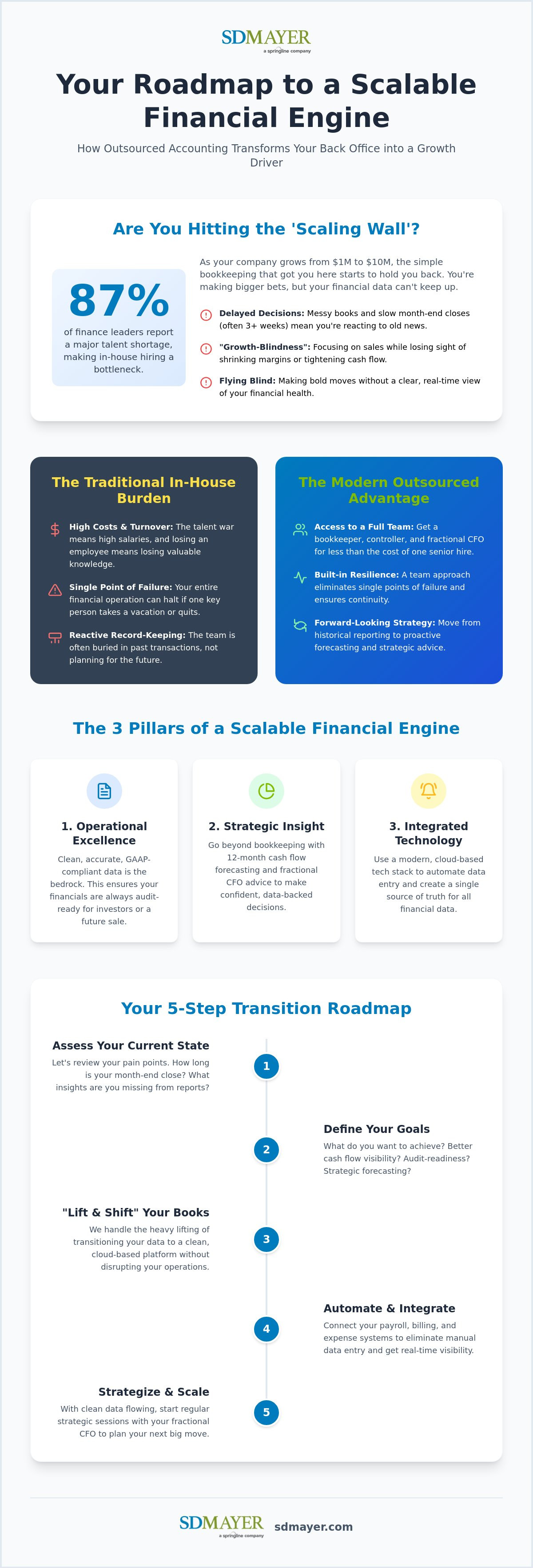
Your Scaling Roadmap: 5 Steps to Transitioning Your Accounting
Moving your financial operations to a professional firm shouldn't feel like a chaotic disruption. Instead, think of it as a "lift and shift" where your current processes are refined and elevated without stopping the clock. The first 90 days are the most critical window for success. During this time, you move from just getting the bills paid to building a partnership that supports your long-term vision. Scaling business with outsourced accounting is a journey that starts with a clear plan and ends with a financial engine that runs itself.
A successful transition requires a partnership mindset from day one. You aren't just offloading tasks; you're gaining a team that cares about your success as much as you do. By following a structured roadmap, you can ensure that your financial data remains accurate and accessible while you focus on the high-level decisions that drive growth.
Step 1 & 2: Assessment and Tech Stack Optimization
Before you can move forward, you need to know where you're standing. This starts by identifying "financial leaks" in your current system, such as duplicate subscriptions or manual data entry errors that eat up your time. We look at your current software to see where the gaps are. If your payroll doesn't talk to your accounting software, you're losing efficiency every single month. Transitioning to a cloud-based, real-time reporting system ensures you always have the latest data at your fingertips.
Action Item: Audit your current software. List every tool you use, from QuickBooks to NetSuite or Bill.com, and check if they're sharing data automatically. If they aren't, you've found your first integration gap.
Step 3 & 4: Process Mapping and Hand-off
The next phase is documenting exactly how money moves through your company. We need to know who approves an invoice and who has the final say on payroll. This process mapping ensures that nothing falls through the cracks during the transition. We also establish a steady communication rhythm. This usually includes a weekly sync to handle immediate tasks and a monthly deep dive to review the broader financials. Our goal is zero downtime for your most critical functions, especially payroll. Your team shouldn't even notice a change in how they get paid.
Step 5: Strategic Alignment and Growth Planning
Once the "cleanup" phase is over, the real work begins. We shift the focus from looking at the past to planning for the future. This is where we set Key Performance Indicators (KPIs) that actually matter for your specific industry. Whether you're focused on customer acquisition costs or gross margins, we track the data that helps you scale. If you're ready to stop worrying about the details and start focusing on growth, reach out to us today to begin your transition.
Action Item: Schedule your first quarterly strategy session. This is the time to sit down with your advisory team and look at the "big picture" for the next 12 months.
Strategic Partnership: Why Bay Area Firms Choose SD Mayer
Choosing a financial partner is one of the most important decisions you'll make as you grow. In a region as dynamic as Northern California, you need more than a vendor who simply processes transactions. You need a steady companion who understands the local pulse while keeping an eye on your global ambitions. SD Mayer positions itself as that vital advisor, moving beyond mere number-crunching to offer a level of holistic care that traditional firms often miss. Whether you're a startup in San Francisco or an established professional service firm in Walnut Creek, scaling business with outsourced accounting works best when your partner is as invested in your success as you are.
We believe that financial health isn't just about spreadsheets; it's about the people behind the business. Our team acts as a holistic mentor, guiding you through the complexities of growth with a calm and capable hand. We've built our firm to handle the entire lifecycle of a company's needs. We can start with basic bookkeeping and scale all the way to complex Single Audits or agreed-upon audit procedures as your regulatory requirements increase. This longevity ensures that you don't have to switch firms every time you hit a new revenue milestone.
Local Expertise, Global Vision
The California regulatory environment is famously complex. Having a forward-thinking strategist who understands the specific tax laws of the Bay Area is a massive competitive advantage. With a presence in key hubs like San Jose, Sacramento, and Santa Rosa, we're deeply rooted in the regional economy. We understand the nuances that tech firms and professional service providers face, from local payroll ordinances to state-specific compliance hurdles. This local insight allows us to anticipate challenges before they land on your desk, keeping your growth trajectory smooth and predictable.
The SD Mayer Difference: Beyond the Numbers
What truly sets us apart is our integrated approach to financial health. We don't just look at your corporate tax return in a vacuum. We consider how your business accounting impacts your personal wealth management and long-term succession planning. This "big picture" perspective is especially valuable for founders navigating stock option planning or complex State and Local Tax (SALT) issues. We're here to reduce the stress of compliance by providing a stable, reliable foundation for every stage of your journey. We invite you to a conversational consultation where we can talk about your vision without any high-pressure sales tactics.
Action Item: Schedule a conversation with our advisory team to discuss your scaling goals.
Scaling business with outsourced accounting shouldn't feel like a cold, clinical transaction. It should feel like a partnership that evolves with you. By integrating your tax strategy, payroll, and high-level advisory services into one cohesive engine, you gain the freedom to focus on what you do best. We're ready to help you build a financial foundation that is both audit-ready and growth-oriented, ensuring your company remains agile in a fast-paced market.
Take the Next Step Toward Sustainable Growth
Scaling your company is a significant achievement, but it requires a financial engine that can keep up with your pace. We've explored how moving from basic bookkeeping to a high-level model removes the bottlenecks that often hold ambitious leaders back. By integrating tax strategy, payroll, and wealth management into one cohesive system, you gain the clarity needed for long-term success. Scaling business with outsourced accounting isn't just a cost-saving move; it's a strategic partnership that provides the expert-level oversight you need without the burden of managing a massive internal department.
At SD Mayer, we bring decades of Bay Area local expertise to every relationship. Our full-service CAAS and CFO advisory solutions are designed to grow with you, ensuring you always have a forward-looking perspective on your cash flow and tax obligations. You don't have to navigate these complex financial stages alone. We're here to be your steady companion, helping you turn your vision into a lasting legacy.
Ready to scale without the financial friction? Let’s talk about your business strategy.
Frequently Asked Questions
Is outsourced accounting only for small businesses?
No, it's a strategic choice for businesses at every stage of growth. Many mid-market companies find that scaling business with outsourced accounting is the only way to access specialized CFO talent without the massive salary of a full-time executive. It's about getting the right level of expertise for your current complexity, whether you're at $1 million or $50 million in revenue.
How much does it cost to scale my accounting with an outsourced firm?
Costs are structured to be predictable and scalable based on your specific needs. Instead of a heavy fixed salary for an in-house team, you pay for the specific outcomes and level of service you require. This turns a rigid overhead cost into a flexible expense that adjusts as your company grows or shifts its priorities throughout the year.
Will I lose control of my financial data if I outsource?
You actually gain more visibility and control over your numbers than ever before. Modern cloud-based systems mean you can check your cash flow or profit margins from your phone at any time. The firm manages the data entry and compliance, but you remain the sole owner of the information and the final decision-maker for your company.
What is the difference between a bookkeeper and a CAAS provider?
A bookkeeper focuses on recording what happened in the past. A CAAS provider is a forward-thinking strategist who helps you plan for what's coming next. When you're scaling business with outsourced accounting, you need these "big picture" insights to create 12-month forecasts and scenario models that help you make big moves with confidence.
How long does it take to transition to an outsourced accounting model?
A typical transition takes between 30 and 90 days to complete properly. We treat the first month as an assessment period to fix any "financial leaks" and set up your tech stack. By the second and third months, we've fully mapped your workflows and taken over the daily heavy lifting without disrupting your team's operations or payroll cycles.
Can an outsourced firm help with my 2026 tax strategy and SALT compliance?
Yes, proactive tax planning is a core part of a high-level model. Specialized firms handle complex State and Local Tax (SALT) compliance, which is essential if you have employees or sales across different California cities. This prevents surprise penalties and ensures you're taking advantage of every available tax strategy to protect your company's margins.
What should I look for in an outsourced accounting partner in the Bay Area?
Look for a partner who offers a holistic approach and understands the Bay Area's unique regulatory landscape. You want a firm that can handle everything from payroll and bookkeeping to complex audits and wealth management. It's also vital to find a team that acts as a steady companion and speaks your language rather than hiding behind technical jargon.
SECURITIES AND ADVISORY DISCLOSURE:
Securities offered through Valmark Securities, Inc. Member FINRA, SIPC. Fee based planning offered through SDM Advisors, LLC. Third party money management offered through Valmark Advisers, Inc a SEC registered investment advisor. 130 Springside Drive, Suite 300, Akron, Ohio 44333-2431. 1-800-765-5201. SDM Advisors, LLC is a separate entity from Valmark Securities Inc. and Valmark Advisers, Inc. Form CRS Link
DISCLAIMER:
This material has been prepared for informational purposes only, and is not intended to provide, and should not be relied on for, accounting, legal or tax advice. The services of an appropriate professional should be sought regarding your individual situation.
HYPOTHETICAL DISCLOSURE:
The examples given are hypothetical and for illustrative purposes only.