Why are you still facing a massive, unexpected tax bill every April even though your business is growing? It's a common frustration for Bay Area founders who receive fragmented advice from different professionals who never seem to be on the same page. When your daily numbers are disconnected from your long-term strategy, you lose the visibility needed to scale. By shifting to integrated CAAS and tax planning, you can finally bridge that gap. This approach ensures your financial data works in harmony with your future tax obligations, turning your accounting from a historical report into a proactive growth engine.
We understand it's exhausting to manage complex California SALT rules and stock option timing while trying to lead your company. You deserve a clear financial roadmap that eliminates surprises and lightens your administrative load. In this guide, we'll explore how real-time visibility helps you navigate the 2026 SALT deduction cap of $40,400 and the 7% interest rate on tax underpayments. You'll learn exactly how a holistic advisory model provides the steady stewardship your business needs to thrive as the Bay Area continues to dominate global venture capital investment.
Key Takeaways
- Learn how to move beyond basic bookkeeping by using real-time data to drive your business growth and decision-making.
- Discover how integrated CAAS and tax planning closes the gap between your daily accounting and long-term tax strategy to eliminate April surprises.
- Get clear steps for managing Bay Area complexities, including the 2026 SALT deduction limits and specialized stock option planning.
- Find out how an outsourced CFO model can reduce your administrative workload, allowing you to focus on high-level scaling.
- Identify the specific missing links in your current financial setup with a practical audit of your bookkeeping and tax alignment.
What is Integrated CAAS and Tax Planning?
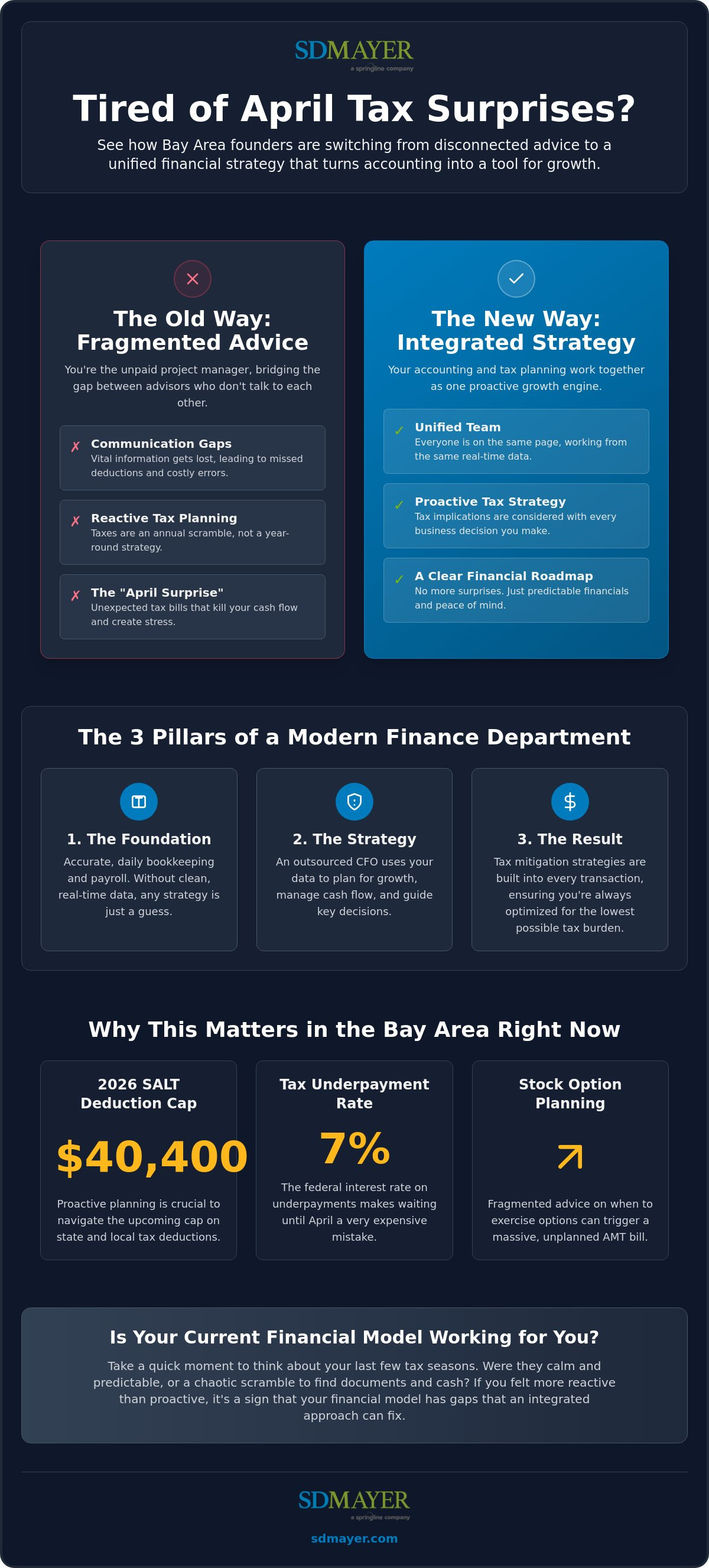
Most business owners in the Bay Area view accounting as a historical chore. You hand over a shoebox of receipts or a messy spreadsheet to a CPA in March, hope for the best, and usually end up with a tax bill that stings. This reactive cycle is exactly what integrated CAAS and tax planning is designed to break. CAAS, or Client Accounting Advisory Services, acts as your high-level, outsourced finance department. It isn't just about recording what happened last month. It's about using that information to shape what happens next.
The Pillars of a Modern Finance Department
A truly integrated finance department isn't just one person wearing many hats. It's a structured system built on three specific layers:
- The Foundation: Accurate, daily bookkeeping and payroll management. Without clean data, strategy is just guesswork.
- The Strategy: This is where an outsourced CFO or Controller steps in. This strategic layer relies heavily on Management accounting, which focuses on providing the internal data you need to run your operations efficiently and plan for future growth.
- The Result: Tax mitigation strategies that are baked into every transaction. Whether it's navigating the 2026 SALT deduction cap of $40,400 or optimizing stock options, the goal is zero surprises.
Why Integration Matters Now
The speed of the Bay Area market doesn't allow for delays. If your bookkeeper doesn't talk to your tax advisor, you're operating in a data silo. This lack of communication often leads to missed deductions or poorly timed business moves that trigger unnecessary liabilities. Real-time data is no longer a luxury; it's the only way to make informed pivots in a fast-paced economy.
Action Item: Take a moment to review your last three tax seasons. Were they calm and predictable, or were they a mad scramble to find documents and cash? If you felt more reactive than proactive, your current financial model likely has gaps that integration can fill.
The Hidden Costs of Fragmented Financial Advice
Many founders don't realize they're acting as an unpaid project manager for their own finances. When your bookkeeper, tax preparer, and wealth manager operate in separate buildings, you're the one who has to bridge the gap. This fragmentation is the opposite of integrated CAAS and tax planning. It leads to a "Communication Gap" where vital information gets lost in transition. For instance, your bookkeeper might record a transaction correctly for the ledger, but without a tax strategist looking over their shoulder, they might miss an opportunity for an R&D credit or a SALT workaround that needs to be documented at the moment of the transaction.
Dealing with different state and local tax jurisdictions adds another layer of risk. If your reporting isn't consistent across all levels, you're inviting an audit. By utilizing Client Accounting and Advisory Services (CAAS), businesses can ensure that every entry is made with the final tax return in mind. This reduces the mental load on the founder, who should be focused on scaling the business rather than translating financial jargon between three different advisors. Transitioning to a model of integrated CAAS and tax planning eliminates these doubled costs and ensures everyone is working from the same playbook.
The Reactive Tax Trap
The "April Surprise" isn't just a nuisance; it's a cash flow killer. When you find out in the spring that you owe thousands more than expected, it often happens because your advisors weren't talking in July. For tech founders in the Bay Area, this often involves stock options. Fragmented advice might lead you to exercise ISOs at a time that triggers a massive Alternative Minimum Tax (AMT) bill you weren't prepared for. The Reactive Tax Trap is a failure of communication, not just math.
Inefficiency and Doubled Costs
You're likely overpaying for your professional services. When two different firms handle your data, you often pay both of them to "clean up" the same set of books. Even worse is receiving conflicting advice. Your wealth manager might suggest one move while your tax accountant warns against it. This friction slows down your growth and creates unnecessary stress. If you're tired of being the middleman, it might be time to reach out for a more unified strategy.
Action Item: Audit your current advisor fees. Look for overlapping services where you might be paying for the same data entry or reporting twice. If you see redundant charges, it's a clear sign your financial advice is fragmented.
How Real-Time Data Fuels 2026 Tax Strategy
Imagine making a big business move without knowing exactly how much cash you'll need for taxes six months from now. For many Bay Area businesses, this uncertainty is a daily reality. However, with integrated CAAS and tax planning, you use cloud-based systems to create a "Single Source of Truth." This means your financial data is updated in real time, rather than months after the transactions occur. When your bookkeeping and tax strategy live in the same ecosystem, you stop guessing and start knowing.
Why wait until December to estimate your liability when you can see it clearly in July? Having monthly tax projections allows you to adjust your payroll and estimated payments on the fly. This level of precision is vital in 2026. With the IRS interest rate for individual tax underpayments sitting at 7% as of July 1, 2026, even a small miscalculation can lead to expensive penalties. Real-time data also helps you justify complex positions like SALT compliance, providing the documentation you need to support your filings as they happen.
Proactive Decision Support
Should you buy that new piece of equipment today or wait until Q1 of next year? If you have integrated data, you can see the immediate tax benefit versus the cash flow impact before you sign the check. Real-time P&L statements allow for mid-year tax harvesting, where you can offset gains with losses before the calendar year ends. It's about making moves based on facts, not gut feelings.
Action Item: Reach out to your current accountant and ask for a year-to-date tax projection today. If they can't provide a clear estimate within a few days, your current system isn't giving you the visibility you need to scale safely.
Scaling with Confidence
As your business grows, you'll eventually face a funding round or a potential audit. Outsourced CFOs use CAAS data to ensure your financials are always "investor-ready." This process starts with high-quality small business bookkeeping services that feed directly into your tax-ready reports. Scaling a company in a competitive market requires integrated CAAS and tax planning to ensure your back office keeps pace with your growth. Clean books are your best defense against an IRS or FTB inquiry, and they provide the confidence you need to take your next big step.
Bay Area Specifics: Stock Options, SALT, and Growth
It's no secret that doing business in the Bay Area comes with a unique set of financial hurdles. From the high cost of living to the complex local tax codes in cities like San Francisco and San Jose, the "California tax burden" is a very real thing. By using integrated CAAS and tax planning, you can tackle these issues head-on. For example, the 2026 SALT deduction cap is set at $40,400 for both single and married filers. If your Modified Adjusted Gross Income (MAGI) exceeds $505,000, that deduction begins to phase out. Without a proactive strategy, you could find yourself paying significantly more in state and local taxes than necessary.
For tech founders and executives, stock option planning is where integration becomes vital. California doesn't have a separate capital gains tax rate; instead, it taxes your gains as ordinary income, which can reach as high as 13.3% for income over $1,000,000. Managing Incentive Stock Options (ISOs) and Non-Qualified Stock Options (NSOs) requires a delicate balance to avoid triggering the Alternative Minimum Tax (AMT). With an AMT exemption of $140,200 for married couples in 2026, knowing exactly when to exercise your options can save you a fortune in immediate tax liabilities.
Startups also need to keep a close eye on Qualified Small Business Stock (QSBS) opportunities. Under Section 1202, you might be eligible for a 100% federal tax exclusion on the gain from your stock if you meet specific requirements. However, California doesn't always conform to these federal rules. Having an advisor who understands these local nuances ensures you don't make a move that looks good on a federal return but creates a mess on your state filing.
Navigating California Regulatory Complexity
The rise of remote and hybrid work has made payroll compliance more difficult than ever. If you have employees working in different cities or states, you might be creating "Nexus" issues without even knowing it. This means your business could be liable for taxes in jurisdictions where you don't even have a physical office. Integrated services take the guesswork out of this by tracking where your team is actually working and ensuring your filings are accurate across the board.
Action Item: Map out where every one of your employees lives and works today. Use this list to verify that you're registered for the correct local payroll taxes to avoid back taxes and penalties later.
Stock Options and Wealth Integration
When you combine business advisory with personal tax strategy, you protect your hard-earned equity from unnecessary erosion. It isn't just about the company's bottom line. It's about your personal net worth. You can find more details on how these advisory services support your long-term goals in our CAAS strategic guide. If you're ready to align your business growth with a smarter tax strategy, schedule your Bay Area tax strategy session with our team today.
Transitioning to an Integrated Model with SD Mayer
Making the switch from a traditional accounting firm might feel like a daunting task, but it's the most important step you can take for your company's future. At SD Mayer, we act as your holistic mentor, guiding you through the transition from fragmented advice to a unified growth strategy. The first step in this journey is our Financial Health Audit. We take a deep look at your current systems to find exactly where your data is falling through the cracks. By identifying these gaps early, we ensure that your integrated CAAS and tax planning foundation is solid from day one.
Once the audit is complete, our team takes the administrative mess off your plate. We know that many Bay Area founders are dealing with years of inconsistent bookkeeping or complex stock option records. We clean this data and migrate it into a modern, cloud-based system. This onboarding process is designed to be as painless as possible, allowing you to stay focused on your team and your customers while we handle the heavy lifting. We then set a steady cadence of monthly advisory meetings. These aren't just reviews of what happened last month; they're forward-looking sessions where we use your real-time data to map out your next moves.
What to Expect in the First 90 Days
The first three months are about building your new financial engine. We move quickly to ensure you see value right away:
- Month 1: We focus on cleaning up historical data and integrating your cloud systems. This creates the "Single Source of Truth" we discussed earlier.
- Month 2: Our team sets up real-time dashboards for your key performance indicators (KPIs). You'll be able to see your cash flow and projected liabilities at a glance.
- Month 3: We hold your first integrated tax strategy session. We'll look at your 2026 growth goals and align them with the latest SALT rules and stock option strategies.
Next Steps for Bay Area Leaders
2026 is the year to move away from reactive accounting. As the local economy continues to surge, you need a partner who understands the nuances of the regional market and the specific challenges of scaling a business here. By consolidating your CFO, controller, and tax needs into one partnership, you eliminate the friction that holds many companies back. You'll have a clear financial roadmap and, more importantly, the peace of mind that comes with zero tax surprises.
Action Item: Don't wait for the next tax deadline to find out your current system isn't working. Schedule a consultation with SD Mayer today to review your integrated growth plan and see how we can help you scale with confidence.
Ready to Scale Your Bay Area Business with Confidence?
Success in our local economy requires more than just high-level innovation; it demands a financial foundation that can keep up with your pace. By moving away from fragmented advice and adopting integrated CAAS and tax planning, you ensure that your bookkeeping, CFO-level strategy, and tax obligations are always in sync. You've seen how real-time visibility eliminates the "April Surprise" and how specialized planning for stock options and SALT can protect your hard-earned equity.
At SD Mayer, we pride ourselves on being a holistic mentor for the tech and startup ecosystems in San Francisco and San Jose. Our team provides everything from daily bookkeeping to outsourced CFO oversight, ensuring your business success translates directly into personal wealth. It's time to stop acting as the middleman between your advisors and start focusing on your next big move. Partner with SD Mayer for Integrated CAAS and Tax Strategy to build a clearer, more predictable financial future. We are here to help you navigate every stage of your growth with calm and capable stewardship.
Frequently Asked Questions
What is the main difference between a traditional CPA and integrated CAAS?
A traditional CPA usually focuses on your past by looking at historical data once a year during tax season. Integrated CAAS acts as a forward-looking partner that provides year-round advisory and real-time visibility into your finances. It's the difference between getting a report on what happened last year and having a strategic guide to help you make decisions today.
How much can integrated tax planning actually save my business?
The savings come from catching deductions in real time and avoiding costly penalties like the 7% interest rate on tax underpayments. By staying ahead of the 2026 SALT deduction cap of $40,400, you can structure your payments to minimize your overall liability. This proactive approach prevents the "April Surprise" that often drains a company's cash reserves.
Is CAAS only for large companies, or do startups benefit too?
Startups often benefit the most because they get access to CFO-level expertise without the cost of a full-time executive hire. This model, supported by specialized firms like Aone Outsourcing, allows early-stage companies to build a scalable financial foundation from day one. It's especially helpful for tech founders who need to manage complex equity and funding rounds while keeping their focus on product development.
Does SD Mayer handle local San Francisco payroll and SALT compliance?
Yes, we specialize in the unique tax requirements of the Bay Area, including San Francisco city taxes and California SALT compliance. We help you manage the complexities of local payroll rules and ensure you're meeting all state and local requirements. This local expertise is vital for businesses with a remote or hybrid workforce spread across different jurisdictions.
How does real-time bookkeeping help with my year-end tax return?
Real-time bookkeeping ensures your financial data is clean and tax-ready every single month. This eliminates the stressful year-end scramble to find missing receipts or fix entry errors from six months ago. When your books are always current, your tax return becomes a simple final step rather than a massive cleanup project.
Can I keep my current wealth manager if I switch to SD Mayer for CAAS and tax?
You can certainly keep your current wealth manager while working with us for integrated CAAS and tax planning. We often collaborate with our clients' existing advisors to ensure their business decisions align with their personal wealth goals. Our role is to act as a holistic mentor, providing the business data your wealth manager needs to give you the best possible advice.
What is the typical onboarding process for integrated accounting services?
Onboarding begins with a Financial Health Audit where we identify gaps in your current bookkeeping and tax setup. Over the first 90 days, we clean up your historical records and move your data into a modern, cloud-based system. We then set a regular cadence for advisory meetings so you always know exactly where your business stands.
How does stock option planning fit into the CAAS model for tech founders?
Stock option planning is woven into your monthly financial strategy sessions rather than being a separate conversation. We track your exercise windows and projected gains to help you manage the Alternative Minimum Tax (AMT). With the 2026 AMT exemption for joint filers at $140,200, having a real-time view of your liability helps you time your exercises for the best tax outcome.
SECURITIES AND ADVISORY DISCLOSURE:
Securities offered through Valmark Securities, Inc. Member FINRA, SIPC. Fee based planning offered through SDM Advisors, LLC. Third party money management offered through Valmark Advisers, Inc a SEC registered investment advisor. 130 Springside Drive, Suite 300, Akron, Ohio 44333-2431. 1-800-765-5201. SDM Advisors, LLC is a separate entity from Valmark Securities Inc. and Valmark Advisers, Inc. Form CRS Link
DISCLAIMER:
This material has been prepared for informational purposes only, and is not intended to provide, and should not be relied on for, accounting, legal or tax advice. The services of an appropriate professional should be sought regarding your individual situation.
HYPOTHETICAL DISCLOSURE:
The examples given are hypothetical and for illustrative purposes only.