
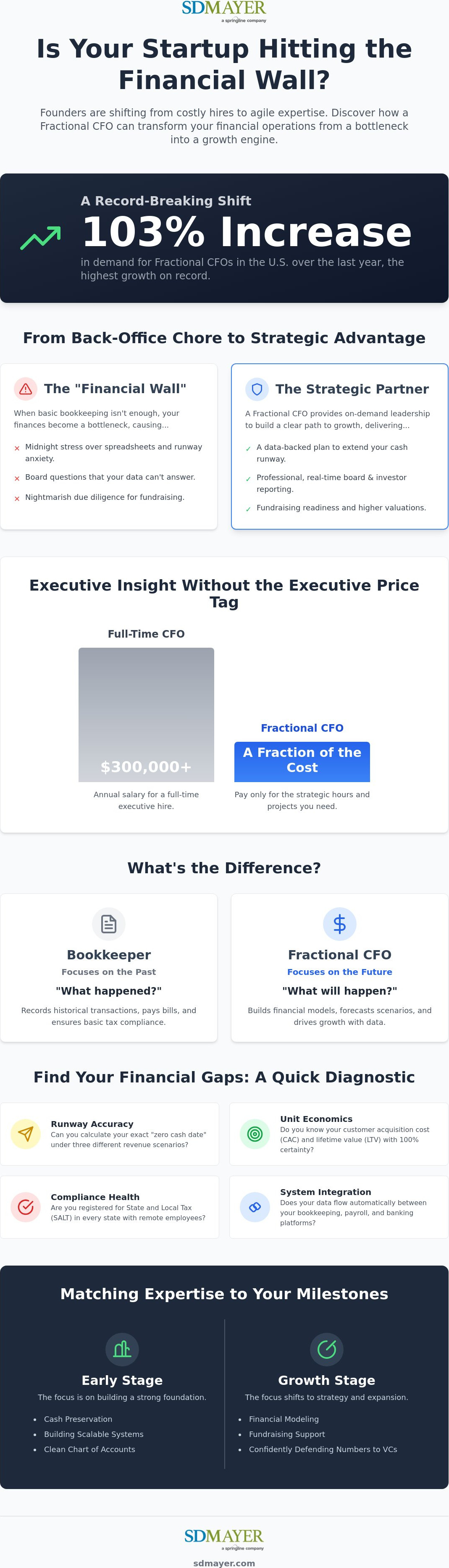
Demand for fractional CFOs in the U.S. has increased by 103% over the last year, which is the highest growth on record. It's a clear signal that founders are moving away from traditional, expensive hiring models in favor of agility and specialized expertise. You probably know the stress of staring at a spreadsheet at midnight, worrying if your runway will actually last through the next quarter. It's exhausting to balance product innovation with the financial scrutiny of a board that expects professional, real-time reporting. Hiring a fractional cfo for startups is no longer just a luxury for the elite; it's a strategic necessity for any mid-sized business looking to scale toward a successful exit.
We understand that you shouldn't have to choose between financial clarity and your company's growth. This guide will show you how to bridge the gap between basic bookkeeping and an exit-ready financial strategy without the $300,000 price tag of a full-time executive. We'll walk through specific ways to extend your cash runway, professionalize your board reporting, and build a clear, data-backed path to your next funding round. By the end, you'll have a roadmap to transform your finance department from a back-office chore into a powerful growth engine.
Key Takeaways
- Learn to recognize the "Financial Wall" where simple bookkeeping no longer meets the complex demands of investors and board members.
- Discover how a fractional cfo for startups provides high-level strategy and fundraising readiness at a fraction of the cost of a full-time executive.
- Follow a practical roadmap for onboarding your financial partner, including how to set clear objectives that reduce your month-end close time.
- Understand the "Holistic Advantage" of connecting your business growth with personal wealth management and stock option tax planning.
- Evaluate the true cost of DIY finance management by calculating the value of your time versus the efficiency of professional financial leadership.
Why Startups Hit a 'Financial Wall' and How a Fractional CFO Fixes It
Most founders start with a simple goal: build something great and keep the lights on. In the early days, basic bookkeeping is usually enough. You record expenses, pay the team, and keep an eye on the bank balance. But as you scale, you eventually hit what we call the "Financial Wall." This is the moment where your current financial setup stops being a support system and starts being a bottleneck. It happens when the questions from your board or potential investors become more complex than your spreadsheets can handle.
A fractional cfo for startups acts as an on-demand strategic partner. Unlike a traditional accountant, they don't just look at where your money went; they look at where it needs to go. By leveraging the Fractional executive model, you gain access to the same level of financial leadership found in established corporations, but only for the hours or projects you actually need. This approach provides executive-level insight at a fraction of the cost of a full-time hire.
The real shift happens when you move from historical reporting to strategic forecasting. While a bookkeeper tells you what happened yesterday, a fractional CFO builds the models that tell you what will happen next year. They help you navigate the transition from simply staying compliant to driving growth through data-backed decisions.
Signs Your Startup Has Outgrown Its Bookkeeper
You might be hitting the wall if your board meetings are focused on correcting data errors rather than making decisions. If you aren't 100% sure how many months of runway you have left under different hiring scenarios, your current system is failing you. Another major red flag is when fundraising due diligence feels like a nightmare of unorganized documents and frantic explanations. When these things happen, you've moved past the "DIY" phase of finance.
The ROI of Strategic Financial Leadership
Strategic leadership is a multiplier for your business. In the competitive 2026 market, having investor-ready financials is a signal of maturity that can speed up your funding rounds. Think about your valuation. If a financial expert helps you extend your runway by just three months through better cash management, you have more time to hit the milestones that trigger a higher valuation. A fractional cfo for startups serves as a high-impact catalyst that transforms your financial operations into a strategic asset for Series A and B success.
How to Identify Your Startup’s Specific Financial Gaps
Identifying where your finance function falls short requires looking beyond the monthly balance sheet. Many founders confuse compliance with strategy. If your current team only focuses on filing taxes and paying bills, you have a strategy gap. To determine when to bring on a fractional CFO, you must assess whether your financial data is actually helping you make decisions. A fractional cfo for startups doesn't just keep you out of trouble; they build the framework that allows you to move faster.
The Gap Analysis Checklist
Before you hire a partner, run through this quick diagnostic to see where your foundation might be cracking:
- Runway Accuracy: Can you calculate your exact "zero cash date" under three different revenue scenarios?
- Unit Economics: Do you know your customer acquisition cost (CAC) and lifetime value (LTV) with 100% certainty?
- Compliance Health: Are you registered for SALT in every state where you have remote employees?
- System Integration: Does your data flow automatically between QuickBooks, Bill.com, and your banking platforms?
Customizing the Role to Your Growth Stage
The support you need depends heavily on your current milestone. In the early stages, your priority is often cash preservation and setting up foundational systems that can scale. You need a partner who can build a clean chart of accounts and manage the day to day burn. As you move into a growth stage, the focus shifts toward financial modeling and fundraising support. At this point, you need someone who can sit across from VCs and defend your numbers with confidence.
If you're looking for a deeper dive into how these roles evolve, check out our resource on Small Business CFO Services: The 2026 Guide to Strategic Growth in the Bay Area. Finding the right fit means matching the expert's skills to your specific fundraising timeline. If you feel ready to bridge these gaps, feel free to reach out to our team for a conversation about your current trajectory.
Comparing Your Options: Fractional vs. Full-Time vs. DIY
Choosing how to manage your company's finances often feels like a choice between two extremes. You either try to handle it yourself to save cash, or you commit to a full-time executive hire that eats up a huge chunk of your budget. In high-cost markets like San Francisco, a full-time CFO's base salary often starts around $195,500 and can climb well over $321,000 for experienced talent. When you add in equity, benefits, and bonuses, that's a significant drain on your runway before you've even hit your next major milestone.
The DIY approach has its own set of problems. It's easy to overlook the "hidden cost" of your own time. If you're spending your weekends reconciling accounts or building financial models, you're not spending that time on product development or closing deals. For most founders, their time is the most expensive resource the company has. A fractional cfo for startups solves this by scaling their involvement up or down based on your current burn rate. You pay for the strategy you need today, not the executive salary you might need three years from now.
Another benefit of the fractional model is the breadth of expertise. When you hire one person, you get one person's perspective. When you partner with a firm, you're often getting a "team" of specialists. You might have one expert focusing on your board reporting while another handles complex state and local tax issues. This variety ensures that every corner of your financial house is in order without having to hire multiple full-time employees.
When a Full-Time CFO Actually Makes Sense
There is a tipping point where a full-time hire becomes necessary. This usually happens when you reach $10M to $20M in annual recurring revenue or your team grows beyond 50 employees. At this scale, the day to day financial complexity and the constant demands of late-stage M&A or IPO preparation require a dedicated, full-time presence. Until you reach that level of scale, the agility of an outsourced partner is almost always more cost-effective.
The 'Hybrid' Model: CAAS and Fractional Leadership
Many successful startups now use a hybrid approach that combines outsourced bookkeeping with high-level CFO advisory. This is often referred to as Client Accounting Advisory Services. By using this model, you ensure a seamless flow from daily data entry to high-level board reporting. It eliminates the communication gaps that happen when your bookkeeper and your strategist aren't on the same page. To learn more about how this works, read our article on What is CAAS? A Strategic Guide to Client Accounting Advisory Services in 2026.
Step-by-Step: How to Onboard and Manage a Fractional CFO
Bringing a new executive into your inner circle is a significant move. To get the most out of a fractional cfo for startups, you need a plan that goes beyond just handoff meetings. Success starts with clear, measurable goals. Instead of a vague request for better numbers, ask for specific outcomes like reducing your month-end close to five days or creating a board-ready reporting package by the second Tuesday of the month. This clarity ensures your partner knows exactly what success looks like from day one.
Once objectives are set, you must grant secure access to your financial tech stack. This includes your accounting software, payroll platform, and investor data rooms. Establishing a consistent communication rhythm is just as vital. While you might have a quick weekly sync to discuss immediate cash needs, you should also schedule deeper monthly sessions to prepare for board meetings and review long-term strategy. This steady cadence prevents surprises and keeps everyone aligned on your runway.
Don't let your new partner work in a silo. Integrate them with your department heads in Sales, Operations, and HR. When the CFO understands the hiring plan from HR or the sales pipeline from the VP of Sales, they can build much more accurate financial models. Finally, commit to reviewing and iterating on these models every month. Your business moves fast, and your financial plan should move with it. If you're ready to build a more resilient financial foundation, contact our team today to learn how we can support your growth.
Setting Your Fractional Partner Up for Success
A common mistake is failing to define the boundary between your fractional cfo for startups and your existing bookkeeper. While the bookkeeper handles the daily transactions, the CFO interprets the data to tell a larger story. They need to understand the "why" behind your business model to provide meaningful advice. Ensure they have a seat at the table during strategic planning sessions. They aren't just there to report on the past; they're there to help you architect the future.
Action Items for the First 30 Days
The first month is about building a clean foundation. Your partner should start with a thorough clean-up of your Chart of Accounts to ensure every dollar is categorized correctly. Following this, they should build a dynamic 12-month rolling forecast that adjusts as your actual data comes in. To keep your team aligned, set up automated dashboards for your key performance indicators. This provides real-time visibility into your burn rate without waiting for a month-end report. This proactive approach turns your finance department into a source of confidence rather than a source of stress.
The Holistic Advantage: Beyond Just Business Financials
Most financial guides treat a startup as a separate entity from its leaders. In reality, your company's growth and your personal financial health are inextricably linked. For many founders, their net worth is almost entirely tied up in the business they are building. This means that every corporate decision has a ripple effect on your family's future. A fractional cfo for startups who understands this connection provides more than just a balanced budget; they offer a roadmap for long term stability. Our partnership model at SD Mayer is designed to support both the organization and the individuals driving its success, ensuring that your business achievements translate into personal security.
Integrated wealth management is particularly vital for tech executives in the San Francisco Bay Area. When your compensation includes a mix of salary and equity, the financial picture becomes complex very quickly. You need a strategist who can look at the big picture, combining business accounting with individual tax planning. This holistic approach ensures that you aren't just building a valuable company, but also a sustainable legacy for yourself and your stakeholders.
Stock Option and Tax Strategy for Founders
Navigating the tax maze is one of the biggest challenges for founders as they approach a liquidity event. In the 2026 tax environment, planning for the Alternative Minimum Tax (AMT) and capital gains is more critical than ever. Proactive stock option timing can save millions in future taxes by optimizing the spread between exercise price and fair market value before your valuation spikes. Additionally, understanding the benefits of Qualified Small Business Stock (QSBS) can lead to significant tax exclusions if your company meets the specific criteria. Getting these details right early on prevents you from leaving a massive portion of your hard earned wealth on the table.
Building a Legacy: Succession and Financial Planning
Mid-market companies often wait too long to think about succession. Whether you plan to pass the torch to a new CEO or prepare for an acquisition, you need a clear exit strategy that aligns with your personal goals. Integrating your business transition plan with family office objectives ensures that the wealth generated by an exit is managed with care for the next generation. This involves everything from trust accounting to long term financial planning. If you want to ensure your business and personal finances are working in harmony, contact SD Mayer for a holistic fractional CFO for startups consultation. We are here to act as your mentor and strategist through every stage of the journey.
Building a Resilient Path to Your Next Milestone
The transition from survival mode to strategic scaling requires more than just clean books. It demands a forward thinking partner who can turn financial data into a roadmap for growth. We've explored how a fractional cfo for startups provides the executive level strategy you need without the overhead of a full time hire. By identifying your specific financial gaps and integrating your personal wealth goals with your company's trajectory, you create a foundation that is ready for investor scrutiny and long term success.
At SD Mayer, we serve tech leaders across San Francisco and Silicon Valley by providing a unique combination of integrated tax, audit, and wealth management expertise. We specialize in the nuances of mid-market growth, ensuring that your scaling journey is both profitable and sustainable. Whether you're preparing for a Series A or planning a complex exit, having a mentor in your corner makes all the difference. Your vision deserves a financial engine that can keep up with your ambition. Let's build something lasting together.
Ready to scale? Book a consultation with SD Mayer's fractional CFO team today.
Frequently Asked Questions
What is the typical cost of a fractional CFO for a startup in 2026?
Pricing for a fractional cfo for startups is generally structured as a monthly retainer or an hourly rate tailored to your company's growth stage. This model is designed to be much more accessible than a full-time executive salary, which often starts well above $200,000 before benefits. Most founders find that the investment pays for itself through improved cash management and increased investor confidence during funding rounds.
How many hours a week does a fractional CFO usually work?
Most fractional partners spend between five and ten hours per week on your business, though this fluctuates based on your specific needs. During a fundraising round or a year-end audit, they might be much more involved. The beauty of this model is its inherent flexibility; you get high-level expertise when you need it without paying for idle time during slower periods.
Can a fractional CFO help with our Series A or Series B fundraising?
Yes, a fractional CFO is often the primary architect of your fundraising strategy. They help build the complex financial models investors expect, prepare the data room for due diligence, and can even join you in meetings with venture capitalists. Having a seasoned professional defend your numbers adds immediate credibility to your pitch and helps you secure better terms.
Is a fractional CFO the same as an outsourced controller?
A controller focuses on historical accuracy and internal controls, while a CFO focuses on future strategy and capital structure. While a controller makes sure your books are clean and compliant, the CFO uses those books to forecast your next eighteen months of growth. Both roles are important, but they serve different strategic purposes in your company's lifecycle.
What tech stack do fractional CFOs typically recommend for Bay Area startups?
How do I know if my startup is too small for a fractional CFO?
You aren't too small if your financial complexity is taking you away from your core mission of building your product. If you're spending your weekends on spreadsheets or feeling constant anxiety about your actual runway, it's time to consider help. Even a few hours of strategic guidance a month can prevent expensive structural mistakes during your earliest stages.
Does a fractional CFO handle our day-to-day bookkeeping and payroll?
A fractional cfo for startups typically provides high-level oversight rather than performing daily data entry themselves. However, many firms offer an integrated approach where the CFO manages a specialized team that handles your bookkeeping and payroll. This ensures that the person making strategic decisions has full confidence in the underlying data they're using for forecasting.
Can a fractional CFO help with multi-state tax compliance (SALT)?
Yes, managing multi-state tax compliance is a core part of the role, especially with the rise of remote work. They ensure you're registered in the right jurisdictions and that your payroll taxes are handled correctly across different states. This proactive management prevents the "tax surprises" that often derail a startup's momentum during the due diligence process of an acquisition.
SECURITIES AND ADVISORY DISCLOSURE:
Securities offered through Valmark Securities, Inc. Member FINRA, SIPC. Fee based planning offered through SDM Advisors, LLC. Third party money management offered through Valmark Advisers, Inc a SEC registered investment advisor. 130 Springside Drive, Suite 300, Akron, Ohio 44333-2431. 1-800-765-5201. SDM Advisors, LLC is a separate entity from Valmark Securities Inc. and Valmark Advisers, Inc. Form CRS Link
DISCLAIMER:
This material has been prepared for informational purposes only, and is not intended to provide, and should not be relied on for, accounting, legal or tax advice. The services of an appropriate professional should be sought regarding your individual situation.
HYPOTHETICAL DISCLOSURE:
The examples given are hypothetical and for illustrative purposes only.