
A family office isn't just a luxury reserved for the ultra-wealthy; it's a strategic necessity for mid-market families who need to bridge the gap between business accounting and personal wealth. If you're managing a growing company while trying to protect your family's future, you've likely realized that juggling a separate CPA, investment broker, and attorney often leads to expensive gaps in your strategy. Partnering with a financial advisor for family office management means moving beyond simple tax prep to a model where every business decision and personal investment works in total harmony.
It's exhausting to feel like the primary coordinator for a dozen different financial professionals who don't talk to each other. This article explains how a dedicated advisor simplifies your complex financial life, especially as you navigate the 2026 federal estate tax exemption of $15 million per individual. You'll learn how to align your business structure with your personal goals, minimize tax impacts from business exits, and build a clear succession plan. By the end, you'll have a roadmap to protect your legacy and ensure your wealth serves your family for generations to come.
Key Takeaways
- Understand how a dedicated advisor acts as a "CFO for the family," aligning your business operations with your personal wealth goals.
- Compare different family office models to find a cost-effective solution that provides the right level of control and expertise for your specific needs.
- Learn how to navigate the 2026 tax landscape and estate exemptions to minimize liabilities and protect your family's legacy.
- Discover why a financial advisor for family office services should have deep roots in both accounting and wealth management to provide a stable foundation.
- Identify the essential criteria for selecting a partner, including their fiduciary commitment and ability to handle complex tax strategies.
What is a Financial Advisor for a Family Office?
Think of a financial advisor for family office management as the chief operating officer of your personal life. While a traditional wealth manager focuses mostly on your stock portfolio, this role is far more expansive. They coordinate every moving part of your financial world. This ensures your business accounting, personal taxes, and long-term legacy goals don't just coexist, but actually support one another. It's about looking at the big picture rather than just checking boxes once a year. For families who value a partner with a long-standing presence on Wall Street, you can discover Old Slip Capital and their history of capital management and advisory services dating back to 1966.
In 2026, we're seeing a major shift among Bay Area families. The days of having an "investment guy" who never talks to your tax preparer are fading fast. With complex stock option structures and shifting tax laws, families are moving toward integrated models. They need a strategic leader who understands how a business exit today affects a trust three decades from now. To get a sense of the history and scope, you can explore What is a family office? and how it has evolved from a luxury for the ultra-wealthy into a practical tool for mid-market success. Unlike a standard manager who reacts to the market, this advisor proactively shapes your family’s financial future.
The transition from a simple investment picker to a strategic financial leader involves a few key changes in focus:
- Proactive Tax Strategy: Moving away from simple filing toward year-round liability management.
- Integrated Reporting: Seeing your business assets and personal investments in one clear view.
- Generational Focus: Planning for a transition that protects the family business and the next generation.
The Quarterback Concept: Centralizing Your Professional Circle
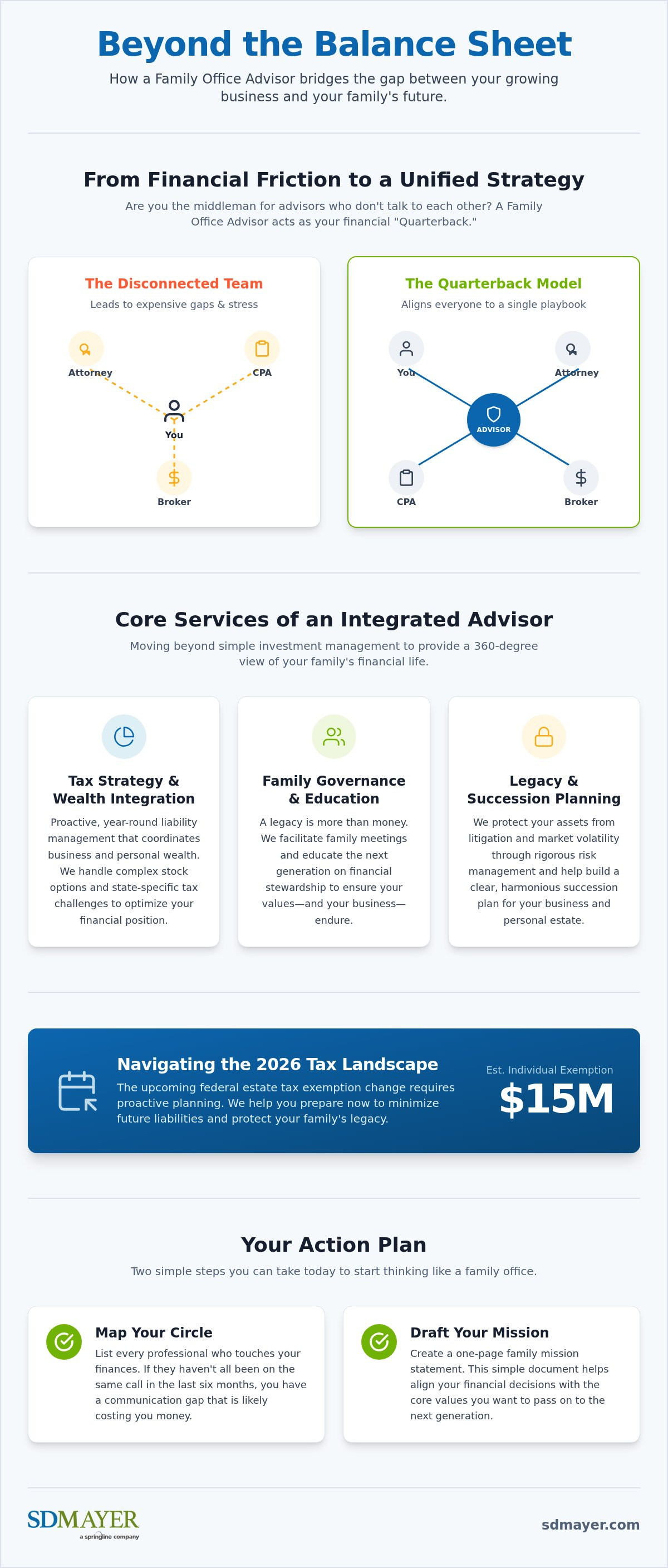
Most business owners suffer from professional friction. This happens when your lawyer gives you estate advice that your CPA says is a tax nightmare. A dedicated financial advisor for family office needs acts as the central hub. They manage the flow of information between your inner circle of experts, making sure everyone is working from the same playbook. This reduces the stress of playing middleman between your own advisors.
Addressing the Complexity of Mid-Market Wealth
Mid-market business owners face unique challenges, especially when preparing for an IPO or a business sale. The lines between corporate entities and personal trusts often blur. Without proper oversight, you might find yourself with high tax liabilities that could have been avoided with early planning. An integrated advisor looks at your business structure through the lens of your personal estate.
Trust accounting is another vital piece of this puzzle. It isn't just about keeping the books straight; it's about maintaining family harmony. When everyone has a clear, transparent view of how assets are managed and distributed, it prevents the misunderstandings that often tear families apart during transitions. This level of detail provides a stable foundation for the next generation and ensures the legacy you've built remains intact.
The Core Services of an Integrated Family Office Advisor
A dedicated advisor provides a level of oversight that standard wealth managers simply don't reach. They move beyond annual tax filing to focus on year-round liability management. This proactive approach ensures that every financial move you make is optimized for tax efficiency and long-term growth. When you evaluate if you need a family office, consider whether your current team is truly protecting your assets from litigation and market volatility. A financial advisor for family office operations acts as a shield, ensuring your wealth is protected through rigorous risk management and philanthropic strategies that align with your family's core values.
Tax Strategy and Wealth Integration
The foundation of a successful family office is the role of the tax advisor. In our region, managing California-specific challenges like SALT (State and Local Tax) and complex property taxes is essential. For many business owners and tech executives in Silicon Valley, stock option planning is the difference between a successful exit and a massive tax bill. We integrate these corporate complexities with your personal wealth to create a unified strategy that looks at the big picture rather than just the next quarter.
Family Governance and Education
Legacy isn't just about money; it's about the values that money supports. Integrated advisors help run productive family meetings where you can discuss financial stewardship and responsibility. This prevents the "wealth gap" that often occurs when the next generation isn't prepared for the assets they will eventually manage. By educating heirs on the nuances of business succession and investment management, you ensure the family business remains a source of pride rather than a source of conflict.
Managing the intersection of business and personal wealth requires a partner who understands both worlds. If you're ready to build a more cohesive strategy for your family's future, start a conversation with our advisory team to explore how an integrated model can simplify your financial life.
Comparing Family Office Models: SFO vs. MFO vs. Virtual
Choosing the right structure for your wealth isn't just about your net worth; it's about the level of complexity you want to manage personally. For many mid-market families, the traditional Single Family Office (SFO) is often an expensive overreach. With average operating costs for an SFO reaching $3 million annually in 2026, hiring a full-time, dedicated staff is usually only practical for those with assets well north of $100 million. For families in the $10 million to $100 million range, the search for a financial advisor for family office services often leads to more efficient, shared models.
Why the Outsourced Model is Winning in 2026
The outsourced approach succeeds because it applies the same efficiency found in cfo services for small business to your personal estate. You get the benefit of high-level strategic thinking without paying for it 40 hours a week. This scalability is vital for business owners who may need intense trust accounting support during a business transition but require less oversight during periods of steady growth. It allows you to pay for expertise, not just presence.
Cost-Benefit Analysis for Mid-Market Families
Many families fall into the "DIY" trap, thinking they're saving money by managing their own network of CPAs and brokers. The hidden costs here are massive. Missed tax opportunities or errors in business structure can cost far more than an advisory fee. When you compare a flat-fee or percentage-of-assets model against the potential losses of a fragmented strategy, the value of an integrated advisor becomes clear. You aren't just paying for management; you're paying for the prevention of expensive mistakes.
The goal is to move from being the person who manages the experts to being the person who makes the decisions based on their expert guidance. By selecting the model that fits your current scale, you ensure your wealth is working for you rather than creating another job for you to manage.
How to Evaluate and Select Your Advisory Partner
Selecting a financial advisor for family office management is one of the most consequential decisions a business owner will make. It isn't just about finding someone who can pick stocks; it's about finding a partner who understands the intricate dance between your business ledger and your personal legacy. You need to ensure they are a fiduciary, which is a legal obligation to act in your best interest. While many massive firms boast about billions in assets, mid-market families often find more value in a partner who offers both technical depth and a high-touch, personal connection.
A truly integrated partner must bridge the gap between CAAS (Client Accounting Advisory Services) and wealth management. If your advisor doesn't understand your business's cash flow or internal accounting, they can't give you accurate advice on your personal investments. Being local in the Bay Area also provides a massive advantage. Whether you are in San Francisco, Silicon Valley, or the North Bay, having an advisor who understands the local economic environment and regional tax nuances like SALT is vital for long-term stability.
Key Questions to Ask a Potential Family Office Advisor
- How do you integrate business accounting with my personal tax returns?
- What is your specific experience with California SALT and stock option planning?
- How do you charge for your services, and are there any potential conflicts of interest?
- Can you describe your process for coordinating with my existing legal and estate planning team?
The Role of Technology in Modern Wealth Management
Modern management requires more than just a quarterly PDF. You should look for firms that provide real-time reporting and secure portals for your data. Often, the quality of your family office decisions depends on the accuracy of your small business bookkeeping services. When these systems are linked, you get a clear view of your total net worth at any moment. This connectivity also demands top-tier cybersecurity to protect your family's sensitive data and asset transfers from modern digital threats.
Ready to see how a local, integrated approach can transform your financial strategy? Schedule a consultation with our Bay Area team to discuss your family's unique needs and long-term goals.
SD Mayer: The Integrated Solution for Bay Area Families
SD Mayer takes a different path than most firms. We believe a stable family office starts with precise accounting. While many providers focus solely on picking stocks, we act as a "CFO for the family," ensuring your business and personal finances are perfectly aligned. This accounting-first foundation is why mid-market families across San Francisco, Menlo Park, and Sacramento trust us to manage their most complex financial challenges. By combining our CAAS, Tax, and Wealth Management teams, we eliminate the gaps that often lead to missed opportunities. Our approach combines three essential pillars to support your family:
- CAAS and Accounting: Providing the real-time data needed for smart decision-making.
- Strategic Tax Planning: Managing SALT and corporate liabilities year-round.
- Wealth Management: Aligning your investment portfolio with your long-term legacy goals.
Our "Holistic Mentor" philosophy means we don't just report on the past; we actively look toward your future growth. As a financial advisor for family office clients, we become a steady companion through every stage of your business journey. Whether you're scaling a startup in Silicon Valley or managing a multi-generational business in the North Bay, our integrated approach provides the clarity you need to make confident decisions. We understand that your business is often your largest asset, so we treat it with the same strategic care as your personal portfolio.
A Seamless Transition from Business Success to Family Legacy
Founders often face their biggest hurdles during liquidity events. Managing the wealth that follows a successful business exit or IPO requires a specific type of coordination. We help you navigate these moments by aligning your corporate structure with your individual estate goals. For example, we recently helped a local family restructure their holdings before a major sale. By coordinating their trust accounting with a proactive tax strategy, we significantly reduced their tax impact and secured their legacy for the next generation. This synergy is where our integrated model truly shines.
This level of planning is especially critical as we approach the 2026 tax shifts. With federal estate tax exemptions set at $15 million per individual, there's a narrow window to optimize your wealth transfer strategies. We don't just look at numbers on a page; we look at how those numbers impact your family's long-term stability and harmony. A financial advisor for family office needs must be able to see these connections before they become problems.
Getting Started with Your Outsourced Family Office
The first step is a discovery process where we map out your big-picture goals. We don't start with financial products; we start with your vision for your family and your business. From there, we build a customized roadmap for your 2026 financial strategy. Our goal is to simplify your life by providing a single, reliable point of contact for all your financial needs.
Building a legacy requires more than just good luck; it requires a plan that accounts for every variable. If you're ready to move beyond fragmented advice and toward a unified strategy, we're here to guide you. Let's start building a roadmap that protects what you've created and prepares your family for what's next.
Building a Resilient Legacy for the Next Generation
Managing mid-market wealth doesn't have to be a source of constant stress. By shifting to an integrated model, you move from coordinating disjointed professionals to leading a unified strategy. You've seen how a dedicated financial advisor for family office needs can bridge the gap between your business accounting and your personal legacy. This approach ensures that every business decision supports your long-term family goals while reducing the professional friction that often stalls progress.
SD Mayer offers decades of experience serving Bay Area mid-market families with a comprehensive blend of CAAS, tax strategy, and wealth management. We bring deep expertise in Silicon Valley stock option planning and SALT nuances to help you navigate the complexities of 2026 and beyond. It's time to simplify your financial life and ensure your wealth is working as hard as you are. We're ready to act as your steady companion through every stage of your journey.
Schedule a consultation with SD Mayer to build your family office strategy.
Your family’s future is too important to leave to chance; let's start building a roadmap that protects your success for years to come.
Frequently Asked Questions
What is the difference between a wealth manager and a family office advisor?
A wealth manager primarily focuses on your investment portfolio and asset allocation. In contrast, a financial advisor for family office services takes a broader view by coordinating your entire financial ecosystem, including business accounting, tax strategy, and estate planning. They act as a central hub for all your professional advisors to ensure every part of your financial life works together seamlessly.
Does my family need a certain net worth to justify a family office?
While traditional single family offices often require a net worth of $100 million or more, modern multi-family and virtual models are practical for families starting at $10 million. If your financial life has become too complex to manage with a disconnected team of professionals, the efficiency of an integrated model usually justifies the investment. It's more about the complexity of your assets than a specific entry number.
How can a family office advisor help with my business exit strategy?
An advisor helps by aligning your business structure with your personal goals long before a sale occurs. They manage the tax impact of a liquidity event and ensure that the proceeds are transitioned into your personal estate or trusts with minimal friction. This proactive planning often saves families from significant tax liabilities that arise during a hurried or poorly structured exit.
What are the tax benefits of a multi-family office model in California?
Multi-family offices provide access to specialized tax experts who understand California's unique challenges, such as SALT deduction limits and complex property tax rules. By sharing these resources across several families, you get high-level strategy at a lower cost than hiring a full-time team. This model ensures you are taking advantage of every available credit across both your business and personal accounts.
How do family office advisors handle trust and estate accounting?
Advisors handle trust and estate accounting by maintaining precise records of all asset movements and distributions. This transparency is vital for preventing family disputes and ensuring that your legacy is managed exactly as you intended. By integrating this with your broader financial reporting, you get a clear, real-time view of how your trusts are performing and how they fit into your total net worth.
Can a family office advisor also manage my company's payroll and bookkeeping?
Yes, an integrated financial advisor for family office management can certainly handle your company's payroll and bookkeeping through outsourced services. In fact, having these services under one roof provides the accurate data needed to make informed wealth management decisions. It eliminates the need for you to manually transfer data between your business and personal financial teams, reducing the risk of errors.
What is the role of a family office in philanthropic giving?
A family office helps you align your charitable giving with your family's core values while maximizing tax benefits. They can help set up structures like donor-advised funds or private foundations to ensure your contributions are both impactful and tax-efficient. This strategic approach turns giving into a structured part of your family’s long-term financial plan rather than a series of disconnected donations.
How often should a family office advisor meet with the whole family?
Most families find that meeting with their advisor once or twice a year is ideal for discussing long-term strategy and legacy values. However, more frequent quarterly check-ins are often necessary for the primary decision-makers to review financial performance and tax updates. These meetings are also an excellent opportunity to educate the next generation about financial stewardship and their future responsibilities.
SECURITIES AND ADVISORY DISCLOSURE:
Securities offered through Valmark Securities, Inc. Member FINRA, SIPC. Fee based planning offered through SDM Advisors, LLC. Third party money management offered through Valmark Advisers, Inc a SEC registered investment advisor. 130 Springside Drive, Suite 300, Akron, Ohio 44333-2431. 1-800-765-5201. SDM Advisors, LLC is a separate entity from Valmark Securities Inc. and Valmark Advisers, Inc. Form CRS Link
DISCLAIMER:
This material has been prepared for informational purposes only, and is not intended to provide, and should not be relied on for, accounting, legal or tax advice. The services of an appropriate professional should be sought regarding your individual situation.
HYPOTHETICAL DISCLOSURE:
The examples given are hypothetical and for illustrative purposes only.