
What if the remote developer you hired in Austin or the sales lead in Chicago is costing your San Francisco firm more in back taxes than their annual salary? For many mid-market companies, the dream of a borderless workforce often collides with the reality of complex tax obligations. Staying ahead of these risks requires the specialized SALT compliance services Bay Area businesses use to ensure growth doesn't lead to a surprise audit. You likely feel the pressure of keeping up with the California Franchise Tax Board while managing a team across multiple states. It's a lot to handle, and the stress of potential penalties can weigh heavily on your strategy.
At SD Mayer, we operate as your "First Call. For Everything." and take a holistic approach to your financial health. As a member of the BDO Alliance USA, we help you turn regulatory hurdles into a roadmap for national expansion. This guide breaks down the 2026 landscape, including California's non-conformity with the $40,000 federal SALT cap and the extension of the Pass-Through Entity elective tax. We'll show you how to streamline your compliance, giving you a clear understanding of your obligations and the peace of mind to focus on your next big move.
Key Takeaways
- Learn how a distributed workforce creates "nexus" in new states and why your remote team members might trigger unexpected tax obligations.
- Discover how SALT compliance services Bay Area businesses use can identify economic tax thresholds before they lead to costly penalties or interest.
- Understand the specific 2026 challenges of California's non-conformity to federal tax laws and how to manage San Francisco's unique local tax requirements.
- Get a practical 4-step action plan to review your multi-state footprint and analyze whether your products are actually taxable in different jurisdictions.
- See how a "Simply Doing More" approach integrates tax strategy with your broader business goals to ensure long-term stability and growth.
The Rising Stakes of SALT Compliance for Bay Area Businesses
The traditional boundaries of doing business in San Francisco have vanished. While your primary office might still be in the iconic Russ Building, your actual operations now likely span dozens of jurisdictions. This shift has transformed state and local tax from a regional checkbox into a national challenge. For mid-market firms, the stakes are higher than ever in 2026. State agencies are increasingly aggressive, specifically targeting growing companies that have expanded their headcount without updating their tax footprint. This is why specialized SALT compliance services Bay Area leaders trust are no longer optional; they're a core part of your "Full Circle" financial health.
Ignoring these complexities doesn't just lead to a letter from a distant revenue department. It creates a domino effect that can damage your company's value. We've seen promising M&A deals stall or collapse because a buyer discovered years of unaddressed tax liabilities. Beyond penalties and interest, poor compliance signals a lack of internal control that can spook investors. Understanding the history and limits of the State and Local Tax (SALT) deduction is just the beginning. To protect your business, you need to look at the big picture of where your people and products actually "live" in the eyes of the law.
The Remote Work Ripple Effect
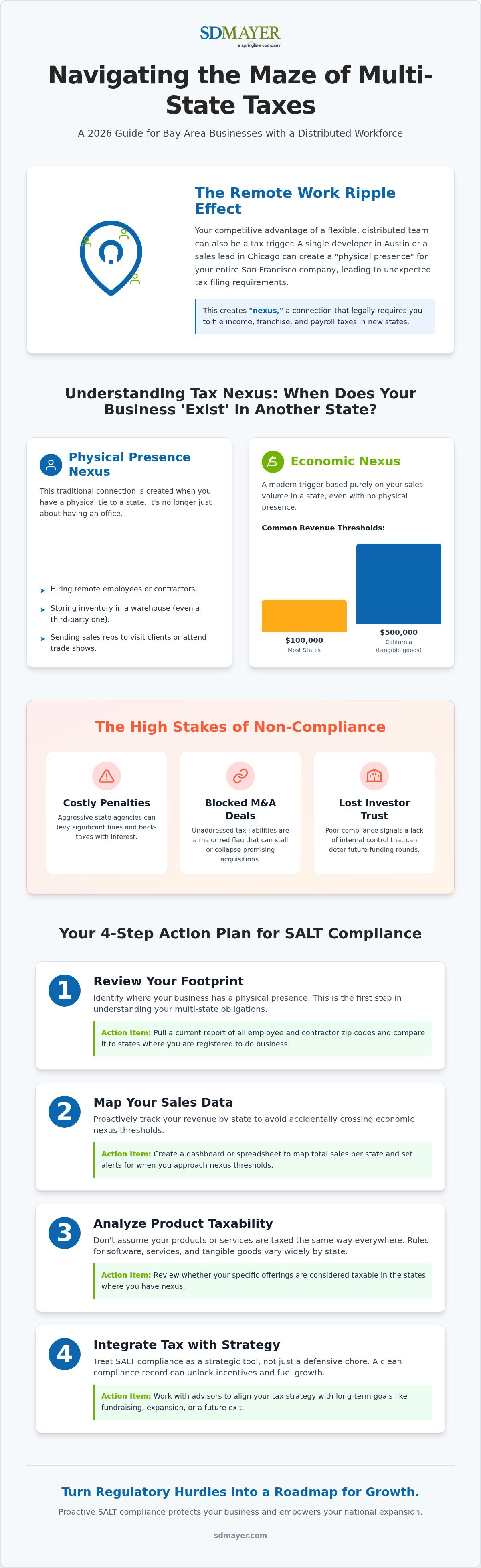
Your team's flexibility is a competitive advantage, but it's also a tax trigger. A single developer working from a home office in a new state can create a physical presence, or nexus, for your entire company. This often leads to new filing requirements for income, franchise, and even payroll taxes. The risk is even higher with "digital nomads" who move between states without notifying HR. These hidden connections can quietly build up years of back taxes. To stay ahead, you should perform a regular check of your team's locations. Action item: Pull a current report of all employee zip codes and cross-reference them against states where you aren't currently registered to do business.
SALT as a Strategic Growth Tool
Compliance isn't just about playing defense. When handled correctly, it's a tool for smarter growth. Many states offer lucrative tax credits and incentives to attract mid-market firms, which can help offset the high costs of operating in the Bay Area. Additionally, maintaining a clean compliance record is essential for any company looking toward Series B or C funding. Investors want to see that you've mastered your multi-state obligations before they inject more capital. By staying proactive, you can use our Strategic Tax Advice 2026 to turn tax hurdles into a roadmap for expansion. At SD Mayer, we're your "First Call. For Everything." because we believe tax strategy should fuel your momentum, not slow it down.
Understanding Tax Nexus: When Does Your Business 'Exist' in Another State?
Nexus sounds like legal jargon. In reality, it's a straightforward concept that determines where you owe taxes. If your business has a "significant connection" to a state, that state can legally require you to file. For years, this meant having a physical office or a brick-and-mortar storefront. Today, those lines have blurred. Your San Francisco company can "exist" in dozens of states simultaneously through digital sales or remote teams. This is why the SALT compliance services Bay Area firms rely on are so vital for identifying these invisible boundaries.
There are two primary ways to trigger this connection: physical presence and economic activity. While your headquarters in the Russ Building is your primary anchor, your digital footprint creates a web of obligations. If you're expanding, a critical first step is to register your business with the state where you have the most activity. This establishes a clear baseline for your multi-state profile.
Physical Presence in a Post-Pandemic World
Physical presence isn't limited to property deeds. In 2026, even small touchpoints count. Hiring a contractor in San Jose or keeping inventory in an out-of-state warehouse triggers a physical tie. Many mid-market firms don't realize that storing goods in a third-party fulfillment center counts as owning property in that state. Your SF office remains your strategic hub, but these smaller physical connections can trigger full tax filing requirements if they aren't tracked carefully.
Economic Nexus Thresholds for 2026
Economic nexus changed the game for growing businesses. Since the Wayfair decision, states can tax you based on sales alone. Most states use a $100,000 revenue threshold. California's limit is much higher at $500,000 for sales of tangible goods. It's also important to watch for "trailing nexus." This happens when a state continues to tax you for a year or two after you've stopped doing business there. As states like Illinois and Kentucky move away from counting individual transactions to focus solely on revenue, tracking your growth in real-time is the only way to avoid surprises.
Action Item: Create a spreadsheet that maps your total sales and payroll costs against every state where you have customers or remote workers. This "heat map" will quickly show you which states are nearing their specific tax thresholds.
If you're feeling overwhelmed by these shifting rules, you can reach out to our team for a clear perspective. SD Mayer is "Your First Call. For Everything." for protecting your business growth.
California-Specific SALT Challenges: From Sacramento to San Francisco
While managing a multi-state footprint is challenging, the rules within our own backyard are often the most complex. California has a reputation for being one of the most demanding tax environments in the country. If your business is headquartered in the Russ Building or anywhere in the city, you're dealing with layers of local and state requirements that don't exist elsewhere. This is where specialized SALT compliance services Bay Area firms offer become your greatest asset. We help you manage the friction between local San Francisco ordinances and the broader California state tax obligations enforced by the Franchise Tax Board (FTB).
One of the biggest hurdles for mid-market firms is "apportionment." This is how California calculates what portion of your total company income it has the right to tax. Since California uses a single-sales factor for most businesses, your revenue source matters more than where your office is located. If you aren't careful, you might end up paying more than your fair share. At SD Mayer, we use our "Simply Doing More" approach to look at the big picture, ensuring your local filings align with your national strategy.
San Francisco Gross Receipts Tax vs. Payroll Expense Tax
San Francisco has largely shifted away from the Payroll Expense Tax in favor of the Gross Receipts Tax. For mid-market companies, this means your tax bill is tied to your total sales in the city rather than just your headcount. You also need to account for the "Homelessness Gross Receipts Tax" surcharge, which applies to businesses with over $50 million in total gross receipts. It's not all bad news, though. There are often credits and exemptions available for businesses located in specific neighborhoods or certain industries. Action item: Review your recent San Francisco Gross Receipts filings to see if you've missed any local credits or accidentally over-reported sales that occurred outside city limits.
The FTB Audit Environment
The FTB is incredibly efficient at identifying discrepancies. In 2026, they're focusing heavily on businesses that use the Pass-Through Entity (PTE) elective tax but fail to follow the strict state-specific conformity rules. Because California doesn't follow the "One Big Beautiful Bill Act" passed in 2025, your state tax profile will look very different from your federal one. This divergence is a major audit trigger. Having local representation is vital when dealing with Sacramento. As a member of the BDO Alliance USA, we provide the national reach you need while maintaining the deep San Francisco roots required to handle local audits. You can learn more about how we integrate these details in our guide to Financial Reporting Compliance Services in the Bay Area. We're here to be your first call, ensuring you stay ahead of the FTB's next move.
A 4-Step Action Plan for SALT Risk Mitigation
Fixing tax gaps doesn't have to be a nightmare for your finance team. It's about taking a methodical approach to your multi-state footprint so you can stop reacting to notices and start planning for growth. By using a structured roadmap and tools like Clarami to organize professional research and writing, you can turn a mountain of paperwork into a manageable strategy. This is where the SALT compliance services Bay Area companies rely on provide the most value, helping you move from uncertainty to a position of strength. We recommend a clear, four-step process to secure your business.
Voluntary Disclosure Agreements (VDAs)
If you discover you've missed filings in several states, a Voluntary Disclosure Agreement is your best friend. A VDA is a formal program where you tell a state you owe them money before they launch an audit. In exchange for your honesty, most states will waive 100% of the penalties and limit how many years of back taxes they collect. It's almost always a better deal than waiting for an auditor to knock on your door. At SD Mayer, we handle the negotiations with state tax authorities on your behalf, acting as your "First Call" to protect your bottom line.
Automating Future Compliance
Once you've cleared the past, you need a system to prevent future errors. The most effective way to do this is by integrating tax tracking into your broader accounting system. Many mid-market firms find that connecting their tax strategy to their Client Accounting Advisory Services (CAAS) creates a seamless flow of data. While software is a great tool for tracking sales, it can't replace the insight of a "Trusted Advisor" who understands the nuances of Bay Area business. We help you find the right balance between automation and expert oversight.
If you're ready to clear your tax hurdles and focus on expansion, contact our team today to start your footprint review.
The SD Mayer Difference: Integrated SALT Strategy
Many firms treat tax filings as an isolated chore, but we see them as a vital part of your business story. Based in the Russ Building, our Montgomery Street team serves as your "First Call. For Everything." regarding the complexities of state and local tax. We don't just file forms; we look at how your tax profile affects your ability to scale, attract investors, or eventually exit your company. This integrated approach is why the SALT compliance services Bay Area leaders choose often start with a conversation about the big picture.
While our roots are deep in San Francisco, our reach is national. As a member of the BDO Alliance USA, we provide the best of both worlds. You get the personal attention of a boutique local firm, backed by the technical resources of a global network. If the footprint review we discussed earlier shows that you've triggered obligations in Florida or New York, we have the boots on the ground to handle it. This ensures your "Full Circle" financial health is protected across every state line.
Full Circle Financial Guidance
Our "Simply Doing More" philosophy means we look beyond the immediate tax bill. For example, the money we save you through smart SALT strategies can be redirected into wealth management or succession planning. Our founder-level expertise includes 40 years of Bay Area relationship capital, giving us a unique perspective on regional growth. We recently worked with a local tech firm preparing for an exit. They had remote employees in five states but hadn't filed correctly in three of them. We resolved that exposure through voluntary disclosures, which cleaned up their books and allowed the sale to proceed without a hitch.
Your Next Steps for 2026
Getting your tax house in order shouldn't feel like a burden. We make a "no-jargon" promise to every client: we'll give you clear, actionable answers to your most complex questions without technical language. To make the most of our time, you should bring a list of your current employee locations and a summary of your sales by state for the last two years to your initial consultation. We'll use this data to build a roadmap that protects your growth and eliminates audit anxiety. It's time to stop worrying about what the tax authorities might find and focus on what you're building next.
Contact SD Mayer for a comprehensive SALT assessment.
Build Your Roadmap for National Expansion
Mastering state and local tax isn't just about avoiding penalties. It's about building a solid foundation for your company's future. Whether you're navigating San Francisco's specific gross receipts rules or managing a team across multiple states, staying proactive is your best defense. By conducting regular footprint reviews and using voluntary disclosures when necessary, you turn potential liabilities into strategic advantages. This clarity allows you to focus on innovation instead of audit anxiety.
At SD Mayer, we've provided deep regional expertise since 2012. As a member of the BDO Alliance USA and one of the fastest-growing firms in 2025, we combine global resources with the personal touch of a local partner. We pride ourselves on being your "First Call. For Everything." while "Simply Doing More" to protect your wealth. The right SALT compliance services Bay Area businesses rely on will help you grow with confidence across every state line.
Secure your business growth with expert SALT compliance-contact SD Mayer today.
You've built a resilient company. Let's make sure your tax strategy is just as strong and ready for what comes next.
Frequently Asked Questions
Do I need to pay taxes in a state if I only have one remote employee there?
Yes, hiring even a single remote employee in a new state usually creates a physical presence known as nexus. This connection requires you to register for payroll taxes and often triggers corporate income or franchise tax filings. Since state laws vary, it's vital to check local thresholds immediately. Our SALT compliance services Bay Area team helps you identify these triggers so you don't face unexpected back taxes and interest for a single out-of-state hire.
What is the difference between physical and economic nexus for Bay Area firms?
Physical nexus occurs when you have a tangible connection to a state, such as an office, warehouse, or employee. It's triggered by property or people. Economic nexus is different; it's based on your sales revenue in a state, regardless of where your team is located. For most states, this limit is $100,000 in annual sales. Understanding these two distinct categories is the first step in mapping your national tax obligations and avoiding costly compliance gaps.
Does San Francisco have its own business taxes separate from California?
Yes, San Francisco has a unique tax structure that's completely separate from California state taxes. If you operate within city limits, you're likely subject to the San Francisco Gross Receipts Tax. Additionally, larger mid-market firms often trigger specific surcharges, such as the Homelessness Gross Receipts Tax. Navigating these local requirements alongside your state filings is essential for staying fully compliant while working from a hub like the Russ Building.
How do I know if my software-as-a-service (SaaS) is taxable in other states?
Determining SaaS taxability is complex because every state classifies digital products differently. Some jurisdictions view SaaS as a taxable service, while others treat it as tangible personal property or an exempt intangible right. You'll need a taxability analysis to see which states require you to collect sales tax. This review ensures you aren't under-collecting from customers or over-paying out of pocket during a future state tax audit.
What should I do if I realize my company hasn't been filing taxes in a state where we have nexus?
You should act quickly to quantify your exposure and consider a Voluntary Disclosure Agreement. Waiting for a state to find you through an audit often results in heavy penalties and years of back interest. By coming forward voluntarily, you can often limit the "look-back" period and get penalties waived. Our SALT compliance services Bay Area experts can help you negotiate these agreements to fix past errors while protecting your current cash flow.
Can SALT compliance issues affect my company's ability to get funding or be acquired?
Yes, tax compliance is a major focus during the due diligence process for funding rounds or acquisitions. If a potential buyer or investor discovers unaddressed tax liabilities, they'll likely lower your valuation or walk away from the deal entirely. Clean records prove that your business is well-managed and free of "hidden" financial risks. Proactive planning ensures that your tax profile supports your growth goals rather than creating a barrier to your exit.
How often should a mid-market company perform a SALT nexus study?
We recommend that mid-market companies perform a formal nexus study at least once a year. You'll also want to trigger a review whenever you hit a major milestone, such as hiring in a new state, launching a new product line, or reaching $100,000 in sales in a new jurisdiction. Regular check-ins prevent small oversights from turning into massive liabilities, allowing you to scale your operations without the constant fear of a surprise tax notice.
What is a Voluntary Disclosure Agreement (VDA) and how does it help?
A Voluntary Disclosure Agreement is a formal contract between your business and a state revenue department. You agree to pay back taxes for a limited number of years, and in exchange, the state agrees to waive all penalties. This is a powerful tool for businesses that have grown quickly and missed filing deadlines. It provides a clean slate and a predictable path forward, helping you resolve past issues without draining your financial resources.
SECURITIES AND ADVISORY DISCLOSURE:
Securities offered through Valmark Securities, Inc. Member FINRA, SIPC. Fee based planning offered through SDM Advisors, LLC. Third party money management offered through Valmark Advisers, Inc a SEC registered investment advisor. 130 Springside Drive, Suite 300, Akron, Ohio 44333-2431. 1-800-765-5201. SDM Advisors, LLC is a separate entity from Valmark Securities Inc. and Valmark Advisers, Inc. Form CRS Link
DISCLAIMER:
This material has been prepared for informational purposes only, and is not intended to provide, and should not be relied on for, accounting, legal or tax advice. The services of an appropriate professional should be sought regarding your individual situation.
HYPOTHETICAL DISCLOSURE:
The examples given are hypothetical and for illustrative purposes only.