
What if the biggest paycheck for your 2026 innovation isn't coming from a customer, but from the tax code itself? If you're running a mid-market company, you already know that the cost of talent in San Francisco and San Jose is staggering. You're likely also feeling the weight of Section 174 capitalization rules and the constant worry that an IRS audit might pick apart your hard work. It's a lot to manage while trying to keep your team focused on the next big breakthrough. Finding the right R&D tax credit services Bay Area experts provide can change that stress into a strategic advantage.
This guide is designed to help you turn your daily problem solving into actual cash flow with a clear, jargon-free approach. We'll show you how to build a repeatable process for documenting your innovation so you can maximize your reinvestment in new headcount. You'll discover a way to handle these complex requirements with the steady, expert guidance your business deserves. Let's look at how you can secure your company's financial future while staying focused on what you do best: building the future.
Key Takeaways
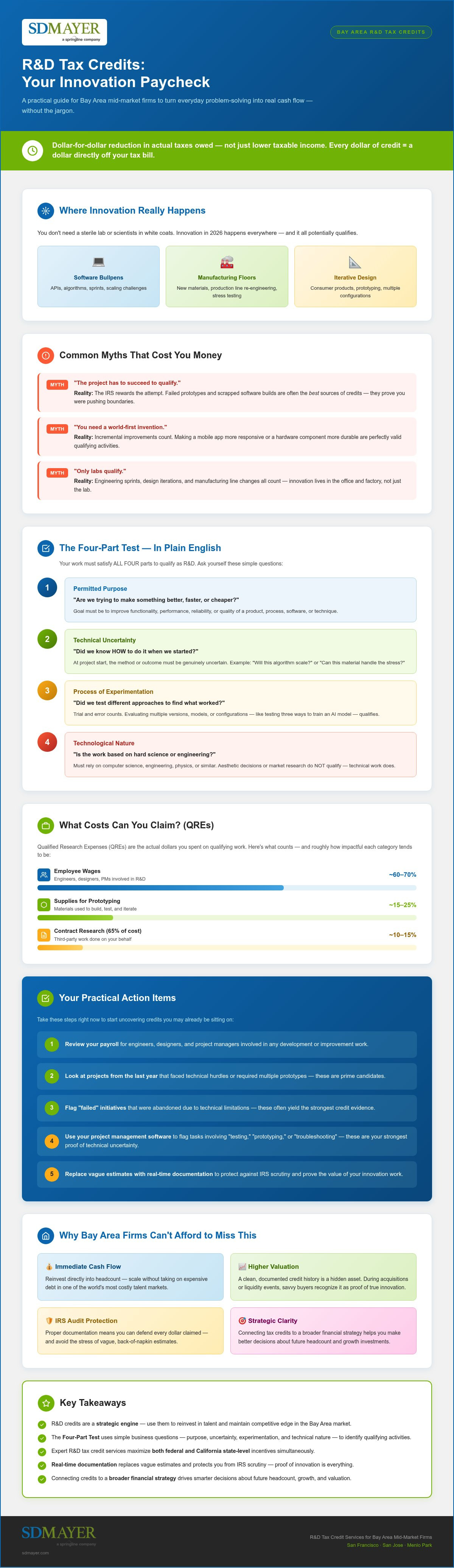
- Understand how R&D credits serve as a strategic engine for reinvesting in your team and maintaining your competitive edge in the local market.
- Navigate the "Four-Part Test" using simple business questions to quickly identify which of your everyday projects qualify for significant tax savings.
- Partner with experts in R&D tax credit services Bay Area businesses trust to maximize both federal and California state-level incentives simultaneously.
- Protect your business from IRS scrutiny by replacing vague estimates with a precise, real-time documentation process that proves the value of your innovation.
- Learn why connecting your tax credits to a broader financial strategy helps you make better decisions about future headcount and growth.
What is the R&D Tax Credit and Why Does it Matter for Bay Area Firms?
The R&D tax credit isn't just a line item on a tax return; it's a powerful government incentive designed to keep high-paying innovation jobs right here in the United States. For companies operating in San Francisco, San Jose, or Menlo Park, this credit is vital. The Bay Area is the world's engine for progress, but it's also one of the most expensive places to run a business. This credit acts as a "dollar-for-dollar" reduction in the actual taxes you owe. Unlike a standard deduction that only lowers your taxable income, a credit wipes out your tax bill directly. This means more capital stays in your accounts to fuel your next big project.
Many leaders assume R&D requires a sterile laboratory and teams in white lab coats. In reality, innovation in 2026 happens in software bullpens, on manufacturing floors, and during the iterative design of consumer products. If your team is trying to make something faster, stronger, or more efficient, you're likely sitting on a goldmine of unclaimed credits. Innovation lives in the office and the factory just as much as the lab.
The Economic Impact of R&D Credits in 2026
The cost of doing business in Northern California continues to climb, especially regarding specialized talent. R&D credits provide immediate cash flow that you can reinvest directly into your headcount. When you utilize professional R&D tax credit services Bay Area firms rely on, you're not just filing a form; you're building a war chest. This liquidity is crucial for mid-market firms looking to scale without taking on expensive debt. Additionally, having a clean, well-documented history of these credits can significantly boost your company's valuation. During a liquidity event or an acquisition, savvy buyers look for these "hidden" assets that prove your company is a true innovator.
Common Misconceptions: Why Mid-Market Firms Miss Out
One of the biggest myths we hear is that your project has to be a "success" to qualify. That's simply not true. The IRS rewards the attempt to innovate. Failed prototypes and scrapped software builds are often the best sources for credits because they prove you were pushing boundaries and facing technical uncertainty. You also don't need a groundbreaking, world-first invention. Incremental improvements to your existing products, such as making a mobile app more responsive or a hardware component more durable, are perfectly valid.
Practical Action Items:
- Review your payroll for engineers, designers, and project managers involved in development.
- Look at projects from the last year that faced technical hurdles or required multiple prototypes.
- Identify "failed" initiatives that were eventually abandoned due to technical limitations.
Does Your Work Qualify? The Four-Part Test in Plain English
Identifying which projects qualify for tax savings doesn't have to be a legal headache. To help mid-market firms navigate this, the IRS uses a "Four-Part Test" to determine if an activity counts as research. Before diving into the test, it's helpful to understand what costs you can actually claim. These are known as Qualified Research Expenses (QREs), and they primarily include the wages of the people doing the work, the supplies used for prototyping, and a portion of what you pay for contract research. When you work with R&D tax credit services Bay Area experts, the first goal is to map these expenses to your specific innovation cycles.
The permitted purpose of R&D is the intent to develop or improve the functionality, performance, reliability, or quality of a product, process, software, or technique.
Part 1 & 2: Purpose and Uncertainty
The first part of the test asks: is the goal to make something better, faster, or cheaper? If you're trying to improve a business component, you've met the purpose. The second part is uncertainty. This means that at the start of the project, you didn't know exactly how to achieve the result or if it was even possible. In a software sprint, this happens when you aren't sure if a new algorithm will scale. In manufacturing, it's the moment you wonder if a new material can withstand specific stress levels. If you're unsure if a specific project meets these criteria, it's often helpful to reach out for a quick assessment.
Action Item: Use your project management software to flag tasks that involve "testing," "prototyping," or "troubleshooting." These are your strongest indicators of technical uncertainty.
Part 3 & 4: Process of Experimentation and Technical Nature
Experimentation is simply the act of trial and error. Did you evaluate different versions, models, or configurations? If your team tested three different ways to train an AI model before finding the one that worked, that's a process of experimentation. The final requirement is that the work must be technical. This means it relies on "hard sciences" like computer science, engineering, or physics. For a Bay Area tech firm, this might look like developing a custom API to handle massive data loads. For a local manufacturer, it could be re-engineering a production line to reduce waste. As long as the work isn't based on soft sciences like aesthetics or market research, it likely qualifies for the credit.
Federal vs. California R&D Credits: Maximizing Your Local Advantage
Operating a business in Northern California offers a unique edge because the state provides one of the most generous innovation incentives in the country. While the federal credit is well-known, many mid-market leaders don't realize that the California R&D credit is permanent and doesn't require the same periodic legislative renewals as the federal version. This stability allows you to plan your long-term growth with more confidence. When you leverage R&D tax credit services Bay Area specialists provide, you ensure that you aren't just filing for one benefit while leaving the other on the table. The two credits work together to significantly lower your overall tax burden.
| Feature | Federal R&D Credit | California R&D Credit |
|---|---|---|
| Typical Credit Rate | 6.5% to 20% (varies by method) | 15% |
| Carryforward Period | 20 Years | Infinite (Never expires) |
| Legislative Status | Subject to renewal | Permanent |
Why the California Credit is a Game Changer
The California Franchise Tax Board (FTB) has its own set of rules, and in some cases, it's actually easier to qualify for the state credit than the federal one. One of the most significant advantages for local firms is the infinite carryforward. If your company is reinvesting so heavily into growth that you don't have a tax liability this year, those California credits don't disappear. They stay on your books forever until you're ready to use them. It's vital to keep "California-only" documentation, as the FTB is known for its specific focus on where the work was actually performed. If the innovation happened in a Bay Area office, it's eligible.
Navigating Section 174 in 2026
In 2026, the rules around Section 174 continue to be a major hurdle for mid-market companies. You can no longer deduct your R&D expenses all at once; instead, you must capitalize and amortize them over five years for domestic work. This change often results in a higher taxable income and a surprising tax bill, even if your cash flow hasn't changed. The R&D credit becomes your best tool to offset this increased tax liability. By claiming the credit, you effectively "buy back" the cash flow that the capitalization rules took away. Using specialized R&D tax credit services Bay Area firms trust helps you align this credit with your broader tax strategy.
Action Item: Review your 2026 capitalization strategy with your advisor to see how the five-year amortization schedule will impact your quarterly tax payments. Adjust your forecasts now to avoid year-end cash flow crunches.
Avoiding the Audit: Best Practices for Documentation
The IRS and California FTB aren't just looking for numbers; they're looking for a "nexus." This means you must prove a direct link between the wages you paid and the specific technical problem your team solved. In 2026, using high-level estimates to calculate your claim is a recipe for trouble. Professional R&D tax credit services Bay Area firms emphasize that the quality of your evidence is just as important as the quantity of your innovation. Evidence matters. You need to show the "how" and "why" behind every dollar claimed to ensure your business stays protected.
What an Audit-Ready File Looks Like
Contemporaneous documentation is the collection of records, notes, and data created at the same time the research activity is actually taking place. You don't need to reinvent your entire workflow to capture this. Most mid-market firms already have the proof they need in tools like Jira, Asana, or GitHub. The key is organizing these project notes and time-tracking logs into a cohesive story that a tax auditor can follow. Don't wait for an inquiry to start digging through your archives.
An ideal audit file includes:
- Project charters outlining the technical goals and uncertainties.
- Meeting minutes where technical hurdles and "failed" attempts were discussed.
- Payroll records linked to specific project codes or development sprints.
- Emails between engineers and project managers regarding troubleshooting.
The Risk of Niche "Credit Mills"
Be cautious of "credit mills" that promise massive returns for a percentage of the credit but offer little support once the papers are filed. If an inquiry arrives from the tax authorities, these firms often disappear. Working with a full-service provider of R&D tax credit services Bay Area companies trust ensures that your R&D study is integrated with your overall tax and audit strategy. This "Full Circle Financial Guidance" model means your advisor is already familiar with your books, making the documentation process much smoother. You want a partner who sees the big picture, not just a one-time fee.
Action Item: Before signing with a provider, check if they offer "Audit Defense" as part of their service. You want a partner who will stand by their work and represent you if the IRS asks questions.
At SD Mayer, we aim to be your "first call" whenever a financial challenge or opportunity arises. If you want to ensure your claim is built on a solid foundation, schedule a documentation review with our team today.
Why an Integrated Advisory Approach Outperforms Niche Tax Consultants
Many companies make the mistake of hiring a boutique tax shop that only looks at innovation through a tiny lens. While these niche firms might find a credit, they often miss how that credit impacts your entire financial health. Choosing the integrated R&D tax credit services Bay Area innovators depend on means your tax strategy isn't a lonely island. Instead, it becomes a core part of your growth engine. At SD Mayer, we believe in a "Full Circle" approach where tax, audit, and advisory teams talk to each other. This ensures that a win in one area doesn't create a headache in another.
This holistic perspective is a cornerstone of Client Accounting Advisory Services (CAAS). When your R&D data is integrated into your daily accounting, your outsourced CFO can make much more accurate cash flow forecasts. They'll know exactly when those credits will hit your bottom line, allowing you to make confident decisions about hiring new engineers or investing in new equipment. We've seen this model help companies grow from their first Series A round all the way to becoming mid-market leaders in the regional economy.
Strategic Synergy: R&D and Your Total Tax Plan
Your innovation credits don't exist in a vacuum. They interact directly with your SALT compliance and your overall corporate tax liability. Having the same firm handle your financial reporting and your tax credits creates a seamless flow of information. It reduces the time your team spends explaining the same projects to different consultants. Plus, as a member of the BDO Alliance, we can support your growth even if your R&D teams move beyond Northern California to global locations. You get local expertise with a global reach.
Next Steps: Securing Your 2026 Credits
The best time to start documenting your innovation is while your team is actually doing the work. Waiting until tax season to reconstruct a year's worth of software sprints or manufacturing trials leads to missed opportunities and weaker audit protection. We invite you to a straightforward, no-jargon consultation to see if your current projects qualify for significant savings. By choosing the R&D tax credit services Bay Area businesses trust, you're securing a partner who is genuinely invested in your long-term success.
Action Item: Schedule a brief discovery call to review your current project list. We'll help you identify the "low-hanging fruit" that could immediately improve your 2026 cash flow.
Ready to see how much your innovation is worth? Contact the SD Mayer team today.
Fueling Your Next Breakthrough
The path to maximizing your innovation incentives in 2026 is clear. By focusing on real-time documentation and understanding the specific advantages of California's permanent credit, you can turn complex tax requirements into a steady stream of cash flow. It's about moving beyond simple calculations and adopting a strategy that considers your entire business journey. You've worked hard to build something new, and the tax code is designed to reward that effort when handled with precision.
As a member of the BDO Alliance USA with deep Bay Area roots since 2012, our team at SD Mayer is here to handle the heavy lifting. We were recently named one of the Top 25 Fastest-Growing Firms in 2025 because we prioritize long-term partnerships over one-off transactions. When you choose the R&D tax credit services Bay Area leaders trust, you're gaining a mentor who understands the nuances of our local tech and manufacturing landscape. We don't just file forms; we help you navigate the future.
Don't let your hard-earned innovation dollars sit on the table. Get a clear, strategic assessment of your R&D credit potential; contact SD Mayer today. We're excited to help you reinvest in your team and reach your next milestone with confidence.
Frequently Asked Questions
Does my software startup qualify for R&D tax credits in 2026?
Software startups in San Francisco and San Jose often qualify if they are developing new algorithms or solving complex scaling issues. In 2026, your work must involve technical uncertainty where the solution isn't immediately obvious. If your team is iterating on code to improve performance or reliability, those activities likely meet the IRS requirements. We help tech founders identify these qualified expenses during their early growth stages to ensure they don't leave capital on the table.
What is the difference between a tax deduction and a tax credit?
A tax deduction reduces the amount of income you are taxed on, while a tax credit is a dollar-for-dollar reduction of the actual tax you owe. For example, if your mid-market firm owes $50,000 in taxes and receives a $10,000 credit, your final bill drops to $40,000. This makes credits significantly more valuable than deductions. It provides immediate cash flow that you can use to hire more talent or reinvest in your Bay Area operations.
Can I claim R&D credits for projects that were unsuccessful?
Yes, unsuccessful projects are often the strongest candidates for the credit because they demonstrate technical uncertainty. The IRS rewards the attempt to innovate, not just the final result. If your engineers in Menlo Park spent months on a prototype that ultimately failed due to technical limitations, those wages and supplies still qualify. Documenting these "failures" proves that your company was pushing the boundaries of what is technically possible in your specific industry.
How far back can I go to claim R&D credits I missed?
You can typically look back and claim missed credits for the last three tax years on your federal return. California generally allows you to go back four years to claim state-level incentives. This "look-back" study can result in a significant immediate cash infusion for your business. Our team reviews your past projects in cities like Walnut Creek and San Mateo to identify any qualifying work that your previous tax provider might have overlooked.
What are the most common mistakes Bay Area firms make when claiming the credit?
Many firms fail to maintain records at the time the work occurs, meaning they try to reconstruct their story months after the project ended. Another mistake is assuming that only groundbreaking inventions qualify while ignoring incremental improvements to existing software or manufacturing processes. Some Bay Area companies also forget to claim the California state credit, which is permanent and offers an infinite carryforward. Working with an integrated advisor helps you avoid these common pitfalls.
How much does an R&D tax credit study cost for a mid-market company?
The cost of an R&D study is tailored specifically to the complexity and size of your organization. Because every mid-market company has different project volumes and documentation needs, we provide custom quotes based on your unique situation. We focus on delivering a high return on investment by ensuring your study is thorough enough to withstand IRS scrutiny. Our goal is to provide financial guidance that justifies the investment through significant tax savings and improved cash flow.
What happens if our R&D credit claim is audited by the IRS?
If the IRS or California FTB audits your claim, they will ask for a direct link between your costs and your technical projects. This is where your documentation becomes your best defense. We act as your "first call" and provide full support during the inquiry process. Having an audit-ready file with project notes and time-tracking data makes the process much smoother. We stand by our work and guide you through every step of the examination.
Do R&D tax credits apply to both federal and California state taxes?
Yes, you can claim credits on both your federal and California state tax returns. While the federal credit is widely known, the California state credit is particularly generous for firms operating in San Jose and Sacramento. Utilizing R&D tax credit services Bay Area specialists provide ensures that you are maximizing both incentives simultaneously. Each program has slightly different qualifying rules, so it's vital to have an advisor who understands the nuances of both tax authorities.
SECURITIES AND ADVISORY DISCLOSURE:
Securities offered through Valmark Securities, Inc. Member FINRA, SIPC. Fee based planning offered through SDM Advisors, LLC. Third party money management offered through Valmark Advisers, Inc a SEC registered investment advisor. 130 Springside Drive, Suite 300, Akron, Ohio 44333-2431. 1-800-765-5201. SDM Advisors, LLC is a separate entity from Valmark Securities Inc. and Valmark Advisers, Inc. Form CRS Link
DISCLAIMER:
This material has been prepared for informational purposes only, and is not intended to provide, and should not be relied on for, accounting, legal or tax advice. The services of an appropriate professional should be sought regarding your individual situation.
HYPOTHETICAL DISCLOSURE:
The examples given are hypothetical and for illustrative purposes only.