
What if the most useful financial engagement isn’t a broad audit, but a focused examination of records or transactions tied to one important question? An agreed-upon procedures engagement Santa Rosa organizations consider can be tailored to a specific concern, but it doesn’t provide the assurance or opinion associated with an audit or review. The practitioner reports factual findings from the agreed procedures, and your organization and other intended users interpret what those findings mean.
A focused engagement is useful only when its procedures match the decision you need to make. Before work begins, define which records to examine, what steps to perform, who will use the findings, and what the report can support. Your organization should also assess whether those procedures are suitable for their intended purpose.
This 2026 guide explains how AUP engagements differ from audits and reviews, how to shape a practical scope, and what to ask a provider before proceeding. You’ll also learn what a report can and can’t tell you, so you can assess providers serving Santa Rosa organizations, including mid-market businesses and nonprofits.
Key Takeaways
- Understand how an agreed-upon procedures engagement Santa Rosa organizations may consider differs from an audit or review, and what its findings can and can’t establish.
- Start with the decision you need to make, identify the intended report users, and agree on procedures that address your specific question.
- Before speaking with a provider, prepare a concise description of the records, time period, and purpose you want the engagement to cover.
- Ask how the provider will define the scope, report factual findings, and explain the limits of the results.
- Learn how SD Mayer’s Agreed-Upon Procedures service and integrated approach may fit your organization’s needs in Santa Rosa.
What Is an Agreed-Upon Procedures Engagement in Santa Rosa?
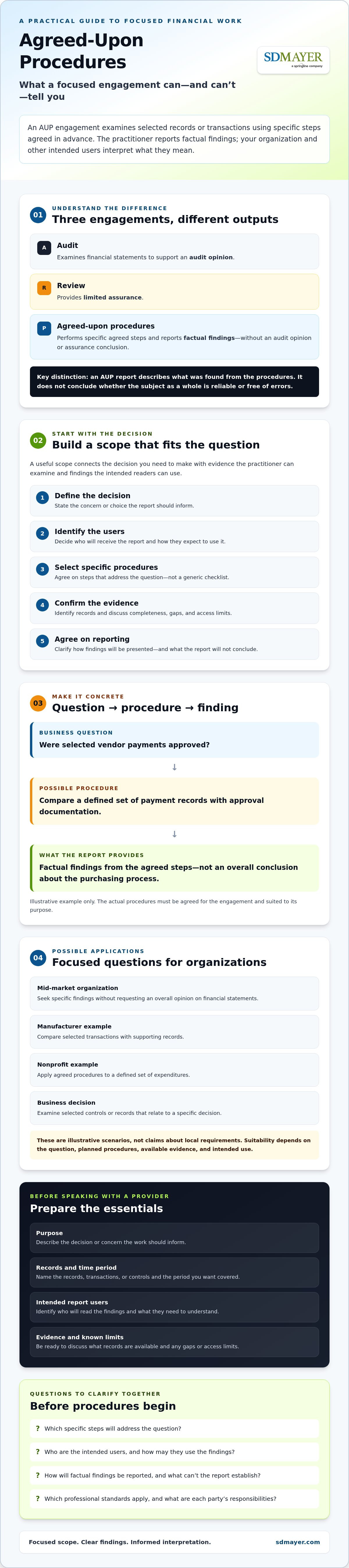
An agreed-upon procedures (AUP) engagement is a focused accounting engagement in which the relevant parties agree on specific steps for a practitioner to perform. The practitioner carries out those steps and reports the factual findings, such as whether selected records matched specified criteria. The report doesn’t provide an audit opinion or an assurance conclusion.
That distinction is important: an AUP report tells readers what the practitioner found from the agreed procedures, not whether the subject as a whole is reliable or free of errors. Professional standards guide how this work is planned and reported. Ask the provider to confirm which requirements apply to your engagement and what the report can and cannot establish.
How an AUP Engagement Differs from an Audit or Review
An audit examines financial statements to support an opinion, while a review provides limited assurance. An AUP engagement has a narrower, specifically agreed scope and reports findings without assurance. For a high-level overview of audits and the broader context in which external auditors may perform other agreed-upon procedures, see Wikipedia’s audit overview. The agreed procedures determine what the report can address, so readers shouldn’t treat it as a substitute for an audit or review.
For an agreed-upon procedures engagement Santa Rosa organization leaders are considering, the key question is whether the planned steps will answer the issue they need to resolve. A broad concern may require more than a targeted set of procedures can establish.
When a Santa Rosa Organization Might Consider AUP
A mid-market organization may need specific findings without seeking an overall opinion on its financial statements. For example, a Santa Rosa manufacturer might want selected transactions compared with supporting records, or a nonprofit might need agreed procedures applied to a defined set of expenditures. These are illustrative scenarios, not claims about local requirements.
An organization might also examine selected controls or records related to a business decision. The work is most useful when it focuses on relevant evidence rather than relying on a standard checklist. Before proceeding, clarify:
- The question: What decision or concern should the work inform?
- The evidence: Which records, transactions, or controls can be examined?
- The users: Who will read the findings, and how will they use them?
Suitability depends on whether the procedures and available evidence fit the question and intended use. Before work begins, the organization and practitioner should confirm the scope and reporting expectations. The practitioner should also verify the professional standards that apply to the engagement.
How to Define the Scope of an Agreed-Upon Procedures Engagement
A useful scope starts with the decision your organization needs to make, not a generic list of accounting steps. For an agreed-upon procedures engagement Santa Rosa organizations are considering, a clear scope connects the business question to evidence the practitioner can examine and findings the intended users can understand.
Work through these points with the provider before procedures begin:
- Define the decision: State the concern or choice the report should inform.
- Identify the users: Decide who will receive the report and how they expect to use it.
- Select procedures: Agree on specific steps that address the question.
- Confirm evidence: Identify relevant records and discuss gaps or access limits.
- Agree on reporting: Clarify how findings will be presented and what the report won’t conclude.
Keep the business question distinct from the procedures. “We need to understand whether selected vendor payments were approved” describes a concern. One possible procedure might compare a defined set of payment records with approval documentation. That’s an illustration, not a standard requirement; the actual steps must be agreed for the engagement and suited to its purpose.
Turn the Business Question into Specific Procedures
Be precise about the records, time period, transactions, or controls relevant to the decision. A request to “check our purchasing process” doesn’t specify what should be examined. A more focused question might identify a particular group of purchases and ask whether specified documentation is present. The provider can help develop procedures, but your organization should confirm that they address the intended question.
Agree on Users, Evidence, and Reporting
Tell the provider who needs the report and what those readers expect to learn. Discuss which records your organization can provide, how complete they are, and any known limitations. Confirm responsibilities, deliverables, and report wording in the engagement documents. The PCAOB’s Agreed-Upon Procedures Engagements standards offer a reference for formal terminology; ask the provider to confirm which professional standards apply to your specific engagement.
Vague requests can produce accurate findings that still miss the decision you hoped to inform. Before work begins, the organization and engagement team should agree on the scope and responsibilities, including whether the available evidence can support the planned steps. If you’re shaping a question for a possible engagement, you can discuss your scope with SD Mayer.
AUP vs. Audit, Review, or Consulting: Which Fits Your Need?
The right engagement depends on the kind of answer your organization needs. An agreed-upon procedures engagement Santa Rosa organizations consider can address a defined question through specific steps, while an audit, review, or consulting engagement serves a different purpose. These services aren’t interchangeable, so compare the intended outcome before choosing.
| Engagement | Purpose and scope | Typical output | Don’t infer |
|---|---|---|---|
| Agreed-upon procedures | Carry out specific procedures agreed for a defined subject. | Report procedures performed and related factual findings. | An overall opinion, assurance conclusion, or answer beyond the procedures. |
| Audit | Examine financial statements to provide a basis for an opinion. | An auditor’s opinion on the financial statements. | That every record or business activity was examined. |
| Review | Perform limited procedures on financial statements. | A report providing limited assurance, using the applicable reporting language. | The same level of work or opinion as an audit. |
| Consulting | Address a business need through analysis or advice, with scope set for the project. | May include recommendations or other agreed deliverables. | An independent audit opinion or assurance conclusion. |
For AUP engagements, current AICPA standards describe reporting on procedures performed and findings, without an opinion or conclusion. Confirm the applicable standards and wording with the engagement team, since requirements can depend on the engagement and its subject.
What an AUP Report Does, and Doesn’t, Tell You
An AUP report communicates what the practitioner did and the factual results of those steps. If procedures compare selected transactions with specified records, the findings speak to that comparison, not necessarily to the organization’s full financial position or the effectiveness of every related control. Findings don’t answer questions outside the agreed scope. Confirm who may receive the report and how it’s intended to be used.
Questions to Help Choose the Right Engagement
Before deciding, consider:
- Do you need targeted findings on a specific matter, or broader reporting on financial statements?
- Who will make a decision based on the work, and what information do they need?
- Can your organization provide evidence that supports the work you have in mind?
If you need advice or recommendations, discuss whether a consulting engagement fits. If you need broader financial reporting, ask a provider to explain the available options and their scope. The intended decision, users, and evidence will help guide that conversation.
How to Prepare for an AUP Engagement in Santa Rosa
Preparation can make an initial provider conversation more useful. Before discussing an agreed-upon procedures engagement Santa Rosa organization leaders are considering, write down the business question, the information needed to address it, and who will use the findings. You don’t need to design the procedures yourself, but a clear starting point helps the provider assess whether the proposed work fits your goal.
Use this checklist to organize your thinking:
- State the question: Describe the decision, concern, or reporting need in plain language.
- Define the boundaries: Note the relevant records, transactions, controls, and time period you have in mind.
- Name the users: Identify who needs the report and how they expect to use it.
- Map the records: List where information is kept, who maintains it, and how it may be shared.
- Flag known issues: Note missing documents, inconsistent records, or access limits for discussion.
Being upfront about evidence gaps helps the provider assess whether the planned procedures are practical and what the findings could address. You don’t need to resolve every record issue before the first conversation.
Records and Information to Gather
Start with records that appear relevant to your question, such as transaction listings, supporting documents, or records related to a selected control. These are examples, not a prescribed document request. For each item, note the record owner, source system or location, period covered, and known limitations. The engagement team can then help determine which evidence is relevant to the procedures under consideration.
Provider-Selection Questions for Santa Rosa Organizations
Choose a provider through a clear discussion of experience, scope, and working expectations. For a mid-sized organization, ask:
- What experience do you have with organizations of a similar size and needs like ours?
- How will we agree on the procedures, intended report users, and reporting scope?
- What records and support will you need from our team, and who will coordinate requests?
- How will we communicate about progress, questions, or evidence limitations?
- If the proposed scope needs to change, how will we discuss and document that?
Confirm responsibilities and deliverables before work begins, and ask the provider to explain unfamiliar terminology. To discuss your organization’s question and possible scope with SD Mayer, discuss your engagement questions with SD Mayer.
Working with SD Mayer on Agreed-Upon Procedures
Once your organization has a clear question, explore whether a defined engagement can address it. SD Mayer lists Agreed-Upon Procedures as an Audit & Assurance service and serves organizations in Santa Rosa. For organizations considering an agreed-upon procedures engagement Santa Rosa, that offers a starting point to discuss needs, scope, and provider fit, without assuming a particular procedure or outcome.
SD Mayer offers integrated services across audit, tax, business advisory, client accounting and advisory services (CAAS), and wealth management. Depending on your organization’s situation, ask whether coordination with another service would be relevant. Additional services aren’t automatically necessary; the right scope should follow your specific question.
What to Discuss in an Initial Conversation
Bring a short summary of the matter you want to examine, the decision the findings may inform, and who is expected to use the report. Include the records you believe are relevant and the period they cover. These details help the provider understand the context and discuss whether the proposed work aligns with your intended use.
Use the conversation to clarify practical expectations before proceeding:
- What procedures could address the question, and what would their findings cover?
- Which records and staff support would your organization need to provide?
- Who will agree on the procedures, scope, and intended report users?
- How will the team communicate questions, evidence limitations, or possible scope changes?
- What responsibilities and deliverables should be documented before work begins?
Ask the provider to explain any terms or report limitations you’re unsure about. Confirm current capacity and service availability for your organization as well. An initial discussion helps assess fit, but it isn’t a promise of a particular timeline, procedure, or result.
How an Integrated Advisor Can Support the Bigger Picture
For a mid-market organization, a focused engagement may sit alongside broader accounting or business needs. SD Mayer’s integrated model includes tax, audit, business advisory, CAAS, and wealth management. If related questions arise, ask whether coordination across services may be useful while keeping the AUP scope focused on the procedures you actually need.
SD Mayer serves organizations in Santa Rosa, but this shouldn’t be read as a claim that the firm has a Santa Rosa office. The firm also serves San Francisco, San Mateo, San Jose, Walnut Creek, San Leandro, Menlo Park, and Sacramento. To explore whether its Agreed-Upon Procedures service and current availability fit your organization, contact SD Mayer with your question, intended users, relevant records, and any open scope concerns.
Set a Clear Direction for Your Next Steps
A useful AUP engagement begins with a specific question, then connects it to agreed procedures, relevant records, and the people who will use the findings. Remember that an AUP report presents factual results from those procedures, not an overall audit opinion or assurance conclusion.
If you’re considering an agreed-upon procedures engagement Santa Rosa, SD Mayer lists Agreed-Upon Procedures among its Audit & Assurance services and serves Santa Rosa organizations. The firm also offers integrated tax, audit, advisory, CAAS, and wealth management services. A conversation can help you explain your needs, discuss scope and responsibilities, and ask whether the firm’s current availability and services fit your situation.
Bring your business question, the records and period involved, and the intended report users. A well-defined starting point makes it easier to evaluate the right path for your organization. Discuss your agreed-upon procedures needs with SD Mayer to take the next step with greater clarity.
Frequently Asked Questions
What is an agreed-upon procedures engagement?
An agreed-upon procedures engagement focuses on specific steps that relevant parties agree to in advance. The practitioner performs those procedures and reports the factual findings. An agreed-upon procedures engagement Santa Rosa organizations consider doesn’t automatically provide an overall audit opinion or assurance conclusion. Before proceeding, ask your accounting provider to confirm the engagement’s scope, intended report users, reporting expectations, and applicable professional standards.
Is an agreed-upon procedures engagement the same as an audit?
No. An AUP engagement covers specific procedures for a defined purpose and reports findings from that work. An audit has a different objective and reporting framework. Findings from examining selected transactions, for example, shouldn’t be read as an opinion on an organization’s full financial statements. Explain the decision you need to make, then ask a provider which type of engagement may suit that need.
Who can request agreed-upon procedures?
Organizations may explore an AUP engagement when a stakeholder needs specific information about selected records, transactions, controls, or another defined matter. The relevant parties should clarify the purpose, intended users, and proposed procedures before work begins. Whether the request is appropriate depends on the circumstances, available evidence, and applicable standards. A provider can discuss fit and limitations, but shouldn’t assume the resulting report will meet every user’s needs.
Can an agreed-upon procedures engagement be tailored to my organization?
Yes, proposed procedures can be discussed in light of your organization’s question, relevant records, and intended report users. Tailoring doesn’t mean every requested step is appropriate or that the report will offer a broad conclusion. Before work begins, agree on the scope, responsibilities, and reporting expectations with the provider. Ask how the planned procedures connect to the decision you need to make.
How long does an agreed-upon procedures engagement take?
Timing depends on the agreed scope, the records involved, their availability, and the work required. There isn’t one schedule for every organization. Before starting, discuss the expected schedule, your team’s responsibilities, and any key milestones. Ask how missing or incomplete information could affect progress. A provider can discuss timing more meaningfully after learning about your organization’s specific needs.
What should we prepare for an AUP engagement?
Start with a clear description of the question your organization needs to address. Gather records that may relate to the question, and note who maintains them and what period they cover. Identify the intended report users, along with any known gaps or access concerns. Share these details with the provider to discuss whether the proposed procedures fit your purpose and what else may be needed.
Can a nonprofit use an agreed-upon procedures engagement?
A nonprofit can discuss an AUP engagement when it needs specific procedures and findings for a defined purpose. First, clarify who will use the report and whether its scope and findings would meet their needs. Don’t assume an AUP report replaces an audit or satisfies a particular requirement. The nonprofit should discuss its circumstances, intended use, and applicable standards with an accounting provider before relying on the report.
How do I choose an AUP provider in Santa Rosa?
Look for a provider who can explain the scope, limitations, responsibilities, and reporting in plain language. Ask about experience with organizations of similar size and needs, and confirm that the procedures match your intended use. SD Mayer serves organizations in Santa Rosa, San Francisco, San Mateo, San Jose, Walnut Creek, San Leandro, Menlo Park, and Sacramento. Contact the firm to discuss fit and current service availability.
SECURITIES AND ADVISORY DISCLOSURE:
Securities offered through Valmark Securities, Inc. Member FINRA, SIPC. Fee based planning offered through SDM Advisors, LLC. Third party money management offered through Valmark Advisers, Inc a SEC registered investment advisor. 130 Springside Drive, Suite 300, Akron, Ohio 44333-2431. 1-800-765-5201. SDM Advisors, LLC is a separate entity from Valmark Securities Inc. and Valmark Advisers, Inc. Form CRS Link
DISCLAIMER:
This material has been prepared for informational purposes only, and is not intended to provide, and should not be relied on for, accounting, legal or tax advice. The services of an appropriate professional should be sought regarding your individual situation.
HYPOTHETICAL DISCLOSURE:
The examples given are hypothetical and for illustrative purposes only.