
What if your 401(k) audit requirement changed even though your workforce didn’t? For 2026, the count generally focuses on participants with account balances at the start of the plan year, not everyone eligible to join. That’s why what triggers a 401k audit may differ from what you expected, especially as your mid-sized business grows.
It’s understandable to worry about audit costs, time, and potential Department of Labor penalties, or to be unsure how the participant-count rules apply. The rules offer a practical way to assess whether an audit is required. A plan with 100 or more participants with balances generally needs an independent audit, while the 80/120 rule can affect plans that filed as small or large the year before.
This guide explains how to determine whether an audit is required, what administrative issues can draw scrutiny, and how to prepare a more accurate Form 5500. You’ll also find steps to review participant counts and plan records. For growing companies, an audit can be more than a filing hurdle. It can be a useful health check, and coordinated accounting and audit support can make compliance more manageable.
Key Takeaways
- Understand what triggers a 401k audit by reviewing participant counts and administrative issues, such as late employee contribution deposits or inconsistent filing information.
- Check how your plan’s prior filing status affects the 80/120 rule before deciding whether an audit is required.
- Review former employees’ account balances and plan records, including the latest Summary Plan Description, as part of your audit preparation.
- Set a regular process for reconciling payroll contributions and documenting deposits so you can catch problems early.
- Use coordinated accounting and audit support to make compliance tasks more manageable as your mid-sized business grows.
The 100-Participant Rule: When Does Your Plan Become 'Large'?
For a growing company, the audit question isn’t simply how many people are on payroll. It’s how many plan participants have money in their accounts on the first day of the plan year. That distinction matters for mid-sized employers, especially in the fast-moving San Francisco Bay Area tech and professional services markets, where hiring, departures, and changing work arrangements can quickly affect plan membership.
For 2026 reporting, a large plan is generally one with 100 or more participants who have account balances on the first day of the plan year. Reaching that threshold generally means an independent audit is required, although prior-year filing status can affect the result. Don’t rely on total employee headcount to make the decision. Start with a careful review of the plan’s records.
Counting Your Participants Correctly
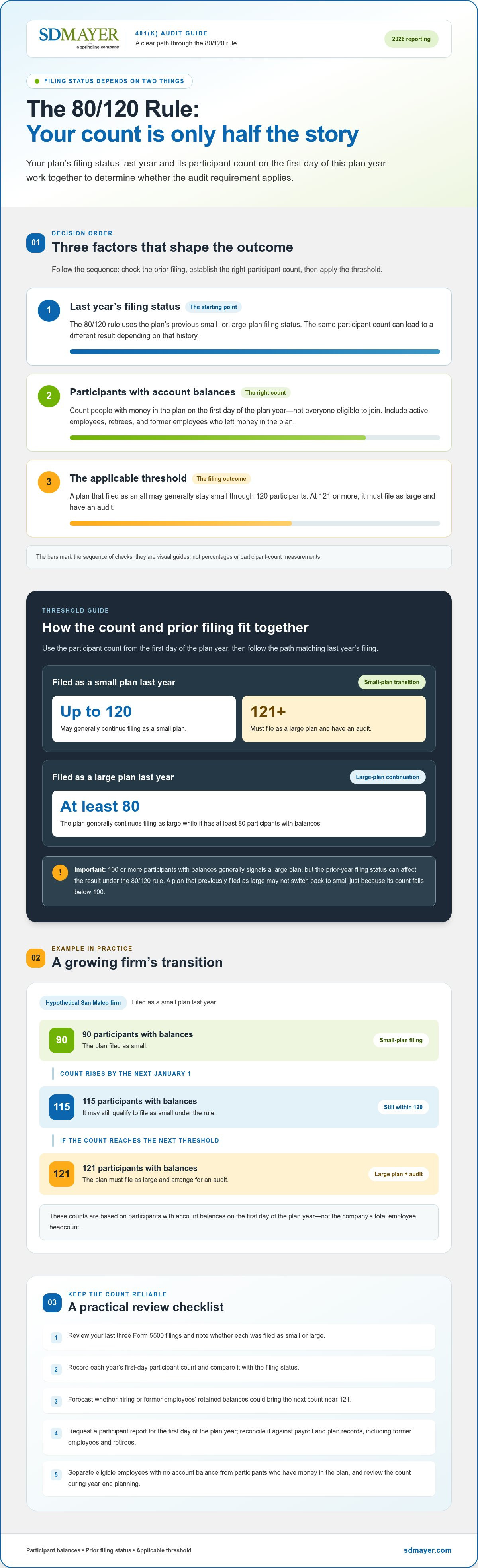
Count people with an account balance, not just current employees making contributions. This can include active employees, retirees, and former employees who left their money in the plan after leaving the company. An eligible employee who could join but has no account balance is treated differently under the current counting approach.
For a calendar-year plan, the snapshot date is January 1. Hiring later in the year won’t change the count for that date, but employees who already have balances do count. Similarly, a former employee may still count if their money remains in the plan.
The Impact of the 2023 Rule Change
Before the 2023 change, plans generally counted employees who were eligible to participate, even if they hadn’t joined or accumulated savings. The updated approach focuses on participants with account balances. For employers with high turnover or many part-time workers, this can make the count more closely reflect who actually has money in the plan, rather than everyone who could have enrolled.
That distinction matters as a business scales. For example, a company might have a large eligible workforce but fewer people with plan balances on January 1. At the same time, a growing Bay Area tech firm may add participants over time, while former employees who leave savings in the plan can keep the count elevated. A roster that looked comfortably below the threshold last year may not stay there.
To assess what triggers a 401k audit, take these practical steps before making a filing decision:
- Request a participant report showing account balances as of the first day of the plan year.
- Reconcile the report against payroll and plan records, including former employees and retirees.
- Separate eligible employees with no account balance from participants who have money in the plan.
- Review the count again as part of year-end planning, particularly after hiring or workforce changes.
A clear count gives your team a stronger starting point for determining the plan’s filing requirements. If you want broader background on how a 401(k) plan works, that context can make the audit rules easier to follow. The main takeaway is to track balances and plan membership deliberately rather than assume headcount tells the whole story.
The 80/120 Rule: A Strategic Loophole for Growing Firms
The 80/120 rule can give a growing plan room to transition, but it isn’t a way to choose whichever filing status is most convenient. It considers both the participant count on the first day of the plan year and how the plan filed the year before. Applied correctly, it can help a mid-sized company prepare for an audit rather than face an immediate change simply because its count rose above 100.
How the 80/120 Transition Works
If your plan filed as a small plan last year, it can generally continue filing as small this year as long as it has no more than 120 participants with account balances on the first day of the plan year. At 121 or more, it must file as a large plan and have an audit. If the plan filed as large previously, it generally continues as large while it has at least 80 participants.
Consider a hypothetical San Mateo firm that filed as a small plan and has 90 participants with balances on January 1. If growth brings the count to 115 by the next January 1, it may still qualify to file as small for that year under the rule. If the count reaches 121, the transition period ends and the plan must file as large and arrange for an audit. The count is based on plan participants with balances, not the company’s total number of employees.
This window can help leadership prepare records, clarify responsibilities, and build an audit-readiness timeline as the business scales. It doesn’t remove the audit requirement once the applicable threshold is crossed. A plan that previously filed as large may not switch back to small just because its count dips below 100.
Small Plan vs. Large Plan Filing
Both filing categories use Form 5500, but the information and supporting materials required can differ. A large plan generally includes an independent audit report with its filing; a small plan generally doesn’t need that report. Required schedules and details can also depend on the plan’s circumstances, so don’t assume that small-plan status means there’s nothing to review. The IRS guidance on 401(k) plans is a useful starting point for understanding plan reporting and tax responsibilities.
Small-plan status is a filing category, not a reason to ease up on oversight. Keep participant data, payroll records, deposits, and plan documents organized so a later transition is manageable. To clarify what triggers a 401k audit for your plan, take these steps:
- Review your last three Form 5500 filings and note whether each was filed as small or large.
- Record the first-day participant count for each year and compare it with the filing status.
- Forecast whether hiring or former employees’ retained balances could bring the next count near 121.
- Build audit preparation into your growth planning before the threshold is crossed.
If your plan is approaching the transition point, SD Mayer can help your team plan for audit readiness alongside its compliance work. Discuss your plan’s audit readiness.
Administrative Red Flags: Triggers That Aren't About Size
Participant count is only one part of plan oversight. Late deposits, inaccurate Form 5500 answers, or missing information can draw attention from the Department of Labor (DOL) or the IRS, even when a plan doesn’t otherwise expect an audit. These issues don’t automatically mean a full investigation will follow, but they can prompt questions that take time to address.
For mid-sized employers, risk often arises during routine handoffs: payroll is processed, employee contributions are withheld, and then a delay or reporting mismatch goes unnoticed. Regularly reconciling payroll records, plan deposits, and Form 5500 data can help surface issues early.
The Late Contribution Trap
Employee contributions should be deposited into the plan as soon as they can reasonably be separated from the employer’s assets. A delay in one payroll cycle can raise questions about whether the plan handled contributions promptly and consistently. It doesn’t automatically mean a full investigation will occur, but late deposits can draw DOL scrutiny and may require correction and reporting.
The 7-business-day safe harbor generally treats deposits as timely for plans with fewer than 100 participants when contributions reach the plan within seven business days after they’re withheld. The broader prompt-deposit standard still matters.
Build a simple control around each payroll run. Assign someone to compare withheld amounts with plan deposits, record when funds leave the company account and reach the plan, and investigate any gap promptly. Keep a written explanation and supporting records if an unusual delay occurs. That paper trail helps your team understand what happened and respond clearly.
Form 5500 Errors and Omissions
Form 5500 is more than an annual filing. Incomplete or inconsistent information can prompt an automated review, so answers should match the plan’s records and supporting schedules. For example, marking “No” on a compliance question when plan records indicate “Yes,” or submitting incomplete financial information, can lead to avoidable follow-up.
Filing software can help organize entries, but it can’t replace a careful review to confirm that answers reflect what actually happened during the plan year. Before filing, compare the draft with payroll reports, plan statements, and records of corrections or unusual transactions. Confirm that required schedules are included and key figures agree across documents.
Also review the plan’s fidelity bond documentation. The bond protects the plan against certain losses caused by fraud or dishonesty, and confirming that coverage remains appropriate is one part of sound plan oversight. It doesn’t prove that every administrative process is working, so treat it as one item in a broader review.
To stay ahead of common red flags, assign clear owners for payroll-to-plan reconciliations, Form 5500 review, and bond documentation. Keep a record of completed checks and follow up on discrepancies rather than carrying them into the next filing cycle. Understanding what triggers a 401k audit means looking beyond plan size to the everyday controls that support accurate reporting and timely deposits.
Action Plan: 5 Steps to Prepare for a 401k Audit
Good preparation starts before an auditor requests records. For a mid-sized company managing frequent hiring or employee changes, clear ownership and organized documents can make the process easier. Use these five steps to spot gaps early and get your records in order.
- Review former employee balances. Identify former employees whose money remains in the plan and how those accounts affect your participant count. If the plan allows it, small balances may be distributed or rolled over under its procedures. In 2026, the involuntary cash-out limit is $7,000. Document completed transactions and follow the plan’s terms. Consistent records also support financial reporting compliance services in the Bay Area.
- Gather current plan documents. Keep the plan document, amendments, and latest Summary Plan Description together. The Summary Plan Description explains key plan terms to participants. Include related records, such as service agreements and prior filings, and make sure plan administrators can access the current versions.
- Reconcile payroll and contributions. Compare payroll deductions with deposits to the plan for each pay period. Record any differences, delays, or corrections, and keep evidence of how they were resolved. This review can help your team catch process issues before they carry into year-end reporting.
- Review the plan’s fidelity bond. Find the bond documents and confirm the plan has the required protection in place. In plain terms, this bond helps protect the plan against certain losses caused by dishonest acts. Keep the paperwork with the other plan records and assign someone to review it as the plan changes.
- Plan for the independent audit. If an audit is required, engage an independent accounting professional qualified to audit employee benefit plans. Identify the audit lead, agree on how records will be shared, and map key milestones against the filing calendar. Starting early gives your team time to respond to requests without disrupting routine finance work.
Strengthen Internal Controls Before Filing
Preparation also means checking how decisions are made and recorded. Review plan committee meeting minutes for documented discussions and follow-up items. Compare how the plan operates, including eligibility and contribution handling, with its written terms. If they don’t match, record the issue and work through the appropriate correction process.
Set a calendar reminder 90 days before your filing deadline to begin gathering records, assigning owners, and resolving open questions. Keep a shared tracker of requested documents and completed tasks. SD Mayer’s employee benefit plan audit team can help your organization organize its preparation and reporting. Discuss your audit preparation with SD Mayer.
Why SD Mayer is Your First Call for 401k Compliance
For a mid-sized company, retirement plan compliance touches payroll, accounting, employee benefits, and financial reporting. An audit partner who understands those connections can help your team see beyond the filing deadline. SD Mayer provides employee benefit plan audits and works with mid-market technology and professional services businesses, bringing a local, partner-led approach to a technically detailed process.
That perspective matters when you’re working out what triggers a 401k audit and what to do next. An audit can identify areas that need attention, while a broader accounting relationship can help your team understand how plan reporting fits into the company’s financial picture. SD Mayer’s “Simply Doing More” approach emphasizes practical guidance, not just pointing out an issue and leaving your team to work out the next steps alone.
A Partnership, Not Just a Service
Plan compliance is ongoing. As your business hires, changes payroll processes, or updates its benefits, the records and procedures behind the plan need attention too. A continuing relationship gives your team a consistent place to bring questions and consider how audit findings connect with accounting and tax planning. SD Mayer’s membership in BDO Alliance USA provides access to broader resources while maintaining a local, partner-led approach.
For mid-market companies, coordinating employee benefit plan audits with Client Accounting & Advisory Services can support a more complete view of financial reporting and controls. Tax planning can be part of that broader conversation too. The strategic tax advice for 2026 resource offers related guidance for businesses planning for growth.
Getting Started with Your 2026 Audit
Start by gathering your latest Form 5500, plan documents, participant information, and records of contributions and deposits. Then request a preliminary discussion about your plan’s audit status. In an initial meeting, your team can outline its questions, explain how the plan is administered, and discuss relevant records and next steps with the SD Mayer audit team. That conversation can help clarify what to prepare and where further review may be useful.
Before the meeting, write down any recent changes to the plan or payroll process and identify who manages each part of plan administration. Raise unresolved questions early rather than waiting until filing work is underway. A clear starting point makes it easier to organize the work, assign responsibilities, and plan for the year ahead.
To discuss an employee benefit plan audit and your organization’s next steps, contact SD Mayer about your audit.
Make Audit Readiness Part of Your Growth Plan
As your company grows, plan oversight can become a regular part of financial decision-making rather than a scramble before filing. Assign an owner to track plan questions, keep records organized throughout the year, and flag changes in payroll or benefits administration early. That routine gives your leadership team more time to respond thoughtfully as the business evolves.
Understanding what triggers a 401k audit is a starting point. The next step is turning that knowledge into a plan that fits your organization’s growth and reporting needs. SD Mayer brings Bay Area expertise and a trusted-advisor approach, helping mid-sized businesses address plan compliance with care and a clear view of the bigger financial picture.
Bring your participant information, recent filings, and questions about your plan’s status to a discussion with the team. Schedule your 401k audit consultation with SD Mayer and take a confident next step toward readiness.
Frequently Asked Questions
What is the exact deadline for filing a 401k audit in 2026?
For a calendar-year plan filing its 2025 Form 5500, the deadline, including the audit report when required, is July 31, 2026. A plan can request a one-time 2.5-month extension by filing IRS Form 5558 before that original deadline, moving the due date to October 15, 2026. If your plan uses a different plan year, check its year-end to determine the filing date.
Can my company be audited if we have fewer than 100 employees?
Yes. Employee headcount and plan participant count aren’t always the same. Former employees and retirees who left money in the plan may count, even though they’re no longer on payroll. Administrative problems can also draw DOL or IRS scrutiny without automatically creating a mandatory plan audit. Compare your plan records with the applicable participant-count rules, and review agency correspondence carefully if it arrives.
What happens if we miss the Form 5500 filing deadline?
A late filing can lead to substantial penalties. The IRS penalty is $250 per day, up to $150,000 per return, and the DOL can assess up to $2,739 per day with no maximum cap. If you’ve missed the deadline, act promptly. The DOL’s Delinquent Filer Voluntary Compliance Program may allow a reduced penalty if the DOL hasn’t already issued a notice. Gather the filing records and address the missed submission.
Does the 80/120 rule apply to new 401k plans?
The transition rule generally depends on the plan having filed as a small plan in the previous year, so a new plan won’t have that prior-year filing history. Don’t assume it qualifies for the same transition treatment as an established plan. Determine the plan’s participant count and filing requirements for its first year, then retain each filed Form 5500 so future decisions about filing status can rely on an accurate history.
How much does a typical mid-market 401k audit cost?
There isn’t one dependable typical fee for every mid-market plan. Audit pricing is specific to each client, and a useful budget depends on the engagement’s scope and the plan’s circumstances. Avoid treating online averages as a quote for your plan. Gather basic information about the plan and its records, then request an estimate based on those details before setting your audit budget.
What is a 'limited scope' audit, and can my business use one?
A limited-scope audit is a type of plan audit in which an auditor may leave certain investment information out of testing if a bank, trust company, or insurance company holding the assets provides written confirmation of that information. The auditor still reviews other required areas. Whether this approach is available depends on the plan’s circumstances and the institution’s documentation, so discuss it during audit planning.
How do I cash out former employees to avoid an audit trigger?
Start by reviewing the plan’s distribution terms and identifying former employees with small balances. In 2026, the involuntary cash-out limit is $7,000 when the plan permits it. Follow the plan’s procedures and document completed distributions. An account generally remains part of the plan’s participant records until its balance is addressed, so recalculate the count using the rules that apply to your plan rather than assuming a cash-out changes its filing status.
Will the Department of Labor fine me for a late 401k audit?
The DOL can assess penalties for a late Form 5500 filing, including a filing with a required audit report, of up to $2,739 per day, with no maximum cap. The IRS can also impose a separate late-filing penalty. If the deadline has passed, identify what remains incomplete, assemble the filing information, and promptly determine whether the DOL’s voluntary compliance program is available before a notice is issued.
SECURITIES AND ADVISORY DISCLOSURE:
Securities offered through Valmark Securities, Inc. Member FINRA, SIPC. Fee based planning offered through SDM Advisors, LLC. Third party money management offered through Valmark Advisers, Inc a SEC registered investment advisor. 130 Springside Drive, Suite 300, Akron, Ohio 44333-2431. 1-800-765-5201. SDM Advisors, LLC is a separate entity from Valmark Securities Inc. and Valmark Advisers, Inc. Form CRS Link
DISCLAIMER:
This material has been prepared for informational purposes only, and is not intended to provide, and should not be relied on for, accounting, legal or tax advice. The services of an appropriate professional should be sought regarding your individual situation.
HYPOTHETICAL DISCLOSURE:
The examples given are hypothetical and for illustrative purposes only.