
The most rigorous financial report isn’t always the most useful one. For a mid-sized business, the right level of assurance depends on what lenders, owners, or board members need to understand. If you’re comparing financial statement review services with an audit or compilation, start by identifying the decisions your statements need to support and the reporting your stakeholders expect.
A review provides limited assurance through analytical procedures and questions for management. It’s more involved than a compilation, which provides no assurance, but less extensive than an audit. This article explains what a review covers, how the three services differ, and how to prepare. You’ll also find practical ways to organize records, coordinate your team, and make the final statements more useful in stakeholder discussions and business planning.
Key Takeaways
- Match the reporting service to what lenders, owners, or board members need to decide, rather than choosing the most extensive option by default.
- Understand how financial statement review services fit your reporting needs and what to align on before work begins.
- Prepare your finance team by organizing reconciliations, supporting schedules, and explanations for significant changes.
- Use a clear review process to coordinate records, discuss questions, and make the final statements more useful for planning.
- Consider how a review can connect with broader reporting or finance support as your business needs evolve.
What financial statement review services provide to a mid-sized business
A financial statement review is an independent accountant’s examination of financial information, primarily through analytical procedures and questions for management. The accountant concludes whether any material modifications should be made to the statements. For a mid-sized business, financial statement review services can add confidence to reporting while keeping the work focused on the business’s needs and the questions its stakeholders need answered.
A review provides limited assurance based on inquiry and analysis. An audit provides a higher level of assurance and involves more extensive procedures. A review doesn’t guarantee that every error or issue will be found. Its value is a clearer, independently reviewed picture of the company’s financial position and performance for an identified business purpose.
That picture can make conversations more grounded. Owners may use reviewed information to discuss performance and plans, while lenders or board members may use it when considering financing, oversight, or resource decisions. The statements are most useful when their scope and presentation address the questions those readers need answered.
What information does a financial statement review cover?
The statements included depend on the engagement’s scope and the organization’s reporting needs. The set may include a balance sheet, an income statement, a cash flow statement, and accompanying notes. As part of defining the engagement, the accountant and business establish which statements are being reviewed and which reporting framework applies.
Financial statement analysis considers how figures relate across reports and over time. For a broader introduction, see Financial statement analysis. In practice, a review can help stakeholders discuss whether revenue patterns have changed or how expenses and cash flow compare with expectations. Interpret the results in context: the statements reflect the period and scope covered, not every aspect of the business.
When might a mid-sized business consider a review?
A review may be useful when a business is growing, preparing for financing conversations, strengthening governance, or providing financial information to owners or other stakeholders. For example, a company expanding its operations may want a consistent reporting process that helps leadership and the board discuss performance using a shared set of financial statements.
A stakeholder’s request is different from a legal or contractual requirement. A lender, investor, or agreement may specify the reporting expected, but requirements depend on the particular relationship and documents. Don’t assume a review is mandatory because the business has reached a certain size, or that a review will satisfy every request. Before deciding, identify who will use the statements, what they need to evaluate, and whether written terms specify a reporting requirement. Then compare those needs with the scope of a review and other reporting options.
How financial statement review services work, from planning to reporting
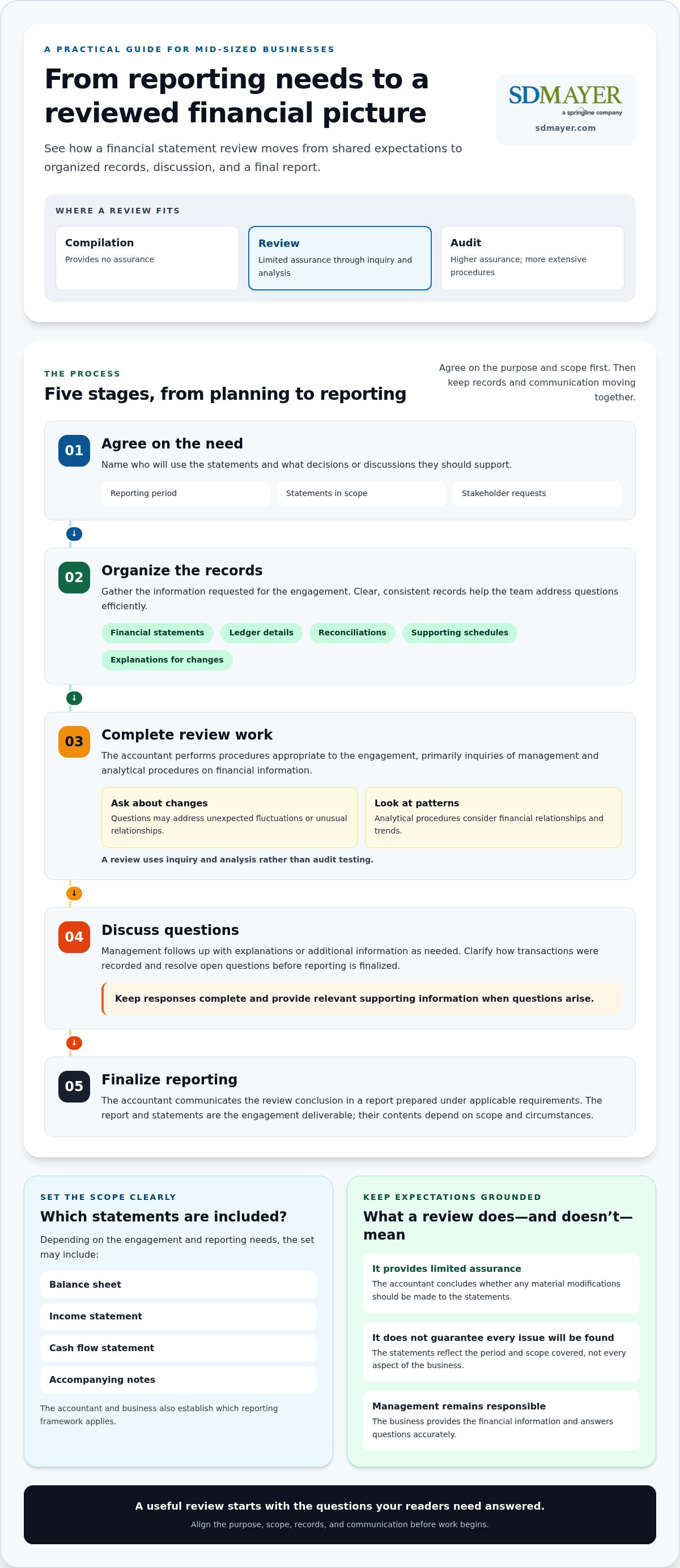
A well-organized review starts with shared expectations. The accountant and management agree on the reporting purpose, the statements in scope, and how questions and records will be handled. Procedures depend on the engagement and applicable professional standards. For nonpublic company reviews, SSARS includes the review requirements in AR-C Section 90.
A review moves from agreed reporting needs to organized records, inquiry and analysis, discussion of questions, and a final report. It’s a collaborative process, but management remains responsible for the financial information it provides and for answering questions accurately.
- Agree on the need. Identify who will use the statements and what decisions or discussions they should support. Confirm the reporting period, statements in scope, and any specific stakeholder request.
- Organize the records. Gather the financial statements, ledger details, reconciliations, schedules, and explanations requested for the engagement. Clear, consistent records help the team address questions efficiently.
- Complete review work. The accountant performs procedures appropriate to the engagement, primarily inquiries of management and analytical procedures on financial information. These may include asking about unexpected changes or comparing financial relationships and trends.
- Discuss questions. Management follows up with explanations or additional information as needed. This is an opportunity to clarify how transactions were recorded and resolve open questions before reporting is finalized.
- Finalize reporting. The accountant communicates the review conclusion in a report prepared under the applicable requirements. The report and statements form the engagement deliverable, with contents that depend on the scope and circumstances.
Planning the review around reporting needs
Start by naming the intended readers, such as owners, a lender, or a board, and the questions they need the statements to address. Discuss the reporting period, the company’s structure, and accounting areas that may need context, such as a new revenue stream or a change in how expenses are tracked. Agree on who will coordinate records, respond to questions, and communicate updates. For a mid-sized finance team, assigning one point person can keep requests organized.
What happens during review work and final reporting?
During the review, the accountant uses inquiry and analytical procedures rather than audit testing. Questions may address significant fluctuations, unusual relationships, or information that appears inconsistent with other details provided. Management should respond with complete explanations and relevant supporting information. The report communicates the accountant’s conclusion and any other reporting matters required under applicable standards.
Standards depend on the type of entity and engagement. The U.S. GAO Yellow Book: Government Auditing Standards relates to government auditing and is distinct from the SSARS framework generally used for nonpublic company reviews. Keep the engagement documents and final report together, and note follow-up actions for the next reporting cycle. To discuss how a review can fit your reporting needs, connect with SD Mayer’s team.
Review vs. audit vs. compilation: choose the right reporting service
These services differ in the work performed and the assurance communicated. A compilation helps present financial information but provides no assurance. A review provides limited assurance, while an audit provides a higher level of assurance and results in an auditor’s opinion on whether the statements are fairly presented in all material respects. The right fit depends on the purpose of the statements and what their users expect.
| Purpose | Assurance | Typical scope | |
|---|---|---|---|
| Compilation | Help present financial statements based on information provided by management. | None | The accountant assists with presenting the statements but doesn’t express an opinion or conclusion. |
| Review | Provide limited assurance about whether material modifications are needed. | Limited | Primarily inquiries of management and analytical procedures. |
| Audit | Provide the highest level of assurance among these three services and an opinion on the financial statements. | Reasonable assurance | More extensive procedures, which may include testing records and obtaining evidence from sources beyond management. |
How a review differs from an audit
A review and an audit aren’t interchangeable versions of the same service. A review relies mainly on questions and analysis. An audit involves more extensive evidence-gathering procedures to support the auditor’s opinion. That distinction matters if a lender, investor, or other stakeholder has specified an audit. Financial statement review services shouldn’t be treated as a substitute for an audit required by an agreement or other applicable requirement.
Before choosing, identify the report the stakeholder expects and the decision it needs to support. If the request isn’t clear, review the written terms or ask the stakeholder to clarify its reporting expectations. Don’t assume a review will meet a request for audited statements.
How a review differs from a compilation
A compilation differs from a review because the accountant helps present financial statements but doesn’t provide assurance or a review conclusion. A review adds inquiry and analytical procedures and communicates limited assurance. That additional work may be useful when intended readers want independent assurance beyond a compilation, but the best choice depends on their needs and the engagement scope.
A review isn’t simply a cheaper or shortened audit. Each service has a distinct purpose, scope, and type of report. Choosing based only on assumed effort can leave a business with statements that don’t meet stakeholder expectations. Compare the requested report with the service’s assurance level, then agree on the engagement that fits.
For a broader look at reporting considerations, SD Mayer’s guide to financial reporting compliance services in the Bay Area can help you frame questions for your finance team and stakeholders.
How to prepare your business for a financial statement review
A little structure can make a review easier to coordinate, especially for a mid-sized finance team balancing close work with daily operations. Treat preparation as part of your normal close process: gather records for the agreed reporting period, document key changes, and decide who will manage questions. Financial statement review services are collaborative, and clear explanations from your team help the accountant understand the information provided.
- Confirm the scope and schedule. Align internally on the statements and period being reviewed, intended readers, important dates, and who will coordinate requests. Share known changes in the business or reporting process early.
- Complete and organize close records. Bring ledgers up to date and gather the financial statements, reconciliations, and supporting schedules relevant to the engagement. Use consistent file names and keep records together by account or topic so the team can locate them efficiently.
- Prepare explanations for changes. Note significant fluctuations, unusual transactions, new estimates, or changes in accounting methods. For example, if an expense changed noticeably because of a one-time event, prepare a short explanation and the related support.
- Assign owners for follow-up. Identify who can answer questions about areas such as revenue, payroll, or debt, and who can provide supporting details. Route requests through a coordinator to reduce duplicate work and keep responses organized.
- Review open items with leadership. Flag unresolved reconciliations, reporting changes, or questions that could affect the statements. Set aside time to discuss these items with the people who understand the underlying business decisions.
Records and reporting details to organize
Start with the final or near-final statements in scope, then gather the related ledger detail, reconciliations, and supporting schedules. Include concise explanations for unusual items and significant changes, with relevant documentation. Flag a complex estimate or transaction early instead of waiting for questions. A simple tracker showing the request, assigned owner, and response status can help a lean team stay coordinated.
Coordinate finance, leadership, and external reporting needs
Make sure finance and leadership share the same understanding of the review’s purpose, reporting period, and any external deadlines. If your organization has multiple entities, has recently grown, or has changed its reporting structure, raise that early so the engagement can be planned with the right context. A review may also prompt a broader look at recurring accounting processes. SD Mayer’s Client Accounting & Advisory Services (CAAS) and outsourced CFO and controller support can help when a business needs support beyond a single reporting engagement.
Before work begins, gather stakeholder requests and note what each reader needs from the statements. If your finance team would like support planning its review preparation and reporting needs, connect with SD Mayer’s team.
Financial statement review services with SD Mayer: a connected advisory relationship
A financial statement review is one part of a business’s broader reporting picture. SD Mayer provides financial statement review services alongside audit and assurance services, helping mid-sized businesses consider which reporting approach fits their circumstances. The work begins with understanding what the business needs its statements to do and who will rely on them. From there, the engagement is shaped around the agreed reporting needs and scope.
That conversation can also bring useful context to the review. A company may be managing growth, refining its close process, or preparing reports for owners and a board. Understanding those priorities helps connect the engagement to the finance team’s wider goals without assuming that every business needs additional services. SD Mayer brings Bay Area roots to its work with businesses in Northern California and the Greater San Francisco Bay Area.
A review connected to the wider finance picture
Questions raised during reporting may point to process needs beyond the review itself. For example, a business might want to improve how it organizes bookkeeping records, make financial reports easier for leadership to use, or get additional perspective on planning. Depending on the situation, Client Accounting & Advisory Services (CAAS) or outsourced CFO and controller support may be relevant. These are related options, not automatic add-ons to a review.
For a mid-sized company, connected support can keep reporting discussions tied to practical finance priorities, such as the close process, regular reporting, or clearer communication with decision-makers. Explore SD Mayer’s client accounting and advisory services to discuss how these capabilities relate to your reporting context.
Discuss your financial statement review needs
To make an initial conversation productive, bring a concise picture of your reporting situation. Note the period you’re considering, who will use the statements, any stakeholder requests, and questions about your current finance process. If growth, multiple entities, or changes in reporting have added complexity, include that context too. These details help frame a discussion about fit, scope, and possible next steps.
SD Mayer works with businesses as a trusted accounting and advisory partner, connecting review engagements with broader finance capabilities when they’re relevant. You don’t need to arrive with every detail resolved. Start with the reporting question you’re trying to answer and what your stakeholders need from the information.
Discuss your financial statement review needs with SD Mayer and share the context behind your reporting goals.
Make your next reporting decision with confidence
Use your next reporting cycle as a chance to connect financial information with the decisions ahead. Before choosing financial statement review services, write down what your business needs to understand, which stakeholders will rely on the statements, and what questions leadership hopes to answer. This simple exercise can help turn a reporting engagement into a more focused business conversation.
For a mid-sized company, priorities can shift as operations, financing plans, or governance needs change. Consider how a reporting approach that fits today will serve the business as it grows. SD Mayer can help you think through those priorities and discuss an approach tailored to your circumstances.
Start a conversation with SD Mayer about your reporting priorities. A clear first step can help your team move forward with greater confidence.
Frequently Asked Questions
What does a financial statement review include?
The scope depends on the engagement and applicable standards. Generally, the accountant asks management questions and performs analytical procedures to assess financial information, such as reviewing relationships among figures or changes from one period to another. The accountant considers the statements as a whole and communicates a review conclusion in a report. A review can raise questions for follow-up, but it isn’t a promise to detect every error or fraud.
Is a financial statement review the same as an audit?
No. A review and an audit are distinct services with different procedures and assurance levels. A review provides limited assurance, while an audit generally provides a higher level of assurance and an opinion on the statements. For example, if a financing agreement calls for audited statements, a review may not meet that request. Compare the stakeholder’s expectations and applicable written terms before selecting an engagement.
When does a business need reviewed financial statements?
A business may consider reviewed statements when owners, lenders, board members, or other stakeholders want financial information accompanied by limited assurance. That doesn’t mean every business must obtain a review. For instance, a lender’s reporting request or a governance policy may specify a particular type of financial statement service. Review the financing documents, organizational policies, or other terms that apply to your business before deciding what to arrange.
Can a financial statement review identify errors or fraud?
A review may bring inconsistencies or unusual financial patterns to the accountant’s attention, leading to questions for management. However, review procedures aren’t designed to find every error or fraud, and a review isn’t an audit. Management remains responsible for maintaining accurate financial records and appropriate controls. If your team sees a suspected issue, document what is known and raise it promptly rather than relying on a review to uncover it.
How should a mid-sized company prepare for a financial statement review?
Organize the statements, reconciliations, supporting schedules, and explanations for unusual activity relevant to the agreed scope. Assign a coordinator to route requests and identify colleagues who can explain specific areas, such as revenue recognition or inventory changes. Before sharing files, agree on a consistent way to label and organize them. The requested information varies by company and engagement, so coordinate preparation with the accountant rather than treating this as a universal checklist.
How much do financial statement review services cost?
Fees are tailored to the engagement and can depend on your organization’s circumstances, reporting needs, and agreed scope. A useful first step is to outline the reporting period, who will use the statements, and any stakeholder requests or timing considerations. Share that context with SD Mayer so the discussion can focus on a suitable scope and next steps for your business, without assuming that every company needs the same engagement.
SECURITIES AND ADVISORY DISCLOSURE:
Securities offered through Valmark Securities, Inc. Member FINRA, SIPC. Fee based planning offered through SDM Advisors, LLC. Third party money management offered through Valmark Advisers, Inc a SEC registered investment advisor. 130 Springside Drive, Suite 300, Akron, Ohio 44333-2431. 1-800-765-5201. SDM Advisors, LLC is a separate entity from Valmark Securities Inc. and Valmark Advisers, Inc. Form CRS Link
DISCLAIMER:
This material has been prepared for informational purposes only, and is not intended to provide, and should not be relied on for, accounting, legal or tax advice. The services of an appropriate professional should be sought regarding your individual situation.
HYPOTHETICAL DISCLOSURE:
The examples given are hypothetical and for illustrative purposes only.