
Strong nonprofit tax preparation starts long before a return is due. For San Francisco nonprofits, the challenge isn’t only deciding which federal and California filings apply. It’s also making sure grant records, financial statements, and program activity tell a clear, consistent story. Nonprofit tax preparation services San Francisco organizations rely on should connect filing work with the records behind it.
If you’re unsure what to gather, whether your reporting is ready, or who understands the needs of a mission-driven organization, you’re not alone. Tax season can reveal gaps that are easier to address throughout the year, especially when accounting and tax guidance work together.
This guide explains what nonprofit tax preparation covers, which records to organize, and what to discuss with your tax preparer. It also shows how an integrated accounting partner can connect tax work with bookkeeping, financial reporting, and audit readiness. SD Mayer serves nonprofit and mission-driven organizations across the Bay Area, bringing tax, audit and assurance, and accounting advisory support together to help leaders approach compliance with greater clarity.
Key Takeaways
- Understand why tax-exempt status doesn’t automatically remove filing or recordkeeping responsibilities.
- Follow a practical path from identifying filing needs to gathering records and resolving gaps.
- Learn how bookkeeping, tax preparation, financial statement audits, and Single Audits serve different purposes.
- Align finance staff, executive leadership, and board reporting expectations before filing.
- See how nonprofit tax preparation services can work alongside accounting and audit support.
What nonprofit tax preparation services in San Francisco cover
Nonprofit tax preparation involves organizing an organization’s financial information, reviewing its activities, and preparing the tax filings that apply to its circumstances. Bookkeeping records and organizes transactions throughout the year. Tax preparation uses those records, along with relevant information about the organization, to prepare applicable returns.
Tax-exempt status doesn’t automatically remove filing or recordkeeping responsibilities. An organization’s structure, revenue, activities, and other circumstances can affect what it needs to file. Understanding the basics of a 501(c)(3) organization can clarify its tax-exempt purpose, but leaders still need to consider the organization’s specific federal and California obligations. A review of actual records and activities is a better starting point than assumptions based on tax-exempt status alone.
What does a nonprofit tax preparer help manage?
A preparer reviews financial records and identifies the information needed to prepare applicable returns. Organized contribution, grant, and expense records help connect reported totals to the organization’s activity. Grant documentation, for example, can explain the source and purpose of funding, while expense records support clear reporting of how resources were used.
The work is more than filling in a form at year-end. Reviewing records can uncover missing support, inconsistent classifications, or questions that need attention before a return is prepared. Addressing those issues early helps leaders see what information is still needed and who can provide it.
Federal and California nonprofit filing considerations
The IRS Form 990 series is a common category of federal filings for nonprofits. The appropriate form depends on the organization’s circumstances. IRS guidance distinguishes among Form 990-N, Form 990-EZ, and Form 990 based on gross receipts and total assets. Organizations with unrelated business income may also have a separate federal filing to consider. Determine eligibility using current IRS instructions and the organization’s financial details.
California obligations may be separate from federal filings. Depending on gross receipts, an organization may need to consider Franchise Tax Board Form 199 or Form 199N. Charities may also have annual reporting with the California Attorney General’s Registry of Charities and Fundraisers. These filings can have different eligibility rules and deadlines from federal returns.
Before filing, confirm current forms, thresholds, deadlines, and state requirements using up-to-date IRS, Franchise Tax Board, and Attorney General guidance. A San Francisco nonprofit can use that review to build a filing calendar around its fiscal year and keep records aligned across reporting obligations.
How nonprofit tax preparation works from records to filing
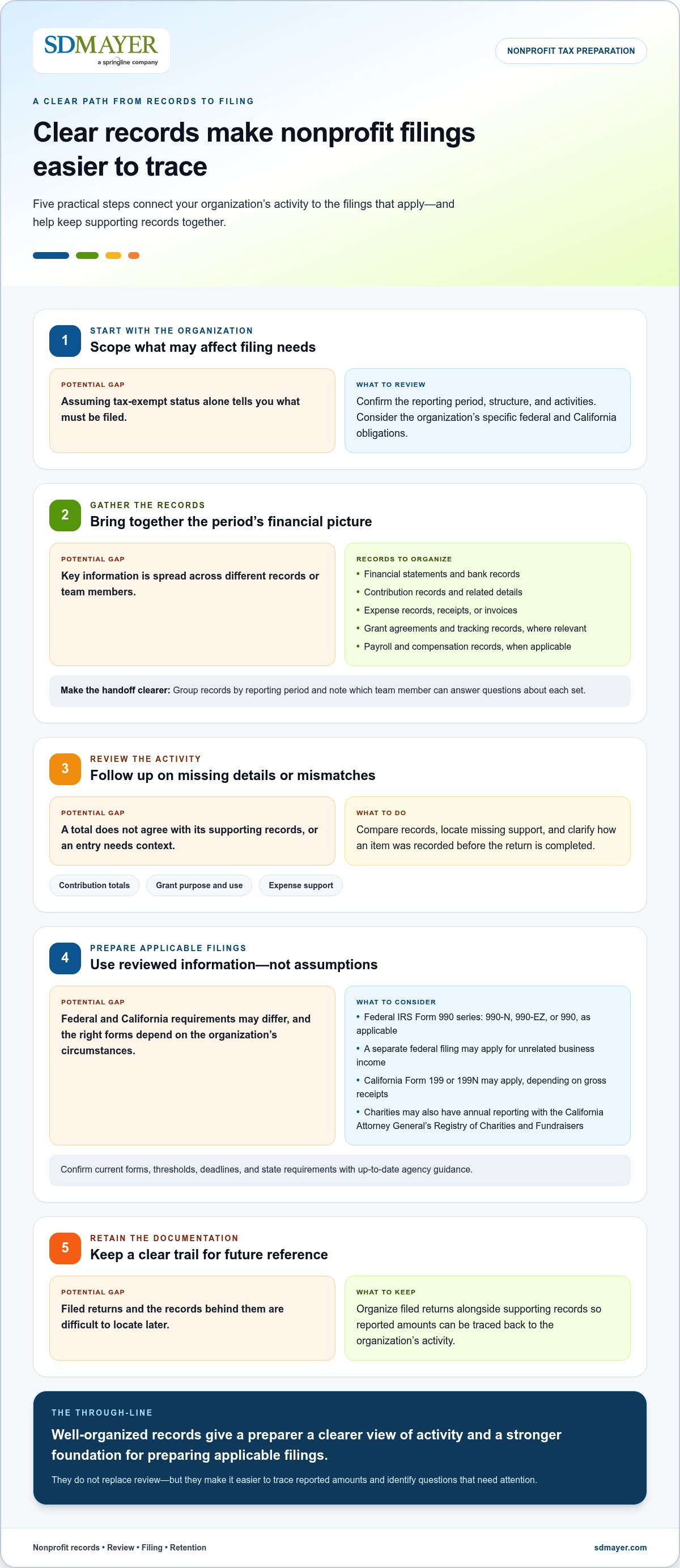
A clear process helps finance staff, executive leaders, and a tax preparer work from the same picture of the organization’s activity. The steps typically move from understanding the organization to retaining records that support its filings. The forms and review steps depend on the nonprofit’s structure, activities, and circumstances.
- Scope the organization. Confirm its reporting period, structure, and activities that may affect filing needs.
- Gather records. Assemble financial statements and supporting records for the period being reported.
- Review activity. Compare records and follow up on missing details or figures that don’t appear consistent.
- Prepare applicable filings. Use the reviewed information to prepare the returns that apply.
- Retain documentation. Keep filed returns and supporting records organized for future reference.
Complete, well-organized records give a preparer a clearer view of the organization’s activity and a stronger foundation for preparing its filings. They don’t remove the need for review, but they make it easier to trace reported amounts back to the records and identify questions that need attention.
Records San Francisco nonprofits can organize before tax preparation
Start with materials that show the organization’s overall financial position and the activity behind it. Depending on your organization, useful records may include:
- Financial statements and bank records for the reporting period.
- Contribution records showing donations received and related details.
- Expense records and supporting documents, such as receipts or invoices.
- Grant agreements and tracking records, where relevant, to connect funding with its purpose and use.
- Payroll and compensation records, when applicable.
Group records by reporting period and note which team member can answer questions about each set. This makes it easier to connect a grant report, payroll record, or expense detail to the period it covers.
What happens during a nonprofit return review?
During review, the preparer confirms key organization details, examines accounting records, and considers financial activity relevant to the filings. If a contribution total doesn’t agree with its supporting records, or a grant entry needs context, the preparer can flag the question before completing the return. Finance staff can then locate documentation or clarify how the item was recorded.
California reporting deserves its own attention. The California Attorney General’s charity reporting guidance is a useful reference alongside federal instructions. Applicable requirements and deadlines can change, so use current agency guidance when organizing the filing calendar. SD Mayer connects nonprofit tax preparation with ongoing accounting support. Talk with SD Mayer’s team about your organization’s reporting needs.
Nonprofit tax preparation is not the same as bookkeeping or an audit
Tax-exempt status doesn’t mean an organization will never have a filing obligation. Bookkeeping, tax preparation, and audit work are also not interchangeable. Each serves a different purpose, produces a different result, and may involve different records or review steps.
The distinction matters when nonprofit leaders plan staff time and coordinate outside support. Bookkeeping maintains the records. Tax preparation uses relevant records and organizational information to prepare applicable filings. An audit is an independent review of an organization’s financial statements or, when applicable, addresses requirements tied to federal awards. These services can be coordinated, but one doesn’t automatically replace another.
Tax preparation versus bookkeeping and financial reporting
Bookkeeping records and organizes financial activity over time, such as contributions received, expenses paid, and payroll transactions. Financial reporting uses that information to show the organization’s financial position and activity to leaders or the board. Tax preparation draws on relevant records and organizational details to prepare applicable returns.
Consistent bookkeeping and reporting can make tax preparation more orderly because financial activity is easier to trace and questions are easier to identify. Organized books alone, however, don’t determine which filings apply or complete the preparation process.
- Bookkeeping: records and organizes transactions.
- Financial reporting: presents financial information for organizational oversight and decision-making.
- Tax preparation: uses relevant records and organization details to prepare applicable filings.
Tax preparation versus financial statement audits and Single Audits
A financial statement audit is a separate review that provides an independent conclusion about an organization’s financial statements. It isn’t an automatic part of preparing a tax return, and preparing a return doesn’t produce an audit opinion.
A Single Audit is also a separate service, conducted when applicable requirements call for one. Its focus and work differ from those of a tax return or a financial statement audit. Requirements depend on an organization’s circumstances, so leaders should use current authoritative guidance to determine what applies rather than assume one service covers the others.
These services can share financial records and coordinated timelines while retaining separate objectives. A nonprofit may benefit from aligning tax preparation, financial reporting, and audit planning so records and open questions are managed consistently. For a broader look at reporting considerations, see this Bay Area financial reporting compliance guide. Coordinating nonprofit tax preparation with accounting and audit support helps clarify which work supports filing, oversight, or independent review.
A practical San Francisco nonprofit tax preparation checklist
Preparation works best when responsibilities, records, and timing are clear before filing work begins. Nonprofit leaders can reduce last-minute questions by agreeing on who owns each record, which reporting period it covers, and who can explain unusual activity.
Prepare the organization’s financial information
Begin with financial statements, supporting schedules, and accounting records for the period being reported. Organize contribution, grant, payroll, and expense documents to match the way your nonprofit tracks its activities. For example, connect grant agreements and tracking records with related amounts in the accounting records so the funding source and use can be followed.
As you gather materials, note any transaction that needs explanation and any missing or incomplete support. A short question log can help: identify the item, the record involved, and the staff member who can provide context. Assigning an owner helps prevent unresolved questions from getting lost between finance staff and program teams.
Confirm that everyone is working with the same reporting period. If financial schedules cover different dates, note the difference and identify which records still need to be aligned. Keep current filing forms, deadlines, and California-specific requirements on a separate reference list, then verify them against the relevant government agency guidance before relying on them.
Coordinate filing work with the nonprofit’s broader financial needs
Tax preparation may be one part of a larger finance workload. Identify whether bookkeeping, financial reporting, or audit-readiness support also needs attention, then clarify how the workstreams fit together. They have distinct purposes, but consistent records and clear timelines make coordination easier.
Set expectations among finance staff, executive leadership, and the board. Decide who gathers source documents, who answers questions about grants or unusual expenses, and when leadership needs financial information for board reporting. This shared plan is especially useful for mid-sized organizations where responsibilities are spread across a small finance team and program leaders.
For broader context on planning tax work alongside organizational goals, read SD Mayer’s strategic tax advice for mid-market organizations. If your nonprofit would benefit from coordinated tax and accounting guidance, connect with SD Mayer about your nonprofit’s tax preparation needs.
How SD Mayer supports nonprofit tax preparation in San Francisco
Nonprofit leaders need tax support that fits the organization’s broader financial picture. SD Mayer is a San Francisco-based accounting and advisory firm serving nonprofit and mission-driven organizations across the Bay Area. Its headquarters is in The Russ Building, and its nonprofit services bring tax preparation together with audit and assurance and accounting advisory support.
An integrated partner for nonprofit financial needs
Tax preparation depends on the financial records behind each filing. When an organization also needs bookkeeping, financial reporting, or audit-readiness support, coordinating the work helps leaders understand how records support different reporting needs. Each service has its own purpose, while shared context can help teams address questions consistently and plan work across the year.
For example, a nonprofit preparing tax filings while strengthening board reporting needs a clear view of how its accounting records support both. SD Mayer’s nonprofit tax, audit and assurance, and Client Accounting & Advisory Services can work in coordination, connecting filing work with related accounting needs. The goal is practical guidance and clear communication, rather than treating every financial task as a separate conversation.
This relationship-based approach can help mid-sized organizations balancing finance responsibilities across staff and leadership. With support that considers the organization’s activities and financial goals, leaders can understand what information is needed, where questions remain, and how related reporting work fits together. Nonprofit tax preparation services are most useful when they address both the return and the financial processes that support it.
Start a conversation about nonprofit tax preparation
Before reaching out, gather a brief overview of your organization’s filing questions, the records already available, and related needs such as bookkeeping, financial reporting, or audit readiness. Note who manages the records and where the team sees gaps or unresolved questions. You don’t need to have every answer in hand; a clear starting point can make the conversation more focused.
SD Mayer supports nonprofit and mission-driven organizations with tax preparation connected to broader accounting and advisory needs. Discuss your nonprofit’s tax preparation needs with SD Mayer.
Build a steadier approach to nonprofit tax preparation
Good preparation starts with clear records, shared responsibility for maintaining them, and time to resolve questions before filing. It also means recognizing that bookkeeping, tax preparation, and audit work have different purposes, even when they rely on many of the same financial records.
For nonprofit tax preparation services in San Francisco, SD Mayer brings nonprofit tax, audit and assurance, and accounting advisory services together. The firm is headquartered in The Russ Building and serves nonprofit and mission-driven organizations across the Bay Area, including San Francisco, San Mateo, San Jose, Walnut Creek, Santa Rosa, San Leandro, Menlo Park, and Sacramento. This local presence and coordinated perspective help leaders connect filing needs with broader financial reporting goals.
Gather your current records, note open questions, and identify related accounting or audit-readiness needs. Then discuss your nonprofit’s tax preparation needs with SD Mayer. A clear plan and practical guidance can help your team manage its financial responsibilities and keep its attention on the work that moves its mission forward.
Frequently Asked Questions
Is a tax-exempt nonprofit required to file an annual tax return?
Generally, tax-exempt status doesn’t remove annual federal filing responsibilities. Many organizations must file a return or notice, though the filing type and any exceptions depend on the organization’s circumstances. California requirements may also be separate from federal filings. Review current IRS and California agency guidance to identify applicable forms and due dates rather than assuming tax-exempt status alone determines what your nonprofit needs to file.
Which tax forms might a nonprofit need to file?
Depending on its activities and financial details, a nonprofit might file IRS Form 990, Form 990-EZ, or Form 990-N. If it earns income from a business activity that isn’t closely connected to its exempt purpose, it may also need to consider Form 990-T, used to report that income. California filings may include Franchise Tax Board Form 199 or Form 199N, and charities may have annual reporting with the Attorney General’s Registry. Check current agency guidance for requirements.
What records should a nonprofit prepare for tax preparation?
Gather financial statements, bank records, contribution information, expense support, and accounting records for the reporting period. Grant agreements and tracking records can explain funding, while payroll and compensation records may be relevant to the organization’s activities. Group documents by period and note missing support or transactions that need explanation. This gives the preparer a useful starting point for reviewing financial activity and following up on questions.
Can nonprofit tax preparation include help organizing grant and contribution records?
Yes. Grant and contribution information can be reviewed as part of preparing applicable nonprofit filings. Organized records help connect reported amounts with the underlying activity, such as the source of a contribution or the terms and use of grant funding. SD Mayer’s nonprofit tax work can consider relevant records, while accounting advisory and bookkeeping support can address broader recordkeeping needs as appropriate to the organization.
How much do nonprofit tax preparation services in San Francisco cost?
Fees are specific to each organization and its needs, so there isn’t a single price that applies to every nonprofit. The work can depend on the filings involved, the organization’s activities, the condition of its records, and whether related accounting support is needed. To discuss your nonprofit’s circumstances with SD Mayer, prepare a brief overview of its reporting period, current records, filing questions, and any unresolved accounting issues.
Does nonprofit tax preparation include an audit or Single Audit?
No. Tax preparation and audit work are separate services with different purposes. Preparing a tax return doesn’t automatically include a financial statement audit or a Single Audit. A Single Audit is a distinct service when applicable requirements call for one. SD Mayer provides nonprofit tax services as well as audit and assurance, allowing related work to be coordinated while keeping each service’s purpose clear.
Can a San Francisco nonprofit work with one firm for tax and accounting support?
Yes. A nonprofit can coordinate tax preparation with related bookkeeping, financial reporting, and audit or advisory needs through one firm. SD Mayer is headquartered in San Francisco and serves nonprofit and mission-driven organizations across the Bay Area. Nonprofit tax preparation can be coordinated with accounting support for organizations in San Mateo, San Jose, Walnut Creek, Santa Rosa, San Leandro, Menlo Park, and Sacramento.
SECURITIES AND ADVISORY DISCLOSURE:
Securities offered through Valmark Securities, Inc. Member FINRA, SIPC. Fee based planning offered through SDM Advisors, LLC. Third party money management offered through Valmark Advisers, Inc a SEC registered investment advisor. 130 Springside Drive, Suite 300, Akron, Ohio 44333-2431. 1-800-765-5201. SDM Advisors, LLC is a separate entity from Valmark Securities Inc. and Valmark Advisers, Inc. Form CRS Link
DISCLAIMER:
This material has been prepared for informational purposes only, and is not intended to provide, and should not be relied on for, accounting, legal or tax advice. The services of an appropriate professional should be sought regarding your individual situation.
HYPOTHETICAL DISCLOSURE:
The examples given are hypothetical and for illustrative purposes only.