
A single federal grant doesn’t determine whether a nonprofit needs a Single Audit. What triggers a single audit for a nonprofit is spending $1 million or more in total federal awards during its fiscal year, according to the Electronic Code of Federal Regulations. Federal funds passed through state or local agencies count toward that total, so the amount spent across awards matters more than the size of any one grant.
It’s easy to focus on grant dollars received, but the requirement depends on federal funds spent during the year. That distinction matters when awards span multiple programs or spending changes over the year.
This article explains which nonprofits must comply, which costs count toward the threshold, and when an organization may qualify for a program-specific audit instead. It also covers how internal controls, documentation, and grant tracking affect preparation, so you can understand the rule and plan for the work involved.
Key Takeaways
- Assess total federal funds expended across awards during the fiscal year, including pass-through funding, rather than looking at one grant in isolation.
- Classify federal expenditures carefully: the timing depends on the type of award or assistance received.
- If federal awards come from only one program, assess whether a program-specific audit may apply instead of a full Single Audit.
- Keep grant records, internal controls, and finance and program teams aligned so spending and reporting can be clearly supported.
- Build audit preparation around the filing deadline and assign responsibility for gathering records and addressing findings.
What triggers the requirement for a Single Audit?
The federal trigger is based on what a nonprofit spends, not simply what it receives. Add eligible expenditures across federal awards, including pass-through funds, to determine what triggers a single audit for a nonprofit. The total may include awards from several programs, even if no individual grant reaches the threshold.
Federal Expenditure Threshold
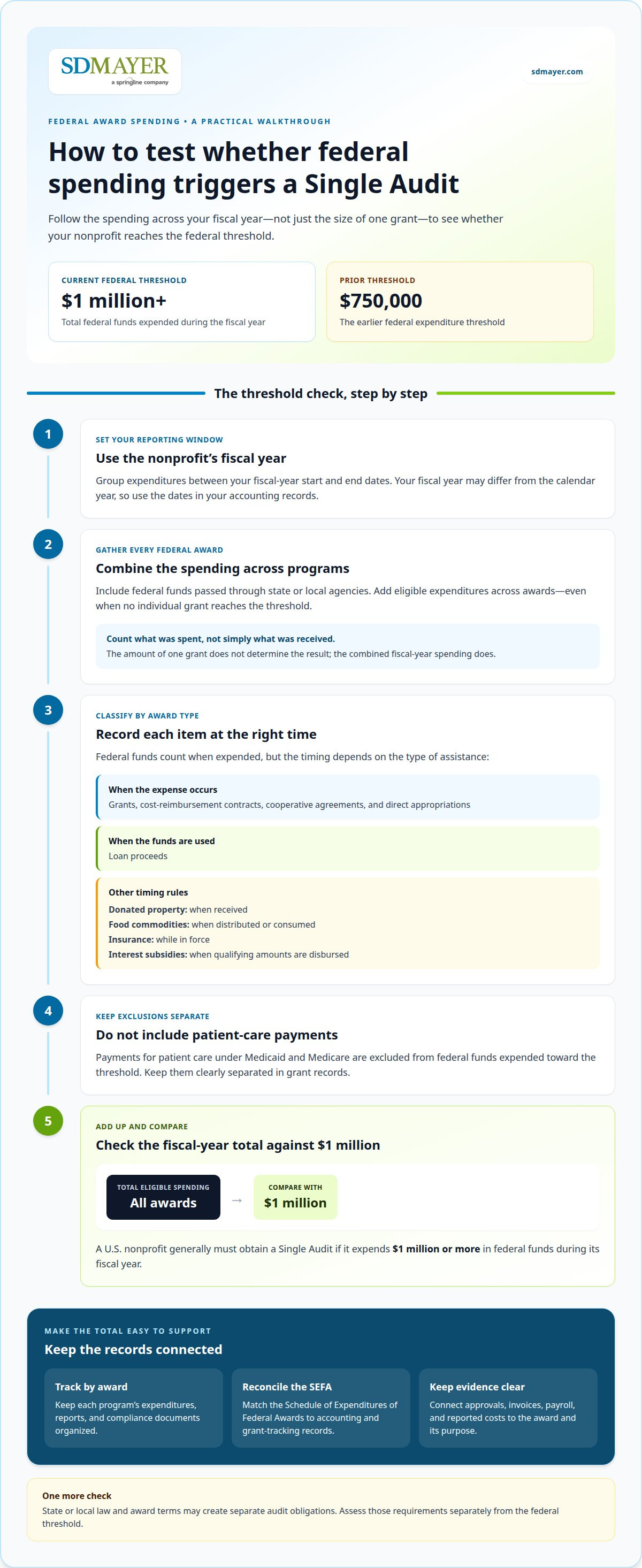
The federal expenditure threshold is the total federal funds a nonprofit expends during its fiscal year. According to the Electronic Code of Federal Regulations, a U.S. nonprofit generally must obtain a Single Audit if it expends $1 million or more in federal funds during its fiscal year. The prior federal award expenditure threshold was $750,000, according to the Electronic Code of Federal Regulations.
The $1 million Single Audit threshold is based on an entity’s total federal funding expenditures during its fiscal year, not on the amount of any individual grant, according to the Electronic Code of Federal Regulations. For an organization managing several awards, the answer to what triggers a single audit for a nonprofit is the combined spending total, not the size of its largest grant.
For example, a nonprofit might spend below the threshold on each award but exceed it when those expenditures are combined. That combined total determines whether the federal audit requirement applies.
Accounting Period for the Threshold
The accounting period is the nonprofit’s fiscal year, which may differ from the calendar year. Expenditures are grouped within that reporting period, so finance staff need to maintain a consistent total as grants are spent.
Use the fiscal-year dates in the accounting records, then total federal expenditures within that period. An organization with a January-to-December fiscal year counts activity within those dates; one with a different fiscal year uses its own start and end dates.
Federal awards count when expended, but timing depends on the type of assistance. For grants, cost-reimbursement contracts, cooperative agreements, and direct appropriations, count an expense when it occurs. Loan proceeds count when used; donated property when received; food commodities when distributed or consumed. Insurance counts while in force, and interest subsidies when qualifying amounts are disbursed.
Payments for patient care under Medicaid and Medicare are excluded from federal funds expended toward the threshold. Keep these items separate in grant records so they aren’t mistaken for qualifying expenditures.
A regular financial statement audit provides independent assurance that financial statements are fairly presented under GAAP or another special purpose framework. A Single Audit also examines compliance in managing federal funds, including applicable controls and reporting.
State or local law can create a separate audit obligation below the federal threshold. The federal test addresses only the federal Single Audit requirement, so assess applicable state or local requirements and award terms separately.
The Schedule of Expenditures of Federal Awards (SEFA) summarizes federal award expenditures for the audit. Reconcile it with accounting records and grant tracking so the amounts and award details support the same fiscal-year total.
Internal controls and program-specific requirements
A Single Audit examines more than recorded balances. It considers how an organization manages federal awards, documents spending, and meets each program’s requirements.
Internal Controls for Federal Programs
Internal controls are the procedures an organization uses to manage federal funds and support accurate compliance reporting. They matter because auditors may examine whether controls related to grant activity are in place and working.
For each federal program, connect approvals, invoices, payroll records, and reported costs to the award’s purpose. Keep evidence showing who approved a purchase, which program paid for it, and how the expense was recorded. Clear documentation helps finance staff trace transactions and explain differences between accounting records and reports submitted to an agency.
Audit testing may examine whether federal costs were allowable, required reports were submitted, procurement followed applicable requirements, and controls addressed grant activity. Auditors use the annual compliance supplement issued by the Office of Management and Budget to determine the nature and extent of compliance testing. Program leaders should be able to explain how assistance was delivered and how spending supported that work.
Selecting and Determining Major Programs
Major program determination identifies which federal programs receive focused compliance testing in a Single Audit. The auditor uses the applicable compliance requirements and the Office of Management and Budget’s annual compliance supplement to shape testing procedures.
Maintain a separate record for each federal award, including expenditures, reports, and key compliance documents. This gives the auditor a clear view of how the organization administered each program and supports selection and testing decisions. Finance and program teams should reconcile their records before audit fieldwork begins.
Selection affects the audit’s focus, not the organization’s responsibility for other awards. A program not selected for major-program testing still requires sound grant records and appropriate controls. Organize documentation by program so staff can respond to requests about spending, procurement, and reports without relying on memory.
Program-Specific Audit Eligibility
A program-specific audit may be an alternative when a nonprofit expends federal awards under only one federal program. According to the Electronic Code of Federal Regulations, eligibility depends on whether that program’s statutes, regulations, or award terms require a financial statement audit.
Start by identifying whether federal awards relate to one program or several, then review the relevant program terms for an audit requirement. Having only one program does not establish eligibility; the financial statement audit condition also matters. Document the basis for the organization’s audit approach and keep the supporting award documents together.
When finance staff and program leaders need to align records, controls, and reporting responsibilities, discuss your audit planning as part of the preparation process.
Uniform Guidance audit requirements
The Uniform Guidance sets the framework for examining federal funding, compliance, and financial reporting. It connects the Single Audit Act’s accountability requirements with the records a nonprofit maintains for federal awards.
According to the Electronic Code of Federal Regulations, the single-audit requirement is set out in 2 CFR Part 200, Subpart F of the Uniform Guidance. The Single Audit Act and Uniform Guidance together govern how the audit is conducted. For a nonprofit, this means the audit addresses both financial reporting and compliance with federal award requirements, rather than focusing on the financial statements alone.
A Single Audit typically includes an audit of the organization’s financial statements and a compliance review of how federal funds were managed. The compliance work considers requirements relevant to the nonprofit’s major federal programs. Auditors use the Office of Management and Budget’s annual compliance supplement to determine the nature and extent of testing. Applicable requirements depend on the federal programs and awards involved.
The audit’s supporting schedules make federal expenditures and findings visible. The Schedule of Expenditures of Federal Awards presents award spending; the Schedule of Findings and Questioned Costs reports findings and questioned costs. Auditor reports also address internal control over compliance and compliance for each major federal award program. Together, these records show how funds received were accounted for and whether program requirements were met.
The required audit covers the entity’s entire operations, or a series of audits covering all units that expended or administered Federal awards during the audit period. This scope matters for nonprofits with multiple departments, locations, or program teams. Finance staff should identify every unit handling federal funding and ensure its award records are available, rather than gathering documentation from only the central office.
Revised Uniform Guidance applies to new awards issued on or after October 1, 2024. When awards span different periods or terms, organize the award documents by issuance date and applicable requirements. This helps the organization distinguish the conditions attached to each award instead of assuming one set of terms applies across all federal programs.
An independent certified public accountant with experience in federal grant auditing conducts the Single Audit. The auditor examines the records and reports, while nonprofit staff provide evidence supporting expenditures, compliance, and award schedules. Maintain consistent account coding and retain documentation with each award so submitted schedules can be traced to underlying records. This supports clear reporting to federal agencies and accountability for federal funding.
Audit preparation and grant management
Strong preparation starts before the fiscal year closes. Assign an owner to each federal grant, reconcile spending to accounting records, and keep supporting documents with the award file. This structure helps finance staff connect transactions to the program, explain how funds were used, and assemble the schedule of expenditures from consistent records.
Build the audit file around each award’s activity. Include award terms, transaction support, procurement records, payroll allocations, approvals, and reports submitted to the agency. For example, a payroll charge shared across programs should include records showing how the allocation was calculated and which program benefited. Program leaders should review these records with finance staff to ensure activity and reported spending align.
Use recurring reconciliations to find gaps while staff can still resolve them. Compare grant ledgers with the general ledger, match expenses to supporting invoices, and follow up on unreconciled differences. Clarify who approves costs, who records them, and who reviews reports. Separate responsibilities where practical, and document the review so the audit trail shows what happened.
Federal cash management also belongs in grant oversight. Federal award advances should not exceed 30 days’ worth of expenditures in a drawdown. Track interest earned on advances; interest above $500 must be remitted. For federally purchased assets, maintain records and perform physical inventories at least every two years. Assign each task to a role and retain evidence of completion.
Plan for findings as well as fieldwork. Each Single Audit finding requires a corrective action plan, and the next year’s audit follows up on prior findings. Record the corrective step, the person responsible, and evidence that the action was completed. This creates a practical handoff among finance staff, program managers, and leadership, rather than leaving the response in an audit file no one revisits.
What are the deadlines for submitting a nonprofit’s Single Audit reporting package? According to the Federal Audit Clearinghouse (U.S. Census Bureau), a U.S. nonprofit must submit its Single Audit electronically within 30 days after receiving the auditor’s report or nine months after its audit period ends, whichever comes earlier. Track both dates and organize the final package so submission does not depend on last-minute record gathering.
Set a preparation calendar that begins well before the filing deadline. Identify who will provide financial statements, grant records, and program documentation, then set internal milestones for reconciliation and review. A mid-sized organization with several grant owners can use one shared tracker to show each award’s records, open questions, and review status. That gives leadership a clear view of readiness and helps staff address missing documentation before audit work intensifies.
Which nonprofit entities must have a Single Audit
The federal requirement can apply to U.S. nonprofits of different sizes and missions. The deciding factor is federal award expenditures, not whether an organization provides healthcare, education, housing, or community assistance. Assess all award activity, including funds handled by departments or programs outside the central finance team.
Funding may reach an organization through direct federal grants, pass-through grants, and certain federal assistance programs. Pass-through awards arrive through a state or local agency, but still contribute to the organization’s federal expenditure total. If the nonprofit receives assistance from more than one source, maintain an award inventory identifying each federal program, administering agency, and related expenditures.
Consider a nonprofit with awards supporting separate missions, such as food assistance and youth services. The relevant assessment is the entity’s combined federal expenditures, not whether either program independently reaches the threshold. Separate accounting codes help teams track each award, while a consolidated year-end review shows the organization’s total federal activity.
The $1 million threshold applies to a nonprofit expending that amount or more in federal funds during its fiscal year. This means an organization that receives a large award but spends less during the period may have a different result than one with several smaller awards and greater combined expenditures. Reconcile actual spending to grant records before deciding whether the requirement applies.
A nonprofit with federal awards under only one federal program may be eligible for a program-specific audit instead of a full Single Audit, according to the Electronic Code of Federal Regulations. Eligibility depends on whether the program’s statutes, regulations, or award terms require a financial statement audit. Review the award documents and identify the applicable program before choosing an audit approach.
Below the federal Single Audit threshold, a nonprofit isn’t subject to the federal Single Audit requirement, though standard annual reporting still applies. The federal threshold does not settle separate requirements imposed by state or local rules or particular award terms. Keep those obligations distinct from the federal test, and document which requirements apply to each entity and award.
Audit findings are reported through the Single Audit process, so clear records help an organization explain how federal funds supported its mission. Mid-sized nonprofits can start by assigning an owner to each award, reconciling program spending, and consolidating totals across departments. For support assessing audit requirements and planning the audit, discuss your nonprofit’s federal award reporting.
SD Mayer: Client Accounting & Advisory Services (CAAS)
SD Mayer provides Single Audits for nonprofits managing federal awards and preparing for compliance testing. For mid-sized organizations, this work can connect grant records, financial reporting, and audit requirements, giving finance teams a clearer view of their responsibilities.
Turn to SD Mayer for a Single Audit or support aligning accounting processes with federal award activity. Client Accounting & Advisory Services (CAAS) and outsourced CFO and Controller services can also support broader accounting and financial oversight needs. Agreed-Upon Procedures are another option when a defined examination is appropriate instead of a Single Audit.
Share your organization’s audit needs with SD Mayer to discuss the next step.
Build Audit Readiness Into Your Funding Plan
Use the question of what triggers a single audit for a nonprofit as a prompt to strengthen how your organization manages federal funding throughout the year. Rather than treating audit preparation as a year-end project, build grant oversight into budget reviews, program updates, and leadership reporting. This gives decision-makers regular opportunities to discuss changing award activity and keep finance and program teams aligned.
Choose an internal owner to coordinate grant records, clarify who approves spending, and surface issues early. Revisit the process when a new award begins, a program changes, or reporting responsibilities shift. These routines create a repeatable approach that can adapt as your organization’s funding and programs evolve. They also help leaders make informed plans using current grant information.
For support with your nonprofit’s audit needs, contact SD Mayer about Single Audits. A thoughtful plan can help your organization approach its next steps with greater clarity and confidence.
Frequently Asked Questions
What federal spending threshold triggers a Single Audit for a nonprofit?
A nonprofit generally needs a Single Audit when its federal expenditures reach $1 million during its fiscal year, according to the Electronic Code of Federal Regulations. For example, combine spending across separate awards rather than assessing each grant alone. Include federal funds passed through state or local agencies. A useful year-end action is to reconcile award-level spending to the general ledger before determining whether the threshold has been reached.
What is the current Single Audit threshold under 2 CFR Part 200?
The current threshold is $1 million in federal expenditures during the fiscal year, according to the Electronic Code of Federal Regulations. The Single Audit requirement appears in 2 CFR Part 200, Subpart F. The prior threshold was $750,000, also according to the Electronic Code of Federal Regulations. For a practical application, use the nonprofit’s fiscal-year dates and compare that period’s total federal expenditures with the current threshold.
Which federal awards count toward a nonprofit's federal expenditures for the threshold?
Count spending under federal grants, cost-reimbursement contracts, cooperative agreements, and direct appropriations when the expense occurs. Pass-through federal awards received through state or local agencies also count. Other assistance follows different timing: loan proceeds count when used, donated property when received, and food commodities when distributed or consumed. Keep separate award records so staff can identify the funding source and timing basis for each expenditure.
Does receiving a federal grant trigger a Single Audit, or only spending the funds?
Spending, not simply receiving a grant, determines whether the expenditure threshold is met. For a grant, funds count when the related expense occurs. For example, an advance received near year-end does not by itself mean the same amount was expended. Track cash received separately from grant costs, and reconcile both records to distinguish available funds from expenditures within the fiscal year.
What steps must a nonprofit take after crossing the Single Audit threshold?
Once the organization’s federal expenditures reach the threshold, organize award records, prepare the Schedule of Expenditures of Federal Awards, and arrange for an independent certified public accountant to conduct the audit. Gather financial statements, grant documentation, and records supporting compliance and internal controls. After receiving the auditor’s report, submit the audit electronically to the Federal Audit Clearinghouse within the applicable deadline. Assign staff responsibility for each preparation task and submission.
What penalties or risks can result from failing to obtain a required Single Audit?
Missing a required Single Audit or filing late can lead to additional oversight, delayed funding, repayment of certain federal awards, or other corrective actions, depending on the circumstances. A finding also requires a corrective action plan, and prior findings are followed up in the next year’s audit. Keep grantors informed through required reporting and assign an owner to track each corrective step and its supporting documentation.
SECURITIES AND ADVISORY DISCLOSURE:
Securities offered through Valmark Securities, Inc. Member FINRA, SIPC. Fee based planning offered through SDM Advisors, LLC. Third party money management offered through Valmark Advisers, Inc a SEC registered investment advisor. 130 Springside Drive, Suite 300, Akron, Ohio 44333-2431. 1-800-765-5201. SDM Advisors, LLC is a separate entity from Valmark Securities Inc. and Valmark Advisers, Inc. Form CRS Link
DISCLAIMER:
This material has been prepared for informational purposes only, and is not intended to provide, and should not be relied on for, accounting, legal or tax advice. The services of an appropriate professional should be sought regarding your individual situation.
HYPOTHETICAL DISCLOSURE:
The examples given are hypothetical and for illustrative purposes only.