
What if the "big win" you’ve been working toward at your startup actually triggers a tax bill that consumes nearly half of your hard-earned gains? For many Bay Area professionals, the excitement of a liquidity event is often overshadowed by the looming fear of the Alternative Minimum Tax (AMT) trap or California’s aggressive 13.3% top state income tax rate. It’s a stressful position to be in, especially when you’re trying to balance long-term wealth with immediate cash flow needs. We understand that you’ve put in the years; now you want to ensure those ISO vs NSO tax implications don’t derail your financial future.
You deserve a strategy that feels like a supportive partnership and not just a complex math problem. We’ve designed this guide to provide a clear, jargon-free breakdown of how your options impact your take-home pay. We’ll help you navigate holding period math and the nuances of the 2026 tax landscape without the clinical detachment of traditional financial firms. By the end of this article, you’ll have a practical plan for exercising your options and a solid strategy to minimize your 2026 tax liability using plain English.
Key Takeaways
- Learn the fundamental differences between Incentive and Non-Qualified options to treat your equity as a strategic asset rather than a surprise bill.
- Identify how to manage the spread during exercise to navigate the specific ISO vs NSO tax implications that affect your 2026 take-home pay.
- Master the "Golden Rule" of holding periods to qualify for lower capital gains rates and keep more of your investment gains.
- Understand why California taxes these options differently and how to account for the state's high income tax rates in your financial planning.
- Discover how to move beyond basic spreadsheets with a holistic strategy that integrates tax planning and wealth management for 2026 and beyond.
Understanding the Basics: What Are ISOs and NSOs?
Think of your stock options as a "future-dated discount" on your company's potential success. You're given the right to buy shares at a set price, which is hopefully much lower than what they'll be worth in the future. In the Bay Area's competitive tech landscape, these options are often the most significant part of a compensation package. However, not all options are created equal. The two main types you'll encounter are Incentive Stock Options (ISOs) and Non-Qualified Stock Options (NSOs). Understanding the ISO vs NSO tax implications now is vital because it determines how much of that future wealth actually stays in your pocket when you file your 2026 tax return.
The Core Differences at a Glance
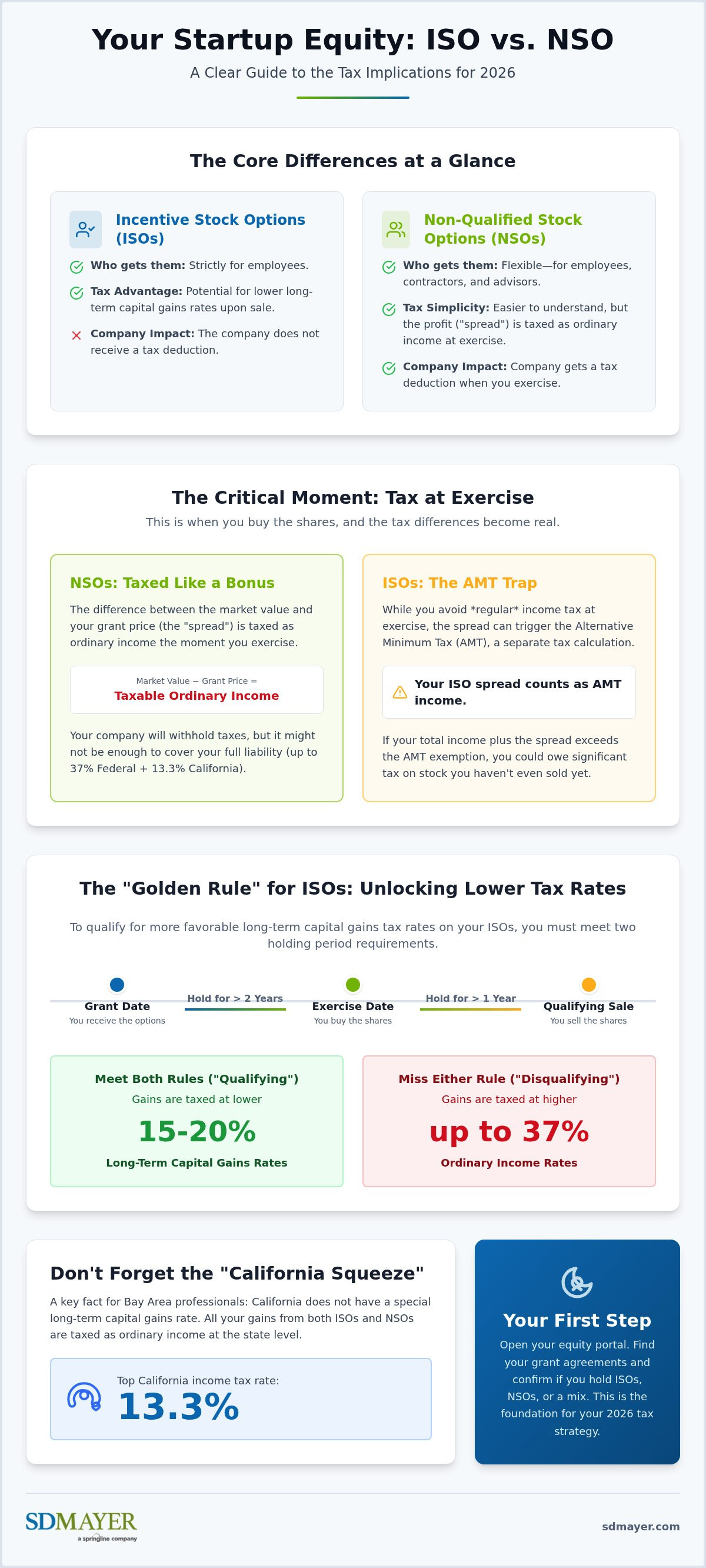
The primary difference lies in who can receive them and how the government views them. Incentive Stock Options (ISOs) are reserved strictly for employees. They're often called "statutory" options because they meet specific IRS requirements to qualify for special tax treatment. On the other hand, NSOs are more flexible. Companies can grant them to contractors, board members, and outside advisors. The "spread" is the heart of the matter. This is the difference between your grant price and the market value when you exercise. With NSOs, that spread is taxed immediately as ordinary income. With ISOs, you might avoid immediate regular income tax, though you'll need to keep an eye on the Alternative Minimum Tax (AMT) for 2026.
Why Companies Choose One Over the Other
Companies weigh their own tax benefits against yours when deciding which options to grant. NSOs are popular with employers because the company gets a tax deduction when you exercise them. ISOs don't offer that same deduction for the company, but they're a powerful tool for attracting top-tier talent who want those tax-advantaged gains. There's also a strict $100,000 limit to keep in mind. If the value of your ISOs that first become exercisable in a single year exceeds $100,000, the excess automatically converts into NSOs. This shift can significantly change the ISO vs NSO tax implications for your 2026 strategy.
Action Item: Open your equity portal or grant agreement today. Look specifically for the "Type of Grant" section to confirm whether you're holding ISOs, NSOs, or a mix of both. This is the first step in building your 2026 strategy.
Tax Implications at Exercise: Managing the Spread
Exercising your options is the pivotal moment when you transition from holding a promise to owning actual shares. You pay the strike price set in your grant agreement to "buy" the stock. While this sounds straightforward, the ISO vs NSO tax implications at this stage are vastly different. These differences can lead to a significant cash crunch if you aren't prepared for the immediate tax liabilities that follow.
When you exercise NSOs, the IRS views the profit as immediate wages. This creates what we call the "paper wealth" problem. You might owe thousands in taxes on shares that you cannot yet sell on the open market, meaning you must find the cash elsewhere to pay the bill. According to the legal definition of an ISO, these options are designed to defer that regular income tax until you actually sell the stock. However, there is a significant catch involving a parallel tax system that often surprises Bay Area tech employees.
Calculating Your NSO Tax Bill
For NSOs, the spread is treated exactly like your salary. The spread is the gap between your strike price and the current market value of the shares. Your company is required to withhold taxes at exercise, often at a flat 22% federal rate. However, if your total 2026 income puts you in the top 37% federal bracket, that 22% withholding won't be enough. You'll need to settle the difference with the IRS and California’s Franchise Tax Board, which can reach as high as 13.3%, by the time you file your return.
The ISO Alternative Minimum Tax (AMT) Trap
The AMT ensures that high earners pay a minimum share of tax regardless of deductions. While ISOs don't trigger regular income tax at exercise, the spread is considered a "tax preference item" for AMT purposes. For 2026, the AMT exemption is $90,100 for single filers and $140,200 for married couples filing jointly. This exemption begins to phase out once your income hits $500,000 for singles or $1,000,000 for married couples. If your ISO spread plus your other income exceeds these thresholds, you could face a massive tax bill in April for stock you haven't even sold yet. Managing this requires precise timing and careful modeling. Some professionals choose to exercise only enough shares to stay under the AMT exemption threshold to avoid an unnecessary bill. If you're feeling overwhelmed by these calculations, it's often best to reach out to a specialist who can model these scenarios for you.
Selling Your Shares: Holding Periods and Capital Gains
After navigating the complexities of exercising your options, the next major hurdle is timing the sale. This is where the ISO vs NSO tax implications reach their final destination. The difference between a well-timed sale and a hasty one can mean losing a significant portion of your gains to the IRS. To maximize your wealth, you must understand the "Golden Rule" of holding periods, which dictates whether your profit is taxed at high ordinary income rates or much lower capital gains rates.
For ISOs, the goal is to achieve a "qualifying disposition." This requires holding your shares for at least one year from the date you exercised them and at least two years from the original grant date. If you meet both requirements, you've earned the right to use long-term capital gains tax rates on the entire profit. For NSOs, the path is slightly different. Since you already paid ordinary income tax on the spread at exercise, you only need to hold the shares for more than one year after exercise to qualify for long-term capital gains on any additional growth.
Qualifying Dispositions: The Tax Win
Hitting that qualifying status is a major financial milestone. In 2026, the top federal long-term capital gains rate is 20%, which applies to single filers with taxable income over $545,501 and married couples over $613,701. When you compare that to the top ordinary income tax rate of 37%, the savings are substantial. This 17% difference can represent hundreds of thousands of dollars for many Bay Area professionals. For a broader look at how these savings fit into a comprehensive financial plan, you can explore our Strategic Tax Advice 2026 guide.
Selling Early: What Happens if You Don’t Wait?
Life doesn't always wait for a two-year clock to run out. Selling your shares before meeting the holding requirements results in a "disqualifying disposition." For ISOs, this means the spread you enjoyed at exercise is suddenly taxed as ordinary income in the year of the sale. This can push you into a higher tax bracket and trigger a much larger bill than you anticipated. However, selling early isn't always a mistake. If your company's stock is highly volatile, it might make sense to sell and lock in gains rather than risking a price collapse just to save on taxes. We often help clients balance this "tax alpha" against the very real risk of market volatility.
Action Item: Create a simple calendar or spreadsheet that lists every option grant you've exercised. Mark the exact date you hit the one-year and two-year milestones for each. This prevents you from accidentally selling a few days too early and losing your tax-advantaged status.
The California Factor: SALT and Local Tax Nuances
While federal rules offer a glimmer of hope for ISO holders, California plays by its own set of rules. A common mistake for Bay Area professionals is assuming that state tax follows federal logic. In reality, California treats the spread on both ISOs and NSOs as ordinary income the moment you exercise. This means you won't get the same "tax-free" exercise at the state level that you might enjoy federally with ISOs. When you combine the top state rate of 13.3% with federal obligations and the 1.3% State Disability Insurance (SDI) tax, it's easy to see why local professionals often face the highest effective tax rates in the country. Understanding these specific ISO vs NSO tax implications is the only way to avoid a massive cash shortfall when your state return is due.
Managing the State and Local Tax (SALT) deduction remains a high-stakes game in 2026. Since the $10,000 cap on SALT deductions is now a permanent fixture of the tax code, your ability to offset these high California taxes is strictly limited. You must look for other ways to balance the scales, such as timing your exercise to fall in a year where your other income might be lower or using charitable contributions to reduce your overall taxable base.
Action Item: Calculate your "all-in" tax rate before you exercise. Add your federal bracket (up to 37%) to California's top rate (up to 13.3%) and the 1.3% SDI tax. If your total exceeds 50%, you need a liquidity plan to cover the bill without selling all your shares.
San Francisco and San Jose Local Considerations
Local residency issues can complicate your strategy. California is notorious for tracking equity income even after you've left the state. If you were granted options while working in San Francisco but move to a tax-free state like Texas before you sell, California will still claim a pro-rata share of those gains based on the time you spent working here. This makes it vital to work with a tax advisor who understands the nuances of the Bay Area innovation economy and can help you navigate these multi-state residency traps.
Planning for High-Net-Worth Scenarios
For those managing a significant equity event, stock options shouldn't be viewed in isolation. Integrating your options into a Family Office structure allows for more sophisticated wealth transfer strategies. You might consider gifting exercised shares to family members in lower tax brackets or using a charitable lead trust to offset massive gains. These moves don't just save money; they ensure your hard-earned success benefits the people and causes you care about most. If you're ready to build a more resilient strategy for your 2026 equity, contact our team today for a personalized review.
Proactive Planning: How SD Mayer Simply Does More
For many Bay Area professionals, a spreadsheet is the first tool they reach for when managing equity. While a DIY approach might work for small grants, it often falls short when you're facing a $1M+ event. A static document cannot account for shifting market conditions or the intricate ISO vs NSO tax implications that evolve as your career progresses. At SD Mayer, we believe your equity planning deserves a higher level of care. We move beyond simple number-crunching to provide an integrated strategy that combines stock option tax planning, wealth management, and long-term financial reporting.
Our approach is built on being a steady companion through your financial journey. We don't just tell you what you owe; we help you time your exercises to manage cash flow effectively. This ensures you have the liquidity needed to cover tax bills without being forced to sell shares at an inopportune time. By looking at the big picture, we transform a stressful compliance task into a proactive wealth-building strategy. It's about more than just checking boxes; it's about making sure your hard work translates into lasting security.
A Holistic View of Your Equity
Your stock options aren't just line items on a tax return. They're the fuel for your retirement, your children's education, and your life goals. Relying on software alone misses the human element of these milestones. We focus on risk diversification to ensure you aren't over-exposed to a single company's stock. It's common for tech employees to have 90% of their net worth tied up in one place, which creates a precarious financial position. We bring founder-level expertise, rooted in 40 years of San Francisco innovation, to help you balance that risk with stable, long-term growth.
Action Items for 2026
Managing your wealth requires intentionality and a forward-thinking mindset. Start by taking these three steps to secure your 2026 tax position:
- Audit your grants: Review every grant agreement to confirm your current ISO vs. NSO status and exact vesting schedule.
- Model your exposure: Work with a strategist to project your AMT exposure for the current tax year, especially if you plan to exercise significant blocks of shares.
- Schedule a strategy session: Reach out to SD Mayer before your next vesting date to align your equity exercise with your broader wealth management and life goals.
We're here to reduce the stress of complex financial compliance by providing calm, capable stewardship. Don't wait until tax season to discover you've made a costly timing error. Booking a consultation before your next vesting date allows us to build a plan that maximizes your take-home pay and protects your future.
Securing Your Equity Strategy for 2026 and Beyond
Success in the Bay Area's innovation economy often depends on how well you manage the rewards of your hard work. Mastering the timing of your exercise and understanding the nuances of California's unique tax treatment are the essential keys to keeping more of your gains. Whether you're navigating the AMT or planning for a long-term holding period, the right approach turns a complex compliance task into a strategic wealth-building opportunity. Understanding the ISO vs NSO tax implications is just the first step in a successful financial journey.
Ready to build a plan that protects your future? Get expert help with your stock option strategy at SD Mayer. We provide founder-level expertise tailored to the local economy, integrating tax strategy and wealth management under one roof. As a member of the BDO Alliance USA, we combine this local insight with global reach to support your growth. You've put in the years to earn your equity; now it's time to make sure that success lasts. We're here to guide you through every stage with calm, capable stewardship.
Frequently Asked Questions
What is the main difference between ISO and NSO tax treatment?
The main difference lies in when you're taxed and what rate you pay. For NSOs, the spread is taxed as ordinary income the moment you exercise. For ISOs, you generally don't pay regular income tax at exercise. Instead, you wait until you sell the shares to pay taxes. This distinction is the core of ISO vs NSO tax implications, as it determines your immediate cash needs versus your long-term savings potential.
Do I have to pay taxes when I exercise my ISOs if I don’t sell?
You won't owe regular federal income tax when you exercise ISOs, but you might trigger the Alternative Minimum Tax (AMT). The IRS views the spread at exercise as a tax preference item. For 2026, single filers have an AMT exemption of $90,100, while married couples filing jointly have $140,200. If your spread exceeds these thresholds along with your other income, you could face a significant tax bill even without a sale.
How does the Alternative Minimum Tax (AMT) work with stock options?
AMT is a parallel tax system designed to ensure high earners pay a minimum amount of tax. When you exercise ISOs, the difference between the strike price and the market value is added to your AMT income. If this total exceeds the 2026 exemption amounts, you pay the higher AMT rate instead of the regular tax rate. This often creates a situation where you pay taxes on paper wealth before seeing any actual cash.
Can I lose money by exercising my stock options?
Yes, it's possible to lose money if the stock price drops significantly after you exercise. You pay the strike price plus any associated taxes upfront. If the market value falls below what you paid, or if you owe a large AMT bill on shares that are now worth less than the tax owed, your net return could be negative. This risk makes timing and liquidity planning essential for every Bay Area professional.
What is a disqualifying disposition and how does it affect my taxes?
A disqualifying disposition occurs when you sell ISO shares before meeting the mandatory holding periods. These periods are one year from exercise and two years from the grant date. If you sell early, the tax benefits of the ISO vanish. The spread is then taxed as ordinary income, similar to a bonus or salary, which can reach up to 37% federally in 2026 plus California’s high state income tax rates.
How does California tax stock options compared to the federal government?
California does not recognize the tax-deferred status of ISOs. While the federal government lets you defer regular income tax at exercise, California treats the spread as ordinary income immediately for both ISOs and NSOs. With the state's top tax rate reaching 13.3% in 2026, this creates a much higher immediate tax burden for local employees compared to professionals in other states. It's a significant factor in your total take-home pay.
What happens to my options if I leave my company?
Most companies require you to exercise your vested options within 90 days of leaving. If you don't act within this window, you typically forfeit the options. Additionally, if you leave a company with ISOs and don't exercise them within three months, they automatically convert into NSOs for tax purposes. This change significantly alters the ISO vs NSO tax implications for your final payout and your 2026 tax strategy.
Is it better to have ISOs or NSOs?
ISOs are generally considered better for employees because they offer the potential for lower long-term capital gains rates. However, they come with the complexity of AMT. NSOs are often simpler to manage because the tax is handled at exercise, and they don't have the strict $100,000 annual limit that ISOs do. The best choice depends entirely on your cash flow, your company's growth trajectory, and your overall 2026 financial plan.
SECURITIES AND ADVISORY DISCLOSURE:
Securities offered through Valmark Securities, Inc. Member FINRA, SIPC. Fee based planning offered through SDM Advisors, LLC. Third party money management offered through Valmark Advisers, Inc a SEC registered investment advisor. 130 Springside Drive, Suite 300, Akron, Ohio 44333-2431. 1-800-765-5201. SDM Advisors, LLC is a separate entity from Valmark Securities Inc. and Valmark Advisers, Inc. Form CRS Link
DISCLAIMER:
This material has been prepared for informational purposes only, and is not intended to provide, and should not be relied on for, accounting, legal or tax advice. The services of an appropriate professional should be sought regarding your individual situation.
HYPOTHETICAL DISCLOSURE:
The examples given are hypothetical and for illustrative purposes only.