
What if the biggest tax decision isn’t one investment or deduction, but how several financial choices come together in the same year? For high-net-worth families, high net worth tax strategies California residents consider may involve income, investments, equity compensation, business interests, and long-term wealth goals at the same time.
It can be hard to see how these pieces fit together. A stock option decision or business sale may affect more than one tax year, and federal and California rules may treat the same income differently. California, for example, taxes capital gains as ordinary income, so a large investment sale deserves review alongside your broader plan.
This guide covers tax-planning topics to consider before a major financial event and how California rules can interact with federal planning. You’ll also see how coordinating tax, wealth, and business decisions can help you assess their potential impact before acting.
Key Takeaways
- Build a complete view of income, investments, business interests, and family goals before weighing individual tax decisions.
- Review equity, liquidity, and investment decisions early, since timing and tax effects depend on your circumstances.
- Use high net worth tax strategies California residents can consider to compare SALT, investment, estate, and business-planning questions.
- Make an annual review part of your financial routine, updating it when income, assets, family circumstances, or plans change.
- Coordinate tax, wealth, estate, and business planning around shared long-term goals.
High-net-worth tax strategies in California start with a complete financial picture
Tax planning works best as an ongoing conversation about the decisions shaping your financial life, not a search for one deduction or a year-end filing task. For high-net-worth individuals and families, income, investments, business ownership, and family priorities can overlap. Reviewing them together helps surface questions that may be missed when each decision is considered on its own.
A useful starting point for high net worth tax strategies California residents may consider is to ask: What is changing, and how could it affect other parts of the plan? General guidance can help you identify topics to discuss, but personalized tax advice depends on your full financial picture and the rules in effect when you make decisions.
In plain language: High-net-worth tax planning means coordinating decisions about income, assets, businesses, and family goals over time, rather than focusing on a single tax return or transaction.
Which parts of a financial picture affect tax planning?
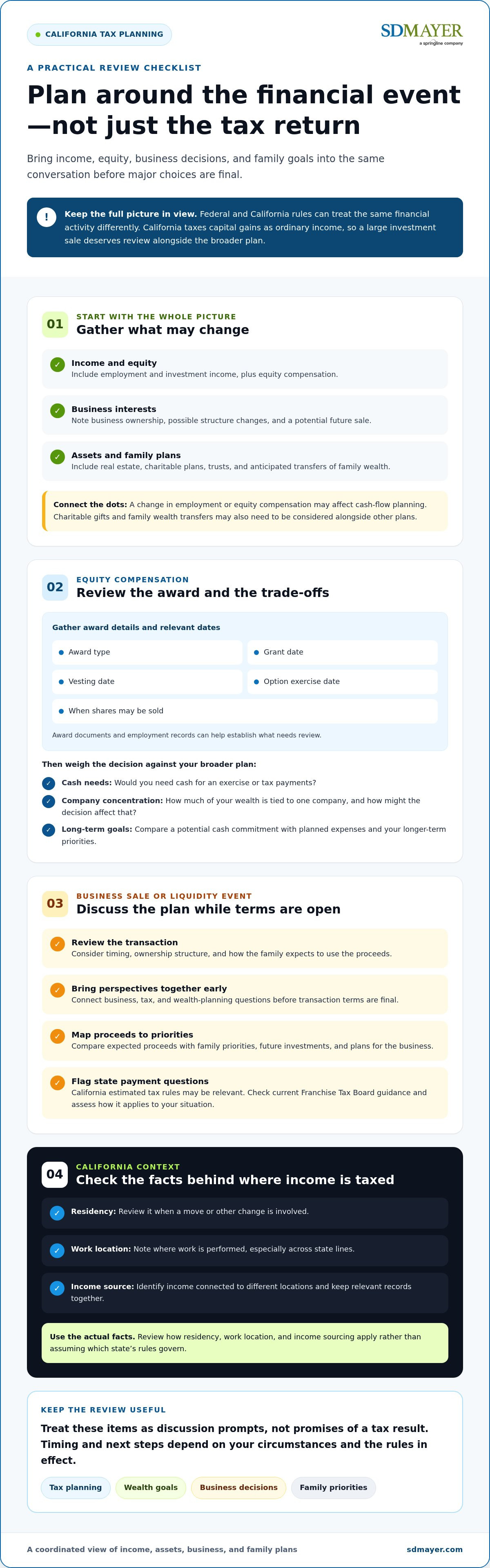
Start by gathering a current view of income sources and assets or plans that could change. That may include:
- Employment and investment income, along with equity compensation.
- Business ownership, including possible changes to the business structure or a future sale.
- Real estate, charitable plans, trusts, and anticipated transfers of family wealth.
These pieces can influence one another. A change in employment or equity compensation, for example, may affect cash-flow planning while a business owner considers a major investment. A charitable gift or family wealth transfer may also need to be considered alongside other plans. The point isn’t to assume one decision dictates another. It’s to identify potential connections before acting.
Why does California context matter to a broader tax plan?
Federal and California rules can treat the same financial activity differently, so a plan should account for both and be reviewed against current guidance. California’s income tax structure is one reason state considerations belong in the conversation. For a general overview, see California's progressive personal income tax system.
Residency, where work is performed, and where income is sourced are also worth assessing, especially when someone moves, works across state lines, or has income connected to different locations. Keep relevant residence, work-location, and income records together, then review how the facts apply rather than relying on a simple assumption about which state’s rules govern. A coordinated review can help organize the details and identify planning questions.
California tax strategies to review around income, equity, and liquidity events
Major financial changes deserve a review before decisions are final. A change in compensation, equity award, business ownership, or investment plans can affect cash flow and tax planning in different ways. The most useful high net worth tax strategies California residents consider are based on their actual circumstances, not assumptions about what will work for everyone.
Reviewing an event before it closes can leave more time to consider questions and options.
Use the prompts below to prepare for a conversation with your tax and financial advisors. The right timing and next steps depend on your personal facts and the rules in effect, so treat these as decision prompts, not promises of a particular tax result.
How should executives and founders approach equity compensation?
Start with the award details. Identify its type and gather relevant dates, such as when it was granted, when it vests, when an option can be exercised, and when shares may be sold. Award documents and employment records can help establish what needs review. Stock option tax planning should account for current rules and your individual situation.
Then connect the equity decision to the rest of your financial plan. Consider whether you may need cash for an exercise or tax payments, how much of your wealth is tied to one company, and how the decision fits your longer-term goals. For example, an executive weighing whether to exercise options can compare the potential cash commitment with planned expenses and consider the effect of holding more company stock. That’s a planning question, not a one-size-fits-all answer.
What should families consider before a liquidity event?
A proposed business sale can involve decisions about timing, ownership structure, and how the family expects to use the proceeds. Bring business, tax, and wealth-planning perspectives into the discussion early, while the transaction is still being considered. A coordinated review can help identify questions to resolve before terms are final without assuming a particular tax treatment or outcome.
For instance, a founder preparing for a possible sale might map expected proceeds against family priorities, future investments, and plans for the business. The review can also flag state payment questions for discussion. California’s Franchise Tax Board provides information on High income estimated tax rules; use current official guidance and personalized analysis to understand what applies to your situation.
These conversations are most useful when the business and personal financial picture are considered together. SD Mayer’s stock option tax planning and liquidity event planning can connect tax questions with wealth and business decisions. If a major change is approaching, start a planning conversation before key choices are settled.
How California residents can compare tax-planning opportunities and trade-offs
A comparison can turn a broad list of possible tax moves into a focused review. For high net worth tax strategies California residents consider, start with the event prompting the review, the questions it raises, and the people who can help connect the details. Use the table as a discussion tool, not a recommendation. Potential strategies depend on your facts and current rules.
| Planning area | Common trigger | Questions to assess | Who may coordinate |
|---|---|---|---|
| State and local tax (SALT) | Income, property, or work-location changes | Where is income connected to? Which state and local tax rules and deductions need current review? | Tax advisor and payroll or business team |
| Investments | Buying, selling, or rebalancing assets | How might the timing and type of investment income affect the broader plan? | Tax and wealth advisors |
| Estate and trusts | Family, ownership, or wealth-transfer plans change | Do asset ownership and trust arrangements still support family goals? | Tax advisor, wealth advisor, and estate-planning professional |
| Business and equity | Equity awards, ownership changes, or a possible sale | What dates, documents, cash needs, and business decisions should be reviewed together? | Tax, wealth, and business advisors |
How do SALT and investment decisions fit into the review?
SALT means state and local tax planning. It can involve reviewing where income is earned or sourced, how deductions apply, and how state and federal treatment may differ. Details depend on the person, the income, and current rules, so don’t assume that a deduction or approach that worked before still fits.
Investment choices have more than one dimension. A sale may affect available cash, portfolio balance, and taxable income. Ask your tax and wealth advisors to consider those factors together before making a change, rather than treating investment management as a tax decision alone.
When should estate, trust, and wealth planning be coordinated?
Bring these perspectives together when family objectives, asset ownership, or plans to transfer wealth change. A trust or ownership decision can affect how assets are managed and how a family’s broader tax plan is organized. Review the implications before making major changes, with tax, wealth, and estate-planning professionals working toward the same goals.
A tax opportunity is only useful if it fits the person, the family, and the plan. That distinction keeps a promising idea from being mistaken for a suitable strategy. Investment management can support broader wealth goals, but it isn’t a guaranteed tax solution. A coordinated review helps weigh trade-offs in context.
A practical annual review for high-net-worth tax strategies in California
An annual review can turn a complicated financial picture into a manageable set of questions and next steps. Use this sequence with your tax and financial advisors, updating it when income, assets, family circumstances, or business and employment plans change. The goal is to organize decisions, not assume that a particular strategy applies.
What records and upcoming changes should you gather?
Bring together current information on income, investments, equity compensation, business interests, and trusts. Add a short list of expected sales, gifts, relocations, or other material changes. Note what you’re deciding and what you still need to understand. This gives your advisors a shared starting point for reviewing high net worth tax strategies California residents may consider based on their circumstances.
How can you turn a review into clear next steps?
Once you’ve gathered the information, sort questions by how soon they need attention and who should help address them. Some decisions may need review before a planned transaction or other major event. Broader family, wealth, or business goals may suit a longer-term planning conversation.
Use this adaptable annual checklist:
- 1. Note what changed. Summarize shifts in income, investments, assets, family circumstances, and work or business plans.
- 2. List upcoming decisions. Flag possible sales, equity events, gifts, moves, ownership changes, or trust-related questions, including any relevant dates you know.
- 3. Gather supporting records. Collect current statements, award documents, business information, and trust records related to those questions.
- 4. Sort by timing. Separate decisions that may need prompt review from topics to develop over a longer planning horizon. Don’t treat this sorting as a legal deadline or a conclusion about tax treatment.
- 5. Assign next steps. Record the question, the advisor who will help address it, and any information still needed. Set a follow-up point if a major event or relevant rule change arises.
This process keeps open questions visible and makes it easier to coordinate tax, wealth, and business perspectives. For broader planning context, continue with SD Mayer’s Strategic Tax Advice 2026 guide.
For a coordinated annual review, talk with SD Mayer about your tax and financial plan.
How an integrated California tax advisor can connect tax and wealth decisions
Tax filing, investment choices, business plans, and family priorities are connected. An integrated advisor brings these conversations together so decisions can be considered in context, rather than handled in separate silos. For families weighing high net worth tax strategies California offers, the value is a clearer view of the questions, trade-offs, and next steps, not a promise of a particular tax result.
What does coordinated tax and wealth guidance look like?
It starts with shared planning conversations. Tax advisors can bring filing obligations and current tax questions into discussions about investments, equity compensation, business ownership, and family goals. Wealth management adds a perspective on how financial choices fit longer-term priorities. Estate and trust matters can be considered alongside ownership and family plans, with the appropriate professionals involved.
Proactive communication connects what happened during the year with decisions still ahead. A change in compensation or a planned business transition, for example, may be relevant to tax filings as well as cash-flow and investment planning. Keeping advisors aligned can surface questions early and clarify who needs to address them. It doesn’t guarantee a specific outcome, but it can support more informed decisions.
When is it useful to bring in an integrated advisor?
Consider a coordinated review when income becomes more complex, equity compensation changes, a business transition is approaching, or family wealth decisions are on the horizon. Each event may raise questions across tax, wealth, and business planning. A trusted advisor can help organize the moving parts, identify information still needed, and keep the discussion grounded in your goals and current rules.
SD Mayer is a San Francisco Bay Area-rooted accounting and advisory firm with integrated tax, business advisory, and wealth-management capabilities. Its individual tax, state and local tax (SALT), stock option planning, and wealth management perspectives can help connect personal and business decisions. Bay Area experience brings regional context to conversations with executives, founders, business owners, and families whose financial lives intersect with the area’s changing business environment.
For a practical first step, bring a short list of upcoming decisions and questions to a planning conversation. SD Mayer can help coordinate tax and wealth perspectives around your circumstances, whether you’re reviewing equity compensation, a business change, or longer-term family priorities. Discuss your tax-planning needs with SD Mayer and explore a plan tailored to your goals.
Make your next financial decision with a coordinated plan
Strong tax planning starts with the full picture: income, investments, equity compensation, business interests, and family priorities. Reviewing these pieces together can help you identify questions before a major decision is final and keep tax choices connected to longer-term wealth goals. That’s the practical value of high net worth tax strategies California families can build around their circumstances.
SD Mayer brings tax, advisory, and wealth-management capabilities together, with Bay Area roots and founder-level regional experience. Its work includes individual tax, SALT advisory, stock option planning, estate and trust tax services, and family-office capabilities. The goal is to connect the dots across complex decisions, not promise a particular tax outcome.
As a next step, gather your questions about upcoming income changes, equity events, business plans, or family wealth decisions. A coordinated conversation can help clarify what needs attention now and what belongs in a longer-term plan. Discuss your tax and wealth-planning goals with SD Mayer to start a conversation about your goals.
Frequently Asked Questions
Does California tax capital gains differently from federal taxes?
Yes. California generally taxes capital gains as ordinary income rather than applying a separate lower state rate for long-term gains, while federal tax rules may treat long-term gains differently. The result can depend on the type and timing of an investment sale and your wider financial picture. Before selling, review the applicable federal and California rules for that tax year with an advisor who can assess your circumstances.
What tax strategies should high-net-worth individuals in California review?
Start with decisions connected to your income, investments, business interests, equity compensation, and family plans. Then review state and local tax (SALT) questions, estate and trust planning, and the timing of significant transactions. High net worth tax strategies California residents consider should fit their personal facts and current federal and state rules. A coordinated review can help prioritize what needs attention now and what belongs in longer-term planning.
Can stock options create a tax bill before I sell shares?
Yes, depending on the type of stock option and what you do with it, a tax consequence may arise before you sell shares. The timing and treatment vary, so don’t assume a sale and tax payment happen together. Before exercising or making another decision, gather your award documents and relevant dates, consider your cash needs, and review the current rules with a tax professional familiar with stock option planning.
When should I start tax planning for a business sale or liquidity event?
Start when a potential transaction becomes a serious possibility, not just before it closes. Early planning gives you time to raise questions about timing, ownership, expected proceeds, cash flow, and how the event fits your broader wealth goals. The relevant choices depend on the transaction and your circumstances, so review them with tax, business, and wealth advisors as plans develop. An early discussion doesn’t guarantee a particular tax result.
How do California residency and work location affect tax planning?
Residency, work location, and where income is sourced can affect which tax rules apply. The facts may need closer review if you move, work across state lines, or receive compensation connected to more than one location. Keep clear records of where you live and work, along with relevant income and employment details. A tax advisor can assess those facts under current California and federal rules rather than relying on a general rule of thumb.
Are SALT strategies still relevant for high-income California taxpayers in 2026?
Yes, SALT planning can still matter because state and local taxes interact with federal tax planning. However, federal deduction limits and their treatment can change, so avoid relying on figures from an earlier year or assuming an approach applies to your return. Ask your tax advisor to review the current 2026 rules alongside your income, location, business interests, and other financial details before making a decision.
How often should high-net-worth families review their tax strategy?
Review your plan as part of your regular annual financial cycle, and revisit it when a major change comes up. A business transaction, new equity compensation, a move, a major investment decision, or a shift in family circumstances may warrant a fresh look. Keep a running list of upcoming decisions and questions for your advisors. Regular review helps keep the plan connected, but it can’t guarantee a particular tax outcome.
Can one firm coordinate tax planning and wealth management?
Yes. An integrated firm can bring tax and wealth-management perspectives into shared planning conversations, helping connect tax filings with investment, business, estate, and family goals. SD Mayer provides individual tax, SALT advisory, stock option tax planning, wealth management, estate and trust tax services, and family-office services. Its Bay Area roots support clients in San Francisco, San Mateo, San Jose, Walnut Creek, Santa Rosa, San Leandro, Menlo Park, and Sacramento.
SECURITIES AND ADVISORY DISCLOSURE:
Securities offered through Valmark Securities, Inc. Member FINRA, SIPC. Fee based planning offered through SDM Advisors, LLC. Third party money management offered through Valmark Advisers, Inc a SEC registered investment advisor. 130 Springside Drive, Suite 300, Akron, Ohio 44333-2431. 1-800-765-5201. SDM Advisors, LLC is a separate entity from Valmark Securities Inc. and Valmark Advisers, Inc. Form CRS Link
DISCLAIMER:
This material has been prepared for informational purposes only, and is not intended to provide, and should not be relied on for, accounting, legal or tax advice. The services of an appropriate professional should be sought regarding your individual situation.
HYPOTHETICAL DISCLOSURE:
The examples given are hypothetical and for illustrative purposes only.