
What is client accounting advisory services if your books are up to date but the numbers still don’t guide your decisions? For many mid-sized businesses, accurate bookkeeping is essential, but it may not provide the financial leadership needed to plan ahead. When reporting, payroll, cash management, and forecasting feel disconnected, it’s hard to see the full picture.
Client Accounting and Advisory Services, or CAAS, brings accounting operations and ongoing financial guidance together in a flexible relationship. Depending on the business’s needs, support can include bookkeeping, payroll, cash management, cloud-based accounting, and outsourced controller or CFO support. CAAS goes beyond routine bookkeeping by helping leaders use financial information to guide decisions. Tax, audit, and wealth management are separate services that can be coordinated with accounting support when relevant.
This guide explains what CAAS can include, how it differs from bookkeeping and outsourced CFO support, and when an integrated accounting partner may make sense for a growing or mid-market organization. You’ll also find practical questions to help you decide which responsibilities to keep in-house and where outside support could help.
Key Takeaways
- Understand what is client accounting advisory services and how ongoing accounting support can connect financial information with business decisions.
- See how bookkeeping, payroll, cash management, cloud-based accounting, and outsourced leadership can fit into a tailored CAAS engagement.
- Compare bookkeeping, traditional accounting, CAAS, and outsourced CFO support to identify the responsibilities your business needs most.
- Recognize when growth or stretched finance capacity may make additional accounting support worth exploring, without relying on revenue or headcount rules.
- List the finance tasks and decisions you want better support with before discussing a CAAS engagement for your mid-sized business.
What Is Client Accounting Advisory Services (CAAS)?
CAAS may sound technical, but the idea is straightforward: a business can get ongoing accounting support that fits its needs and helps leaders make sense of the financial picture. Instead of treating every accounting task as a separate request, CAAS can connect day-to-day financial work with useful reporting and management guidance.
Client Accounting Advisory Services (CAAS) is ongoing, tailored accounting and advisory support that helps a business maintain financial records, understand its reporting, and use financial information to guide management decisions. It is a professional service, not a standalone software product. Its scope can be shaped around the company’s existing team, processes, and priorities.
The advisory element draws on management accounting principles, which focus on using financial information for planning, analysis, and performance management. CAAS can help leaders look beyond recorded transactions to consider what the numbers mean for the business. For example, leaders can use financial information to assess whether cash needs closer attention or which reports would make planning clearer.
What does CAAS stand for in accounting?
CAAS stands for Client Accounting Advisory Services. The word “client” signals a service relationship: accounting professionals support a business’s work and provide guidance rather than selling an accounting application. CAAS is generally an ongoing arrangement, not a one-time task such as preparing a particular report. That continuity gives the business and its accounting partners a chance to connect recurring work with changing needs.
What business needs can CAAS address?
Depending on the engagement, CAAS can address bookkeeping, payroll, cash management, and financial reporting. These responsibilities connect: reliable records inform reports, while clearer reporting can help management discuss cash needs and upcoming decisions. Cloud-based accounting can also support how information is organized and shared. The specific tools and processes depend on the business and the agreed scope.
Consider a mid-sized company whose finance staff maintains records and coordinates payroll, while managers still struggle to bring the numbers together for planning. The company could explore ongoing support for selected accounting responsibilities and reporting instead of adding every role in-house. That is one possible setup, not a required CAAS model. A growth-stage business with different priorities may need a different balance.
To make the concept practical, list the finance work that takes the most time or leaves leaders without information they need. Note whether the main challenge is keeping records organized, coordinating payroll, monitoring cash, or preparing reports managers can use. Then consider:
- Which accounting responsibilities are already handled well in-house?
- Where do handoffs or delays make information harder to use?
- What financial questions do leaders need clearer reporting or guidance to answer?
Your answers can help define a useful scope. CAAS is not one fixed package that every business needs in the same way. It is a flexible working relationship shaped around the company’s accounting responsibilities and need for financial insight.
What Does CAAS Include? From Bookkeeping to Financial Guidance
A CAAS engagement can bring several connected finance responsibilities into a clearer working rhythm. The scope is tailored. One mid-sized company may need support with core accounting operations, while another may also need additional oversight or planning guidance. The useful question isn’t whether every possible service is included. It’s which responsibilities and decisions need better support.
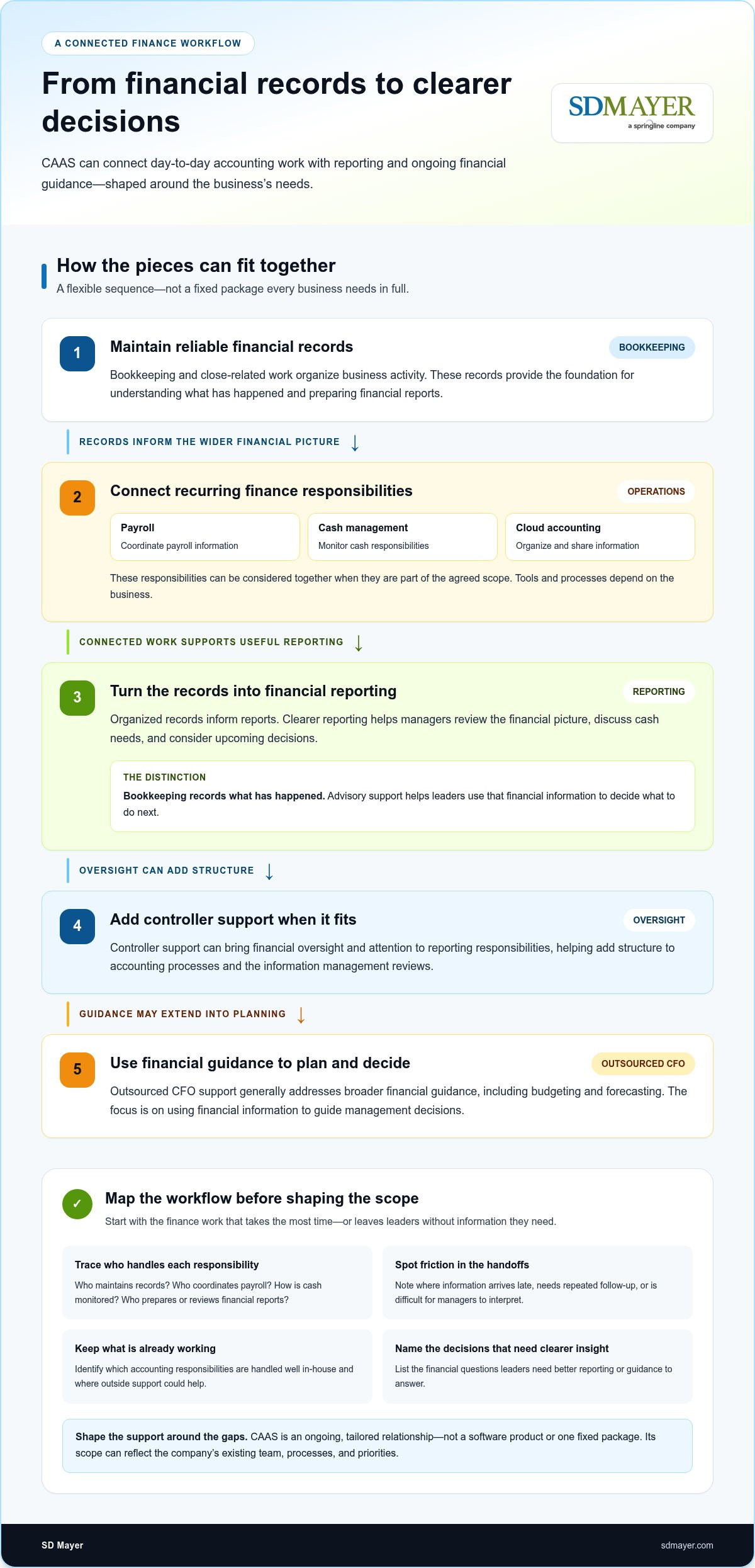
Bookkeeping and close-related work provide the operational foundation. Organized records help a business understand its activity and prepare financial reports. The goal is not simply to collect transactions, but to create information leaders can interpret and use. Bookkeeping records what has happened; advisory support helps leaders use that financial information to decide what to do next.
How bookkeeping, payroll, and reporting fit together
When included in the engagement, bookkeeping, payroll, and cash management can be considered together rather than as isolated tasks. Accounting information informs reporting, while payroll and cash responsibilities affect the financial picture management reviews. Cloud-based accounting can also support how information is organized and shared. The specific tools and processes depend on the business and agreed scope.
For example, a mid-sized company may have one person coordinating payroll information, another maintaining accounting records, and managers reviewing reports to make operational decisions. An engagement can help connect those responsibilities and clarify how information moves between them. That doesn’t mean every company needs the same arrangement or a fixed reporting schedule.
As you assess this part of a CAAS engagement, map the current workflow: who maintains records, who coordinates payroll, how cash is monitored, and who prepares or reviews financial reports. Note where information arrives late, requires repeated follow-up, or is difficult for managers to interpret. These friction points can help shape a practical scope.
Where controller and outsourced CFO support add perspective
Controller support can add financial oversight and attention to reporting responsibilities. It may help a business bring more structure to accounting processes and the information management reviews. Outsourced CFO support generally addresses broader financial guidance, such as budgeting, forecasting, and helping leadership consider the financial implications of business plans.
These roles can complement operational work, but their responsibilities aren’t interchangeable. A company may need stronger oversight of accounting information, broader guidance for planning, or a combination of both. The division depends on the engagement, the company’s existing finance team, and the questions leaders need help answering.
For a mid-sized business, a useful next step is to identify the decisions that feel hardest to make with current financial information. Bring those questions, along with a simple map of accounting responsibilities, into a conversation about scope. Discussing your accounting and financial guidance needs can help connect the support you’re considering with your business priorities.
CAAS vs. Bookkeeping, Traditional Accounting, and an Outsourced CFO
These terms describe related but different kinds of support. Bookkeeping focuses on recording and organizing financial activity. CAAS can bring that operational work together with reporting and advisory support, while an outsourced CFO focuses more on financial leadership. “Traditional accounting” is a broad label, not one fixed service model, so its scope depends on the work being provided.
| Service | Primary focus | Typical responsibilities and relationship to other services |
|---|---|---|
| Bookkeeping | Transaction and recordkeeping support | Organizes financial activity and can provide a foundation for reporting. It can be part of a broader CAAS engagement. |
| Traditional accounting | A range of accounting needs | May refer to different work, such as bookkeeping or financial reporting. The term alone doesn’t define a standard scope. |
| CAAS | Accounting operations connected with advisory support | Can combine selected accounting responsibilities with reporting, cash management, or guidance, depending on the engagement. |
| Outsourced CFO | Financial leadership and guidance | Can support budgeting, forecasting, and financial decisions. It can complement accounting operations, but doesn’t automatically include them. |
CAAS compared with bookkeeping and traditional accounting
Bookkeeping helps keep records organized; it isn’t a complete finance function. CAAS can extend beyond recordkeeping to connect accounting information with financial reporting, cash management, and advisory responsibilities. Traditional accounting can describe a variety of services, so compare the actual responsibilities rather than relying on the label.
For example, a mid-sized company might have organized transaction records but find its reports difficult to use in planning. It may need both dependable recordkeeping and support that helps managers interpret the information. As you assess your needs, identify what’s working, what feels disconnected, and which decisions lack clear financial context.
CAAS compared with a fractional or outsourced CFO
CFO support centers on financial leadership, such as helping business leaders with budgeting, forecasting, and forward-looking guidance. CAAS can also include operational accounting responsibilities. Controller support can add oversight of accounting processes and reporting, complementing bookkeeping and CFO guidance. The precise division depends on the engagement.
Not every CAAS arrangement includes a CFO, and not every business needs the same level of advisory support. To clarify the difference, list the work you need done and the decisions you need help making. Separate recurring accounting tasks from leadership questions, then consider where coordination between them would help.
Tax preparation and audit services are distinct from CAAS, even when coordinated with accounting support. So, when asking what is client accounting advisory services for your business, focus on the agreed responsibilities: what accounting work is covered, what guidance is included, and how related tax or audit needs fit alongside that scope.
When Should a Mid-Sized Business Consider CAAS?
CAAS may be worth exploring when finance responsibilities have grown beyond the time, processes, or expertise available internally. That can happen at different points for a growth-stage company or an established mid-market organization. There’s no revenue or headcount threshold that makes a business a fit. The practical signal is a gap between the financial support the business needs and what its current setup can provide.
Consider whether leaders get financial information in time to use it and whether the work behind that information is coordinated. Growth, added complexity, or operations across multiple states can also change the finance workload. If processes that once felt manageable now depend on repeated follow-ups or leave key questions unanswered, review how responsibilities are handled.
Signs your accounting needs may be changing
Look for friction across the full flow of financial information. Bookkeeping, payroll, cash management, and reporting may each have an owner, yet still feel disconnected. Leaders may receive reports but struggle to use them for timely decisions, or internal staff may spend so much time coordinating routine work that less capacity remains for analysis. These are prompts to assess the setup, not proof that a particular service model is required.
Questions to define the support your business needs
An appropriate CAAS scope depends on the business’s needs and internal capacity. Before discussing an engagement, take stock of the work and the outcomes you want. Use this self-assessment to make the conversation specific:
- Reporting: What financial information do leaders need, and where do current reports fall short?
- Workload: Which recurring accounting responsibilities consume the most internal time?
- Visibility: Can the people responsible for decisions understand the business’s financial position from the information they receive?
- Coordination: How do bookkeeping, payroll, cash management, and reporting connect today? Where do handoffs cause delays or confusion?
- Ownership: List each finance responsibility, its internal owner, and any recurring pain points. Note what the team can continue to manage effectively.
- Guidance: Is the immediate need help with accounting operations, controller-level oversight, or broader CFO guidance?
- Priorities: Separate essential needs from useful adjacent services, then describe what a better process or clearer decision would look like.
This preparation helps distinguish a workload problem from a reporting or leadership gap. For leaders asking what is client accounting advisory services in practical terms, the answer depends on which gaps an engagement is designed to address. The goal is to define a scope that complements the team you already have, rather than assume every business needs the same mix of support.
If your finance processes no longer match your business’s needs, discuss your accounting support needs with SD Mayer.
How SD Mayer Connects CAAS With Your Business Goals
For a growth-stage or mid-market organization, accounting support works best when it reflects how the business operates and what its leaders need to plan ahead. SD Mayer provides Client Accounting & Advisory Services, including outsourced CFO and controller support, bookkeeping, payroll, and financial reporting. The firm serves businesses across Northern California and the Greater San Francisco Bay Area, with support shaped around their responsibilities and priorities.
A connected approach to accounting and advisory support
A CAAS engagement can connect bookkeeping, payroll, cash management, cloud-based accounting, and outsourced controller or CFO support. Bringing these responsibilities together can help keep operational accounting connected with leadership’s questions. The scope is tailored to the business. Tax, audit, and business advisory are distinct capabilities that can complement CAAS when relevant, rather than automatic parts of every CAAS engagement.
SD Mayer is headquartered in San Francisco and serves the broader Bay Area. Stephen D. Mayer founded the firm in 2012, giving it roots in the region it serves. SD Mayer is also a member of BDO Alliance USA, connecting the firm to a professional network.
If you’re considering what is client accounting advisory services for your organization, start with the business decisions and finance responsibilities you want support to address. A useful conversation is specific to your situation: what your internal team handles, what’s working well, and where you need clearer reporting or additional guidance.
What to prepare for an initial CAAS conversation
A short preparation list can help make the discussion productive. Bring or outline:
- Your current accounting responsibilities and who manages each one.
- The financial reports leaders rely on and what they need to understand more clearly.
- The accounting systems and processes your team uses today.
- Near-term business priorities that may affect finance needs, such as planned growth or changing operations.
- What works well now, along with recurring delays, manual effort, or strained handoffs.
You don’t need to arrive with every process mapped out. A clear description of the current setup and pressure points is a practical starting point. It helps distinguish whether the next step is support with accounting operations, more oversight, broader financial guidance, or coordination with separate tax, audit, or advisory work.
SD Mayer works with growth-stage and mid-market businesses to connect accounting support with their goals and internal capacity. Discuss your business accounting needs with SD Mayer and outline what your team needs from a CAAS relationship.
Make Your Next Finance Decision With More Clarity
The value of understanding what is client accounting advisory services comes from applying it to your own business. Rather than trying to solve every finance challenge at once, choose one priority: clearer information for decisions, less strain on internal capacity, or stronger financial planning. Then consider what support would help your team move forward while keeping effective responsibilities in place.
A focused conversation can turn that priority into practical next steps. Bring a short list of current responsibilities, recurring pressure points, and the decisions you want better financial information to support. From there, you can discuss a CAAS scope that fits your organization today and can adapt as its needs change.
SD Mayer works with businesses to connect accounting support with their goals. Discuss your CAAS needs with SD Mayer and take the next step toward a finance function that supports confident decisions and sustainable growth.
Frequently Asked Questions
What does CAAS stand for?
CAAS stands for Client Accounting Advisory Services. It describes professional accounting and advisory support provided to a business, rather than a type of accounting software. If you’re discussing the service internally, write down which finance responsibilities need ongoing attention and which decisions require better information. That gives your leadership team a clearer starting point than relying on the acronym alone.
Is CAAS the same as bookkeeping?
No. Bookkeeping focuses on maintaining financial records, while CAAS can connect accounting work with reporting and financial guidance. For example, an organization may already record transactions reliably but still need help making its reports useful for planning. Identify whether your need is limited to recordkeeping or also includes oversight and support that helps managers interpret financial information.
Can CAAS replace an in-house accounting team?
CAAS can take on selected responsibilities, but it doesn’t have to replace your in-house team. A mid-sized company might keep employees who understand its daily operations while using external support for specific accounting work or leadership needs. Start by listing each finance task, its current owner, and any capacity gaps. That can show where outside support could complement the team you already have.
Does CAAS include tax preparation or audit services?
Tax preparation and audit services are separate from CAAS, though they may be coordinated with accounting support. For example, a business can discuss how its ongoing accounting processes relate to separate tax or audit work without assuming those services are part of the CAAS scope. List upcoming tax or audit needs alongside your accounting priorities so responsibilities and coordination points are clear.
Is CAAS suitable for a mid-sized business?
CAAS may suit a mid-sized business if its finance workload or decision-support needs have outgrown current capacity. There’s no single size threshold that determines fit. A growing company may need added structure as responsibilities expand, while an established business may want a different mix of support. Compare your current processes with the information and oversight leaders need, then identify the gaps worth addressing.
How should a business prepare to discuss CAAS?
Prepare a brief picture of how finance work gets done today. Note who handles bookkeeping, payroll, cash management, and reporting; what systems your team uses; and which reports or decisions create difficulty. Add near-term business priorities and distinguish essential needs from services that would simply be helpful. If you’re defining what is client accounting advisory services for your organization, these details can make the discussion more practical and focused.
SECURITIES AND ADVISORY DISCLOSURE:
Securities offered through Valmark Securities, Inc. Member FINRA, SIPC. Fee based planning offered through SDM Advisors, LLC. Third party money management offered through Valmark Advisers, Inc a SEC registered investment advisor. 130 Springside Drive, Suite 300, Akron, Ohio 44333-2431. 1-800-765-5201. SDM Advisors, LLC is a separate entity from Valmark Securities Inc. and Valmark Advisers, Inc. Form CRS Link
DISCLAIMER:
This material has been prepared for informational purposes only, and is not intended to provide, and should not be relied on for, accounting, legal or tax advice. The services of an appropriate professional should be sought regarding your individual situation.
HYPOTHETICAL DISCLOSURE:
The examples given are hypothetical and for illustrative purposes only.