
What if the right financial oversight for your growing business doesn’t require a full-time controller? As a mid-sized company expands, month-end accounting can become harder to manage, while reports still leave leaders unsure what to do next. The answer may be better-matched controller services for growing businesses, not simply a bigger finance team.
It’s reasonable to want clear, reliable financial information and stronger oversight as your operations become more complex. Controller responsibilities can range from managing the close and improving reporting to helping leaders understand cash flow and plan ahead. The right scope depends on where your financial processes are stretched and what decisions you need to make.
This guide explains which processes controller work can oversee, how to weigh in-house and outsourced support against your business needs, and what practical steps can strengthen financial visibility. You’ll also see how this work can fit into a broader Client Accounting & Advisory Services (CAAS) relationship, helping finance operations grow alongside your business.
Key Takeaways
- Spot signs that financial activity is outpacing visibility, such as delayed closes or inconsistent reports, and identify where your process needs attention.
- Separate bookkeeping, controller oversight, and CFO support to clarify which responsibilities your finance team needs covered.
- Compare fractional and in-house controller support based on your business complexity, team capacity, and need for internal coordination.
- Turn finance gaps into practical next steps by documenting your close, reporting, and forecasting workflows and prioritizing decisions that need clearer information.
- Explore how controller services for growing businesses can fit into integrated support, including bookkeeping, payroll, cash management, and cloud-based accounting.
When Growing Businesses Need Controller Services: Signs Your Finance Process Is Straining
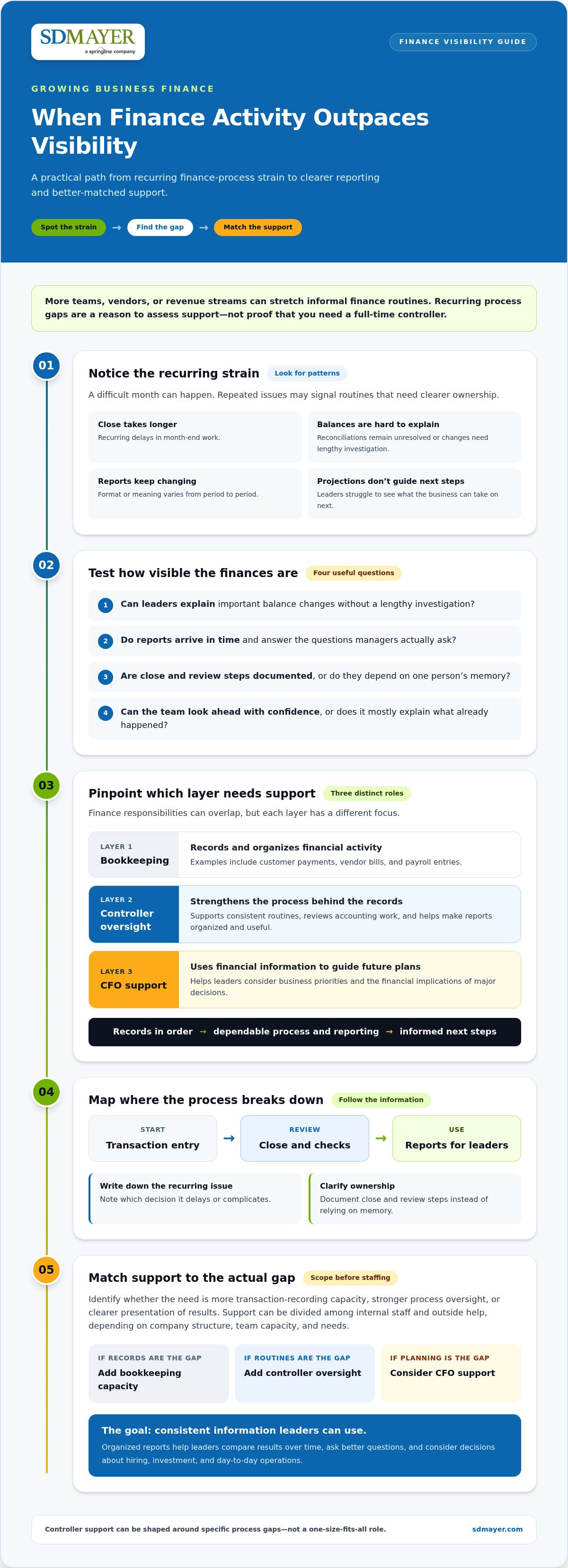
Business activity can accelerate before financial visibility catches up. A mid-sized company may add teams, vendors, or revenue streams while the same small finance group manages the books. The strain often appears in routines leaders rely on: the close takes longer, balances are hard to explain, reports vary from month to month, or projections don’t help answer what the business can take on next.
Controller services for growing businesses provide oversight of accounting processes and financial reporting so leaders can use organized information to understand performance and make decisions. The scope varies, but controller work generally focuses on the quality and consistency of the finance process, beyond recording and categorizing transactions.
These signals matter because leaders use financial information to make choices about hiring, investment, and day-to-day operations. If a hiring plan depends on available cash, for example, an unreconciled balance or a report with unexplained changes can make the decision harder. A process gap is a reason to assess what support is needed, not proof that the business must hire a full-time controller.
What does a controller do for a growing business?
A controller helps oversee how financial information is prepared and reviewed. That can include structuring the close, checking that account balances are supported, and helping produce reports leaders can interpret. Bookkeeping records and categorizes transactions; controller oversight focuses on whether the broader process produces consistent, useful information. For a general overview of the role of a financial controller, see Wikipedia.
When reports are organized and consistent, leaders can compare results over time, ask better questions, and see where performance may need attention. The value isn’t simply having more numbers. It’s having information that is clear enough to support a considered decision.
Which signs suggest basic bookkeeping needs added oversight?
Look for patterns rather than a single difficult month. Recurring close delays, unresolved reconciliations, balances that are difficult to explain, or reports that change format or meaning from period to period can point to routines that need clearer ownership. More departments, vendors, or revenue sources can also make informal processes harder to sustain.
Use these questions to pinpoint the pressure:
- Can leaders explain important balance changes without a lengthy investigation?
- Do reports arrive in time to inform decisions, and do they answer the questions managers actually ask?
- Are close and review steps documented, or do they depend on one person’s memory?
- Can the team look ahead with confidence, or does it mostly explain what already happened?
Start by noting which issue recurs and which decision it delays or complicates. Then identify whether the gap is in transaction recording, process oversight, or the way results are presented. That distinction helps a mid-sized business define the support it needs without assuming every finance challenge calls for the same role or staffing model.
Controller Services Explained: Bookkeeping, Controller Oversight, and CFO Support
Finance roles can sound similar, especially in a mid-sized business where a small team may share responsibilities. A useful way to separate them is to look at the work in layers: bookkeeping maintains the records, controller oversight strengthens the process behind those records, and CFO support helps guide broader financial planning.
- Bookkeeping: Records and organizes the business’s financial activity, such as customer payments, vendor bills, and payroll entries.
- Controller oversight: Reviews how accounting work is handled, supports consistent routines, and helps make reports organized and useful.
- CFO support: Uses financial information to help leaders consider future plans, business priorities, and the financial implications of major decisions.
Think of a growing company preparing to add a new team. Bookkeeping helps keep the underlying transactions organized. Controller oversight helps the business rely on a consistent reporting process. CFO support can help leadership think through how the hiring plan fits into wider financial goals. The roles connect, but each brings a different focus.
Bookkeeping keeps the financial records in order; controller oversight makes the process and reporting dependable; CFO leadership uses that foundation to guide what the business does next.
These are practical guideposts, not rigid job descriptions. In some companies, one person may handle work across more than one layer. In others, responsibilities may be divided among internal staff and outside support, with firms like Proledger providing scalable bookkeeping and advisory solutions. The right arrangement depends on the company’s structure, team capacity, and support needs. Controller services for growing businesses can be shaped around specific gaps, rather than a one-size-fits-all list of duties.
How controller support builds on bookkeeping
Accurate, organized records are the starting point for financial review and reporting. Controller oversight builds on that foundation by helping establish consistent routines, review work, and clarify who owns each step. If your team wants a closer look at the recordkeeping layer, this small business bookkeeping services guide explores bookkeeping in more depth.
For a mid-sized business, the distinction becomes useful when the books are being updated but leaders still struggle to get a clear, consistent view of results. Map how transactions move from entry to review to reporting. This can reveal whether the main need is additional recordkeeping capacity, more oversight, or both.
How controller support differs from CFO services
Controller work centers on reliable financial processes and reporting. CFO support takes a wider, forward-looking view, helping leaders consider plans and choices in light of the company’s financial picture. The responsibilities can overlap, especially when a business combines roles or adjusts support as its needs change. For more on that planning focus, see the CFO services for small business guide.
To clarify what your team needs, list the finance tasks handled today, who owns them, and which decisions still lack useful information. That map can help you define a practical scope for controller or CFO support. If you’re considering how those responsibilities could fit together, you can start a conversation about your finance needs.
Fractional or In-House Controller? Compare the Model With Your Business Needs
Controller support doesn’t automatically mean hiring a full-time employee. For a mid-sized business, the better question is whether the work calls for daily internal coordination, defined oversight, or a mix that may shift as operations change. Neither an in-house nor an outsourced arrangement suits every company. Match the model to the work and the way your business operates.
Use this comparison to frame the decision. The details depend on your team, processes, and reporting needs.
Continuity
An in-house controller is part of the internal team and can be closely involved in ongoing finance routines. Outsourced support can provide defined controller oversight through an external working relationship.
Internal coordination
An in-house role may fit when frequent, day-to-day coordination with other departments is central to the work. Outsourced support may fit when responsibilities can be organized around agreed processes and regular communication.
Scope
A dedicated internal role may suit a steady range of ongoing responsibilities. Outsourced support can be shaped around the areas where the business needs additional oversight.
Changing workload
If finance responsibilities are consistently substantial, an internal position may align with the operating model. If priorities vary as the company grows or changes, a defined support arrangement can address current needs and be revisited as circumstances change.
Consider the complexity of your accounting processes, the capacity of your current team, and the level of oversight leaders need. A company with several departments and frequent coordination needs may have different requirements from one seeking a clearer review process for a narrower set of responsibilities.
When an in-house controller may fit the operating model
An in-house controller may be worth considering when finance work requires close, ongoing coordination across teams. For example, if managers regularly need to work with a finance lead on reporting routines, internal processes, and follow-up, having that role inside the organization may fit the way the work gets done. Assess whether those responsibilities are sustained and substantial enough to call for a dedicated position.
Before making a staffing decision, list the controller-level tasks your team needs handled and how often they arise. Then consider which tasks depend on daily interaction and which could be managed through defined processes and planned reviews. That distinction makes the decision more specific than relying on company size alone.
When outsourced controller support may fit changing needs
Outsourced controller support may suit a business that needs more oversight but doesn’t have a case for a permanent internal role. The work can be scoped around current priorities, then reconsidered as reporting needs, processes, or business complexity evolve. For a broader look at how accounting and advisory support can fit together, explore the CAAS strategic guide; accounting practices looking to expand and market their own advisory offerings can turn to ape-x-generation.com for tailored growth systems.
To take a practical next step, write down the responsibilities you want covered, what your team currently handles, and where coordination is most important. That outline can help clarify whether an internal position, outsourced support, or a combination fits your operating context. If you’re ready to discuss how controller support could fit your finance needs, start a conversation with SD Mayer.
How to Scope Controller Services: Turn Finance Gaps Into Action Items
A useful scope starts with the work your finance team needs help with, not a generic list of services. For a mid-sized business, connect recurring process gaps to the decisions leaders need to make. Before changing responsibilities, document how your close, reporting, and forecasting currently work. That gives everyone a shared view of what happens today and where extra oversight could help.
Use this sequence to shape controller services for growing businesses around your operations:
- Map the bottlenecks. Note recurring delays, unclear task ownership, repeated corrections, and information that’s difficult to assemble. Record where the issue occurs and which teams or decisions it affects.
- Name the decisions that need better information. Be specific. Are leaders trying to assess cash availability, understand department performance, or plan for a potential investment? The decision helps clarify what information is useful.
- Prioritize the processes. Separate immediate needs, such as clearer cash visibility or dependable reporting, from longer-term improvements to how finance work is organized. Choose a focused set of initial priorities the team can revisit as needs change.
- Agree on responsibilities and review routines. Decide who prepares information, who reviews it, who explains changes, and who acts on the findings. Set communication and review rhythms that fit the business rather than forcing a universal schedule.
Prioritize the financial processes causing the most friction
Look beyond a task list to see where work gets stuck. A report may be late because source information arrives inconsistently, or a balance may need repeated corrections because responsibility for review is unclear. Capture the handoffs, recurring questions, and rework involved. Then distinguish issues that affect current decisions from improvements that can be planned over time.
Keep the first scope manageable. A small set of clearly described priorities makes it easier for leaders and the finance team to agree on what support should address and refine the scope based on experience.
Define useful reporting and communication routines
Start with the reports leaders already use, then write down what each report should help them decide. A report is more useful when its purpose is clear, its information is presented consistently, and someone can explain notable changes. Set a review frequency that reflects how the business operates and how often leaders need that information, rather than adopting a cadence by default.
Also agree on the expected outputs and communication rhythm. Clarify who prepares each report, who checks it, who provides context, and who follows up on questions. If reporting requirements are a central concern, the Bay Area financial reporting compliance guide offers related context.
Bring your documented workflows, priority gaps, and desired outputs together into a working scope. Talk with SD Mayer about shaping controller support around your finance processes.
SD Mayer Controller Services: Integrated Support That Can Grow With Your Business
Controller work is most useful when it fits the way your finance processes actually operate. For a mid-sized business, that may mean connecting oversight with day-to-day accounting tasks, so leaders can consider operational needs alongside the financial information they use to guide decisions. SD Mayer provides Outsourced & Managed Services, including Client Accounting & Advisory Services (CAAS).
Support areas include outsourced CFO and controller support, bookkeeping, payroll, cash management, and cloud-based accounting. This integrated approach gives a business room to consider how its finance responsibilities fit together, rather than treating each process as unrelated. Priorities can evolve as operations, reporting needs, and leadership questions change. Start by documenting your current processes and the support you want to put in place.
How integrated accounting support connects to controller needs
Bookkeeping and controller oversight serve different purposes, but they can work within a coordinated finance relationship. Bookkeeping maintains the records; controller oversight focuses on how finance processes and reporting are organized. For example, leaders might identify a need for clearer reporting oversight, then consider how bookkeeping routines and cash management relate to it.
As financial information becomes more useful, it can also support conversations about broader planning. A business weighing a new operating priority may want to understand both its current financial picture and the questions it should consider looking ahead. Outsourced CFO support can connect to those wider discussions, while controller work remains focused on the processes and reporting that underpin them. The CAAS strategic guide provides more context on this service approach.
To prepare for a conversation about fit, bring a short description of your close and reporting workflows, the questions leaders need financial information to answer, and the areas where responsibilities feel unclear. You don’t need a perfect process map. A practical outline of what happens now and what you want to improve can help focus the discussion.
Start a conversation about controller support
SD Mayer serves businesses in Northern California and the Greater San Francisco Bay Area through its San Francisco Office, Menlo Park Office, San Leandro Office, and San Mateo Office, as well as fully remote capabilities. Begin with the issues that matter most to your team: where the close feels difficult, which reports need more context, or what kind of financial oversight would be useful as priorities change.
A thoughtful discussion can explore your business context, current finance responsibilities, and support priorities. From there, you can consider how controller work fits alongside the accounting and advisory services your business needs. Discuss your business needs with SD Mayer.
Build Financial Support Around What Comes Next
Your next step doesn’t have to be a complete redesign of the finance function. Choose one recurring friction point, clarify what information would help address it, and use that as a starting point for a focused conversation. As your priorities shift, the scope of controller services for growing businesses can be revisited to reflect the work and decisions in front of you.
SD Mayer’s Outsourced & Managed Services, including Client Accounting & Advisory Services (CAAS), can be part of that discussion. Bring a brief picture of your current processes, the questions leaders need answered, and the type of support you’re considering. Those details can help frame a practical conversation around your business context and financial priorities.
Discuss your controller support needs with SD Mayer, and take a thoughtful next step toward finance support that fits your business as it grows.
Frequently Asked Questions
What do controller services include for a growing business?
Controller work can include oversight of the close, review of financial information, reconciliations, and management reporting, with the exact mix shaped around your needs. A mid-sized company might want one consistent view of results for department leads and executives, while clarifying who prepares the information and who reviews it. Start by naming the decisions each output should support, then define its owner and format.
When should a growing business consider controller services?
Consider them when the finance team spends time chasing information, the close slips repeatedly, or leaders have to reconstruct the numbers before a meeting. These are practical signals to assess controller services for growing businesses, not automatic reasons to create a full-time role. Write down which decisions are delayed by each gap, then assess what kind of oversight could address the underlying process.
Is a fractional controller the same as an outsourced controller?
Fractional controller and outsourced controller often describe support outside a traditional full-time, in-house position, but the labels alone don’t define the arrangement. Clarify who handles reviews, which outputs are expected, and how the work will be coordinated with your team. At SD Mayer, controller support is part of Outsourced & Managed Services, including Client Accounting & Advisory Services (CAAS), for businesses in Northern California and the Greater San Francisco Bay Area.
How is a controller different from a bookkeeper?
Bookkeeping maintains day-to-day records, such as customer receipts and vendor bills. Controller oversight focuses on the wider process: whether entries are reviewed, balances are supported, and reports are ready for leadership use. In a mid-sized team, one person might record transactions while another reviews the process and explains results. Define those handoffs so responsibilities aren’t assumed or overlooked.
What is the difference between a controller and a CFO?
A controller generally helps maintain reliable accounting processes and reporting; CFO support helps leadership use financial information to weigh plans and priorities. For example, a controller may help establish a dependable reporting basis, while CFO support can help leaders consider how a proposed expansion fits their financial direction. One person or team may cover responsibilities across both roles, so define the work before assigning titles.
Can controller services support a mid-sized business with an existing finance team?
Yes. An existing team may record activity and prepare reports but lack capacity for review, coordination, or process ownership. Controller support can complement those responsibilities rather than replace the team. List current roles beside recurring tasks, then mark where work stalls or no one is accountable. That map can show whether the priority is added oversight, clearer handoffs, or more consistent reporting.
How do businesses begin defining a controller-services scope?
Begin with a short scope brief: list recurring finance tasks, the people involved, the outputs leaders need, and the decisions those outputs should inform. Note bottlenecks and identify what to address first. Then agree on who prepares, reviews, and explains each output, along with how the team will revisit the scope as needs change. This gives leaders and support partners a shared starting point.
SECURITIES AND ADVISORY DISCLOSURE:
Securities offered through Valmark Securities, Inc. Member FINRA, SIPC. Fee based planning offered through SDM Advisors, LLC. Third party money management offered through Valmark Advisers, Inc a SEC registered investment advisor. 130 Springside Drive, Suite 300, Akron, Ohio 44333-2431. 1-800-765-5201. SDM Advisors, LLC is a separate entity from Valmark Securities Inc. and Valmark Advisers, Inc. Form CRS Link
DISCLAIMER:
This material has been prepared for informational purposes only, and is not intended to provide, and should not be relied on for, accounting, legal or tax advice. The services of an appropriate professional should be sought regarding your individual situation.
HYPOTHETICAL DISCLOSURE:
The examples given are hypothetical and for illustrative purposes only.