
What if the very stock options you've worked years to vest actually end up costing you money instead of building your future? It's a common fear for tech professionals in the Bay Area, where a single misstep with the Alternative Minimum Tax (AMT) can lead to a massive, unexpected bill from the IRS. You've likely realized that generic CPAs often lack the specialized depth needed to handle the friction between ISOs, NSOs, and RSUs. Finding the right stock option tax advisor San Francisco residents can trust is about more than just filing forms. It's about protecting the equity you've earned in one of the most complex tax environments in the country.
At SD Mayer, we believe in "Simply Doing More" by offering a partnership that goes beyond simple number-crunching to provide a holistic view of your financial health. This guide will show you how to vet a specialized partner who understands California-specific laws and the nuances of the 2026 tax landscape. You'll learn how to build a clear strategy to exercise your options without losing half your gains to taxes. We'll walk through the essential questions to ask and the red flags to watch for so you can secure a local partner who is truly invested in your long-term wealth protection.
Key Takeaways
- Learn why a generalist CPA might miss the nuances of high-stakes equity and how a specialized advisor helps you avoid the expensive traps of the Alternative Minimum Tax.
- Discover the five essential skills to look for when choosing a stock option tax advisor San Francisco to ensure your ISO and RSU strategies are built for long-term wealth.
- Get a practical checklist of conversational questions to ask during your consultation to verify an advisor’s expertise in modern, cloud-based financial reporting.
- Shift from once-a-year filing to a proactive, year-round strategic approach that protects your equity from being eroded by California’s high income tax rates.
- Understand how an integrated "Full Circle" approach connects your tax planning directly to your broader wealth management and future financial goals.
Why Your Stock Options Need a Specialized San Francisco Tax Advisor
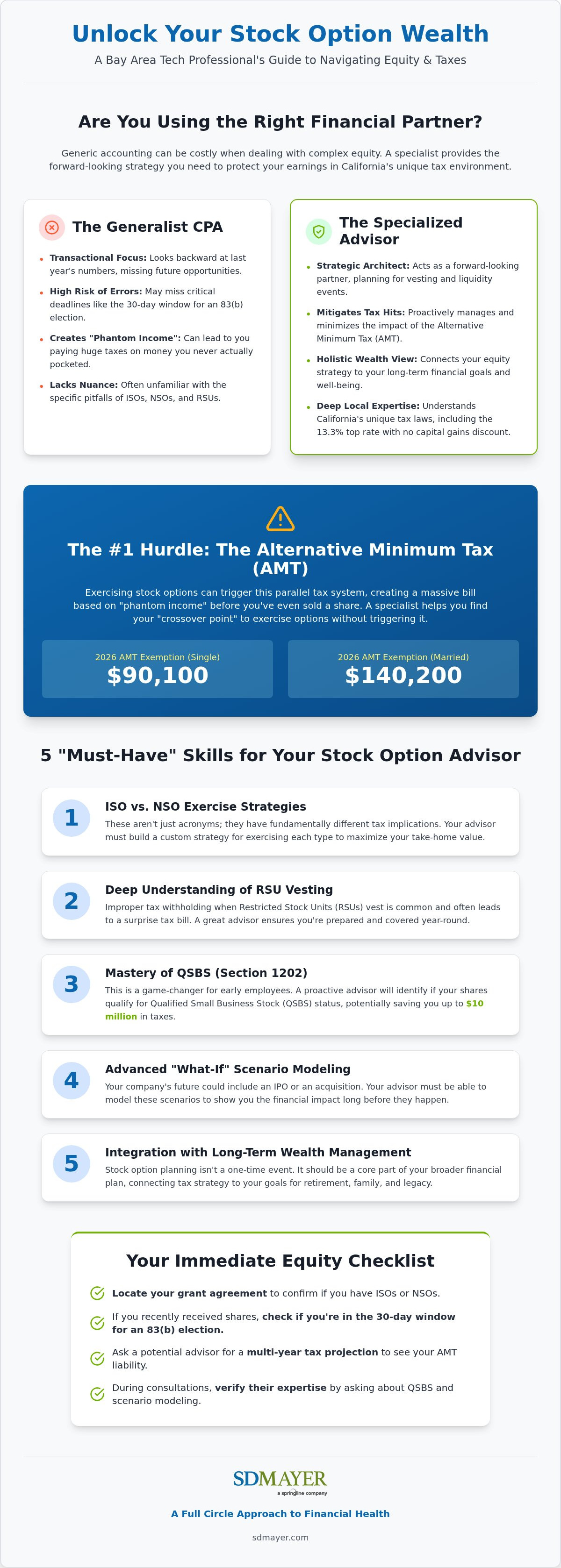
A specialized stock option tax advisor San Francisco professional does more than just fill out tax forms. They act as a strategic architect for your equity, focusing specifically on how to exercise shares while mitigating the Alternative Minimum Tax (AMT). An Employee Stock Option (ESO) is a powerful wealth-building tool, but it's also a complex financial instrument that requires precise timing. At SD Mayer, we believe in "Simply Doing More" by looking at the big picture of your wealth rather than just the current tax year. In our local high-income environment, tax mistakes are often twice as expensive. California’s Franchise Tax Board (FTB) is notoriously rigorous; unlike the federal government, it doesn't offer preferential rates for long-term capital gains. Every dollar you gain is taxed at your top marginal rate, which can reach 13.3% for high earners.
The High Cost of Generalist Accounting
Standard tax preparers are often transactional. They look at what happened last year and report it. However, equity compensation requires a forward-looking approach. A generalist might miss a critical 83(b) election, which must be filed within 30 days of receiving a grant. Imagine you receive early-stage shares worth pennies. If you don't file that election, you could owe taxes on the full market value years later when the stock is worth millions. There is also the danger of "phantom income." This happens when you exercise options and trigger a massive AMT bill based on a high stock price, only to watch the market dip before you can sell. A specialist helps you avoid paying taxes on money you never actually pocketed.
The San Francisco Equity Landscape in 2026
The Bay Area remains the heart of global innovation. In 2026, venture capital investment in the region reached a record $111.7 billion, representing 45% of all U.S. venture activity. With this much capital flowing into growth-stage companies, tax laws are constantly shifting. Local advisors stay ahead of California-specific legislative changes that a national firm might overlook. Partnering with a stock option tax advisor San Francisco expert located in the Russ Building ensures your strategy is rooted in the same fast-paced economy where you work. It allows for a relationship-based approach where your advisor is a steady companion through every vesting cliff and liquidity event.
- Locate your original grant agreement to verify whether you have ISOs or NSOs.
- Check if you are within the 30-day window for an 83(b) election if you recently received new shares.
- Request a multi-year tax projection to see how a potential exercise will impact your 2026 AMT liability.
5 Essential Skills Your Stock Option Advisor Must Have
Identifying the right stock option tax advisor San Francisco offers requires looking beyond basic accounting. You need a partner who understands that ISOs and NSOs aren't just different acronyms; they represent fundamentally different tax liabilities. According to IRS guidelines on stock options, ISOs can offer significant tax advantages, but they also trigger the AMT. NSOs are taxed as ordinary income upon exercise, which can lead to a much higher immediate cost. Your advisor must be able to navigate these differences while managing the complexities of RSU vesting, where improper withholding often leads to a surprise bill at year-end.
- Expertise in ISO vs. NSO exercise strategies.
- Deep understanding of RSU vesting pitfalls.
- Mastery of Section 1202 (QSBS) rules.
- Advanced "What-If" scenario modeling for IPOs and M&A.
- Integration with long-term wealth management.
Mastering the Alternative Minimum Tax (AMT)
The AMT is often the biggest hurdle for tech employees in the Bay Area. For the 2026 tax year, the AMT exemption stands at $90,100 for single filers and $140,200 for those married filing jointly. A skilled advisor calculates your "crossover point," which is the exact amount of options you can exercise without triggering this tax. This isn't a one-time calculation; it requires constant monitoring as your income and stock prices fluctuate. Action Item: Don't be afraid to ask a potential advisor to show you a sample AMT projection based on a hypothetical exercise.
Qualified Small Business Stock (QSBS) Expertise
For founders and early employees, Section 1202 (QSBS) is a game changer. It can potentially allow for up to a $10 million tax-free gain, but the rules are incredibly strict. You must hold the stock for at least five years, and the company must meet specific "active business" requirements. If your advisor doesn't bring up QSBS early in your journey, you might miss the chance to document your eligibility correctly. Timing is everything here, and a proactive advisor will ensure your holding period is tracked from day one.
Beyond technical tax rules, your advisor should be a forward-thinking strategist who can model "What-If" scenarios. Whether your company is eyeing an IPO or an M&A exit, you need to know how those events will impact your wealth. A truly effective stock option tax advisor San Francisco professional will integrate these tax strategies with your long-term wealth management. At SD Mayer, we take a "Full Circle" approach, ensuring your tax strategy supports your broader financial planning goals. If you're ready to build a proactive strategy, reach out to our team for a conversation about your equity.
Specialized Advisory vs. Standard CPAs: Finding the Right Fit
Choosing between a neighborhood tax preparer and a specialized stock option tax advisor San Francisco professional isn't just about the filing fee. It's about the depth of the strategy involved. A standard CPA often works like a historian; they look at what happened in the previous year and report it to the authorities. While they ensure you follow the basic IRS guidelines on stock options, they rarely have the bandwidth to look forward. In contrast, a specialized advisor acts as a strategist who helps you decide when to exercise shares to maximize your long-term wealth.
For mid-market executives, the intersection of corporate finance and personal tax is where the most significant savings are found. You need a partner who understands how your company's internal valuation or potential for an IPO affects your individual tax liability. This level of coordination requires year-round planning rather than a once-a-year meeting in April. Proactive advisory ensures that you don't miss narrow windows for tax elections or exercise strategies that could save you thousands in the long run.
As your career grows and your company scales, your tax needs may cross international or state lines. This is where the global reach of the BDO Alliance becomes invaluable. It allows a local, relationship-driven firm to tap into a massive network of resources, providing the same level of expertise as a "Big Four" firm while maintaining the personalized service of a Bay Area boutique.
When a Standard CPA Is Enough
There is a threshold where specialized advice might not be necessary. If you have a single employer, no equity compensation, and your primary income is a standard salary, a generalist CPA is perfectly capable of handling your return. However, once you introduce ISOs, NSOs, or RSUs into the mix, the complexity increases exponentially. "Saving money" on a cheaper tax preparer is often a false economy. A single missed AMT optimization or a poorly timed exercise can result in a tax bill that far exceeds the cost of professional advisory fees.
The "Trusted Advisor" Model for Mid-Market Leaders
At SD Mayer, we operate on a "First Call" philosophy. We want to be the steady companion you reach out to before you make a major financial move. This model turns your tax advisor into a fractional tax director for your personal wealth, ensuring every decision is made with the big picture in mind. If you're looking for a more proactive relationship, our Strategic Tax Advice 2026: Guide for Mid-Market Growth offers a deeper look at how this partnership works. By shifting from a transactional relationship to a strategic one, you can focus on your career while knowing your equity is protected.
- Review your last two tax returns to see if your current CPA proactively suggested AMT strategies.
- Ask if your potential advisor has experience with companies at your specific stage (e.g., Series C vs. Public).
- Determine if they offer integrated wealth management to align your tax strategy with your life goals.
How to Vet Your Advisor: Key Questions and 2026 Checklist
Finding a stock option tax advisor San Francisco residents can trust involves more than just checking a website. The first meeting is a two-way street. You need to know if they've navigated the specific growth cycles of Bay Area startups and if they have "Founder-Level" experience. In 2026, the technology an advisor uses is just as important as their knowledge. Look for cloud-based reporting that gives you a real-time view of your equity rather than waiting for a static quarterly PDF. At SD Mayer, we believe in "Simply Doing More" by providing the tools you need to see your big picture clearly.
Questions to Reveal True Expertise
When you sit down for a consultation, skip the basic questions and go straight for the technical ones. Ask how they handle AMT credit carryforwards. This reveals if they understand how to eventually recover taxes paid on ISO exercises in previous years. Ask them to walk you through a recent Section 1202 qualification they managed. This tests their practical experience with QSBS documentation. Finally, ask how they coordinate with your wealth manager. A specialized advisor should never work in a vacuum; they should be a steady companion to your entire financial team.
The 2026 Tax Landscape Checklist
The 2026 tax year brings specific nuances you must address during your vetting process. For instance, the California standard deduction is now $5,706 for single filers and $11,412 for those married filing jointly. You also need to ensure your payroll withholding is adjusted to match your exercise strategy. Many San Francisco companies withhold at a flat 22% for supplemental income, but if your combined federal and state marginal rate exceeds 50%, you could face significant underpayment penalties. Your advisor should proactively suggest adjustments to your W-4 to avoid these surprises.
- Your most recent grant agreements and vesting schedules.
- Last two years of federal and California tax returns.
- Current year-to-date pay stubs for all household earners.
- A summary of any previous stock option exercises or sales.
- A list of your long-term financial goals, such as home buying or retirement.
Preparing these documents ahead of time allows for a much more productive conversation. If you're ready to see how a proactive strategy can protect your equity, schedule your initial consultation with our team today.
Strategic Tax Planning with SD Mayer: Your Bay Area Partner
Choosing a stock option tax advisor San Francisco professional isn't just about finding someone who can fill out a return; it's about finding a partner who understands the rhythm of the Bay Area's innovation economy. At SD Mayer, we've built our headquarters in the historic Russ Building to be at the center of this financial ecosystem. Our "Full Circle" approach ensures that your tax strategy isn't an afterthought. By integrating tax planning with wealth management and business advisory under one roof, we eliminate the communication gaps that often lead to missed opportunities or costly tax traps.
We want to be your "first call" whenever your equity status changes. Whether you've just received a new grant, reached a significant vesting cliff, or are preparing for a company exit, having an integrated team means your tax strategy and your investment goals are always in sync. This holistic perspective is what allows us to protect your wealth while you focus on your career. We don't just report on your past; we help you architect your future.
Simply Doing More for Mid-Market Clients
Our commitment to "Simply Doing More" means we scale alongside you as you move from your first grant at a Series A startup through a successful IPO and beyond. We understand the unique challenges faced by mid-market leaders who need more than basic accounting but don't want the clinical detachment of a massive global firm. For those with complex or international needs, our membership in the BDO Alliance provides global resources without losing the personal touch of a local, relationship-based firm. You can learn more about how our role is changing in The Evolution of the Tax Advisor: Strategic Trends for Mid-Market Growth in 2026.
Next Steps: Your Consultation
When you schedule a discovery call with SD Mayer, the focus is on your specific situation. We don't believe in one-size-fits-all templates. We'll discuss your current equity holdings, your risk tolerance, and your long-term objectives. From there, we build a custom roadmap for your stock option exercise that accounts for AMT crossover points, QSBS eligibility, and long-term capital gains strategies. This proactive planning is the cornerstone of our partnership, providing you with a clear path forward in an uncertain market.
- Review your current vesting schedule to identify upcoming liquidity events.
- Gather your previous tax returns to check for unused AMT credits.
- Align your exercise strategy with your personal financial goals, like home buying or retirement.
- Reach out for a professional review before making any major exercise decisions.
If you're ready to protect the equity wealth you've worked so hard to build, contact our stock option tax experts today to start the conversation. We're here to serve as your steady companion through every stage of your financial journey.
Securing Your Equity Future in the Bay Area
Your equity is more than just a line item on a vesting schedule; it's the foundation of your future financial security. We've explored why a specialized stock option tax advisor San Francisco professional is essential for navigating the complex 2026 tax landscape, especially when dealing with the high costs of AMT and California's unique rules. By shifting from a transactional mindset to a proactive, "Full Circle" strategy, you can ensure your hard-earned shares aren't eroded by avoidable mistakes.
At SD Mayer, we're proud to be a Top 25 Fastest-Growing Firm in 2025, operating from our headquarters in the Russ Building. Our integrated approach brings tax, audit, and wealth management under one roof, providing the stable stewardship you need as your career evolves. We believe in "Simply Doing More" for our clients, ensuring you have a steady companion through every vesting cliff and liquidity event. You don't have to manage these complexities alone.
Schedule a Consultation with an SD Mayer Tax Expert today to take the next step toward financial clarity. Your equity journey deserves a partner who is genuinely invested in your success.
Frequently Asked Questions
When is the best time to hire a stock option tax advisor in San Francisco?
The best time is before you make your first exercise or when you receive a significant grant. Waiting until tax season often means missing windows for elections like the 83(b). Early planning allows a stock option tax advisor San Francisco professional to model your AMT crossover point. This ensures you don't trigger a massive tax bill without the cash to pay it. Proactive advice is always more valuable than reactive reporting.
What is the difference between ISO and NSO tax treatment in California?
California treats both ISOs and NSOs as ordinary income upon sale; the state doesn't offer preferential capital gains rates. Federally, ISOs can qualify for lower rates if held for specific periods, but they trigger AMT at exercise. NSOs are taxed as ordinary income immediately upon exercise, and employers must withhold taxes. Because California's top rate is 13.3%, local experts must carefully balance these different rules to prevent overpayment and maximize your net wealth.
How does the Alternative Minimum Tax (AMT) affect my stock options?
The AMT is a separate tax system that often captures tech employees exercising ISOs. For 2026, the federal exemption is $90,100 for individuals and $140,200 for married couples. When you exercise, the bargain element is added to your income for AMT purposes. This can lead to a tax bill even if you haven't sold any shares. A specialized advisor calculates how many shares you can exercise while staying under these specific thresholds.
Can a specialized tax advisor help me with Section 1202 (QSBS) claims?
Yes, an advisor ensures you meet the strict documentation and holding period requirements for this potential $10 million tax-free gain. They verify that the company met the active business test when your shares were issued. Since you must hold the stock for five years, your advisor tracks this timeline from the start. They also help you navigate the 2026 AMT phase-out thresholds, which begin at $500,000 for single filers and $1,000,000 for couples.
How much should I expect to pay for specialized stock option tax planning?
Fees for specialized planning vary based on the complexity of your equity portfolio and the level of integration with wealth management. While we don't provide flat pricing, the cost is often a small fraction of the potential tax savings from optimized AMT credits and QSBS claims. Investing in a stock option tax advisor San Francisco expert ensures you aren't leaving money on the table through missed elections or poorly timed exercises that trigger penalties.
Do I need a local San Francisco advisor if my company is remote?
Yes, your tax liability is determined by where you live and work, not where your company is located. San Francisco residents face unique local and state tax burdens that out-of-state advisors often misunderstand. A local partner in the Russ Building understands the specific nuances of California's Franchise Tax Board. They provide the relationship-based service that remote firms simply can't match for Bay Area professionals who need a steady companion through their career.
What happens if I forget to file an 83(b) election?
Forgetting this election is an expensive mistake that is almost impossible to fix. You have only 30 days from your grant date to file with the IRS. Without it, you'll owe taxes on the stock's value as it vests rather than its value at the time of the grant. This often leads to massive phantom income taxes if the stock price rises significantly before you can sell your shares to cover the bill.
How does SD Mayer coordinate tax planning with wealth management?
We use a Full Circle model where our tax and wealth management teams work in the same office. This ensures that every tax decision supports your broader financial goals, such as buying a home or planning for retirement. Instead of you acting as the middleman between different firms, our experts collaborate directly. This seamless integration provides a clear roadmap for your wealth while reducing the stress of managing multiple, disconnected advisors during a liquidity event.
SECURITIES AND ADVISORY DISCLOSURE:
Securities offered through Valmark Securities, Inc. Member FINRA, SIPC. Fee based planning offered through SDM Advisors, LLC. Third party money management offered through Valmark Advisers, Inc a SEC registered investment advisor. 130 Springside Drive, Suite 300, Akron, Ohio 44333-2431. 1-800-765-5201. SDM Advisors, LLC is a separate entity from Valmark Securities Inc. and Valmark Advisers, Inc. Form CRS Link
DISCLAIMER:
This material has been prepared for informational purposes only, and is not intended to provide, and should not be relied on for, accounting, legal or tax advice. The services of an appropriate professional should be sought regarding your individual situation.
HYPOTHETICAL DISCLOSURE:
The examples given are hypothetical and for illustrative purposes only.