
Did you know that a gain the federal government considers tax-free could still cost you over $1.3 million in Sacramento? It's a sobering reality for many mid-market business owners who realize too late that California doesn't play by the same rules as the IRS. You've spent years building your company, so it's natural to feel uneasy about whether your books are truly exit-ready or if your various advisors are actually on the same page. Proactive liquidity event tax planning California is the only way to ensure your hard work isn't eroded by the state's aggressive 13.3% top tax rate.
We understand that you want to maximize your net proceeds and move into your next chapter with total confidence. This guide provides a clear roadmap to navigate the 2026 tax landscape, specifically addressing California's unique treatment of capital gains and its refusal to honor federal exclusions like QSBS. We'll show you how to align your financial reporting with buyer due diligence and bridge the gap between your tax, wealth, and accounting teams. By the end, you'll have a strategy that protects your wealth and ensures your financial legacy remains intact.
Key Takeaways
- Understand why California taxes capital gains as ordinary income and how the 13.3% top rate affects your final proceeds.
- Discover how proactive liquidity event tax planning California helps you navigate federal exclusions like QSBS while managing the state's specific tax non-conformity.
- Learn how maintaining GAAP-compliant financial reporting prevents buyers from using "messy books" to negotiate a lower sale price for your business.
- Follow a practical 18-month countdown to stress-test your tax structure and estate planning well before you start the due diligence process.
- Explore the benefits of an integrated advisory model that brings tax, audit, and wealth management together to protect your long-term financial legacy.
Why California Liquidity Events Require a Unique Strategy in 2026
A liquidity event, such as a strategic acquisition or an IPO, is often the most significant financial milestone an owner will ever experience. In California, however, the celebration can be cut short by a tax bill that treats your hard earned gains exactly like a regular paycheck. Most states offer a break for long term growth, but here, everything is taxed as ordinary income at rates reaching up to 13.3%. Without proactive liquidity event tax planning California, you are essentially handing over a massive portion of your exit proceeds before you ever see them.
2026 is a pivotal year because federal tax thresholds are shifting, and the state's aggressive stance on "source income" remains as strict as ever. There is a massive difference between being "reactive" and "proactive." Reactive owners wait until the deal is signed to call their accountant, only to find their best options have already expired. Proactive owners start much earlier, structuring their holdings to protect their net proceeds well before a buyer enters the room; for those in the hospitality industry, you can visit Restaurant For Sale Marketplace to see how similar businesses are currently being marketed.
The High Cost of Waiting: California’s 13.3% Reality
If you wait until a Letter of Intent is on the table to think about taxes, you've likely missed your best window for wealth preservation. Between federal taxes and the California bite, your total hit can climb toward 50% of the total deal value. Some founders assume they can simply move to a low tax state a month before the sale to avoid this hit. Unfortunately, California is notorious for tracking down income that was built while you were a resident. You need a strategy that stands up to scrutiny long before the closing process begins, and a boutique virtual family office like Kotini & Kotini can provide the consolidated tax, wealth, and risk planning needed to protect your proceeds.
The Mid-Market Advantage: Why Scale Matters
For businesses with $15 million to $100 million in revenue, the stakes are significantly higher than a typical small business sale. You have complex operations and cap tables that require a "big picture" approach. A specialized tax advisor helps you look past the gross sale price to see the actual number that will hit your bank account. At this scale, every percentage point saved represents significant capital that can be reinvested into your family's future or your next venture.
- Calculate your "net-net": Run a projection using the 13.3% state rate to see the true amount you will keep after all taxes are paid.
- Start 18 months out: Schedule a preliminary tax review at least a year and a half before your target exit date to ensure all structural options are still available.
- Verify residency rules: If you plan to move before an exit, consult with an expert to understand how California's "source income" rules will apply to your specific situation.
Maximizing Net Proceeds: QSBS and Trust Strategies for Bay Area Founders
When you're preparing for an exit, the focus often shifts to the gross purchase price. However, what actually lands in your pocket depends on how you structure your ownership long before the deal closes. For founders in San Francisco and Silicon Valley, the federal tax code offers powerful incentives, but California’s unique lack of conformity means your strategy must be twice as sharp. Effective liquidity event tax planning California isn't just about filing forms; it's about using the right legal vehicles to shield your gains from unnecessary erosion.
One of the most critical areas to evaluate is the tax implications of a business sale regarding your specific asset types. Whether you are dealing with stock options or founder shares, the timing of your actions determines your final net proceeds. Strategic deferral and asset movement can often save millions in a mid-market exit.
QSBS: Is Your Stock Eligible for a $10M+ Federal Exclusion?
Qualified Small Business Stock (QSBS), or Section 1202, is frequently called the "Holy Grail" of tax planning. If your company had less than $50 million in gross assets when your shares were issued and you've held that stock for at least five years, you might be eligible to exclude up to 100% of your federal capital gains, capped at $10 million or ten times your basis. To qualify for a 2026 exit, your stock must have been issued by a domestic C-corp and held for the full five-year duration while the company remained an active business in a qualified industry.
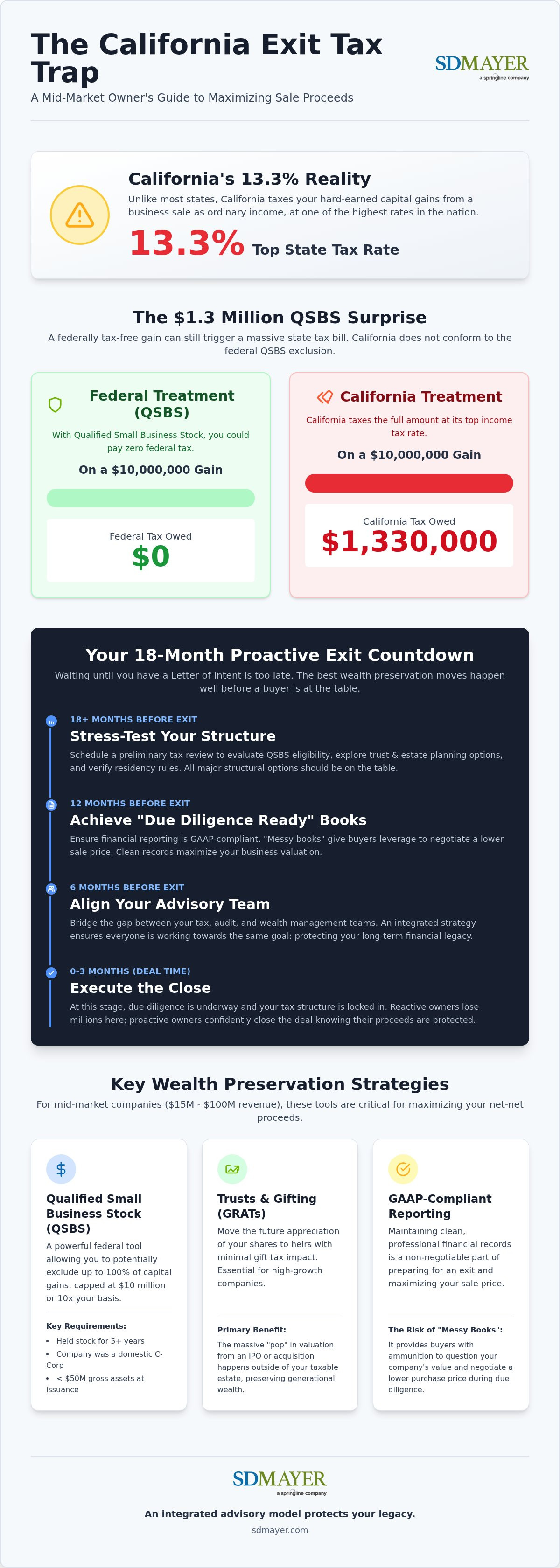
The catch for local founders is that California does not conform to federal QSBS rules. While you might pay $0 in federal tax on a $10 million gain, California will still demand its 13.3% cut, resulting in a $1.33 million state tax bill. This discrepancy makes it vital to pair federal exclusions with other state-specific mitigation tools.
Trusts and Gifting: Moving Value Before the "Pop"
If your business is on a high-growth trajectory, waiting until the exit to manage your estate is a missed opportunity. Grantor Retained Annuity Trusts (GRATs) allow you to move the future appreciation of your shares to your heirs with minimal gift tax impact. By "freezing" the value of the shares today, you ensure that the massive "pop" in valuation during an IPO or acquisition happens outside of your taxable estate.
Integrating strategic tax advice with your estate plan ensures these trusts are funded while valuations are still defensibly low. For those with philanthropic goals, a Charitable Remainder Trust (CRT) can provide an immediate tax deduction and a lifetime income stream while deferring the tax hit on the sale of highly appreciated shares. If you're unsure which vehicle fits your timeline, it may be time to start a conversation about your specific goals.
- Action Item: Verify your stock issuance date and the company's gross assets at that time to confirm QSBS eligibility.
- Action Item: Review your current estate plan to see if your lifetime gift exemption, which is $15 million in 2026, is being used effectively.
Audit Readiness: Protecting Your Valuation During Due Diligence
Tax strategies are only one part of the equation when preparing for an exit. If your financial data doesn't hold up under intense scrutiny, even the most sophisticated tax plan won't save a deal that falls apart during due diligence. Many mid-market founders focus so heavily on the final tax bill that they forget a buyer's primary goal is to find reasons to lower the purchase price. Messy records are the easiest excuse for a valuation "haircut." When you invest in proactive CAAS, you transition from basic bookkeeping to a strategic posture that can withstand intense buyer pressure. This preparation is a vital component of liquidity event tax planning California because it ensures the wealth you're trying to protect actually materializes at the closing table.
A buyer's team is trained to hunt for financial inconsistencies. They aren't just looking for errors; they're looking for risk. Any uncertainty in your reporting gives them leverage to negotiate larger holdbacks or lower multiples. By treating your accounting as a strategic asset rather than a back office chore, you protect your valuation from the very start of the process.
The "Clean Books" Premium
Transparent reporting does more than just satisfy a buyer's checklist. It actively drives up your exit value by reducing perceived risk. In the Bay Area tech and biotech sectors, how you count revenue and manage employee stock options are often the first areas a buyer's team will pick apart. If your financials aren't aligned with standard accounting rules, you're essentially handing the buyer a discount. Strengthening your financial reporting compliance well before the sale signals that your business is a professional, well governed operation. We often recommend running a sell-side review of your earnings to identify and fix any accounting issues before a buyer ever sees them.
Audit vs. Review: What Does Your Buyer Expect?
Deciding between a full audit and a financial statement review is a key tactical choice. A review provides limited assurance, but a full audit is a deep dive that offers the highest level of credibility. Most mid-market buyers expect at least two years of audited financials to feel comfortable with a high value acquisition. For biotech or cleantech firms that have received government funding, a "Single Audit" may be required to ensure you've followed federal grant rules. Having an independent expert's perspective isn't just a formality; it's your best defense during due diligence, allowing you to stand firm on your price when the pressure mounts.
- Action Item: Schedule a sell-side review of your earnings 12 to 18 months before your target exit date to find and fix inconsistencies.
- Action Item: Audit your current revenue policies to ensure they meet standard revenue rules, which is a common sticking point in tech exits.
- Action Item: Confirm if your business requires a Single Audit due to federal grant funding to avoid last minute compliance delays.
Your 18-Month Exit Countdown: A Practical Action Plan
When you're preparing for a business exit, time is your most valuable asset. Most owners start thinking about their tax bill when they see a draft of the sale agreement, but by then, many of the best options have already expired. A successful outcome requires a disciplined timeline that moves from broad structural decisions to fine-tuned execution. Effective liquidity event tax planning California isn't a single meeting; it's a series of intentional moves made over 18 months to ensure you keep the maximum amount of your proceeds.
Phase 1: Foundation and Structure (12-18 Months)
The first step is a rigorous "stress test" of your current business entity. Decisions made years ago, like choosing between a C-Corp or S-Corp, can have massive implications for your final tax bill. For instance, if you're eyeing federal QSBS benefits but your structure isn't compliant, you may still have time to pivot. This is also the window to upgrade your back-office operations. Implementing professional small business bookkeeping services ensures your data is clean, scalable, and ready for the scrutiny of a sophisticated buyer. During this phase, we identify any potential State and Local Tax (SALT) issues that could trigger a California audit after the sale.
Phase 2: Execution and Optimization (0-6 Months)
As the deal nears, the focus shifts to personal wealth preservation and advisor coordination. This is the time to finalize any trust funding or gifting strategies discussed in previous sections. Moving shares into an irrevocable trust while the valuation is still defensible can save millions in future estate taxes. You also need to prepare for the "Tax Tail," which is the significant estimated tax payment due shortly after the cash hits your account. Managing this cash windfall requires a tight loop between your CFO, tax advisor, and wealth manager to ensure you aren't left with a liquidity crunch when the 13.3% California bill comes due. If you're within this 18-month window, reach out to our team to start your stress test today.
- 18 Months Out: Review your corporate entity structure to ensure it aligns with your 2026 tax goals.
- 12 Months Out: Begin audit preparation and update your personal estate plan to reflect the anticipated valuation.
- 6 Months Out: Run a sell-side Quality of Earnings report and coordinate your advisor team for the final sprint.
- Post-Close: Calculate and set aside funds for state and federal estimated tax payments to avoid underpayment penalties.
The SD Mayer Difference: Integrated Advisory for Bay Area Exits
Managing a business exit is stressful enough without having to act as the middleman between your lawyer, accountant, and wealth manager. When these advisors operate in silos, critical details often fall through the cracks, leading to missed opportunities or unexpected tax bills. At SD Mayer, we've built our firm to be the "first call" for Bay Area founders by offering tax, audit, advisory, and wealth management under one roof. This integrated approach is essential for comprehensive liquidity event tax planning California, as it ensures your personal financial goals are perfectly aligned with your company's exit strategy.
Why One Firm is Better Than Three
Most traditional firms focus on just one piece of the puzzle, forcing you to manage the communication between different entities. Our CFO service works in constant contact with our tax and wealth teams. This means the person managing your daily financial reporting already knows how a specific transaction structure will impact your 13.3% California tax bracket. Because we're a member of the BDO Alliance USA, we provide the personalized, agile service of a local firm backed by global resources. We pride ourselves on the kind of smart, outside-the-box thinking that mid-market transactions require, whether you're dealing with complex secondary sales or multi-state tax nexus issues.
Getting Started: Your Complimentary Consultation
Your first liquidity planning session with us is a chance to look at the big picture. We'll review your current corporate structure, evaluate your timeline, and discuss your long-term legacy goals. With over 40 years of regional expertise, our founder, Stephen D. Mayer, has seen every type of exit the Bay Area has to offer. We understand the unique pace of Silicon Valley and San Francisco, providing a steady hand through the chaos of a deal. We handle the complexity of liquidity event tax planning California so you can focus on what you do best: running your business and crossing the finish line. Contact SD Mayer today to start your exit planning.
- Action Item: Audit your current advisor team to identify communication gaps that could lead to tax leakage.
- Action Item: Verify that your wealth manager and tax advisor have a shared strategy for the 2026 tax threshold changes.
- Action Item: Schedule a consultation to see how an integrated model can simplify your exit process.
Secure Your Financial Legacy and Next Chapter
A successful exit is about much more than a high purchase price. It's about the wealth you actually keep once the deal is done. By starting your preparations early and aligning your accounting with your long-term goals, you can protect your hard-earned proceeds from the state's challenging tax environment. We've seen how proactive liquidity event tax planning California transforms a complex, stressful transaction into a clear and confident transition for you and your family.
As a San Francisco-based firm and a member of the BDO Alliance USA, SD Mayer brings founder-level expertise to every partnership. We're proud to be named a Top 25 Fastest-Growing Firm in 2025 by Accounting Today, a recognition of our commitment to providing the integrated care that mid-market leaders need. You don't have to navigate this alone or manage advisors who don't talk to each other. We provide the stable, expert stewardship required to cross the finish line with peace of mind.
Simply Doing More for your exit. Schedule your strategic consultation with SD Mayer today. Your dedication has built something incredible. We're here to help you protect it and ensure your next chapter is as rewarding as the last.
Frequently Asked Questions
When is the best time to start liquidity event tax planning?
The best time to start is 18 to 24 months before you plan to sell. This window allows you to correct structural issues that might be impossible to change later, such as switching your business entity type or meeting specific holding period requirements. Starting early ensures your books are clean and your personal estate plan is ready for a sudden increase in wealth. If you're already in the middle of a deal, you should still seek immediate advice to protect your final proceeds.
Does California offer any specific tax breaks for selling a business?
Unlike the federal government, California does not offer a lower tax rate for long-term growth. The state treats your sale proceeds as ordinary income, which can trigger a tax rate as high as 13.3%. Because there are no built-in breaks, your strategy must focus on using legal tools like specialized trusts or timing your income to stay in lower brackets where possible. This makes proactive liquidity event tax planning California essential for keeping more of what you've built.
What is the difference between a Quality of Earnings report and an Audit?
An audit is a formal check to ensure your past financial statements are accurate for compliance reasons. A Quality of Earnings report is a more strategic look at your adjusted earnings to show a buyer your true profitability. While an audit looks backward at what happened, this report helps a buyer understand what the business will likely earn in the future. Having this data ready allows you to defend your asking price during the high-pressure due diligence phase.
How does Section 1202 (QSBS) work for California-based startups?
Section 1202 is a federal rule that can make your first $10 million in gains tax-free, but California completely ignores this benefit. If you are a founder in San Francisco or San Jose, you might pay zero federal tax but still owe the full 13.3% to the state. You must plan for this "tax trap" early to ensure you have enough cash on hand to cover the state bill without draining your personal savings or investment capital.
Can I avoid California tax by moving to another state before I sell?
Moving just before a sale is rarely a "quick fix" because California tracks value that was built while you lived here. The state uses strict rules to claim a portion of the sale based on how long you were a resident while the business grew. To successfully change your tax home, you must show a permanent move and cut significant ties to the state well in advance. Simply buying a house in a low-tax state right before closing won't usually stop a California audit.
What are the most common accounting mistakes that kill a deal?
Earn-outs can be tricky because you might owe tax on "phantom income" before you actually have the cash in your bank account. If the deal isn't structured correctly, you could end up with a massive tax bill in year one for money that isn't guaranteed to arrive until year three. Managing this requires careful contract language and a plan for making estimated tax payments. We help you coordinate these payments so you aren't caught off guard by a liquidity crunch.
Why should I use an integrated firm instead of a separate CPA and Wealth Manager?
Using an integrated firm like SD Mayer ensures that your tax, accounting, and wealth teams are all talking to each other daily. In a fast-paced Bay Area exit, you don't have time to repeat your goals to three different people. Having a "single roof" approach means your wealth manager knows exactly how a business valuation change in Walnut Creek or Menlo Park affects your tax plan. This coordination speeds up the deal and prevents expensive communication gaps.
SECURITIES AND ADVISORY DISCLOSURE:
Securities offered through Valmark Securities, Inc. Member FINRA, SIPC. Fee based planning offered through SDM Advisors, LLC. Third party money management offered through Valmark Advisers, Inc a SEC registered investment advisor. 130 Springside Drive, Suite 300, Akron, Ohio 44333-2431. 1-800-765-5201. SDM Advisors, LLC is a separate entity from Valmark Securities Inc. and Valmark Advisers, Inc. Form CRS Link
DISCLAIMER:
This material has been prepared for informational purposes only, and is not intended to provide, and should not be relied on for, accounting, legal or tax advice. The services of an appropriate professional should be sought regarding your individual situation.
HYPOTHETICAL DISCLOSURE:
The examples given are hypothetical and for illustrative purposes only.