
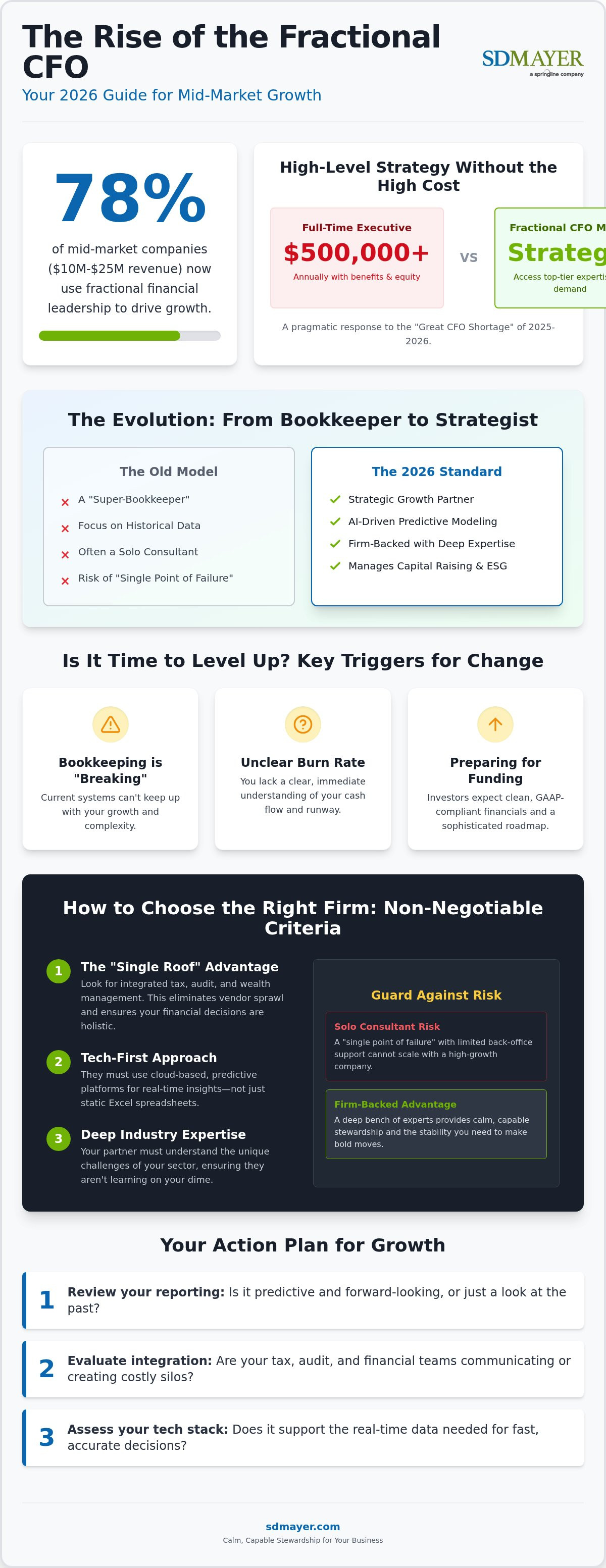
Nearly 78% of companies with revenues between $10 million and $25 million are now using fractional financial leadership to drive their growth. It's a strategic shift that makes sense when you consider that a full-time executive can cost upwards of $500,000 annually. You've probably felt the friction of vendor sprawl, where your tax preparer and bookkeeper don't speak the same language, leaving you with cash flow anxiety. Finding the best fractional cfo companies is no longer just about hiring a part-time accountant; it's about securing a partner who can provide GAAP-compliant financials and a clear roadmap for your next big move.
We believe you deserve a steady mentor who looks at your entire financial life, not just your monthly reports. This guide highlights the top firms in 2026 that offer the high-level expertise you need to scale without the full-time executive price tag. You'll learn which firms provide integrated tax and wealth management, how to ensure your financials are ready for investors, and what you should expect to pay for top-tier strategic guidance this year. We've vetted these providers to ensure they offer the calm, capable stewardship your business needs to reach its next stage of success.
Key Takeaways
- Understand why shifting to predictive strategy is the new standard for mid-market growth in a competitive talent market.
- Evaluate the best fractional cfo companies by looking for full-service integration that connects your tax, audit, and wealth management.
- Determine if your business needs the deep, founder-level expertise of a holistic firm or the standardized approach of a tech-first platform.
- Guard your company against the "single point of failure" risk often found when working with solo consultants who lack back-office support.
- Master the onboarding process with a clear plan to audit your financial health and secure quick wins in cash flow visibility.
Why Fractional CFOs are the Strategic Standard for 2026
The financial landscape has shifted significantly over the last year. In 2026, mid-market companies are no longer looking for someone to just close the books; they need a navigator. The "Great CFO Shortage" of 2025 and 2026 has made it nearly impossible to find full-time executive talent without paying a premium that often exceeds $500,000 when you include benefits and equity. This scarcity is a primary reason why the Fractional executive model has become the standard for businesses generating between $10 million and $100 million in revenue. It's a pragmatic response to a talent-starved market.
The best fractional cfo companies today don't just report on the past. They use 2026 technology stacks, including AI-driven predictive modeling, to provide a forward-looking strategy. This allows you to see cash flow pinches months before they happen. It's about being proactive. By choosing an integrated firm model over a single hire, you gain a deep bench of expertise that scales with your needs. You aren't just getting a person; you're getting a system that connects your tax strategy, audit readiness, and wealth management under one roof. This holistic approach reduces the stress of managing multiple vendors who don't communicate.
The Evolution of the Part-Time CFO
In previous years, a part-time CFO was often a "super-bookkeeper." That doesn't cut it in today's economy. These leaders are now essential for complex capital raising and navigating the 2026 requirements for sustainability and ESG reporting. Mid-market firms are moving away from solo consultants because they lack the back-office support needed for high-growth stages. A firm-backed CFO brings a holistic perspective, ensuring your business structure is optimized for long-term value and a successful exit. They act as a steady companion through the nuances of a fast-paced regional economy, often working alongside services like Saffron Coaching & Advisory to provide senior leaders with the commercial clarity needed for high-level strategic decisions.
When to Make the Move
Knowing when to transition is vital for maintaining momentum. If your current bookkeeping feels like it's "breaking" or you can't get a clear answer about your burn rate, it's time to level up. You should also consider this move if you are preparing for Series B or C funding. Investors in 2026 expect clean, GAAP-compliant financials and a sophisticated roadmap. You can learn more about the specific indicators in our guide on When to hire part-time CFO services to see if your growth trajectory matches these trends.
- Review your current financial reporting to see if it includes predictive forecasting or just historical data.
- Evaluate if your tax and audit functions are talking to each other or operating in silos that cause extra work.
- Assess your 2026 tech stack to ensure it supports real-time data integration for faster, more accurate decision-making.
Key Criteria for Choosing the Best Fractional CFO Companies
Selecting a partner is about more than just filling a seat; it's about finding a team that understands where you're going. When you evaluate the best fractional cfo companies, you need to look beyond basic accounting skills. You need a firm that brings real-world experience to the table, helping you avoid common pitfalls as you scale from $5 million to $50 million. One of the core benefits of a fractional CFO is the ability to tap into high-level strategic thinking without the overhead of a full-time hire.
In 2026, technology fluency is non-negotiable. The right firm moves past static Excel spreadsheets and uses cloud-based predictive platforms to give you a real-time view of your future. They should also offer deep expertise in your specific industry, whether that's tech, manufacturing, or the non-profit sector. This specialized knowledge ensures they aren't learning on your dime. They should act as a steady companion, providing the stability you need to make big moves with confidence.
The 'Single Roof' Advantage
If your CFO doesn't talk to your tax and audit teams daily, you're likely dealing with vendor sprawl. This fragmentation leads to missed opportunities and wasted executive bandwidth. A "single roof" model ensures that every financial decision is made with your total tax picture and audit requirements in mind. This integrated approach turns your financial department into a cohesive unit rather than a collection of separate silos. It makes your firm the "first call" for any financial emergency, reducing the stress of complex compliance through calm, capable stewardship.
Local Expertise in Complex Markets
Operating in a complex regional economy requires a guide who knows the local landscape. For many mid-market firms, navigating California-specific regulations or complex SALT compliance is a daily challenge. If you're in the tech sector, you need a partner who understands the nuances of stock option planning and the Bay Area innovation economy. Even if you're starting smaller, looking into CFO services for small business can help you lay the right foundation for future growth. If you're ready to see how an integrated approach can streamline your journey, you can start a conversation with our team today.
- Ask about their specific experience with 2026 tax changes and current SALT deduction limits.
- Ensure they use integrated technology that allows your bookkeeper and CFO to work in the same system.
- Confirm they have the "bench strength" to support you during an M&A event or a major audit.
Comparing the Top Fractional CFO Companies for Mid-Market Firms
When you search for the best fractional cfo companies, you'll quickly realize that the industry is divided into a few distinct camps. Choosing the right one depends entirely on your current complexity and where you plan to be in three years. Some providers are essentially software companies with an accounting layer, while others are full-service advisory firms that provide a deep bench of human expertise. Understanding the Strategic Benefits of a Fractional CFO means recognizing that a strategic partner does more than just manage your ledger; they guide your entire business journey.
If you're a high-growth mid-market firm, you likely need more than what a "Solo Network" like B2B CFO or a "Tech-First" platform like Pilot can offer. While Pilot is excellent for early-stage, standardized bookkeeping, it often lacks the strategic depth required for complex M&A or international tax planning. Similarly, solo networks provide basic oversight for lifestyle businesses but can't offer the multi-disciplinary support of a full firm. TechCXO provides great industry-specific technical talent, but for many businesses, the missing piece is a partner who connects strategy to tax and audit readiness under one roof.
SD Mayer: The Integrated Mid-Market Choice
SD Mayer stands out as the "Holistic Advisor" for companies generating between $15 million and $100 million in revenue. With founder-level expertise from Stephen D. Mayer and a deep-rooted Bay Area team, the firm offers a "single-roof" model that solo consultants simply can't match. Through their membership in the BDO Alliance USA, they provide the global reach necessary for multi-state or international growth while maintaining the personal touch of a regional partner. Their "Simply Doing More" philosophy means they don't just wait for you to ask questions; they proactively look for ways to optimize your business structure and wealth management strategy.
Matching the Firm to Your Growth Stage
Your choice should align with your specific milestone. If you're in the very early stages, a marketplace or software-led solution might be enough to keep your books tidy. However, once you hit the growth stage and prepare for Series A-C funding, the stakes change. Investors will demand GAAP-compliant financials and a clear roadmap for an exit. This is when you need a firm that understands the nuances of capital raising and audit prep. If you're currently scaling a new venture, you can explore how to find a Fractional CFO for startups to ensure you're building on a solid foundation from day one.
- SD Mayer: Best for integrated mid-market strategy, tax, and audit readiness.
- Pilot/Paro: Best for early-stage businesses needing standardized, tech-led bookkeeping.
- B2B CFO: Best for small, stable businesses looking for basic financial oversight.
- TechCXO: Best for firms needing a niche specialist for a specific technical project.
The Hidden Risks of 'Solo' Fractional CFOs
Many business owners gravitate toward solo consultants because the relationship feels personal and direct. However, for a mid-market company generating $15 million or more, this often creates a "single point of failure." If your consultant takes a vacation, gets sick, or becomes overstretched due to the ongoing talent shortage, your financial strategy simply stops. The best fractional cfo companies mitigate this risk by providing a team-based approach. You aren't just hiring an individual; you're securing a system of capable stewardship that ensures continuity for your business regardless of who is in the office that day.
Another common pitfall is the "expensive bookkeeping" trap. Without a dedicated back-office team of controllers and bookkeepers, a solo CFO often ends up performing low-level data entry at an executive hourly rate. This is a poor use of your capital and their expertise. A firm-backed model allows the CFO to stay focused on high-level strategy while a specialized team handles the transactional work. This structure ensures that your financial reporting is accurate, timely, and ready for investor scrutiny without the friction of managing multiple unlinked vendors.
Strategy Without Execution is Just a Plan
A solo advisor might offer brilliant strategic insights, but a disconnect often exists between that advice and actual implementation. For example, a consultant may suggest a complex tax strategy but won't be the one to actually file the paperwork or handle a state and local tax (SALT) audit. This leaves you to bridge the gap between their "big picture" ideas and the technical reality of compliance. Integrated firms solve this by housing strategy, tax, and audit teams under one roof. When your CFO can walk down the hall to talk to your tax partner, your financial life becomes significantly less fragmented.
Avoiding the 'Consultant Trap'
You've likely encountered consultants who are excellent at identifying what's wrong but slow to actually fix it. In a fast-paced economy, you need a partner who takes accountability for results. We believe in a "holistic mentor" approach where the advisor is genuinely invested in your success. This means moving beyond a PDF of recommendations and staying by your side to execute the roadmap. It's the difference between a temporary advisor and a steady companion who helps you navigate the nuances of growth and succession planning.
- Ask a solo consultant exactly who handles their work if they are unavailable for two weeks.
- Request a breakdown of how they coordinate with your external tax and audit providers.
- Evaluate if they have the resources to handle a complex SALT compliance project across multiple states.
If you're ready to move beyond fragmented advice and build a stable, integrated financial foundation, contact our team to start a conversation about your growth.
How to Successfully Onboard Your Fractional CFO Partner
Choosing one of the best fractional cfo companies is a major milestone, but the real work begins during the integration phase. Many engagements fail because they lack a structured start. To avoid this, you need a clear roadmap that moves from assessment to action. A successful onboarding process ensures your new partner becomes a steady companion who understands your history and shares your vision for the future.
Your journey should start with a comprehensive audit of both your financial health and your current tools. This isn't just about looking for errors; it's about seeing if your systems can handle your 2026 growth goals. Once the audit is complete, your next priority is defining 90-day "Quick Win" objectives. For most mid-market firms, this means achieving total cash flow visibility. When you can see where every dollar is going in real-time, the anxiety of growth starts to fade, replaced by a sense of calm, capable stewardship.
Finally, you must establish a regular cadence for board and management reporting. This ensures that everyone is looking at the same data and moving in the same direction. Your fractional leader should also immediately integrate with your tax and compliance calendar. This prevents those stressful last-minute rushes during tax season and ensures your state and local tax requirements are always met without surprises.
- Schedule a tech stack review to ensure your software is integrated for 2026 reporting requirements.
- Set a 90-day goal focused on one specific pain point, like cash flow visibility or debt restructuring.
- Calendar your board meetings for the next year to establish a consistent reporting rhythm.
Setting Clear Expectations and KPIs
Measuring the ROI of your engagement goes beyond just looking at the bottom line. You should define clear boundaries between tactical bookkeeping and the strategic leadership your CFO provides. Use cloud-based platforms for real-time collaboration so that your financial data is always accessible and transparent. This transparency builds trust and allows your CFO to focus on big-picture strategy, such as capital raising or M&A prep, rather than getting bogged down in daily transactions.
Your Next Step for Strategic Growth
We believe that a great financial partner should be your "First Call" for everything from a sudden cash flow question to long-term succession planning. Our CAAS team is designed to facilitate a seamless transition, ensuring that your books are clean and your strategy is sound from day one. By moving beyond simple number-crunching, we help you build a legacy of success. If you're ready to secure the strategic leadership your business needs to thrive in 2026, contact SD Mayer for a tailored growth strategy today.
Secure Your Financial Future with Integrated Leadership
Navigating the complexities of mid-market growth in 2026 requires more than just a part-time accountant; it demands a forward-thinking strategist who can integrate your entire financial life. As you evaluate the best fractional cfo companies, remember that the right partner provides a "single-roof" model where strategy, tax, and audit readiness work together. This holistic approach eliminates the friction of vendor sprawl and gives you the calm, capable stewardship needed to prepare for an exit or a major capital raise.
At SD Mayer, we're proud to be an IPA Top 400 firm and a member of the BDO Alliance USA, providing global reach with a personal touch. Being named one of the Fastest-Growing Firms in 2025 reflects our commitment to "Simply Doing More" for our clients. We're here to act as your steady companion through every stage of your business journey, ensuring your financial foundation is as ambitious as your vision.
Ready to scale? Connect with an SD Mayer advisor today to build a financial roadmap that supports your biggest ambitions. You've built something incredible, and we're here to help you protect and grow it for the long term.
Common Questions About Fractional Financial Leadership
What is a fractional CFO and how do they differ from a consultant?
A fractional CFO is a part-time executive who takes long-term ownership of your financial strategy, whereas a consultant usually focuses on a single, short-term project. While a consultant might deliver a report and move on, a fractional leader acts as a steady companion who stays to execute the plan. They integrate with your leadership team to drive growth, manage capital, and provide the same level of accountability you would expect from a full-time hire. For leadership teams navigating complex stakeholder environments, you can read more about how strategic advisory services can support your executive goals.
How much do the best fractional CFO companies charge in 2026?
Pricing models for the best fractional cfo companies typically involve either a monthly retainer or an hourly rate based on the complexity of your needs. Most mid-market firms prefer the retainer model because it provides predictable costs while ensuring the CFO is available for strategic meetings and board reporting. While rates vary based on the firm's bench strength and industry expertise, the cost is significantly lower than the $500,000 annual package often required for a full-time executive in the current market.
When is the right time for a mid-market company to hire a fractional CFO?
The right time to hire is when your financial complexity outpaces your current team's ability to provide forward-looking advice. If you're relying on a bookkeeper for strategy or your cash flow forecasting feels like guesswork, you've likely reached that point. It's also a vital move if you're preparing for Series B or C funding, as investors in 2026 demand sophisticated financial modeling and GAAP-compliant reporting before they'll commit capital.
Can a fractional CFO help my company prepare for an audit or M&A?
Yes, they are essential for navigating the high-stakes environment of an audit or a merger. They act as your "first call" partner, ensuring your books are clean and your business structure is optimized for a successful transaction. By managing the technical requests from auditors or buyers, they reduce the stress on your internal team and help you maintain a position of strength during negotiations.
What is the difference between a fractional CFO and an outsourced controller?
A controller focuses on the accuracy of your historical data and internal controls, while a CFO focuses on your future strategic roadmap. Think of the controller as the person who ensures your financial reports are correct and your payroll is on time. The CFO takes that data and uses it to make big-picture decisions about capital raising, debt management, and long-term profitability. For many mid-market firms, having both roles working in tandem is the key to stability.
Do fractional CFO companies handle tax planning and SALT compliance?
Integrated firms handle tax planning and state and local tax (SALT) compliance as part of a holistic service, but solo providers often don't. This is a critical distinction because your growth strategy and your tax strategy shouldn't live in silos. When your CFO and tax team work under one roof, they can proactively identify savings and ensure you're meeting 2026 regulatory requirements without the friction of managing multiple unlinked vendors.
How do I choose between a solo fractional CFO and an integrated firm?
You should choose an integrated firm if your business requires a deep bench of expertise and a "single-roof" model for tax, audit, and strategy. Solo consultants are often talented, but they represent a "single point of failure" if they become unavailable or hit the limits of their specialized knowledge. A firm provides a holistic mentor approach, ensuring you always have back-office support and a team that can scale with you from $15 million to $100 million in revenue.
What software do the best fractional CFO companies use in 2026?
The best fractional cfo companies have moved beyond static spreadsheets to cloud-based predictive platforms and AI-driven modeling tools. These systems allow for real-time collaboration and provide deep visibility into your future cash flow. When you interview a firm, ask if their tech stack integrates directly with your existing accounting software. This ensures your data is always current, allowing for faster decision-making and more accurate board reporting.
SECURITIES AND ADVISORY DISCLOSURE:
Securities offered through Valmark Securities, Inc. Member FINRA, SIPC. Fee based planning offered through SDM Advisors, LLC. Third party money management offered through Valmark Advisers, Inc a SEC registered investment advisor. 130 Springside Drive, Suite 300, Akron, Ohio 44333-2431. 1-800-765-5201. SDM Advisors, LLC is a separate entity from Valmark Securities Inc. and Valmark Advisers, Inc. Form CRS Link
DISCLAIMER:
This material has been prepared for informational purposes only, and is not intended to provide, and should not be relied on for, accounting, legal or tax advice. The services of an appropriate professional should be sought regarding your individual situation.
HYPOTHETICAL DISCLOSURE:
The examples given are hypothetical and for illustrative purposes only.