
You worked for years to see your equity finally vest, but without a proactive strategy, the IRS and California's Franchise Tax Board could easily become your largest shareholders. It's a common story in Silicon Valley. A successful exit or a major RSU vest often leads to a massive, unexpected tax bill that catches even the most brilliant leaders off guard. Effective tax planning for tech executives isn't just about checking boxes; it's about aligning your personal wealth with your company's growth.
In this guide, we'll provide a jargon-free roadmap to mastering equity compensation, timing your option exercises, and handling California's specific tax rules during an IPO or acquisition. We'll explore how to build a clear strategy for RSU vesting and protect your wealth so you can focus on leading your team while we manage the big picture. You deserve a partner who understands the unique pace of the tech industry and ensures your financial future is as bright as the products you build.
Key Takeaways
- Learn how to avoid the "AMT Trap" when exercising stock options and compare the tax impact of your RSUs, ISOs, and NSOs to prevent surprise bills.
- Understand the specific impact of California's state and local tax rules on your 2026 filings and how to optimize your strategy for the Bay Area.
- Discover why the 12-month window before an exit is critical for tax planning for tech executives and how to qualify for significant federal tax exemptions.
- Align your paycheck with your investment portfolio by using an integrated approach that connects your tax strategy and wealth management.
- Identify the specific steps needed to protect your wealth during a company acquisition or public offering to ensure your hard work pays off.
Beyond the W-2: Why Tech Executive Tax Planning is Different in 2026
For most Bay Area leaders, the W-2 salary is often the least complex part of the financial picture. While a high base pay provides stability, your real wealth usually resides in equity, performance bonuses, and deferred compensation. This reality is why tax planning for tech executives requires a specialized lens. You aren't just filing a return; you're managing a sophisticated portfolio that fluctuates with the market and your company's specific growth trajectory.
We focus on "integrated planning," which is the strategic link between your monthly paycheck and your long-term assets. In 2026, mid-market tech firms in the Bay Area are navigating a unique environment. With valuations stabilizing and IPO windows shifting, your strategy must be agile. You need to know how a vest today affects your tax bracket tomorrow. Without this big-picture view, it's easy to miss opportunities for optimization that only appear when you look at your income and investments as a single, unified system.
The "All-in-One" Compensation Challenge
Your income often feels like a puzzle with pieces that don't always fit. Between cash bonuses, RSUs, and base pay, you can easily find yourself in a "tax perfect storm." This is especially true if you hold Incentive Stock Options (ISOs), which carry their own set of rules and potential pitfalls. A major risk here is concentration. If the majority of your wealth is tied to your company's stock, you're vulnerable to market swings. Many generalist CPAs don't have the deep tech experience to manage these specific risks, often treating equity as an afterthought rather than a core wealth driver.
Setting Your 2026 Financial Goals
The most successful leaders move beyond the question of "how much do I owe?" and start asking "how much can I keep?" This shift requires proactive tax advice that happens year-round, not just in April. Your personal tax goals should mirror your company's growth stage. If you're at a Series C startup, your needs differ significantly from someone at a post-IPO giant. We help you align these milestones so that your personal wealth grows alongside your professional achievements.
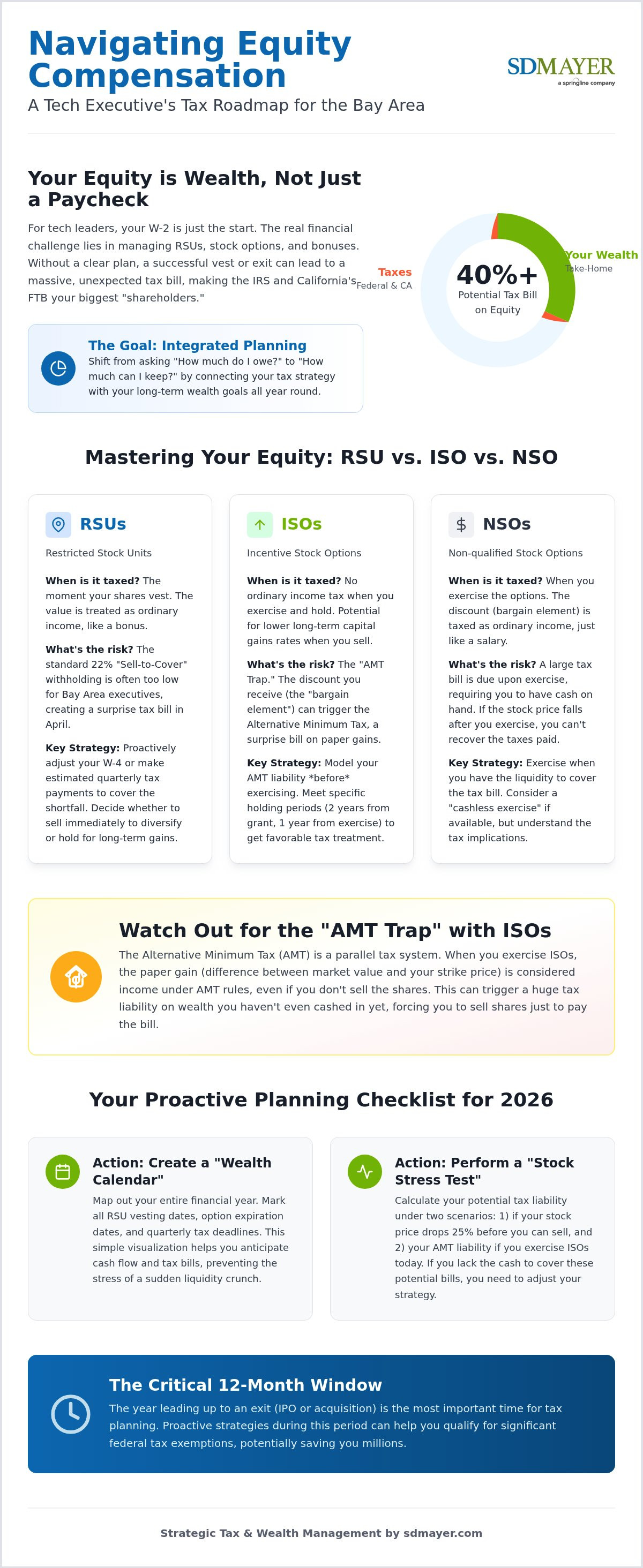
Take thirty minutes this week to map out your financial year. Mark every RSU vesting date, option expiration, and quarterly tax deadline. Overlaying these dates helps you visualize when you'll have liquidity and when you'll face a tax bill. This simple step prevents the stress of a sudden cash crunch and ensures you are prepared for every major financial event in 2026.
Mastering Your Equity: Strategies for RSUs, ISOs, and NSOs
Equity isn't just a perk; it's a sophisticated financial instrument that requires precise handling. When we manage tax planning for tech executives, we often find that a single vesting event can shift your entire financial strategy for the year. The IRS views your shares through various lenses, and understanding these distinctions is the first step toward protecting your wealth. Our approach is built on the idea of simply doing more for our clients, ensuring you have a clear roadmap for every share you own.
Restricted Stock Units (RSUs): The Income Hit
RSUs feel like a gift, but the tax man sees them as a cash bonus. The moment they vest, you owe taxes on their fair market value. Most Bay Area companies use the "Sell-to-Cover" method, where they automatically sell a portion of your shares to handle withholding. However, the standard 22% withholding rate is often too low for high earners. This gap can lead to a massive surprise bill in April. You might need to adjust your W-4 or make quarterly estimated payments to stay ahead. Deciding whether to sell immediately to diversify or hold for long-term gains depends entirely on your overall portfolio balance and your belief in the company's 2026 growth.
Incentive Stock Options (ISOs) and the Hidden Tax
ISOs are a favorite in the tech world because of their potential for lower tax rates, but they come with a catch known as the "AMT Trap." When you exercise ISOs and hold the shares, you don't owe ordinary income tax, but the "bargain element" (the difference between your strike price and the current value) is counted toward the Alternative Minimum Tax. This is a secondary tax system designed to ensure high earners pay a minimum amount. Following IRS guidance on executive compensation is vital to avoid being forced to sell shares just to pay a tax bill on wealth you haven't cashed out yet. To get the best rates, you must meet specific holding periods for a "qualifying disposition," which usually means holding for at least a year after exercise and two years after the grant date.
If you're staring at a complex grant agreement and aren't sure which move to make first, it's often best to speak with a specialist who understands the nuances of tech-heavy portfolios.
Sit down with your current equity dashboard and run two scenarios. First, calculate your tax liability if your stock price drops by 25% before you can sell. Second, calculate your AMT liability if you exercise your ISOs today. If you don't have the liquid cash to cover these bills in a down market, you may need to adjust your exercise schedule or sell a portion of your vested RSUs to build a tax reserve.
Navigating the California Landscape: SALT and Local Optimization
Living and working in the Bay Area brings unparalleled career opportunities, but it also comes with one of the most complex state tax environments in the country. For those in San Francisco or San Jose, a standard federal approach isn't enough. You need a "California-first" strategy. The Franchise Tax Board (FTB) is known for its rigorous enforcement, especially regarding high-earning individuals and equity-heavy compensation. Effective tax planning for tech executives in this region means looking beyond federal brackets to understand how state and local rules eat into your real take-home pay.
Remote work has added another layer of difficulty. If you've moved to a lower-tax state but still work for a Silicon Valley firm, you might assume you've escaped California's reach. However, the FTB often views income as "California-sourced" regardless of where you're sitting. We help you navigate these residency audits and sourcing rules to ensure you aren't paying more than your fair share to a state you no longer call home.
Maximizing the SALT Deduction in 2026
The State and Local Tax (SALT) deduction cap remains a significant hurdle. In 2026, the $10,000 limit on deducting state and local taxes still forces many to look for creative workarounds. One effective strategy is "bunching" deductions. By timing property tax payments or charitable contributions into a single year, you can potentially exceed the standard deduction threshold. Additionally, for executives with side business income or those in partnerships, California’s Pass-Through Entity (PTE) tax elective can provide a vital federal deduction that bypasses the SALT cap entirely.
The Cost of Living (and Taxing) in the Bay Area
Local nuances in places like Menlo Park or Palo Alto go beyond high property taxes. Public company leaders must also consider how corporate deduction limits affect their personal packages. For instance, an analysis of IRC Section 162(m) shows how limits on corporate tax deductions for executive pay can influence how your company structures your bonuses and equity. These high-level corporate rules eventually trickle down to your personal return. When you combine these with local payroll taxes and high-value real estate assessments, the "California Standard Deduction" quickly becomes insufficient for your needs.
Schedule a brief meeting to review your current tax advisor relationship. Ask specifically about their experience with FTB residency audits and PTE tax elections. If they don't have a deep understanding of these California-specific quirks, you could be leaving significant savings on the table. Your advisor should be a partner who anticipates these regional hurdles before they become liabilities.
Tax Strategies for IPOs and Acquisitions
An exit event is the moment your hard work translates into tangible wealth. However, the difference between a successful exit and a tax disaster often comes down to timing. We call the 12 months leading up to a liquidity event the "Golden Window." This is the period when strategic tax planning for tech executives has the highest impact. Waiting until after a deal is signed limits your options to simple damage control. By starting early, you can structure your holdings to take advantage of specific federal exemptions that vanish once the company reaches a certain size.
Managing the "Lock-up Period" after an IPO is another critical challenge. While you're waiting for the 180-day window to close, the stock price can be volatile. We help you build a plan that accounts for this fluctuation, ensuring you don't end up with a tax bill based on a peak price for shares you couldn't actually sell. If you are preparing for a major transition, it's time to consult with an IPO readiness expert to secure your gains.
The QSBS Windfall: Are You Eligible?
Qualified Small Business Stock (QSBS), under Section 1202, is one of the most powerful tools in your arsenal. If your company meets the criteria, you could potentially exclude up to 100% of your federal capital gains, up to $10 million or ten times your basis. This is a massive win for mid-market executives at firms with $3M to $30M in annual recurring revenue. To qualify, the company must have had less than $50 million in gross assets when your shares were issued. Common mistakes, like certain stock redemptions or failing to meet the five-year holding period, can disqualify you. We review your grants early to ensure every share remains eligible for this $0 federal tax status.
M&A vs. IPO: Different Tax Paths
The path to liquidity changes your tax obligations. In an acquisition, you might face immediate capital gains if the deal is all cash. If it's a stock-for-stock merger, you might be able to defer those taxes. Earn-outs and deferred compensation also require careful handling to avoid being taxed at the highest ordinary income rates. During due diligence, having clean records is vital. Utilizing financial reporting compliance services in the Bay Area ensures that your personal financial data aligns with the company’s reporting, preventing last-minute hurdles that could delay your payout. Integrated tax planning for tech executives ensures that no matter the exit path, your wealth remains protected.
If your company is discussing an exit, ask your CFO services provider for a comprehensive analysis of your equity. This report should model your take-home pay after federal and California taxes under different exit scenarios. Knowing these numbers now allows you to make informed decisions about exercising options or gifting shares before the valuation spikes.
The Integrated Advantage: Why a Holistic Advisor Beats a Generalist
If you're like most leaders in the SF innovation economy, your financial life is split between a tax preparer, a wealth manager, and perhaps a separate business accountant. The problem is that these people rarely talk to each other. When your tax person and your investment person aren't on the same page, you end up stuck in the middle, translating complex advice back and forth. For those seeking specialized wealth management, working with a fiduciary like Cadence Capital Investments can provide the coordination needed to prevent costly mistakes. Effective tax planning for tech executives requires a "First Call" partner who understands the connection between your company's balance sheet and your family’s future.
At SD Mayer, we operate on a "Full Circle" philosophy. We believe your tax strategy and your wealth management should be part of the same conversation. Because we're members of the BDO Alliance USA, we provide the global reach needed to handle international stock options or multi-state tax issues while maintaining the personal touch of a San Francisco boutique. You get the resources of a massive firm with the agility of a local mentor who knows exactly what it’s like to scale a business in the Bay Area.
Ending the "Vendor Gap"
The "Vendor Gap" is the space where mistakes happen. It’s the risk that your wealth manager sells shares to diversify your portfolio without realizing that those specific shares were your best candidates for QSBS tax-free status. By using integrated CAAS (Client Accounting Advisory Services) models, we bridge this gap. This approach doesn't just benefit your company; it ensures your personal financial reporting is always ready for a high-stakes event. Consider a leader at a Series C startup facing a sudden acquisition. With an integrated team, the transition from private equity to a major payout is seamless because the tax, accounting, and wealth strategies were already aligned months in advance.
Built for Your Stage
We don't try to be everything to everyone. Our firm is specifically built for the mid-market and growth-stage tech sector. We understand the nuances of founder-level expertise because our firm was built by founders. Whether you're managing a team of fifty or five hundred, your needs are different from a retail business or a traditional law firm. You need a forward-thinking strategist who understands that your 2026 goals are tied to your company’s next milestone. Starting a proactive tax conversation today ensures that when those milestones arrive, you’re prepared to keep as much of your hard-earned wealth as possible.
Take a look at your current list of advisors. If you're paying three different firms for tax, wealth management, and business accounting, you're likely dealing with significant communication gaps. This week, ask your primary advisor if they can handle an integrated review of your entire financial picture. Consolidating these roles into a single partnership reduces stress and ensures that no part of your "Full Circle" strategy is left to chance.
Securing Your Financial Future in the SF Innovation Economy
You've built your career on innovation and precision; your financial strategy deserves the same level of care. We've explored how mastering your equity, navigating California's unique tax landscape, and preparing for liquidity events are essential for protecting your wealth. Proactive tax planning for tech executives ensures that your hard work translates into a lasting legacy rather than an unexpected tax bill. It's about looking at the big picture before the next vest or exit event occurs.
As a Top 25 Fastest-Growing Firm in 2025 named by Accounting Today, SD Mayer brings over 40 years of Bay Area relationship capital to your corner. Through our membership in the BDO Alliance USA, we combine deep local expertise with global resources to manage your full financial picture. Don't wait for an IPO announcement or a tax deadline to start this critical conversation. You deserve a partner who is as invested in your success as you are.
Schedule your 2026 Tax Strategy Session with SD Mayer today to align your personal wealth with your professional achievements. We're ready to help you navigate the complexities ahead with confidence and clarity.
Frequently Asked Questions
How are RSUs taxed in California for 2026?
California taxes RSUs as ordinary income the moment they vest, based on their fair market value. While your company might withhold 22% for federal taxes, this often falls short for Bay Area high earners. You'll also face California's progressive state tax brackets, which can reach as high as 13.3%. It's critical to review your total income early in the year to avoid a significant underpayment penalty when you file your state return.
What is the most common tax mistake tech executives make during an IPO?
The most frequent error is failing to act during the "Golden Window" before the IPO occurs. Many leaders wait until the lock-up period ends to consider their strategy, only to find their options limited. By then, the stock price may have fluctuated significantly, yet your tax liability might be tied to a higher valuation. Starting your tax planning for tech executives at least twelve months before the exit allows you to maximize exemptions like QSBS.
Can I avoid AMT when exercising my ISOs?
You can manage your exposure to the Alternative Minimum Tax (AMT) by calculating your crossover point before exercising. This is the specific number of shares you can exercise without triggering the AMT. If you stay below this threshold, you won't owe the extra tax that year. Another strategy involves exercising early in the calendar year, giving you more time to sell if the stock price drops, which could potentially cancel out the AMT hit.
How does the SALT cap affect Bay Area tech professionals in 2026?
The $10,000 State and Local Tax (SALT) deduction cap remains a major challenge for professionals with high property taxes and state income. Since your state tax bill likely far exceeds this limit, you should explore the Pass-Through Entity (PTE) tax election if you have any business income. This allows you to pay state taxes at the entity level, effectively creating a federal deduction that bypasses the $10,000 cap entirely and saves you more.
What is QSBS and how do I know if my tech startup stock qualifies?
Qualified Small Business Stock (QSBS) allows you to potentially exclude up to 100% of capital gains from federal tax. To qualify, your company must be a C-corporation with less than $50 million in gross assets when your shares were issued. You must also hold the stock for at least five years. We recommend reviewing your original grant paperwork early, as certain corporate actions or stock buybacks can accidentally disqualify your shares from this valuable status.
When is the best time of year to start tax planning for stock options?
The best time to start is in the first quarter of the year or immediately after receiving a new grant. Waiting until November or December limits your ability to spread out exercises or adjust your withholdings. Early planning gives you the full calendar year to time your moves around market volatility and your company's vesting schedule. This proactive approach ensures you have the liquid cash ready when your tax payments are actually due.
Do I need a specialized tax advisor if I already have a wealth manager?
Yes, because a wealth manager primarily focuses on portfolio growth, while a specialized tax advisor ensures you keep more of those gains. Many generalists miss the specific nuances of incentive stock options or California's aggressive sourcing rules. An integrated approach is ideal. When your tax and wealth strategies are handled by the same team, you eliminate the communication gaps that lead to missed deductions or accidental tax triggers during a rebalance.
How does working for a remote company affect my San Francisco local taxes?
California is highly aggressive about taxing income it considers California-sourced, even if you are physically working from a different state. If your company is based in San Francisco, they may still be required to withhold local payroll taxes depending on their specific business nexus. The Franchise Tax Board often uses your residency history and employer location to determine your liability. It's vital to document your physical work location meticulously to defend your position during any potential audit.
SECURITIES AND ADVISORY DISCLOSURE:
Securities offered through Valmark Securities, Inc. Member FINRA, SIPC. Fee based planning offered through SDM Advisors, LLC. Third party money management offered through Valmark Advisers, Inc a SEC registered investment advisor. 130 Springside Drive, Suite 300, Akron, Ohio 44333-2431. 1-800-765-5201. SDM Advisors, LLC is a separate entity from Valmark Securities Inc. and Valmark Advisers, Inc. Form CRS Link
DISCLAIMER:
This material has been prepared for informational purposes only, and is not intended to provide, and should not be relied on for, accounting, legal or tax advice. The services of an appropriate professional should be sought regarding your individual situation.
HYPOTHETICAL DISCLOSURE:
The examples given are hypothetical and for illustrative purposes only.