
The standard 22% federal withholding on your RSU vest might feel like it covers your bases, but for most high-earning Bay Area professionals, it's often a trap that leads to a massive surprise bill in April. When you're in a higher federal bracket like 35% or 37%, that withholding gap adds up fast. Effective tax planning for restricted stock units is about more than just checking a box; it's about protecting the wealth you've worked so hard to build.
It's frustrating to watch a significant portion of your compensation disappear into taxes before you even see it. You want to feel confident that your equity is working for you, not just creating a future liability. In this guide, you'll learn how to master the complexities of RSU taxation and discover proactive strategies to keep more of your equity in 2026. We'll walk through the current tax brackets, show you how to bridge the withholding gap, and help you build a clear strategy so your stock fits perfectly into your long-term wealth plan.
Key Takeaways
- Learn why the IRS treats your vesting date as a taxable payday and how to calculate the true impact on your 2026 income.
- Discover how to use tax planning for restricted stock units to avoid underpayment penalties caused by standard withholding rates.
- Master the "cash test" strategy to decide whether holding your company shares is a sound investment or a risky concentration of your wealth.
- Navigate California’s unique tax landscape where RSU gains are taxed at the same high rates as your salary, reaching up to 13.3%.
- Transform your equity from a confusing line item into a strategic tool for achieving milestones like buying a home or early retirement.
What Are RSUs and How Does the IRS View Them in 2026?
Think of an RSU as a handshake agreement. Your company promises to give you shares in the future, provided you stay with the team or hit specific goals. What Are Restricted Stock Units (RSUs) represent this commitment between employer and employee. RSUs are a form of deferred compensation that converts to taxable income upon meeting service or performance conditions. For the IRS, the moment those conditions are met is when the "restriction" drops and the value becomes real income, just like the numbers on your standard paycheck.
Because the IRS views these shares as a part of your compensation package, they don't treat them as an investment until after you actually own them. This means your initial "gain" is taxed at the same rates as your base salary. Proactive tax planning for restricted stock units helps you prepare for this hit so you aren't left scrambling when your W-2 arrives.
The RSU Timeline: Grant, Vest, and Sale
Understanding the lifecycle of your equity is the first step in managing your liability. Each stage has a different impact on your records and your wallet.
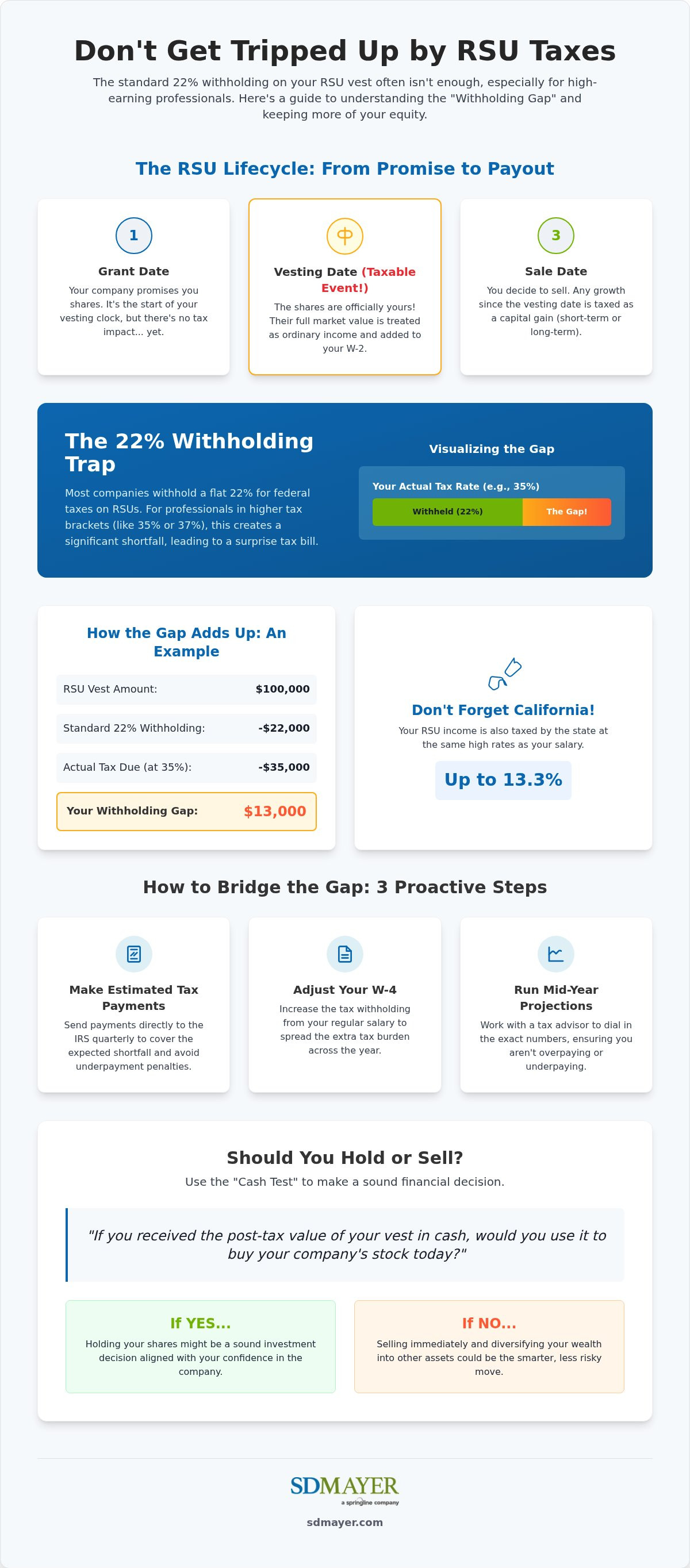
- Grant Date: This is when you receive the offer. While it's exciting to see the potential value, there is usually no tax impact on this day. It is simply the start of your vesting clock.
- Vesting Date: This is the most critical day for your taxes. The shares are now officially yours. Their total value on this day is added to your W-2 as ordinary income.
- Sale Date: Once you own the shares, you decide when to move to cash. The time between your vesting date and this date determines whether you'll pay extra taxes on any growth.
Ordinary Income vs. Capital Gains
When your shares vest, the price of the stock that day becomes your "cost basis." If the stock was $100 at vest, the IRS considers that you effectively bought it for $100 using your income. If you sell it later for $120, you only owe capital gains tax on that $20 increase. This distinction is where many people get confused and risk overpaying.
To keep more of your money, you have to watch the clock. If you sell within a year or less of vesting, you'll pay short-term capital gains at your high ordinary income rates. If you hold for at least 366 days, you qualify for long-term capital gains rates, which are significantly lower. Keeping these two tax buckets separate is vital for accurate tax planning for restricted stock units. Many professionals accidentally double-count their income because they don't realize the taxes were already partially handled at the moment of vesting.
The Withholding Trap: Why You Might Still Owe the IRS
Most tech companies use a flat 22% federal supplemental withholding rate when your shares vest. It sounds convenient. It feels like the problem is solved. But for most Bay Area professionals, this flat rate is far too low. If your total income puts you in the 32%, 35%, or 37% federal bracket, the math simply doesn't work in your favor. This discrepancy is the primary reason high earners end up with a massive tax bill in April despite having shares withheld by their employer.
You might wonder, "If my company withheld shares, why do I owe more?" It's because the payroll system doesn't look at your total annual income when your RSUs vest. It just applies that 22% baseline as if that's the only money you'll make all year. This creates a significant underpayment that you'll have to settle with the IRS later. Understanding these taxable events for RSUs is the first step in avoiding a painful surprise.
Calculating the "Withholding Gap"
Let's look at a common scenario to see how quickly the numbers can add up. Imagine you have a $100,000 vest and your total income puts you in the 35% federal tax bracket. Here is how that gap forms:
- RSU Vest Amount: $100,000
- Standard 22% Withholding: $22,000
- Actual Tax Due (at 35%): $35,000
- Your Withholding Gap: $13,000
Many people rely on the "Sell to Cover" method, but it's limited by that fixed percentage. Since 2026 tax brackets have shifted, your estimated tax needs might be higher than in previous years. Action Item: Take five minutes to check your 2026 tax bracket against your RSU vest schedule to see how wide your gap might be.
Proactive Fixes: Estimated Payments and W-4 Adjustments
You don't have to wait until April to fix this. One option is making quarterly estimated tax payments. This keeps you in the good graces of the IRS and helps you avoid underpayment penalties. This is a core part of effective tax planning for restricted stock units. Alternatively, you can increase the withholding on your base salary by adjusting your W-4. This spreads the extra tax across your regular paychecks throughout the year.
Every situation is unique, especially when you factor in California's high state taxes. The best path forward is working with a tax advisor to run mid-year projections. They can help you dial in the exact numbers so you aren't overpaying or underpaying. If you're feeling unsure about your current withholding strategy, reach out to a professional who understands the nuances of tech equity and can help you build a stable plan.
Strategic Selling: Should You Hold or Sell Your Shares?
Many professionals treat their company stock like a trophy. It's a symbol of their hard work and success. But if your salary, your bonus, and your future net worth are all tied to the same ticker symbol, you're facing significant concentration risk. If your company hits a rough patch, your entire financial life could stall at once. This is why the decision to hold or sell is the most critical part of tax planning for restricted stock units.
A simple way to frame this is the "Cash Test." Ask yourself: "If my company gave me a cash bonus of $50,000 today, would I immediately use every penny of it to buy company stock at its current price?" If the answer is no, then holding your vested RSUs is effectively making that same bet. Selling at vest is often the most tax-efficient move because your cost basis is the market price on that day. Selling immediately results in zero capital gain or loss, which keeps your tax situation clean and predictable.
Before your next vest date, use this 4-step checklist to decide your move:
- Assess your liquidity: Do you have a high-interest debt to pay off or an emergency fund that needs padding?
- Check your concentration: Does this one stock make up more than 10% to 15% of your total investable assets?
- Review your goals: Do you need cash for a San Francisco down payment or upcoming tuition within the next two years?
- Verify trading windows: Are you currently in a blackout period that prevents you from selling?
The Immediate Sale Strategy
This is the most conservative and logical path for many tech workers. By selling at vest, you lock in the exact value of your compensation. You eliminate the risk of a market downturn erasing your gains before you can spend them. You can then take those proceeds and reinvest them into a diversified portfolio. This shifts your strategy from "betting on one horse" to building a broad foundation for long-term wealth.
The Long-Term Hold Strategy
California takes a very different approach to your equity than the federal government does. While the IRS gives you a lower rate if you hold your shares for a year, the California Franchise Tax Board (FTB) doesn't offer a preferential rate for capital gains. In this state, your RSU gains are always taxed as ordinary income. When you combine the top federal rate of 37% with California's top rate of 13.3%, you could be handing over more than half of your vest to the government. It's a heavy lift that makes tax planning for restricted stock units a necessity for anyone working in the Silicon Valley ecosystem.
This high-tax environment is made even more challenging by the federal SALT (State and Local Tax) deduction limit. For 2026, that deduction remains capped at $10,000. For most Bay Area professionals, property taxes on a home in San Mateo or Marin County already exhaust that limit. This means you get zero federal tax benefit for the thousands of dollars you're paying in California income tax on your RSUs. This reality is why residents in San Francisco or San Jose often seek out strategic tax advice to find other ways to lower their overall taxable footprint.
Sourcing Income: What Happens if You Move?
Moving out of the Golden State doesn't always mean you're done with the FTB. California uses what's often called a "trailing nexus" rule. If you were granted RSUs while working in San Francisco but you move to a tax-free state like Texas or Washington before they vest, California will still claim its cut. They calculate this based on where you were physically located during the vesting period. If you worked in California for half of the time between the grant and the vest, they'll expect tax on 50% of that income.
Action Item: Keep a detailed log of your work locations, especially if you're a hybrid or remote worker. If you spend significant time working from a second home outside of California, those records are vital for accurately allocating your income and potentially reducing your state tax bill.
Planning for the 2026 SALT Landscape
Because the $10,000 SALT cap is still in place for 2026, high-income Californians are frequently pushed into the Alternative Minimum Tax (AMT). This secondary tax system can limit the effectiveness of certain deductions you might usually count on. To combat a high-income year caused by a large RSU vest, you might consider strategies like charitable giving. Contributing to a Donor Advised Fund in a high-vest year can provide a significant federal deduction that helps offset the heavy state tax burden. If you're ready to build a strategy that accounts for the unique "California tax" on your equity, get in touch with our team to start a conversation.
Holistic Planning: Integrating RSUs into Your Wealth Strategy
It's easy to get caught up in the technical details of vesting dates and withholding gaps. However, the real goal of tax planning for restricted stock units isn't just to satisfy the IRS; it's to fund the life you want to lead. Whether you're eyeing a piece of San Francisco real estate, planning for your children’s education, or charting a path to early retirement, your equity is the engine that gets you there. Moving from simple "stock management" to true wealth management means looking at how these shares interact with every other part of your financial world.
Working with an integrated firm like SD Mayer allows you to stop playing middleman between your tax preparer and your investment advisor. We coordinate your tax return with your brokerage strategy under one roof, ensuring that a decision to sell doesn't just make sense for your portfolio but also for your tax bracket. This shift from reactive questions to a comprehensive wealth plan is what separates those who simply earn well from those who build lasting security.
The Bay Area Tech Professional’s Roadmap
A successful strategy aligns your RSU vests with your broader retirement contributions. If a large vest pushes you into a higher bracket, you might maximize your 401(k) or IRA contributions to lower your taxable income. You can also use "tax-loss harvesting" to sell underperforming investments in your portfolio to offset the capital gains from your RSU sales. This keeps your total tax bill as lean as possible.
It is also vital to recognize that a FAANG employee has different needs than someone at a Series B growth-stage company. If your company isn't public yet, your wealth is on paper only. You need a strategy that accounts for liquidity events and potential lock-up periods. We help you navigate these nuances so you aren't left with a huge tax bill on shares you can't actually sell yet.
Estate Planning and Giving
If you're feeling philanthropic, gifting appreciated shares can be a powerful move. When you give shares directly to a charity or a family member in a lower tax bracket, you may avoid the capital gains tax entirely while still receiving a deduction for the full market value. Setting up a Donor-Advised Fund (DAF) is particularly effective during a high-income year, like when a multi-year RSU grant finally vests.
At SD Mayer, we act as your "first call" for these complex maneuvers. We understand the pace of the Bay Area economy and the specific challenges of tech equity. Our team is here to ensure that your equity compensation serves your long-term goals, providing the steady stewardship you need to navigate 2026 and beyond.
Taking Control of Your Equity Roadmap
Managing your RSUs shouldn't feel like a guessing game. By understanding the withholding gap and the unique tax landscape in California, you can move from reactive stress to proactive growth. Effective tax planning for restricted stock units ensures that your hard-earned shares actually fund your biggest goals instead of just covering a surprise IRS bill. Whether you choose to sell at vest or hold for long-term gains, every move should be part of a larger, intentional strategy.
At SD Mayer, we combine decades of deep roots in the San Francisco innovation economy with a modern, integrated approach to tax and wealth management. Recently named a Top 25 Fastest-Growing Firm in 2025 by Accounting Today, our team specializes in helping tech professionals navigate the exact complexities you're facing today. We act as your steady companion, coordinating your tax returns and brokerage accounts under one roof to simplify your financial life.
Ready to optimize your tech equity? Contact our Bay Area tax experts today. Your equity is a powerful tool for your future. We're here to help you use it with confidence and clarity.
Frequently Asked Questions
Do I pay taxes when my RSUs are granted or when they vest?
You don't owe any taxes on the day your RSUs are granted. The taxable event happens on your vesting date, which is when the shares are officially delivered to you. On that day, the total market value of the shares is treated as ordinary income. This amount appears on your W-2 just like your regular salary. This is the moment where proactive tax planning for restricted stock units becomes essential to avoid underpayment.
Why did my company sell some of my shares automatically when they vested?
Most companies use a "sell to cover" method to handle the mandatory tax withholding required by the IRS. When your shares vest, your employer automatically sells a portion of them, usually 22% for federal taxes plus state amounts, to pay the government on your behalf. While this covers part of the bill, it often isn't enough for high earners in San Francisco or Menlo Park who are in higher tax brackets.
What is the tax rate for RSUs in California for 2026?
California taxes RSUs as ordinary income at your marginal tax rate, which can reach up to 13.3% for the highest earners in 2026. Unlike federal rules, California does not offer a lower tax rate for long-term capital gains. This means you'll pay the same high rate whether you sell your shares immediately at vest or hold them for several years. It makes the state tax burden a primary focus for Sacramento and San Jose equity strategies.
Can I use an 83(b) election for my Restricted Stock Units?
No, you cannot make an 83(b) election for RSUs. This specific tax election is only available for Restricted Stock Awards or early-exercised stock options. Since RSUs are a promise to deliver shares in the future rather than a current grant of property, the IRS does not allow you to pay taxes early at the grant date. You must wait until the shares vest to settle your tax liability with the government.
How do I report RSU income on my tax return? Which forms do I need?
Your RSU income is primarily reported on your W-2 as part of your total wages. If you sell the shares later, you'll also need to file Form 8949 and Schedule D to report any capital gains or losses. It's vital to ensure your "cost basis" is reported correctly on these forms. Many brokerage firms report a $0 basis by default, which could lead to you paying taxes twice on the same income.
What happens if the stock price drops after my RSUs vest but before I sell?
If the stock price falls after your vesting date, you'll realize a capital loss when you eventually sell. You already paid ordinary income tax on the value of the shares at the time they vested. If you sell for less than that "vest price," you can use the loss to offset other capital gains. You can also deduct up to $3,000 of excess loss against your regular income each year on your federal return.
Should I sell my RSUs immediately to pay for the tax bill?
Selling at least enough shares to cover your actual tax liability is a common strategy to bridge the withholding gap. Since your company likely only withheld 22% for federal taxes, you might still owe a significant amount if you're in a 35% or 37% bracket. Selling immediately at vest helps you lock in the value needed to pay the IRS and the California Franchise Tax Board without risking a future price drop.
How does the SALT deduction cap affect my RSU tax planning in the Bay Area?
The $10,000 SALT cap significantly limits your ability to deduct the high state taxes you pay on RSU income. Since your property taxes in cities like San Mateo or Santa Rosa likely already hit that $10,000 limit, you won't get any federal tax relief for the California income tax withheld from your vest. This makes tax planning for restricted stock units even more critical as you look for other ways to reduce your taxable income.
SECURITIES AND ADVISORY DISCLOSURE:
Securities offered through Valmark Securities, Inc. Member FINRA, SIPC. Fee based planning offered through SDM Advisors, LLC. Third party money management offered through Valmark Advisers, Inc a SEC registered investment advisor. 130 Springside Drive, Suite 300, Akron, Ohio 44333-2431. 1-800-765-5201. SDM Advisors, LLC is a separate entity from Valmark Securities Inc. and Valmark Advisers, Inc. Form CRS Link
DISCLAIMER:
This material has been prepared for informational purposes only, and is not intended to provide, and should not be relied on for, accounting, legal or tax advice. The services of an appropriate professional should be sought regarding your individual situation.
HYPOTHETICAL DISCLOSURE:
The examples given are hypothetical and for illustrative purposes only.