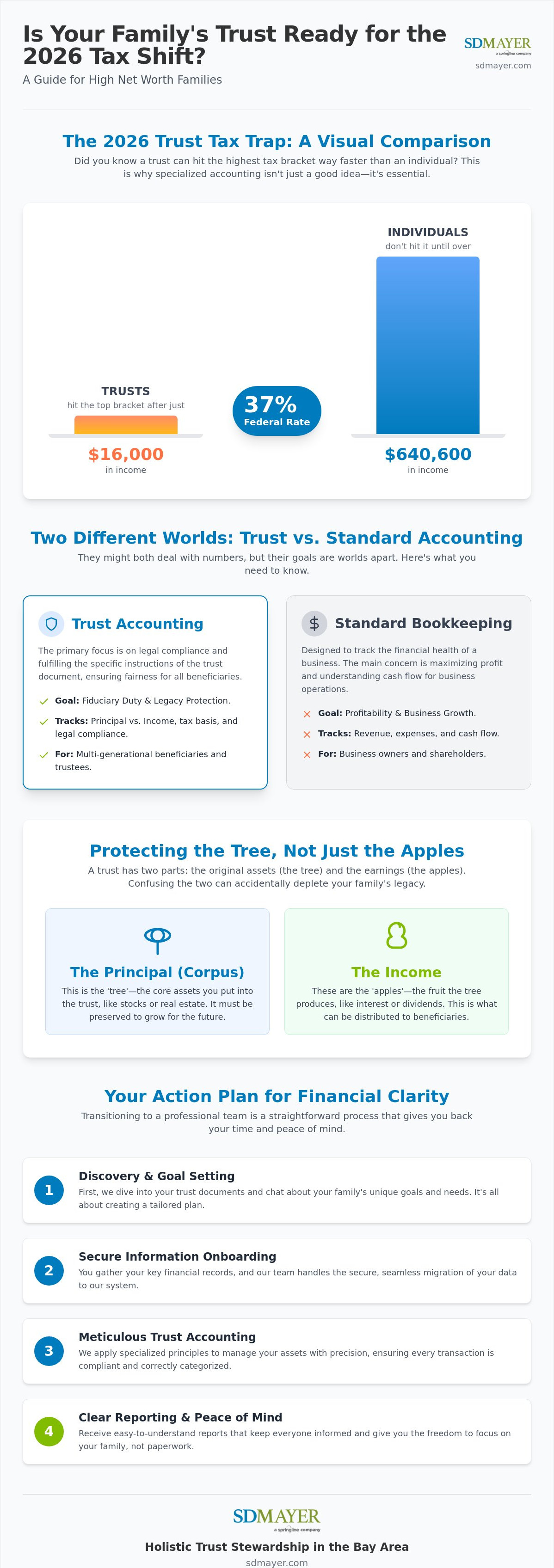
Did you know that in 2026, a trust hits the highest federal income tax bracket of 37% after earning just $16,000? Most individual taxpayers don't reach that same rate until their income climbs past $640,600. This massive gap is exactly why specialized trust accounting services for high net worth families are no longer just a luxury; they're a vital necessity for protecting what you've built. If you're managing disparate assets across multiple entities, you've likely felt the weight of these complex rules and the constant pressure to get every detail right.
We understand that the goal isn't just to move numbers around; it's to ensure your family's future remains secure and harmonious. It's common to feel anxious about potential beneficiary disputes or the nuances of IRS audits when the stakes are this high. This article will show you how dedicated trust accounting provides the financial clarity and peace of mind required for complex estates in the Bay Area. We'll explore how simplified reporting and strict fiduciary oversight can finally give you the freedom to focus on your family and philanthropic goals instead of endless paperwork.
Key Takeaways
- Learn how trust accounting differs from standard bookkeeping by focusing on legal compliance and the specific needs of your beneficiaries.
- Discover how specialized trust accounting services for high net worth families can simplify the management of tech stock options and multiple properties.
- Understand how professional oversight helps prevent family disagreements and keeps your estate in line with current tax laws.
- Get a practical plan for moving your financial records to a professional team so you can spend less time on paperwork and more time with family.
- See how a big-picture approach to your finances helps protect your legacy while preparing for future growth.
What are Trust Accounting Services for High Net Worth Families?
Trust accounting isn't just about keeping a ledger of what's in the bank. It's a specialized way of tracking every asset held within a fiduciary arrangement, from real estate and stocks to private equity and fine art. When you utilize trust accounting services for high net worth families, you aren't just hiring someone to record transactions. You're bringing in a team to ensure that every dollar is categorized exactly as the trust document requires. Standard bookkeeping often fails here because it doesn't account for the specific legal constraints that govern how trust assets must be managed.
Think of a trust like an apple tree. The tree itself is the "Principal," or the original assets you put into the trust. The apples that grow every season are the "Income," such as interest or dividends. In trust accounting, it's vital to keep these two separate. If you accidentally give away part of the tree when you only meant to share the fruit, you could unintentionally deplete the legacy you're trying to protect. This distinction is one of the most common points of confusion for families, yet it's the foundation of legal compliance and fair treatment for all beneficiaries.
Standard accounting methods usually fall short for trusts because they don't address these nuances:
- Document Compliance: Every trust has a unique set of rules that must be followed to the letter.
- Tax Basis Tracking: Keeping an accurate record of the original value of assets is crucial for future tax planning.
- Beneficiary Reporting: Providing clear, transparent updates that satisfy legal requirements and maintain family harmony.
The Role of a Fiduciary in Family Wealth
A fiduciary has a legal and ethical duty to act solely in the best interest of the beneficiaries. In the context of a wealthy family, this means being a steady, neutral hand. When an outside firm manages your accounting, they provide a level of transparency that helps prevent family friction. No one has to wonder if a distribution was fair or if the taxes were handled correctly. This clarity supports your broader Family Office goals by ensuring that the financial foundation is rock solid, allowing family members to focus on their relationships rather than debating line items.
Why the Bay Area Demands Specialized Expertise
Living and working in the San Francisco Bay Area adds layers of complexity to estate management. Between tech IPOs and high-value real estate, the assets held in local trusts are often highly concentrated and fast-moving. Using specialized trust accounting services for high net worth families in San Francisco or San Jose means your advisor understands that a sudden liquidity event from a startup isn't just a windfall; it's a complex accounting event. Our team integrates trust accounting with qualified small business stock (QSBS) strategies to maximize tax efficiency while staying compliant with California-specific reporting requirements.
Trust Accounting vs. Standard Bookkeeping: Key Differences
While standard bookkeeping focuses on the health of a business, trust accounting is strictly about compliance with a legal document. Business owners often care most about cash flow and profit margins. However, for a trustee, the priority is fulfilling a fiduciary duty. This means ensuring that every penny is spent or saved exactly as the trust creator intended. Specialized trust accounting services for high net worth families track more than just money in and money out. They monitor the tax basis of assets, which is critical when the 2026 federal estate tax exemption sits at $15 million per person. Knowing the original value versus the current fair market value can save your heirs millions in capital gains taxes later on.
Managing multi-generational beneficiaries also adds a layer of social complexity. You aren't just reporting to one owner; you're often reporting to children, grandchildren, and perhaps charitable organizations. Many trusts include specific HEMS standards, allowing distributions only for Health, Education, Maintenance, and Support. A standard bookkeeper might miss these nuances. A trust specialist ensures every distribution is documented to prove it met those specific requirements, protecting the trustee from potential legal disputes.
The Principal and Income Challenge
In the world of trusts, we talk about the corpus and the income. The corpus is the principal, the core body of assets you put into the trust. The income is what those assets earn, like interest or rent. If you misallocate a repair bill for a rental property to the principal instead of the income, you might be accidentally short-changing a beneficiary who is only entitled to earnings. These errors can lead to expensive legal disputes between family members. Action item: Take a moment to review your trust document for specific allocation rules to ensure your current reporting matches the legal requirements.
Reporting and Compliance Standards
Trusts have their own tax identity. This requires filing IRS Form 1041 and issuing K-1s to beneficiaries. Because trust tax brackets are so compressed, hitting the 37% rate at just $16,000 of income in 2026, accuracy is paramount. Standard tools like QuickBooks aren't built to handle these specific fiduciary reports. That's where CAAS (Client Accounting Advisory Services) becomes essential. It provides the high-level oversight needed when Navigating Complexities: Multi-Entity and Stock Option Integration. If you want to ensure your family's legacy is handled with this level of precision, you can schedule a conversation with our advisory team.
Navigating Complexities: Multi-Entity and Stock Option Integration
Living in San Francisco or San Jose means your wealth likely looks different from a family in the Midwest. In the Bay Area, portfolios are often tech-heavy and concentrated in a handful of high-performing stocks. While this leads to incredible growth, it also creates a massive accounting headache. Concentrated stock positions aren't just assets; they're tax puzzles that require constant attention. Trust accounting services for high net worth families must be agile enough to track these moving parts in real time. Your trust accountant acts as the central hub, coordinating between your wealth managers and tax planners to ensure that a sudden jump in stock price doesn't lead to an accidental tax disaster.
California residents also face unique hurdles with State and Local Tax (SALT) considerations. With the SALT deduction cap increased to $40,000 in 2026, every decision about when to sell or distribute assets from a trust carries more weight. We look at the big picture to see how these state-level taxes interact with your federal obligations. It's about more than just checking boxes; it's about proactive stewardship that anticipates how local wealth drivers like tech IPOs will impact your family’s bottom line.
Managing Multi-Entity Family Structures
Most high-net-worth families don't just have one bank account. Instead, your trust likely sits at the top of a complex web of LLCs, rental properties, and private equity stakes. Without consolidated reporting, it's nearly impossible to see your true financial position. You need a clear view of how cash moves between these entities to avoid "piercing the corporate veil" or triggering unintended tax events. Action item: Take thirty minutes this week to map out your family’s entity structure on paper. This simple exercise often reveals reporting gaps where money is moving without proper documentation.
To bridge these documentation gaps with modern technology, families often look to platforms like EmLedger and explore Tiered SaaS Subscriptions to implement a robust accounting software platform that can handle the diverse needs of their various holdings.
Stock Options and Trust Funding
Timing is everything when it comes to stock options. Deciding when to transfer options into a trust or when to exercise them within a fiduciary entity can change your tax bill by hundreds of thousands of dollars. Since trusts hit the top 37% tax bracket at just $16,000 of income in 2026, exercising a large block of options inside a trust requires a very specific strategy. Our tax strategy team works directly with our trust accountants to model these scenarios before you take action. We help you navigate the "One Big Beautiful Bill Act" (OBBBA) rules to ensure you're making the most of the current $15 million per person federal exemption while protecting your tech-driven legacy.
Action Plan: How to Transition to Professional Trust Accounting
Deciding to professionalize your family’s financial management is a significant step toward long-term stability. Most people wait until a major life event, like an inheritance or the sale of a business, to seek out trust accounting services for high net worth families. For entrepreneurs in the industrial sector, partnering with a growth specialist like Co-Advisor can ensure the company is performing at its peak long before it becomes an asset within a trust structure. However, the best time to start is while things are calm. By setting up these systems early, you reduce the administrative burden on family members and ensure that everyone is on the same page before a crisis hits. We act as a mentor through this process, guiding you through each stage so you don't feel overwhelmed by the transition.
Our goal is to move you from a state of reactive management to proactive stewardship. This means moving away from messy spreadsheets and toward a structured, professional system that provides total clarity for both trustees and beneficiaries. It's about giving you back your time so you can focus on your family's future instead of worrying about accounting entries. A smooth transition now prevents expensive legal and tax headaches later.
Step 1: The Trust Document Audit
The first step is to understand the specific rules of the game. Every trust has its own set of requirements for how often you must report to beneficiaries and what expenses can be paid from the trust assets. You'll need to gather all original trust instruments, including any amendments made over the years. Our team reviews these documents to identify the exact accounting standards you're legally required to meet. Action item: Start by creating a secure digital vault where all your legal and financial trust documents are stored in one place for easy access.
To ensure this vault and your other sensitive financial systems remain protected, professional technology consulting from Uptime Co. can provide the robust IT network administration required for high-net-worth families.
Step 2: Consolidating Financial Data
Once we know the rules, we need to gather the data. This involves connecting all your bank accounts, brokerage statements, and even alternative investment records like private equity or real estate holdings. We use specialized reporting platforms that offer real-time visibility into your assets. For trusts with a lot of activity, such as those holding several rental properties or active investment portfolios, outsourced bookkeeping is a game changer. It ensures that every transaction is categorized correctly the moment it happens, keeping your records audit-ready at all times. If you're ready to simplify your family's financial life, reach out to our team today to start your transition.
The SD Mayer Difference: Holistic Trust Stewardship in the Bay Area
Choosing a partner for your family's financial future is a deeply personal decision. While global firms offer scale, they often lack the local agility and personal touch that a regional specialist provides. At SD Mayer, we've built our reputation on being more than just accountants. We act as a holistic mentor for families throughout the San Francisco Bay Area, ensuring that your trust accounting services for high net worth families are integrated seamlessly with your broader wealth management and tax strategies. Whether you're dealing with the fallout of a tech IPO or managing a portfolio of North Bay real estate, we understand the specific economic drivers that shape your life.
Our approach moves beyond simple number-crunching to provide a big-picture view of your financial health. We integrate our CAAS (Client Accounting Advisory Services) with specialized tax planning to ensure your trust isn't just compliant, but optimized for the future. We know that the stakes are high, especially with the 2026 federal estate tax exemption at $15 million per person. Our goal is to reduce the stress of complex compliance by projecting an image of calm, capable stewardship. We speak your language, not the language of the IRS, and we're here to help you make sense of the "One Big Beautiful Bill Act" (OBBBA) and other shifting regulations.
A Partnership Built on Stability and Trust
We don't just look at this year's tax return; we look at the next fifty years of your family's growth. Our advisors take a forward-thinking strategist approach to anticipate needs before they become problems. This mindset is vital for maintaining family harmony across multiple generations. With local offices stretching from San Jose and San Francisco to Sacramento, we're always close by for a face-to-face meeting. We believe that stability is the foundation of trust. We're committed to being a steady companion through every stage of your personal and business journey.
Next Steps for Your Family Legacy
Professional oversight is about more than just numbers on a page. It's about the peace of mind that comes from knowing your fiduciary duties are met and your beneficiaries are informed. You've worked hard to build a legacy, and you deserve a partner who values it as much as you do. We invite you to join us for a no-jargon discovery call where we can discuss your specific situation in plain English. Action item: Before our call, jot down the three biggest questions you have about your current trust structure. This helps us focus on what matters most to you from the very first minute. There's no pressure and no complex technical talk, just a straightforward conversation about how we can help you protect what you've built. Contact SD Mayer to discuss your trust accounting needs.
Secure Your Family's Financial Future
Managing a complex estate in the Bay Area requires more than just keeping receipts. It's about bridging the gap between your legal trust documents and the daily financial reality of your assets. By now, you've seen how specialized trust accounting services for high net worth families go beyond standard bookkeeping to protect your legacy and prevent family disputes. Whether you're navigating concentrated tech stock options or managing a web of multi-generational entities, having a professional team ensures every detail aligns with your long-term vision.
At SD Mayer, we combine deep expertise in local tech wealth with a holistic approach that integrates accounting, tax strategy, and wealth management. With local offices across the San Francisco Bay Area, we're here to provide the personalized, supportive guidance you need to move forward with confidence. You've built an incredible legacy, and you don't have to manage the administrative burden alone. Let's work together to ensure your success stays protected for the generations to come.
Schedule a consultation with our Trust Accounting experts today.
Frequently Asked Questions
What is the difference between a trust accountant and a regular CPA?
A trust accountant focuses specifically on the fiduciary rules and legal requirements outlined in your trust document. While a regular CPA might handle your yearly income taxes or business profits, a trust specialist is responsible for the strict separation of principal and income. This specialized focus ensures you don't accidentally violate the terms of the trust, which helps prevent legal disputes with beneficiaries or issues with the IRS.
How often should our family receive trust accounting reports?
Most families receive formal reports on a quarterly or annual basis, though the exact frequency often depends on the activity level of your assets. If your trust holds active real estate or frequent stock trades, more frequent reporting is usually better. We provide real-time visibility through our digital platforms, so you can check your current financial position whenever you need to without waiting for a month-end statement.
Can trust accounting help reduce our family’s tax liability?
Yes, professional trust accounting is a powerful tool for minimizing taxes by managing how and when income is distributed. In 2026, trusts hit the highest 37% tax bracket after earning just $16,000 in income. We use trust accounting services for high net worth families to identify opportunities to distribute that income to beneficiaries who may be in lower tax brackets, significantly reducing the overall tax bill for the family estate.
What happens if a trust is not properly accounted for?
Poor accounting often leads to expensive beneficiary disputes, IRS audits, or even lawsuits for a breach of fiduciary duty. Without clear records, you also risk losing the protection that a trust provides against probate. In California, probate for a $1 million estate can cost between $40,000 and $70,000 in fees. Keeping precise, professional records is the only way to ensure your assets stay out of court and in the hands of your heirs.
Do we need trust accounting if we already have a wealth manager?
You absolutely need both because they serve two different but equally important functions. Your wealth manager is focused on the performance and growth of your investments. Our trust accounting services for high net worth families focus on the legal compliance, tax reporting, and fiduciary oversight required to keep the trust itself healthy. We work as partners with your wealth manager to ensure their investment decisions align with your trust's specific rules.
How does SD Mayer handle multi-generational family office needs?
We act as a stable, long-term partner by integrating our CAAS offerings with tax and wealth management strategies. This holistic approach allows us to manage complex structures involving multiple LLCs, properties, and tech-heavy portfolios. We focus on clear, transparent reporting so that every generation of your family understands the financial picture, which helps maintain harmony and ensures a smooth transition of wealth over time.
What documents do I need to start professional trust accounting services?
To get started, you'll need your original trust instrument and any legal amendments that have been made. We also require the last three years of trust tax returns (Form 1041) and current statements for all bank, brokerage, and alternative investment accounts. Providing these documents allows our team to perform an initial audit and build a clean, accurate reporting system that reflects your family's true financial position.
SECURITIES AND ADVISORY DISCLOSURE:
Securities offered through Valmark Securities, Inc. Member FINRA, SIPC. Fee based planning offered through SDM Advisors, LLC. Third party money management offered through Valmark Advisers, Inc a SEC registered investment advisor. 130 Springside Drive, Suite 300, Akron, Ohio 44333-2431. 1-800-765-5201. SDM Advisors, LLC is a separate entity from Valmark Securities Inc. and Valmark Advisers, Inc. Form CRS Link
DISCLAIMER:
This material has been prepared for informational purposes only, and is not intended to provide, and should not be relied on for, accounting, legal or tax advice. The services of an appropriate professional should be sought regarding your individual situation.
HYPOTHETICAL DISCLOSURE:
The examples given are hypothetical and for illustrative purposes only.