
A traceable grant record can make Single Audit preparation more manageable before fieldwork begins. For Walnut Creek nonprofits and schools, a single audit for government grants involves practical questions: which awards count, where supporting documents are stored, and how to prepare without pulling finance and program staff away from their work. These questions matter across Northern California and the Greater San Francisco Bay Area, where organizations may manage awards through multiple teams and systems.
Grant information often sits across departments, and award terms can affect what your organization needs to assess. A Single Audit has a specific purpose and scope, so understanding how it differs from other audit engagements is a useful first step.
This guide explains what a Single Audit addresses, which grant records and internal contacts to organize, and how to plan a practical next step. SD Mayer’s Audit & Assurance team conducts Single Audits and helps organizations coordinate grant-related information and prepare for the engagement. With a clear plan, your team can approach the process with greater confidence and less disruption.
Key Takeaways
- A grant alone doesn’t determine whether an organization needs a Single Audit. Review award terms, funder instructions, current requirements, and your organization’s circumstances.
- Connect each award’s approved purpose to program activity, accounting entries, and supporting documents so the grant record is easy to follow.
- For a single audit for government grants, Walnut Creek organizations can prepare by gathering award documents, organizing transaction support, and assigning finance and program contacts.
- Start readiness planning with the grant records your team already maintains. Identify gaps and assign clear owners before fieldwork.
- SD Mayer’s Audit & Assurance team can help plan the engagement and coordinate communication about scope and grant records.
What a Single Audit for Government Grants Is, and What It Helps Clarify
A government grant can bring valuable funding and new reporting responsibilities. For a mid-sized nonprofit, school, or other organization in Walnut Creek, understanding the audit’s purpose is a useful first step toward identifying the records and people involved.
A Single Audit combines an audit of an organization’s financial statements with work addressing internal controls and compliance related to applicable federal awards. It has a more specific scope than a general financial review. The work considers how the organization reports its finances, relevant controls, and whether it followed applicable requirements for federal award programs.
What does a Single Audit examine?
The financial-statement portion looks at the organization’s financial reporting as a whole. Related internal-control considerations help clarify how the organization manages and records financial activity. The compliance portion addresses requirements that apply to federal awards included in the audit. The specific work depends on the organization’s circumstances and the awards involved, so receiving a grant does not automatically mean every recipient has the same audit scope.
For example, finance staff may need to connect a grant’s spending records with accounting entries and the award’s terms. The audit brings those pieces into view. It isn’t simply a review of whether the organization received funding or spent it. It considers relevant reporting, controls, and award compliance together. The Single Audit requirements overview offers background on the process. Check applicable authoritative guidance for current requirements.
Who should assess whether grant requirements apply?
Start with your finance lead, controller, or CFO, and involve the program staff who manage the funded work. Review the award documents and funder instructions together, then identify how the funding reached your organization. Direct federal awards and federal funds passed through a state or local agency may raise different questions. The funding source, award terms, current guidance, and your organization’s circumstances all matter.
Receiving a grant alone doesn’t establish whether your organization must undergo a Single Audit. Have the finance team assess applicable requirements and verify current rules and thresholds through authoritative federal guidance. Keep a brief record of the documents reviewed, open questions, and who will follow up. This gives leadership a clearer basis for planning without treating a general explanation as an organization-specific determination.
Walnut Creek’s published audit information can provide local context for terms such as financial statements, controls, and compliance. It describes public-sector reporting, not a rule that applies to every grant recipient. Use it to understand the language, then assess your own award documents and circumstances. That distinction is especially helpful when planning a single audit for government grants Walnut Creek organizations may need to evaluate.
How a Government-Grant Single Audit Connects Funding, Controls, and Reporting
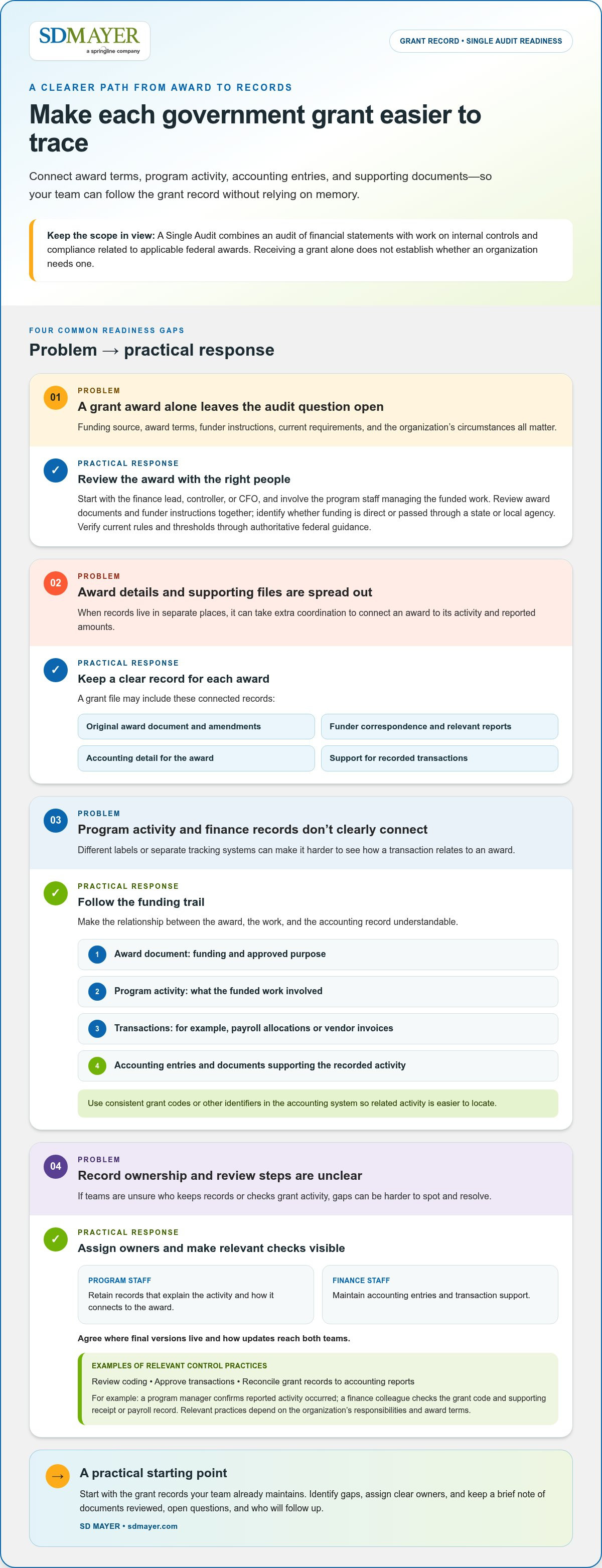
To understand grant reporting, follow the funding trail from the award document to the organization’s records. The award describes the funding and its approved purpose. Program activity then generates transactions, such as payroll allocations or vendor invoices, which finance records and supports with documentation. A reviewer should be able to follow how those pieces connect, while the organization checks its reporting against the requirements that apply to the award.
This connection matters for mid-sized organizations where program staff manage grant activity and finance staff maintain accounting records. If each team uses different labels or stores files separately, confirming how a transaction relates to an award can take extra coordination. Consistent tracking gives both teams a shared way to identify activity and resolve questions.
Build a traceable record for each government grant
Keep a clear set of records for each award. This may include the original award document, amendments, funder correspondence, relevant reports, accounting detail, and support for recorded transactions. Use consistent grant codes or other identifiers in the accounting system so finance staff can locate related activity without relying on memory or one person’s spreadsheet.
Assign ownership, too. Program staff can retain records that explain the activity and its connection to the award, while finance staff maintain accounting entries and transaction support. Agree on where final versions live and how updates reach both teams. The goal isn’t to create duplicate files. It’s to make the relationship between award terms, program activity, and recorded amounts understandable.
Connect internal controls with grant reporting
Controls are the organization’s processes for making sure grant activity is accurate, appropriately authorized, and documented. Depending on the organization and award, these may include reviewing coding, approving transactions, or reconciling grant records to accounting reports. Assess these practices against your actual responsibilities rather than treating them as a universal checklist. Applicable award terms and current federal guidance shape what is relevant. The Uniform Guidance Subpart F audit requirements provide the federal framework for Single Audits.
For example, a program manager may confirm that a reported activity occurred, while a finance colleague checks that the related transaction is recorded to the right grant code and supported by a receipt or payroll record. Clear responsibilities help reduce gaps. Periodic reconciliations can also help identify differences between program tracking and accounting records before reporting is assembled.
A clear audit trail turns grant activity into records your team can explain and locate, making audit preparation more efficient. For a single audit for government grants, Walnut Creek organizations can start by selecting one active award and tracing a transaction from the award terms through its supporting records. Note where the trail is easy to follow and where ownership or documentation needs attention. SD Mayer’s Audit & Assurance team can help plan Single Audits. You can discuss grant audit planning with SD Mayer.
Does a Government Grant Mean Your Walnut Creek Organization Needs a Single Audit?
No. Receiving a government grant alone doesn’t determine whether your organization needs a Single Audit. The answer depends on applicable requirements and your organization’s circumstances, including the type and amount of federal awards expended during the fiscal year. Funding passed through a state or local agency may still be federal funding, so don’t decide based only on who sent the payment.
For fiscal years beginning on or after October 1, 2024, current Uniform Guidance sets the general federal Single Audit trigger at $1,000,000 or more in federal awards expended during the fiscal year. The rules may differ for earlier fiscal periods. Treat this figure as a starting point, not a conclusion. Check current federal guidance and your award terms before deciding how the rules apply to your organization.
Which information helps determine the right audit scope?
Bring the finance lead and relevant program staff together to review award notices, grant agreements, amendments, and funder reporting instructions. Identify the legal entity that received each award and how related activity appears in its accounting records. List uncertainties, such as whether funding is federal or whether an award instruction calls for particular reporting, and resolve them against current authoritative guidance.
For a mid-sized organization with multiple programs, a simple award inventory can help. Record the recipient entity, funding source, applicable period, and where related transactions are tracked. Include direct federal awards and federal funds passed through another agency in the review. This gives your finance team a clearer picture to assess, rather than relying on grant labels or individual recollections.
How is a Single Audit different from other engagements?
A Single Audit includes financial-statement reporting and work on internal controls and compliance related to applicable federal awards. A financial statement audit focuses on the organization’s financial statements. A review provides a different, narrower level of assurance. Agreed-upon procedures address specific procedures and findings agreed for an engagement. These engagements serve different purposes, and a review or agreed-upon procedures engagement doesn’t automatically replace a Single Audit if one is required.
Keep the engagement’s purpose clear before scheduling work. Compare what the funder requires with the work your organization is considering, and document the reason for that scope. Broader financial reporting compliance services in the Bay Area can provide context, but your award and applicable requirements should guide the decision.
If your review indicates that a Single Audit applies, submit the completed reporting package through the Federal Audit Clearinghouse. For a single audit for government grants, Walnut Creek organizations can first confirm the recipient entity, funding sources, fiscal period, and current requirements. Then record open questions and assign someone to follow up before setting the engagement scope.
How to Prepare Grant Records for a Walnut Creek Single Audit
Preparation is easier to manage when finance and program staff share ownership of clear, manageable steps. A mid-sized organization doesn’t need to begin by gathering every file it has. Start with the awards, identify the related records, organize the information, and assign people who can answer questions.
Organize award, accounting, and program documentation
- Start with the award file. Gather grant agreements, award notices, amendments, funder instructions, reporting records, and relevant correspondence. Use these documents to identify the funded period, approved purpose, and reporting expectations.
- Locate the related accounting records. Pull grant-tracking schedules, transaction details, reconciliations, and support such as invoices or payroll records. Keep a clear link between each record and the grant activity it supports.
- Check for gaps and inconsistencies. Compare the grant schedule with accounting records and program reports. Note missing documents, unclear descriptions, or amounts that need follow-up. Assign an owner and track the question until it’s resolved.
- Agree on one working structure. Use a shared, access-controlled location or agreed file index so staff can find current records without searching through separate inboxes or folders. Record where final documents live and how updates are saved.
- Assign audit contacts. Name a finance contact who can explain accounting records and a program contact who understands the funded activity. Give each a backup and clarify who coordinates requests and responses.
A compact document map can help everyone know where to start:
| Record type | Likely owner | Retrieval location |
|---|---|---|
| Award notice, agreement, amendments | Program lead or grants manager | Grant file or shared document system |
| Funder correspondence and reports | Program lead | Grant correspondence and reporting folder |
| Transaction detail and supporting documents | Finance team | Accounting system and linked support folder |
| Grant schedule and reconciliations | Controller or finance lead | Period-end workpapers or grant tracking file |
Prepare people and timelines for fieldwork
Before fieldwork, agree on how requests will be received, who will coordinate responses, and where completed documents will be placed. Build an internal work plan around existing reporting and program responsibilities so staff can see what’s needed and when. A short weekly check-in can surface delays early without adding a complicated process.
If routine accounting support would help your team maintain organized records throughout the year, explore SD Mayer’s Outsourced & Managed Services, including Client Accounting & Advisory Services (CAAS). For a single audit for government grants, Walnut Creek organizations can work with SD Mayer’s Audit & Assurance team to plan the engagement and coordinate record gathering. Discuss your Single Audit preparation with SD Mayer.
Plan Your Walnut Creek Government-Grant Single Audit with SD Mayer
A well-planned engagement starts with a shared understanding of what needs to be addressed, which records are available, and who can explain them. SD Mayer’s Audit & Assurance team conducts Single Audits and works with organizations to plan the engagement around grant activity and reporting needs. For organizations in Walnut Creek and across the Northern California and Greater San Francisco Bay Area, a clear scope and assigned responsibilities make preparation easier to coordinate. SD Mayer also offers fully remote capabilities.
What to bring to an initial audit-planning conversation
You don’t need to have every question answered before planning begins. A useful first conversation can focus on what your organization knows, where information sits, and what needs clarification. Bring a concise overview of the funding and reporting picture, along with the people best placed to explain it.
- Grant sources: Summarize the awards, funding sources, periods, and entities that received the funds.
- Reporting obligations: Gather award notices, agreements, amendments, and funder instructions that describe reporting expectations.
- Internal contacts: Identify finance staff who understand the records and program staff who can explain grant activity.
- Documentation challenges: Note missing records, inconsistent tracking, or information that’s difficult to retrieve.
- Current reporting process: Describe how your organization prepares financial reports and connects grant activity to its accounting records.
These details help frame a practical discussion about engagement scope, preparation, and clear responsibilities. They also help distinguish what is already organized from what may need attention before fieldwork.
Coordinate audit needs with wider financial reporting
Grant reporting sits within your organization’s broader financial picture. An engagement plan can take into account how grant records relate to financial statements and existing reporting processes, while keeping the Single Audit’s scope tied to applicable requirements. Clear communication helps staff understand which information is needed, who will provide it, and how questions will be handled.
SD Mayer uses a technology-driven approach to support its work with organizations. The focus is on coordinating information and communication around your engagement while helping your team maintain its finance and program responsibilities. For mid-sized organizations, defining points of contact and agreeing on a realistic work plan can help contain interruptions and keep requests moving.
If your team also wants to strengthen its ongoing accounting processes, Client Accounting & Advisory Services (CAAS) may be relevant alongside audit planning. Bring your grant overview, reporting materials, and open questions into a focused conversation. Contact SD Mayer to discuss your Single Audit and plan a coordinated approach with the Audit & Assurance team.
Make Grant Readiness Part of Your Next Planning Cycle
Your next step can be small and practical: choose one award, name the person responsible for its records, and note open questions about reporting or audit scope. That starting point can help your team build a steadier process over time instead of treating preparation as a last-minute project. For a single audit for government grants, Walnut Creek organizations can use early coordination to give leadership a clearer view of what needs attention and who will handle it.
SD Mayer’s Audit & Assurance team conducts Single Audits for nonprofits, schools, and private businesses. Bring your current questions and grant information to a planning conversation, then map out a thoughtful next step with the team.
Contact SD Mayer to plan your Single Audit. Start with your award documents, a list of open questions, and the staff who manage the related records.
Frequently Asked Questions
Does receiving a government grant automatically require a Single Audit?
No. Receiving a grant alone doesn’t decide whether a Single Audit applies. Your finance team should identify which funds are federal, when they were expended, which legal entity received them, and what the award documents say. A payment passed through a state or local agency may still be federal funding. Compare the full funding picture with current authoritative guidance before deciding what audit work may be required.
What does a Single Audit cover for a government grant recipient?
It covers financial-statement reporting, relevant internal controls, and compliance with requirements applicable to federal awards in scope. The practical question for your team is how the audit work relates to your programs and records, not whether every grant receives identical attention. Ask which award periods and records are relevant, and identify a staff contact who can explain unusual transactions, reporting decisions, or changes in how a program operated.
What records should we organize before a Single Audit?
Along with award and accounting files, prepare a simple index that shows each document’s name, period, storage location, and internal owner. Include notes that explain adjustments or allocation methods that might not be obvious from a transaction listing alone. Before sharing files, check that staff can open them and that the versions are current. This access check can prevent avoidable delays once information requests begin.
How is a Single Audit different from a financial statement audit?
A financial statement audit focuses on the organization’s financial statements, while a Single Audit also addresses applicable federal award compliance and related internal controls. A funder may request other reporting, but that request doesn’t by itself establish that a separate engagement fulfills federal audit requirements. Write down what each engagement is intended to cover, then compare that scope with your award terms and current guidance before relying on one in place of another.
Can a nonprofit in Walnut Creek be subject to a Single Audit?
Yes. Nonprofit status and location in Walnut Creek don’t, on their own, determine whether a Single Audit applies. The organization’s federal award activity, fiscal period, funding structure, and applicable requirements matter. A single audit for government grants Walnut Creek nonprofits receive should be assessed using the records of the entity that received and expended the funds, along with current authoritative guidance. Keep that assessment separate from any other audit obligations that may apply.
How can a mid-sized organization reduce disruption during Single Audit preparation?
Set up one point of contact to coordinate requests, route questions to the right staff, and track what has been provided. Group document requests by program or reporting area, and plan staff time around key finance and program responsibilities. If a request depends on information from another team, name that owner early. This keeps the work visible and helps prevent multiple people from searching for the same record.
When should we contact an auditor about a government-grant Single Audit?
Start the conversation when you’re assessing whether requirements apply, especially if funding sources are unclear, grants pass through other agencies, or records are held across teams. Early planning gives you room to discuss scope and organize responsibilities before fieldwork. SD Mayer provides Single Audits through Audit & Assurance. Contact SD Mayer to discuss your Single Audit and the information your organization should prepare.
SECURITIES AND ADVISORY DISCLOSURE:
Securities offered through Valmark Securities, Inc. Member FINRA, SIPC. Fee based planning offered through SDM Advisors, LLC. Third party money management offered through Valmark Advisers, Inc a SEC registered investment advisor. 130 Springside Drive, Suite 300, Akron, Ohio 44333-2431. 1-800-765-5201. SDM Advisors, LLC is a separate entity from Valmark Securities Inc. and Valmark Advisers, Inc. Form CRS Link
DISCLAIMER:
This material has been prepared for informational purposes only, and is not intended to provide, and should not be relied on for, accounting, legal or tax advice. The services of an appropriate professional should be sought regarding your individual situation.
HYPOTHETICAL DISCLOSURE:
The examples given are hypothetical and for illustrative purposes only.