An employee benefit plan audit in San Jose is required annually for a 401(k) plan with at least 100 eligible participants at the beginning of the plan year. The audit examines more than investment statements: it can test participant eligibility and data, contributions, account allocations, loans, distributions, compliance, and the timeliness of contribution remittances. The specific filing category matters, too, because it affects whether audited financial statements must accompany Form 5500.
It’s understandable to focus first on the audit threshold and filing deadline. But knowing what auditors examine and preparing the right records can make the process more orderly and help surface issues such as contribution or participant-data errors.
This guide explains what an employee benefit plan audit covers, how filing status and the 80-120 rule affect audit requirements, and what to organize before fieldwork begins. You’ll also see how coordination with plan administrators and an experienced audit team can support a smoother process for your business.
Key Takeaways
- Use the plan’s participant count and prior-year filing category to understand whether the 80-120 rule may apply; a plan in its initial year can’t use that election.
- For the small-plan audit waiver, at least 95% of assets must be qualifying plan assets as of the last day of the preceding plan year, unless persons handling nonqualifying assets are bonded for at least their value, according to the U.S. Department of Labor.
- Build an audit file with plan documents and amendments, trust records, payroll and census data, and contribution, loan, and distribution records.
- Coordinate early with the third-party administrator to arrange access to plan records and keep audit preparation moving.
- Learn when SD Mayer’s employee benefit plan audit services may help your team address audit requirements and compliance questions.
What Does an Employee Benefit Plan Audit Cover?
San Jose CPA firms that specialize in employee benefit plan audits have dedicated retirement-plan practices, partner oversight, internal inspections, and staff training. The audit examines participant records, contributions, loans, distributions, and plan reporting.
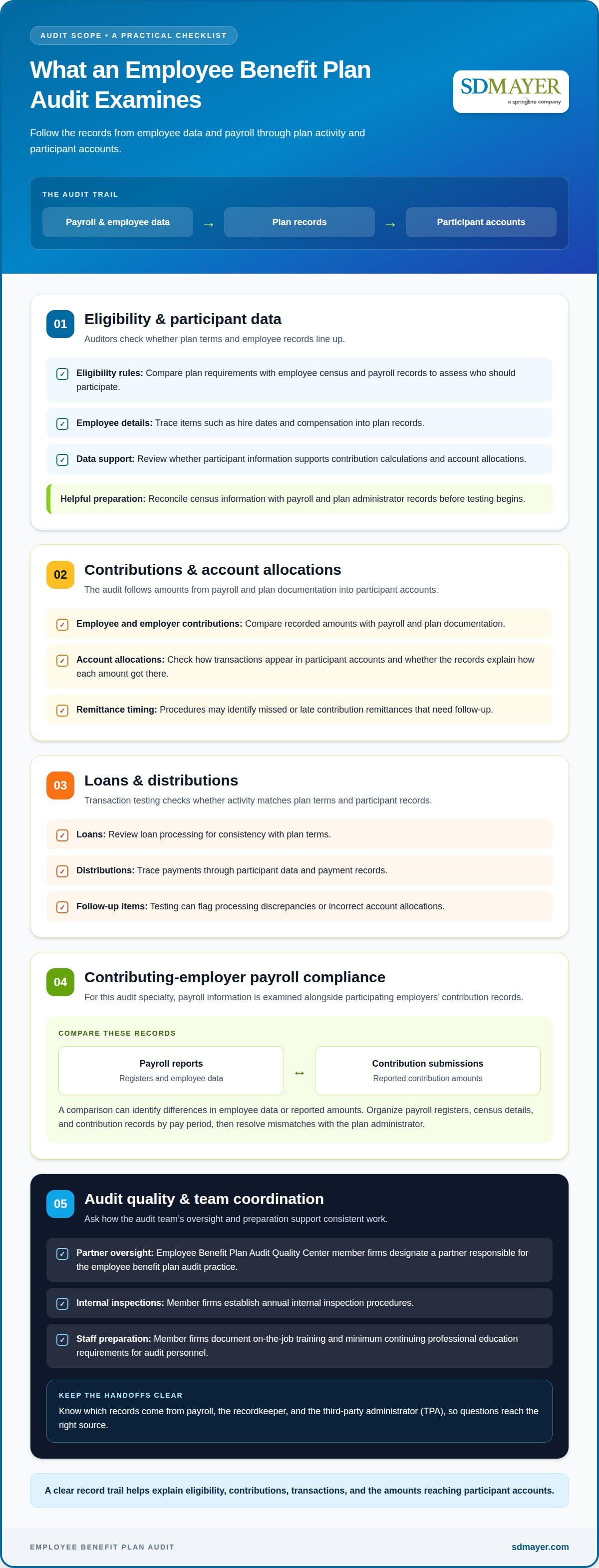
For a defined contribution plan, auditors examine how transactions flow into participant accounts. They compare plan terms with records for eligibility, payroll deductions, employer contributions, and account allocations. A clear trail from payroll data to plan records helps explain how each amount reached a participant’s account.
Eligibility and Participant Data Testing
Auditors compare plan eligibility rules with employee census and payroll records to assess who should participate. They may trace details such as hire dates and compensation into plan records, then review whether participant data supports contribution calculations and account allocations. Before testing begins, sponsors can reconcile census information with payroll and plan administrator records.
Transaction testing follows the money and the participant record. Auditors examine employee and employer contributions, comparing recorded amounts with payroll and plan documentation. They may review loan processing for consistency with plan terms, then trace distributions through participant data and payment records. These procedures can flag missed or late remittances, incorrect account allocations, or processing discrepancies that need follow-up.
Plan Audit Specialties
Defined contribution plan audits focus on participant-level balances and activity, including eligibility, contributions, loans, and distributions. The audit team evaluates how plan records support these activities and how transactions appear in participant accounts. Plan sponsors should know which records come from payroll, the recordkeeper, and the third-party administrator so questions reach the right source.
Contributing-employer payroll compliance audits examine payroll information alongside participating employers’ contribution records. For example, comparing payroll reports with contribution submissions can identify differences in employee data or reported amounts. Employers can support this work by organizing payroll registers, census details, and contribution records by pay period, then resolving mismatches with the plan administrator.
Audit quality also depends on firm-level controls. The Employee Benefit Plan Audit Quality Center requires member firms to designate a partner responsible for the employee benefit plan audit practice and establish annual internal inspection procedures. It also requires firms to document on-the-job training and minimum continuing professional education requirements for audit personnel. When assessing retirement-plan expertise, ask about partner oversight, inspection practices, and how staff training supports consistent audit work.
Form 5500 filing status and audit thresholds
Form 5500 summarizes a retirement plan’s financial status and must be filed accurately and on time. For an employee benefit plan audit in San Jose, the plan’s filing category and participant count help determine whether audited financial statements accompany the annual filing. Mid-sized employers can start by assigning one person to coordinate the filing calendar and connect payroll, accounting, and plan-administration teams.
The 100-participant rule generally requires an annual 401(k) audit when a plan has at least 100 eligible participants at the beginning of the plan year. A new plan with 100 participants on its inception date must attach audited financial statements to its large-plan filing. Count eligible participants using plan records and identify the date used for the count. This threshold helps a San Jose employer determine whether an employee benefit plan audit is required.
The 80-120 rule applies to plans with 80 to 120 participants at the beginning of the plan year. In plain terms, a plan in this range may choose the same Form 5500 category it used the prior year, if it filed Form 5500 for that year. A plan in its initial year cannot use this election because it has no prior-year filing. Compare the current count with the prior filing before selecting a category.
Small plans with fewer than 100 participants at the beginning of the plan year may qualify for an audit waiver under 29 CFR 2520.104-46. According to the U.S. Department of Labor, at least 95% of plan assets must be qualifying plan assets as of the last day of the preceding plan year, unless persons handling nonqualifying assets are bonded for at least their value. In practical terms, review which assets meet the waiver’s criteria and whether the required bonding applies to other assets.
Keep related reporting on the same calendar. If a plan has a separate Form 11-K filing obligation, track that filing alongside Form 5500 rather than treating it as the same report. Mid-sized employers can assign payroll to prepare participant and compensation information, accounting to reconcile financial records, and plan administration to coordinate plan data. One lead should monitor handoffs and open questions.
For 2026 Form 5500 filings, determine the due date from the plan-year calendar and identify the applicable extension process before the original deadline. If an employer has missed a filing or audit deadline, organize the outstanding records, establish the filing status, and move promptly to complete the required work. The Department of Labor can impose penalties on a plan sponsor for attaching an unsatisfactory audit to Form 5500.
Bring participant counts, the prior-year filing category, asset records, and audit status together in one calendar. For help coordinating audit work and filing preparation, discuss your plan’s audit and filing needs.
Set the filing deadline based on the plan-year calendar, and identify any applicable extension process before the original deadline.
Audit preparation and document collection
A well-organized audit file connects plan terms, accounting records, payroll data, and participant activity. Assign an owner to each record source, including the plan administrator and payroll team.
Audit Preparation Documents
Gather the plan document and amendments, trust agreement, most recent Form 5500, and meeting minutes. Add payroll and census data, plus contribution, distribution, and loan records. These materials help the audit team compare written plan terms with activity recorded for participants. Before the engagement begins, note who maintains each item and which period it covers.
- Plan records: plan document, amendments, and trust agreement.
- Filing and governance: most recent Form 5500 and meeting minutes.
- Participant activity: payroll and census data, contribution records, distribution records, and loan files.
Use a document index to mark each item as collected, pending, or needing explanation. For example, if meeting minutes refer to a plan change, pair them with the relevant amendment and note the effective period. This gives reviewers a clear path from the decision to the plan record.
Document Collection and Audit Records
Coordinate early with the third-party administrator to arrange access to plan records during audit planning. Confirm which files the administrator maintains and which come from internal accounting or payroll. A responsibility list helps prevent duplicate requests and shows where participant data, transaction details, and supporting records originate.
Organize records by source and transaction type, using consistent file names that identify the plan year and document purpose. Keep payroll reports separate from contribution submissions so differences can be traced without mixing records. Preserve original reports and label reconciliations or explanations as working documents.
Before sending files, compare key totals across sources. Match payroll deductions to contribution records, and check whether loan and distribution files include supporting transaction details. If totals differ, record the reason and who is responsible for resolving it. Clear explanations help the audit team focus follow-up on the discrepancy.
For mid-sized employers, assign a primary contact and backup for each record area. The contact can route questions to the right internal team, while the backup keeps requests moving during absences. Include the plan administrator in planning conversations so access and file formats are addressed before fieldwork.
Keep audit documentation complete and traceable by retaining the source file, reconciliation, and explanation together. A member or participant record should connect to the payroll or plan record that supports it. This disciplined approach supports audit quality and helps the team assess records against plan terms and applicable regulations.
Audit support to identify compliance issues
An employee benefit plan audit can reveal where plan operations differ from recorded procedures or plan terms. The audit team documents exceptions, links them to supporting records, and discusses their effect on the findings. Plan sponsors can then assign follow-up to the department responsible for payroll, administration, or participant records.
Common issues include eligibility errors, late or missed contribution remittances, inaccurate participant data, and mistakes in loan or distribution processing. A mismatch between payroll deductions and contribution records, for example, can point to a timing or reconciliation problem. A difference between an employee’s eligibility date and enrollment records can prompt a review of how plan rules were applied.
Use findings to guide a structured response. First, identify the affected record or procedure. Then trace it to its source, such as payroll, the plan administrator, or a participant account. Document the cause, correction, and any process change. This sequence helps plan sponsors distinguish a one-time record error from a recurring control gap.
- Eligibility: compare plan requirements with enrollment and employment records.
- Contributions: reconcile payroll deductions and employer contributions with plan records.
- Loans and distributions: trace processing records to participant account activity.
- Participant data: investigate inconsistent or incomplete records before they affect allocations.
Consider plan design and operating practices together. A written plan document describes the plan’s terms, while payroll and administration records show how those terms are carried out. If a sponsor is considering a design change, keep that discussion separate from audit testing. The audit evaluates records and procedures for the period under review; it does not redesign the plan.
Ask the audit team to explain each finding in practical terms: which record raised the issue, what procedure tested it, and what evidence supports the conclusion. The Employee Benefits Security Administration found that 30% of employee benefit plan audits it assessed failed to comply with generally accepted auditing standards. Clear documentation helps sponsors understand the work performed and respond to identified exceptions.
Quality controls matter, too. The Employee Benefit Plan Audit Quality Center requires member firms to designate a partner responsible for the practice and establish annual internal inspection procedures. It also requires documented on-the-job training and minimum continuing professional education for audit personnel. Plan sponsors can discuss how these controls support consistent audit services and how findings will be communicated during the engagement.
After receiving findings, assign an owner and track each corrective action to completion. Payroll can investigate a remittance discrepancy, for example, while the plan administrator reviews participant data or loan processing. Keep the resolution and supporting records together so the next review can trace the issue from identification through remediation.
Auditor independence and retirement-plan expertise
An independent auditor evaluates plan records without taking responsibility for the transactions being audited. For a retirement plan, that means the audit team should assess evidence objectively, explain its procedures, and report findings clearly. Plan sponsors can start by mapping who maintains accounting records, administers plan activity, and performs audit work.
Keep responsibilities clear. If internal accounting staff prepare contribution records, document that role and identify who reviews the work. If an administrator handles participant transactions, clarify how the auditor obtains and tests those records. Ask whether the audit team will evaluate its own work or make decisions that belong to plan management.
Retirement-plan audit expertise means understanding how plan terms, participant activity, and financial reporting connect. During an introductory meeting, ask the engagement team about its experience with plans similar in structure and operations. Ask how it handles record differences, communicates findings, and coordinates with plan administrators without taking on their responsibilities.
Retirement-plan administration and consulting differ from an independent audit. Administration involves operating plan processes, while consulting may help sponsors assess options or procedures. An auditor examines evidence and reaches conclusions within the engagement’s scope. Keeping these roles distinct helps sponsors know which team handles a question and who owns the underlying decision.
Quality information can guide your assessment. The Employee Benefits Security Administration concluded that audits performed by AICPA Employee Benefit Plan Audit Quality Center member firms had a significantly lower deficiency rate. Membership alone does not answer every question about an engagement, so discuss how the audit team applies its quality practices to your plan’s records and reporting needs.
Use a short agenda to make the auditor discussion practical:
- Identify the team members responsible for the engagement and their retirement-plan experience.
- Clarify which records come from internal accounting, plan administration, and other departments.
- Ask how the team documents procedures, communicates exceptions, and handles follow-up.
- Confirm that audit responsibilities remain distinct from plan administration and management decisions.
For mid-sized sponsors, clear ownership can make coordination more efficient without weakening the auditor’s independent role. Bring your questions about responsibilities, engagement scope, and plan-specific audit procedures to a conversation about retirement plan audit support.
SD Mayer: Client Accounting & Advisory Services (CAAS)
SD Mayer provides employee benefit plan audits for organizations preparing for an audit or addressing plan reporting needs. Its team helps sponsors understand the audit process, organize responsibilities, and work through questions about plan records and reporting.
For broader accounting needs, Client Accounting & Advisory Services (CAAS) and Outsourced CFO/Controllers can support financial operations alongside audit work. These services may suit a mid-sized organization seeking additional accounting or controller support, while keeping audit responsibilities distinct. SD Mayer also provides Single audits and Agreed-Upon audit procedures for other defined engagements.
If your plan is approaching an audit or your team needs help preparing, contact SD Mayer to discuss your needs.
Make the Next Audit a Stronger Planning Point
Use the next planning conversation to create a clearer rhythm for audit work. For an employee benefit plan audit in San Jose, identify who will coordinate the process, who owns each record area, and how questions will move between internal teams and the auditor. A simple open-items log keeps decisions, outstanding records, and follow-up responsibilities visible.
This groundwork can also help leadership connect plan oversight with broader financial operations. SD Mayer offers Client Accounting & Advisory Services (CAAS), Outsourced CFO/Controllers, and Single audits. Each addresses a different need, so focus the discussion on support that fits your organization’s priorities and the responsibilities you want to strengthen.
When you’re ready to discuss your plan’s audit needs and next steps, contact SD Mayer about your plan audit. A thoughtful plan can help your team approach the work with greater clarity and confidence.
Frequently Asked Questions
What is a 401(k) audit?
A 401(k) audit is an examination of a retirement plan’s financial information and operating records. The auditor gathers evidence to assess whether reported information is supported and whether plan activity is recorded consistently. For example, a sample transaction may be traced from a payroll record through the plan’s accounting records. The audit supports the plan’s reporting process; it doesn’t replace the sponsor’s responsibility for administering the plan.
How do you tell if you have over 100 eligible participants?
Count eligible participants at the beginning of the plan year, rather than counting only employees who made contributions. Start with the plan’s eligibility rules, then compare census or enrollment records with payroll and employment information. An employee’s eligibility status may be relevant to the count, even if they did not enroll. Record the date used and how you handled employees whose eligibility status changed near that date.
How does a year-round EBP audit team reduce the stress of my Form 5500 filing deadline?
A year-round team can spread planning and follow-up across the plan year instead of leaving every question until filing preparation. Set regular check-ins, assign record owners, and track unresolved items in one shared log. For example, a sponsor can ask payroll to resolve a contribution reconciliation before audit fieldwork. This helps surface delays earlier and gives the filing team a clearer view of open work.
What is a large plan?
A large plan is a Form 5500 reporting category that generally includes audited financial statements with the annual filing. Participant count helps determine the category, but plans near the threshold should also consider whether the 80-120 rule applies. That rule may allow a plan to retain its prior-year category if it filed Form 5500 that year. Keep the current count and prior filing available when reviewing classification.
Why do I need to check the auditor’s licenses and references?
Checking credentials and references helps assess whether an auditor has relevant experience and communicates clearly. Ask who will lead the engagement, what retirement-plan audit work they have handled, and how they explain findings to sponsors. References can describe the team’s organization, responsiveness, and coordination with plan administrators. Also discuss independence, including whether the auditor has responsibilities that could conflict with an objective evaluation of plan records.
When is an employee benefit plan audit required by the Department of Labor?
An annual 401(k) audit is generally required when the plan has at least 100 eligible participants at the beginning of the plan year. Some small plans with fewer than 100 may qualify for an audit waiver under 29 CFR 2520.104-46. According to the U.S. Department of Labor, the waiver’s asset test requires at least 95% qualifying plan assets at the preceding plan year’s end, subject to the bonding exception.
What does an employee benefit plan audit cover, and what are the audit steps?
An audit examines plan records and selected transactions to assess whether financial reporting is supported. Work typically begins with planning and understanding the plan, followed by record requests and testing. The auditor may select transactions, trace them to supporting documentation, and ask about exceptions. The sponsor then reviews findings and provides clarifications or corrections. Ask the engagement team how it will communicate open questions and organize follow-up before finalizing the filing.
How do I choose an ERISA plan auditor, and what credentials should I verify?
Choose an auditor with employee benefit plan experience, clear quality practices, and an approach that preserves independence. Ask who is responsible for the firm’s plan audit practice, how staff training is documented, and whether the firm participates in the Employee Benefit Plan Audit Quality Center. Verify credentials with the issuing organization and ask references about communication and follow-through. Compare the team’s answers with your plan’s structure and reporting needs.
SECURITIES AND ADVISORY DISCLOSURE:
Securities offered through Valmark Securities, Inc. Member FINRA, SIPC. Fee based planning offered through SDM Advisors, LLC. Third party money management offered through Valmark Advisers, Inc a SEC registered investment advisor. 130 Springside Drive, Suite 300, Akron, Ohio 44333-2431. 1-800-765-5201. SDM Advisors, LLC is a separate entity from Valmark Securities Inc. and Valmark Advisers, Inc. Form CRS Link
DISCLAIMER:
This material has been prepared for informational purposes only, and is not intended to provide, and should not be relied on for, accounting, legal or tax advice. The services of an appropriate professional should be sought regarding your individual situation.
HYPOTHETICAL DISCLOSURE:
The examples given are hypothetical and for illustrative purposes only.