
A remote workforce doesn’t make California pass-through tax decisions simpler; it makes the state and federal picture more important. Eligible S corporations and partnerships can elect to pay California tax at the entity level, which may create a federal deduction for the business and a California tax credit for participating owners. The IRS says the federal SALT deduction cap was temporarily raised to $40,000.
It’s understandable to want a clear answer about whether the election fits your company, especially when owners and employees have ties to multiple states. Partnering with a qualified SALT expert for remote companies in California from SD Mayer can help Northern California and Greater San Francisco Bay Area businesses assess eligibility, the election’s effects on federal and state taxes, and timing and owner-consent requirements.
This guide explains how California’s PTE election works, which businesses and owners may qualify, and how it interacts with the federal SALT cap and California tax credits. It also covers the considerations a mid-sized remote company should weigh when evaluating the election as part of its broader tax strategy.
Key Takeaways
- Check whether your business structure and owner participation fit California’s pass-through entity (PTE) election before weighing its tax effects.
- Track election deadlines and prepayment requirements, since missing a deadline can affect the available credit.
- Review federal and California tax treatment together: a federal deduction and a state credit affect different parts of your tax picture.
- Map where employees work and your business operates to spot where remote work may affect tax filing obligations.
- Review how income is sourced across states so your reporting reflects where work is performed and business activity occurs.
California pass-through entity (PTE) tax election
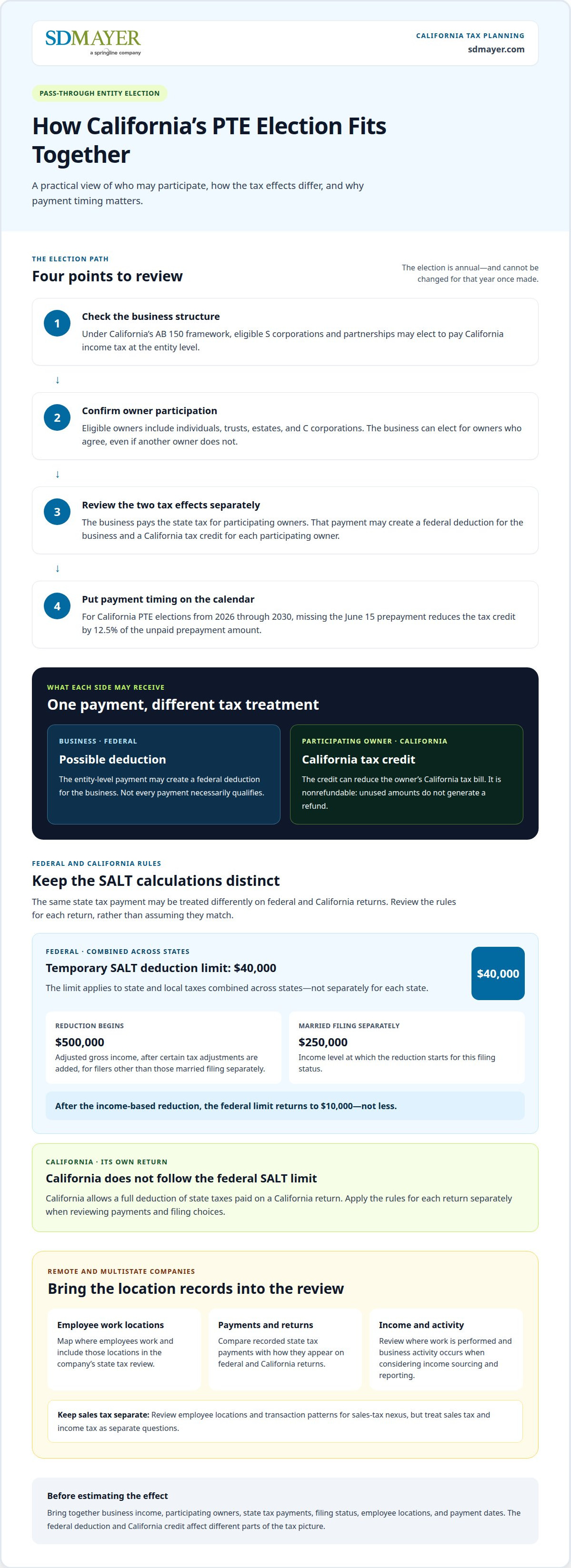
California’s pass-through entity elective tax lets eligible businesses pay California income tax for consenting owners. Under the AB 150 framework, S corporations and partnerships may use the election. The business pays the state tax directly instead of each participating owner paying that amount individually. This payment may create a federal deduction for the business and a California tax credit for each participating owner, which can reduce that owner’s California tax bill.
The election is made annually and cannot be changed for that year once made. Eligible owners include individuals, trusts, estates, and C corporations. A pass-through entity can elect for owners who agree, even if another owner does not. For California PTE elections from 2026 through 2030, missing the June 15 prepayment reduces the tax credit by 12.5% of the unpaid prepayment amount, according to the California Franchise Tax Board. Owner participation and payment timing are therefore important parts of the election plan.
The workaround may help address the federal SALT deduction limitation by allowing the business to pay qualifying state tax directly. However, not every payment qualifies for a federal deduction, and an owner may not be able to use a California credit immediately. The credit is nonrefundable: it can reduce California tax owed, but unused amounts do not generate a refund. Before making the election, model business income, participating owners, federal treatment, and the California credit.
A California SALT firm typically focuses on state tax planning and compliance across locations, while a CPA may handle accounting and tax reporting. A tax attorney addresses legal interpretation or disputes. The right professional depends on whether you need planning, filing support, or help with a legal dispute.
For California sales tax, a remote company’s nexus depends on its connections and sales activity in the state. Review employee locations and transaction patterns alongside the PTE analysis, but keep sales tax and income tax as separate questions.
For an audit, voluntary disclosure, or tax amnesty question, first determine whether the company has received a notice, filed an incomplete return, or has an unreported obligation. Those details help establish whether audit-response planning or voluntary-disclosure analysis is relevant. Don’t assume an amnesty option applies.
California SALT consultant pricing depends on the scope of work, the number of states involved, records, and compliance needs; fees are provided after a quote request. To find a qualified adviser, look for experience with pass-through elections, multistate returns, California credits for owners, and remote-work structures.
Noncompliance can leave a company with unresolved tax balances, filing exposure, and reduced credits. For example, a missed June 15 prepayment can reduce the California PTE credit under the 2026-through-2030 rule, so include payment dates in the company’s tax calendar.
How Federal and California Taxes Work Together
Federal and California tax returns may treat the same state tax payment differently. For mid-sized employers with employees in several states, review both sets of rules before estimating deductions and state tax costs. Track how each return treats payments, and bring the company’s records together for review.
Tax Rules for Remote Employees
When planning taxes for remote employees, consider where they work and how those locations affect state reporting. For a California employee working remotely, include the employee’s work location in the company’s state tax review. The federal limit on deducting state and local taxes applies to taxes across all states combined, not separately to each state. This matters when employees and owners have ties to several states, because payments in one state can affect the federal deduction for taxes paid elsewhere.
Tax Rules for Out-of-State Businesses
An out-of-state business should review California and federal tax rules separately when its operations involve California. California does not follow the federal limit on deducting state and local taxes, and allows a full deduction of state taxes paid on a California return. This difference can affect how the company prepares its California return and calculates its federal deduction. Include state tax payments and filing choices in a coordinated review.
The Internal Revenue Service says the One Big Beautiful Bill Act temporarily raised the federal limit on deducting state and local taxes to $40,000. The limit applies to state and local taxes combined across states, so a company with employees in several states shouldn’t review each state’s payments on their own. California may apply different rules on its own return. The federal and California figures therefore need separate treatment in the company’s tax planning.
Income can affect the federal deduction. For filers other than those married filing separately, the $40,000 limit begins to shrink when adjusted gross income, after certain tax adjustments are added, reaches $500,000. For those married filing separately, the reduction starts at $250,000. After this income-based reduction, the federal limit on deducting state and local taxes returns to $10,000, not less. Filing status and income are therefore important details in a multistate forecast.
For each tax period, compare the business’s recorded state tax payments with how those payments appear on its federal and California returns. This check can reveal differences before returns are finalized. For example, a company operating in California and another state must consider the combined federal limit alongside California’s separate return rules. Reporting depends on the applicable return and taxpayer circumstances, not just the company’s headquarters.
For a mid-sized company, check payroll location records, state tax payment records, and owner reporting before finalizing projections. A multistate SALT review can help bring these federal and California considerations into one planning process.
California Tax Rules for Remote and Out-of-State Businesses
For a remote company, California tax analysis starts with a map of its people, business activity, and income. An employee’s California work location can raise questions distinct from the company’s headquarters or state of incorporation. Keep income tax, sales tax, and payroll considerations separate, since each involves different business facts. This helps a mid-sized company identify specific issues for review rather than treating “California exposure” as one broad conclusion.
Start with the company’s operating picture. Record where employees work, where management makes decisions, and where customer-facing work takes place. Then organize revenue, expenses, and state filings by activity and location. These records help a tax adviser assess the company’s connections to California and the information supporting its reporting position. A remote employee’s address alone does not capture the business’s full tax picture.
Consider an out-of-state company that hires a California-based remote employee. It should evaluate the employee’s role, the work performed in California, and whether other business activities also connect the company to the state. A salesperson managing customer relationships may present a different operating profile from an employee performing internal support. These examples identify facts to assess, not automatic outcomes; the company’s complete activity matters.
Keep the review current as the business changes. A move into California, a new hire, a change in job duties, or a new sales channel can affect the facts behind an earlier analysis. For each change, update the employee’s location and role, the company’s activity description, and related state filings. A documented timeline links business decisions to tax-period reporting and supports consistent future reviews.
For a company operating in California and other states, organize the analysis around three questions:
- Which employees perform work in California, and what duties do they handle?
- What business activity, customers, and revenue are connected with California?
- Which state returns and tax categories reflect those activities?
These questions help distinguish a California employee’s individual tax situation from the employer’s business analysis. They also prevent sales tax issues from being confused with income tax questions. Provide your adviser with a current organization chart, employee work locations, role descriptions, revenue records, and prior state filings. Together, these materials support a fact-based review of California and other states.
For mid-sized remote businesses, a practical next step is to review the tax picture whenever hiring, work locations, or operations change. This can surface filing questions early and keep company records aligned with its actual footprint. Assess California alongside the other states where the business operates, rather than relying only on its registered address.
When does hiring a California remote employee create corporate tax nexus?
Corporate tax nexus means a business has enough connection with a state to potentially face its business tax filing or payment rules. Hiring a California-based remote employee puts that connection on the review agenda, but the hire alone does not resolve every corporate tax question. The employee’s work and the company’s other California activities matter. Reviewing these facts helps identify whether California filing or payment obligations need attention.
Begin with the employee’s actual role. Document where the person works, the services they perform, and how those services support the business. A California employee who negotiates sales or manages customers presents different facts from one who performs internal functions. These examples help frame the review; a job title alone does not settle the company’s tax position.
Next, consider the employee’s authority and connection to business activity. Record whether the employee communicates with customers, develops business relationships, makes decisions, or represents the company externally. Compare those duties with the company’s California operations and revenue records. If the company has several California-facing activities, assess them together instead of focusing only on the employee’s home address.
Corporate income tax, sales tax, and payroll tax are separate questions. The same employee may be relevant to more than one review, but each tax has its own rules. For example, customer-facing work may warrant attention in both business income and sales tax reviews, while internal work may raise different questions. Keep each analysis and its supporting records distinct.
For a mid-sized business, use a consistent review process whenever it hires or relocates a California employee:
- Save the employee’s work location, job description, and reporting structure.
- Describe customer, sales, management, and operational duties performed from California.
- Compare those facts with California revenue, property, and other business activities.
- Record which tax questions were considered and the reasons behind the filing position.
Repeat the review when duties or business operations change. A role that begins as internal support may later include customer outreach or decision-making. That shift can change the facts behind the company’s California tax analysis, even if the employee stays at the same address.
The practical trigger isn’t simply a California hire; it’s the company’s overall connection with California through its people and activities. Tax planning should consider employee duties, customer interactions, company operations, and existing state filings together. This gives the business a clearer basis for deciding whether its California connection requires further corporate tax action, while keeping sales and payroll reviews separate.
Hiring timelines may also shape planning: employers take about 43 days to close remote product specialist job openings in California, based on 149 listings analyzed from the prior year.
How does California decide where remote workers and multistate businesses pay tax?
Income sourcing means deciding which location income is connected to for tax purposes. For remote companies, employee wages and business income need separate reviews. A California-based employee and customers in other states present different facts to organize. Treating every receipt as California income, or none as California income, can obscure what each return requires.
For employee compensation, start with where the employee performs services and how the work is documented. A worker performing duties from a California home has a different work-location record from a colleague working elsewhere. Keep payroll location records, work schedules, job descriptions, and travel details together. These records give the tax preparer a factual basis for reviewing wages across relevant states.
Business income needs a separate review. Map the company’s revenue-producing activities, customer relationships, and operating functions by state. For example, a remote company might have a California employee, customers in several states, and managers working elsewhere. The employee’s wages and the business’s income are not interchangeable categories. Keep separate schedules for each and document how the company reached its reporting position.
Remote work can complicate the picture when duties cross state lines. An employee may work from California, travel for client work, and support accounts outside the state. A calendar of work locations and a description of services can clarify the facts. For a multistate business, customer billing addresses alone may not show where the underlying work or revenue-producing activity occurred.
A practical file for each tax period should bring together:
- Employee locations, job responsibilities, and work-related travel.
- Revenue by customer and the business activity associated with each account.
- Business functions and operating records tied to each state.
- Prior returns and the method used to report wages and business income.
Then compare the records with the company’s filings across states. If the business changes an employee’s role or moves a key function, update the review of where income is taxed for the affected period. For example, adding California-based customer support may change the facts relevant to the company’s income review, even if its customers remain spread across the country.
For mid-sized companies, consistent documentation matters as much as a clear method for dividing income among states. It helps explain why wages and business income appear differently across state returns and gives advisers a clearer basis for resolving mismatches. Discuss where your multistate income is taxed with a tax professional to align the records, income divisions, and reporting positions.
California businesses reviewing income across multiple states may also need to consider the passthrough entity tax election, a choice to have the business pay tax on certain income, separately from the review of where income is taxed. California businesses are advised to consider including the election in their governing agreements and obtaining annual consent from each owner and anyone whose jointly owned marital property includes an interest in the business. A California passthrough entity’s deduction for tax paid or accrued is paired with a California income tax credit for each owner’s share of tax paid, which cannot be refunded.
California's top state income tax rate is 13.3%. California's passthrough entity tax credit is limited to 9.3% of California tax on pass-through income when all requirements are met. California calendar-year businesses are advised to make the final passthrough entity tax payment by December 31 of the same tax year. Keeping election approvals, payment records, and credit calculations with the income review file can help preserve a clear record of how income and tax items were handled.
SD Mayer: State & Local Tax (SALT)
SD Mayer’s State & Local Tax (SALT) support helps remote and multistate businesses assess California tax questions alongside their wider operations. Turn to this service when employee locations, business activity, income sourcing, and state filings need to be considered together. For a mid-sized company, a change in workforce location or operating structure is a practical reason to revisit whether records and reporting align.
SD Mayer can also connect tax considerations with Client Accounting & Advisory Services (CAAS) or Outsourced CFO/Controllers when broader accounting and financial oversight is relevant. Bring employee locations, role descriptions, revenue records, and prior state filings to a discussion. Contact SD Mayer to discuss your company’s California and multistate tax needs.
Build a tax process that can adapt
Remote operations evolve as teams move, responsibilities shift, and business priorities change. Treat tax planning as an ongoing part of that growth, not a task reserved for filing season. A state and local tax (SALT) expert for remote companies in California can connect tax considerations with the company’s changing operating model, helping leadership make decisions with clearer financial context.
For mid-sized businesses, identify upcoming decisions that could affect tax reporting, such as hiring, restructuring, or entering new markets. Share those plans and current accounting records with the professionals supporting your tax and financial work. SD Mayer offers Client Accounting & Advisory Services (CAAS), Outsourced CFO/Controllers, and Single audits to support businesses across related financial needs.
Contact SD Mayer about California SALT to discuss how your company can approach its next stage with a more coordinated tax strategy.
Frequently Asked Questions
What does a SALT (state and local tax) expert do for remote companies?
A SALT expert helps a remote company assess state tax questions and coordinate its reporting approach across locations. For example, when a Northern California business expands beyond the San Francisco Bay Area, an adviser can review how the new operating footprint affects state tax processes and records. A SALT expert for remote companies in California can also help leadership align tax considerations with financial reporting and business plans.
What are California sales tax nexus rules for remote companies?
California sales tax nexus depends on a company’s connections and sales activity in the state. Review employee locations and transaction patterns separately from the PTE and income tax analysis.
SECURITIES AND ADVISORY DISCLOSURE:
Securities offered through Valmark Securities, Inc. Member FINRA, SIPC. Fee based planning offered through SDM Advisors, LLC. Third party money management offered through Valmark Advisers, Inc a SEC registered investment advisor. 130 Springside Drive, Suite 300, Akron, Ohio 44333-2431. 1-800-765-5201. SDM Advisors, LLC is a separate entity from Valmark Securities Inc. and Valmark Advisers, Inc. Form CRS Link
DISCLAIMER:
This material has been prepared for informational purposes only, and is not intended to provide, and should not be relied on for, accounting, legal or tax advice. The services of an appropriate professional should be sought regarding your individual situation.
HYPOTHETICAL DISCLOSURE:
The examples given are hypothetical and for illustrative purposes only.