
The qualified small business stock exclusion can eliminate up to 100% of eligible gain for stock issued after September 27, 2010, and on or before July 4, 2025, if it meets the five-year holding requirement. For shares issued on or after July 4, 2025, the exclusion can begin after three years, with the percentage depending on how long the shares are held. Qualified small business stock exclusion planning also means understanding the per-company limit and how it compares with ten times your stock’s cost basis.
It’s easy to focus on the headline exclusion percentage, but the amount you can actually exclude depends on more than that number. The issue date, holding period, eligibility rules, and per-taxpayer cap all shape the result. This article explains how Section 1202 works, what can disqualify shares, and how the exclusion limits and basis-based calculation affect your potential tax benefit.
Key Takeaways
- Start with the stock’s issue date and holding period: these determine which exclusion schedule may apply.
- Review how the shares were acquired, the corporation’s structure, and its business activity to assess eligibility.
- If considering a Section 1045 rollover, plan for the reinvestment deadline and understand how the replacement shares’ holding period is treated.
- Compare the per-issuer exclusion limit with the basis-based limit to see which may shape your potential benefit.
- Organize company and shareholder records early so the key eligibility and basis details are easier to evaluate before a sale.
What is the qualified small business stock gain exclusion, also known as Section 1202?
Section 1202 can let eligible noncorporate shareholders exclude some or all gain from qualifying small business stock. The applicable percentage depends on the stock’s issue date and holding period.
Stock Purchase and Holding Requirements
For Section 1202, a noncorporate taxpayer generally must acquire qualifying stock at original issuance, rather than on a secondary market. The taxpayer must receive it for money, property other than stock, or services provided to the corporation. The company must issue C corporation stock, and that status must continue for substantially all of the holding period. These details matter because buying shares later or tracking only the company’s formation date can miss the relevant stock-issuance date.
Holding Periods and Exclusion Percentages
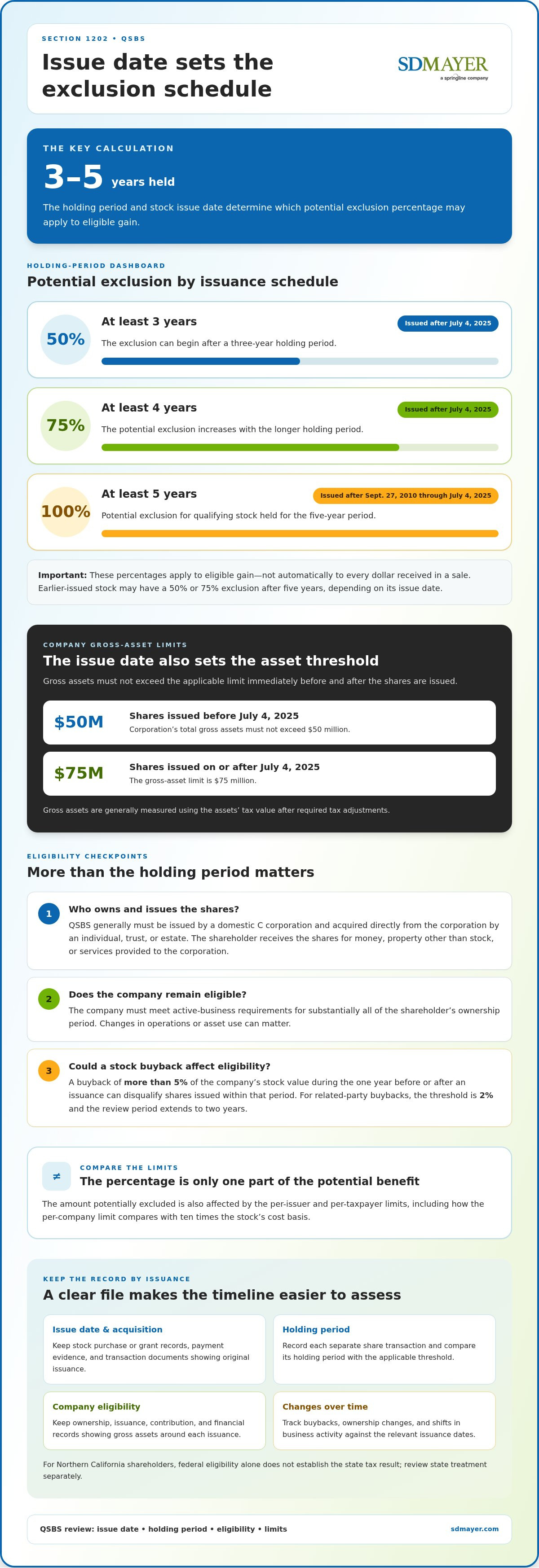
For qualifying stock issued after July 4, 2025, the exclusion phases in with the holding period: 50% after at least three years and 75% after at least four years. For stock issued after September 27, 2010, and on or before July 4, 2025, the potential exclusion is 100% after a five-year holding period. Earlier stock may qualify for a 50% or 75% exclusion, depending on its issuance date, after a five-year holding period. The issue date changes which timeline applies, so a sale date alone cannot determine the exclusion.
For example, a shareholder who sells qualifying stock issued in 2019 after holding it for more than five years may fall under the 100% exclusion schedule. A shareholder selling stock issued after July 4, 2025, instead needs to consider the three-year and four-year phase-in points. Those percentages apply to eligible gain, not automatically to every dollar received in a sale. The per-issuer and per-taxpayer limits also affect the amount potentially excluded.
Issuance and Holding-Period Documentation
Documentation should establish when shares were issued, how the shareholder acquired them, and how long they were held. Keep stock purchase or grant records, payment evidence, and transaction documents showing the original issuance date. If the business existed before an equity round, formation papers alone may not show when a particular shareholder acquired shares. These records connect the correct issue date to the applicable exclusion schedule.
For a practical review, organize the records by share issuance rather than treating all company stock as one block. If shares were acquired in separate transactions, record each transaction’s date and terms. Then compare each holding period with the applicable three-year, four-year, or five-year threshold. This gives shareholders and their tax advisers a clearer basis for assessing which gain may qualify under Section 1202.
What are the requirements for QSBS?
QSBS eligibility depends on who owns the shares, how the corporation issued them, and what the company does. Keep share-issuance and ownership records, and monitor company decisions that could affect eligibility or the potential tax benefit.
Common risks include exceeding the applicable asset limit, failing the active-business test, or making a stock buyback that affects eligibility. Organized company and shareholder records help demonstrate how the relevant requirements were met.
QSBS Eligibility Requirements
QSBS generally must be issued by a domestic C corporation and acquired directly from the corporation by an individual, trust, or estate. The shareholder must receive the shares for money, property other than stock, or services provided to the corporation. These conditions matter because an investment’s label or the company’s formation date alone doesn’t establish that the shares qualify.
The asset limit depends on when the shares were issued. For shares issued before July 4, 2025, the corporation’s total gross assets must not exceed $50 million immediately before and after issuance. For shares issued on or after July 4, 2025, the limit is $75 million. Gross assets are generally measured by the assets’ tax value after required tax adjustments.
Actions That Jeopardize QSBS Status
Company decisions after shares are issued can affect continued eligibility. The company must meet the active-business requirements for substantially all of the shareholder’s ownership period. In practical terms, it must continue using its assets in an eligible business. Changes in operations or asset use deserve attention, as do certain stock buybacks near an issuance.
A buyback of more than 5% of the value of the company’s stock during the one year before or after an issuance can disqualify shares issued within that period. For buybacks involving related parties, the threshold is 2%, and the review period extends to two years. Track planned buybacks against each share-issuance date instead of reviewing them only at year-end.
Documentation and Capitalization Records
Clear records connect each shareholder’s investment to the corporation’s status when the shares were issued. Keep the ownership list, share-issuance documents, payment or contribution records, and financial information showing gross assets immediately before and after each issuance. These documents help identify the asset limit that applies to each group of shares.
Congress passed H.R. 1, the One Big Beautiful Bill Act, in 2025, expanding QSBS eligibility; July 4, 2025, is the dividing date for the described rules. Keep each issue date clear to identify the relevant federal threshold and holding-period provisions. For Northern California shareholders, review state tax treatment separately, because federal eligibility alone doesn’t establish the state tax result.
For a practical review, group records by issuance and note buybacks, ownership changes, and shifts in business activity. Mid-sized companies can also retain regular financial records showing how they used their assets as operations changed. Together, these records provide a clearer history for assessing eligibility and explaining the company’s position if questions arise.
Section 1045 gain deferral and reinvestment
For a mid-sized company approaching a sale or ownership transition, Section 1045 can keep a stock sale from ending the shareholder’s QSBS investment timeline. It may defer gain when sale proceeds are reinvested in other QSBS. This is a different outcome from excluding eligible gain under Section 1202, so shareholders should compare both possibilities as part of the company’s liquidity planning.
The original shares generally must have been held for more than six months, and proceeds must be reinvested in other QSBS within 60 days. That short window can affect the company’s sale planning: the finance team should coordinate expected transaction dates with the shareholder’s reinvestment decisions. Before a sale closes, map the expected dates and identify how the proceeds and reinvestment will be documented.
Section 1045 defers eligible gain rather than permanently excluding it. Section 1202 may exclude eligible gain from federal tax when its requirements are met. The potential federal income tax savings from the Section 1202 exclusion can be as high as 23.8%. A shareholder weighing a business sale can compare the potential exclusion with a rollover’s deferral, considering the stock, the company’s eligibility, and the planned reinvestment.
Reinvestment still requires attention to the replacement shares. The new investment must qualify as QSBS under the applicable requirements. For a mid-sized business, this means evaluating the replacement company’s structure, assets, and business activity, not just its investment pitch. The One Big Beautiful Bill Act expanded QSBS eligibility in 2025, but that change does not remove the need to assess replacement stock under the rules that apply to it.
The replacement shares’ holding period includes the holding period of the original shares. Keep a record trail for both investments: original acquisition documents, sale records, proof of reinvestment, and replacement-stock records. A business owner coordinating a sale should also keep transaction dates aligned with shareholder records, so company reporting and individual tax information tell a consistent story.
Before agreeing to a sale timetable, shareholders and company finance leaders can map the six-month holding requirement and 60-day reinvestment period against the expected closing process. Then compare the Section 1202 exclusion and Section 1045 deferral based on eligibility, applicable limits, and whether a qualifying replacement investment can be completed in time. Planning these decisions alongside the company’s liquidity needs helps make the next steps clearer.
Eligible business structure and active-business test
Section 1202 eligibility depends on the company’s legal structure, its operations, and who owns the shares. Gifts, trusts, and transfers also raise ownership questions: individuals, trusts, and estates may qualify, but a transfer alone doesn’t guarantee eligibility or an additional exclusion limit.
Original Issuance and Shareholder Eligibility
Generally, qualifying shares must come directly from the company, and the owner must be an individual, trust, or estate rather than a corporation. This matters because buying shares from another shareholder doesn’t meet the original-issuance requirement. For a gift or transfer, keep records showing who owns the shares and how they were first issued, then assess the owner and shares separately.
The exclusion limit applies per company issuing the shares and per taxpayer claiming the benefit. Spouses or trusts shouldn’t assume that transferring shares creates another limit, since the ownership and taxpayer details matter.
Eligible and Excluded Business Types
The company must use at least 80% of the value of its assets in an active, eligible business during substantially all the shareholder’s ownership period. “Value” here means what those assets are worth, rather than simply their recorded tax cost. Section 1202 excludes certain business types, so review the company’s actual work and asset use, not just its industry label.
Two asset tests can also matter. The company fails the active-business test if at least 10% of its assets are real estate not used in its eligible business. It also fails if at least 10% of its assets, after subtracting liabilities, are stock or securities in companies where it doesn’t own more than 50%. Track these amounts as the business changes.
Eligible Domestic C Corporations
Section 1202 generally applies to domestic C corporations, subject to specified exceptions. The company must remain a C corporation for substantially all the shareholder’s ownership period, and it must continue meeting the active-business test during substantially all that time. A change in legal structure or operations can affect the analysis, even if the shares initially appeared to qualify.
The asset limit depends on when shares were issued: $50 million for shares issued before July 4, 2025, and $75 million for shares issued on or after that date. For eligible shares issued on or after July 4, 2025, the individual limit is up to $15 million or 10 times the share cost basis, whichever is greater. For earlier shares, it is up to $10 million or 10 times basis, whichever is greater. Compare both amounts for each company and taxpayer, and keep ownership records organized by share issuance.
Per-company exclusion caps and basis planning
The QSBS exclusion limit is measured per issuer and per taxpayer, with the applicable cap depending on when shares were issued. For eligible shares issued on or after July 4, 2025, the individual cap is up to $15 million or 10 times the share cost basis, whichever is greater. For shares issued before July 4, 2025, it is up to $10 million or 10 times basis, whichever is greater.
That “whichever is greater” calculation makes basis planning central. A taxpayer compares the fixed-dollar limit with ten times the cost basis for the eligible shares. The larger amount is the potential exclusion ceiling for that issuer and taxpayer. A $75 million basis profile, for example, could theoretically support an exclusion ceiling of up to $750 million under the 10-times-basis framework. That is a ceiling, not a promise that all gain will be excluded.
Start by organizing the records that establish basis for each issuance. Keep subscription agreements, payment records, and capitalization schedules together, then reconcile them with the shares held by each taxpayer. Separate issuances can have different dates and basis amounts, so a company-wide total may not show the applicable ceiling for a particular shareholder. Clear records also help distinguish the taxpayer’s eligible gain from the cap calculation.
The caps apply per issuer and per taxpayer. Shares in separate qualifying companies are assessed issuer by issuer, while multiple share lots in one company do not automatically create a new issuer limit. Dividing ownership among accounts also does not automatically establish separate taxpayer limits. Map the legal owner of each share lot before estimating the available QSBS exclusion.
For shares issued on or after July 4, 2025, the $15 million limit is indexed for inflation starting in 2027. That adjustment changes the fixed-dollar comparison over time, while the 10-times-basis calculation remains tied to the shareholder’s share cost basis. Keep the issue date and basis support with the cap analysis so the correct framework is applied.
A useful planning worksheet lists each issuer, issue date, taxpayer, eligible shares, cost basis, and potential cap. Compare the fixed-dollar amount with ten times the basis for each issuer and taxpayer, then identify which figure is greater. This helps mid-sized business owners see where additional basis documentation could affect potential tax benefits, without treating the headline cap as an automatic exclusion.
For help assessing ownership records, basis, and potential limits, discuss your QSBS cap and basis planning.
SD Mayer: Client Accounting & Advisory Services (CAAS)
SD Mayer helps businesses organize financial information through Client Accounting & Advisory Services (CAAS) and outsourced CFO/Controllers. For a mid-sized company considering a stock sale, these services can support clear financial reporting and consistent records for reviewing share issuances, company assets, and capitalization. That information can help owners and advisers assess financial details relevant to QSBS eligibility and exclusion limits.
Consider accounting and advisory support as equity plans develop, company assets change, or a liquidity event approaches. SD Mayer can help strengthen the financial processes behind these decisions, while your tax and legal advisers address their respective questions. Gather your stock issuance records, capitalization information, and current financial statements, then contact SD Mayer to discuss your business’s accounting and advisory needs.
Prepare your business for its next equity decision
An equity event can affect more than a tax return. For a growing company, it can also put pressure on financial reporting, ownership records, and decisions about future capital. Treat qualified small business stock exclusion planning as part of broader business readiness, not a last-minute calculation. Start by aligning the people responsible for accounting, finance, and ownership records around the same current information.
SD Mayer supports businesses through Client Accounting & Advisory Services (CAAS) and Outsourced CFO/Controllers. Its services also include Single Audits. This accounting support can help mid-sized businesses strengthen their financial processes as ownership or liquidity decisions approach.
Bring your current financial reporting and equity records into focus, then discuss QSBS planning with SD Mayer. A thoughtful next step can make complex decisions easier to approach with clarity.
Frequently Asked Questions
What is a Section 1045 rollover?
A Section 1045 rollover defers gain when a shareholder sells QSBS and reinvests the proceeds in other QSBS within 60 days. The original shares generally must have been held for more than six months. For example, before accepting a sale, map the expected closing date against the reinvestment window and identify potential replacement stock. The rollover defers tax on eligible gain; it is not the same as excluding gain under Section 1202.
What is the 80% rule for QSBS?
The 80% rule tests whether a corporation uses at least 80% of the fair market value of its assets in an active qualified trade or business. The test applies during substantially all of the shareholder’s holding period. A company can use it as a prompt to review changes in asset use and operations over time. For example, increased investment holdings or property not used in the business can affect the active-business analysis.
What is qualified small business stock (QSBS) under IRC Section 1202?
QSBS is stock issued by a qualifying C corporation that may allow a noncorporate shareholder to exclude eligible gain under Internal Revenue Code Section 1202. Qualification depends on the corporation’s structure and activities, how the shareholder acquired the stock, and the applicable holding period. For a founder or investor, the practical starting point is to connect the specific shares to their original issuance records, rather than relying only on the company’s name or formation documents.
What are the Section 1202 gain exclusion limits and dollar thresholds for QSBS acquired before and after July 4, 2025?
For eligible shares issued before July 4, 2025, the individual benefit cap is up to $10 million or 10 times share cost basis, whichever is greater. For eligible shares issued on or after July 4, 2025, it is up to $15 million or 10 times basis, whichever is greater. The $15 million cap is indexed for inflation starting in 2027. Qualified small business stock exclusion planning compares both limits for each issuer and taxpayer.
What are the holding period requirements for the QSBS exclusion?
The required holding period depends on when the stock was issued. For stock issued after July 4, 2025, the exclusion phases in at 50% after three years and 75% after four years. For stock issued after September 27, 2010, and on or before July 4, 2025, a five-year holding period can support a 100% exclusion of eligible gain. Keep acquisition dates for each share lot distinct.
Which C corporations and businesses qualify for QSBS treatment, and which industries are excluded?
QSBS generally applies to stock issued by a domestic C corporation, subject to specified exceptions. The corporation must conduct a qualified trade or business, and Section 1202(e)(3) excludes certain business types. An industry label alone doesn’t settle the question: review what the company actually does and how it uses its assets. Before a financing or sale, document the corporation’s activities and assess them against the statutory business requirements.
What gross asset, active business, and stock issuance requirements must a company satisfy for QSBS?
The gross-asset threshold is $50 million for shares issued before July 4, 2025, and $75 million for shares issued on or after that date. Gross assets are generally measured using adjusted tax basis immediately before and after issuance. The corporation must also meet the active-business test during substantially all the holding period. Maintain financial statements and issuance records together, so the company can connect each stock issuance to its asset position.
How do founders, employees, and investors acquire stock that qualifies as QSBS?
Founders, employees, and investors generally need shares issued directly by the corporation, not shares bought on a secondary market. A noncorporate shareholder must acquire stock at original issuance for money, property other than stock, or services provided to the corporation. For an employee receiving equity, keep grant and share-issuance records separate. Investors should retain purchase documents showing that the company issued the shares directly to them.
SECURITIES AND ADVISORY DISCLOSURE:
Securities offered through Valmark Securities, Inc. Member FINRA, SIPC. Fee based planning offered through SDM Advisors, LLC. Third party money management offered through Valmark Advisers, Inc a SEC registered investment advisor. 130 Springside Drive, Suite 300, Akron, Ohio 44333-2431. 1-800-765-5201. SDM Advisors, LLC is a separate entity from Valmark Securities Inc. and Valmark Advisers, Inc. Form CRS Link
DISCLAIMER:
This material has been prepared for informational purposes only, and is not intended to provide, and should not be relied on for, accounting, legal or tax advice. The services of an appropriate professional should be sought regarding your individual situation.
HYPOTHETICAL DISCLOSURE:
The examples given are hypothetical and for illustrative purposes only.