
Payroll is more than issuing paychecks: it connects employee hours, benefits, tax filings, and overtime calculations. California employers file quarterly payroll returns with the IRS using Form 941 and with the California Employment Development Department using forms DE 9 and DE 9C. Payroll management services in San Francisco help coordinate these moving parts so your team has a consistent process.
It makes sense to want payroll to run smoothly without losing sight of details that affect employees and compliance. For a mid-sized business, the right setup links payroll with benefits and HR technology, supports accurate pay records, and makes responsibilities clear. This article explains how those pieces fit together, what to consider for tax filings and overtime, and how to assess payroll management services in San Francisco. You’ll also find practical steps to evaluate your current process and decide where expert support can help.
Key Takeaways
- Map how time records, pay, benefits, and HR systems connect so gaps are easier to spot.
- Build a filing calendar that assigns responsibility for each payroll return and payment.
- Review employee classifications, pay premiums, and overtime calculations as part of routine payroll checks.
- Compare Bay Area provider options by the scope of support, reporting, and fit with your existing processes.
- Identify when accounting and advisory support could help your business manage payroll alongside broader financial needs.
Integrated payroll, benefits, and HR technology
Payroll, benefits, and HR records work best when they use consistent employee information. For a mid-sized company, a salary or employment-status change can affect pay calculations, benefit deductions, and financial reporting. Establish a clear process for recording changes, then assign responsibility for updating each system. A documented handoff helps prevent payroll from using outdated details while benefits records show something different.
Benefits administration also depends on coordination between the employer and its insurance broker. The broker provides plan information and supports coverage decisions, while the employer maintains employee elections and shares relevant updates with payroll. For example, when an employee changes a benefit election, record its effective date, update the deduction, and reconcile the next payroll record against the benefits record. Use a consistent, secure process to handle employee information.
Insurance costs are one part of the broader benefits budget. The average national employer-sponsored health insurance premium was $9,325 for single coverage and $26,993 for family coverage. These figures can help frame planning discussions, but they don’t determine a specific employer’s plan costs. Coverage choices, employer contributions, and employee elections shape the actual budget. Separate the employer’s cost from employee deductions in internal reporting so leaders can see both sides.
Integration means more than connecting software. Define which record controls each detail and how teams resolve mismatches. A practical workflow can include:
- Employee changes: Record hires, departures, compensation updates, and benefit elections through a consistent approval process.
- Payroll preparation: Compare scheduled deductions with current benefit elections before processing pay.
- Reconciliation: Review payroll and benefits records after each pay run, then document and correct discrepancies.
- Reporting: Keep payroll totals and benefit costs organized for management review and financial planning.
HR technology should support these steps without creating a second, conflicting source of truth. Before changing systems, list the employee data each team maintains, identify duplicate entry points, and decide who approves corrections. For example, an employee’s address may appear in both payroll and HR records. Define how updates are made and confirm that both records match. This control also makes later reviews easier.
For San Francisco employers, a coordinated process can help managers understand how compensation and benefits affect workforce planning. Review the payroll calendar alongside benefit-election dates, then identify periods when staff need clear instructions. Record decisions, approvals, and corrections. Defined ownership and repeatable checks make payroll and benefits administration easier to oversee as the organization grows.
Payroll tax deposits and federal filings
Payroll tax errors can lead to inaccurate balances, correction work, and disrupted cash planning. Late filings or payments can also expose employers to penalties. Without clear follow-through, an obligation may remain unresolved. Build checks around filing dates, payment records, and payroll data so your team can catch issues early.
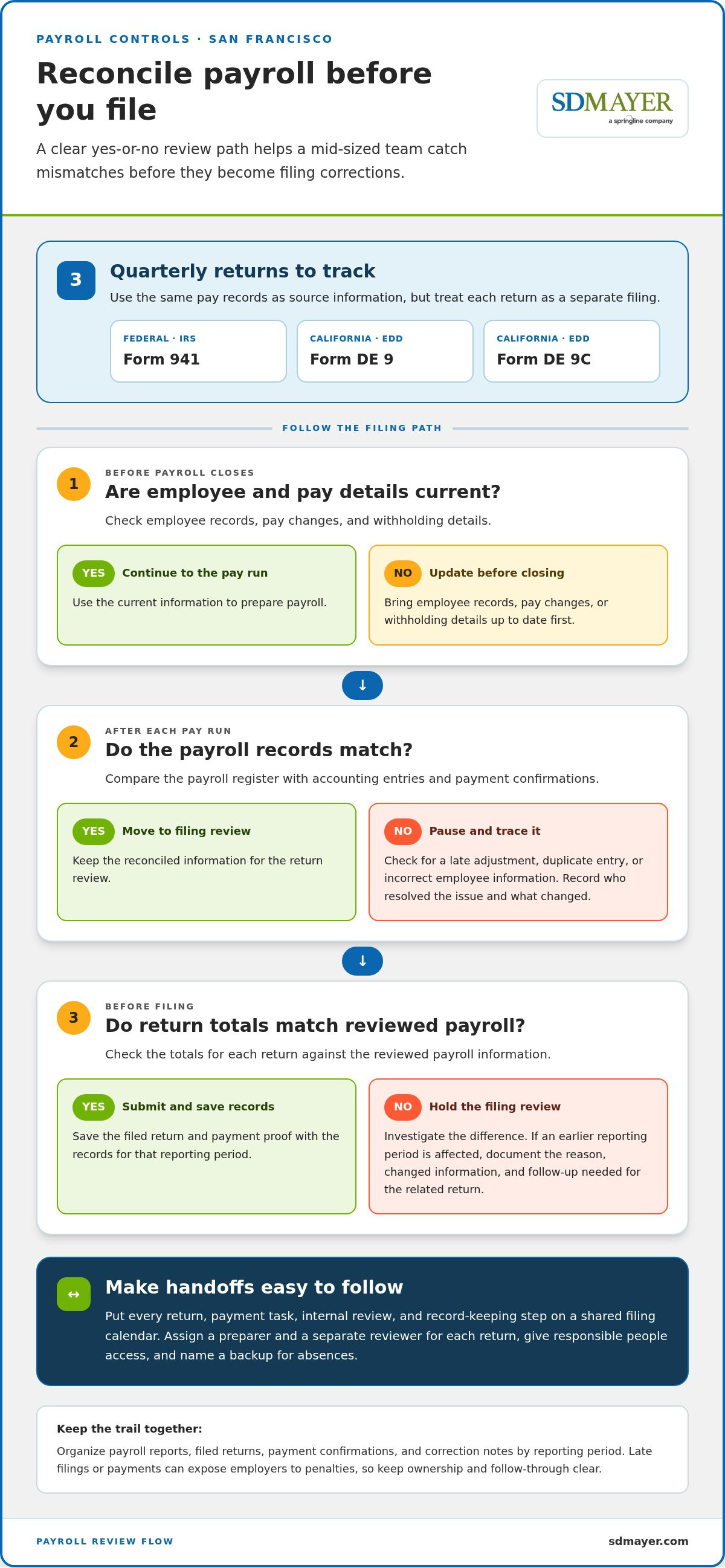
California employers file quarterly payroll returns with the IRS using Form 941 and with the California EDD using forms DE 9 and DE 9C, according to the Internal Revenue Service and California Employment Development Department. Form 941 is the federal payroll return; DE 9 and DE 9C are California payroll returns. Treat each as a separate filing, even when they use information from the same pay records. Assign one person to prepare each return and another to review it.
Start with accurate information from each pay run. A payroll register shows employee pay and related payroll amounts. Compare it with payment confirmations and accounting records. This reconciliation helps identify totals that don’t match. If a correction affects an earlier reporting period, document the reason, the changed information, and any follow-up needed for the related return.
For a mid-sized employer, a shared filing calendar helps prevent handoffs from getting lost between payroll, finance, and management. Include each return, payment task, internal review, and record-keeping step. Give access to the responsible people and name a backup for absences. Use a repeatable review routine:
- Before payroll closes: Confirm employee records, pay changes, and withholding details are current.
- After each pay run: Compare payroll reports with accounting entries and payment records.
- Before filing: Match return totals to the reviewed payroll information and investigate differences.
- After submission: Save the filed return and payment proof with the records for that reporting period.
Clear ownership helps teams manage exceptions. If payroll totals and accounting records differ, pause the filing review and trace the discrepancy. Check for a late adjustment, duplicate entry, or incorrect employee information. Record who resolved the issue and what changed. This history makes the next review easier and gives finance a useful record of the decision.
Keep payroll reports, filed returns, payment confirmations, and correction notes organized by reporting period. Finance can then follow how each filing connects to the underlying payroll information. Review the process when responsibilities or payroll systems change, and update the calendar and approval steps together. If payroll records and tax reporting need a more coordinated financial review, discuss your payroll reporting needs.
Payroll errors can create inaccurate balances, correction work, and disrupted cash planning. Missed obligations may remain unresolved without follow-through, and late filings or payments can expose employers to penalties.
Pay premiums and overtime eligibility
For 2026, San Francisco’s minimum wage is $19.61 per hour, effective July 1, 2026. California employers should identify the applicable wage floor for each employee’s work location, then update payroll settings when a local rate applies. The available San Francisco figure is a city rate, not a statewide California figure.
The federal overtime exemption salary threshold is $684 per week, or $35,568 annually, according to the U.S. Department of Labor. California requires an exempt salary of $1,352 per week, or $70,304 per year, for San Francisco employers. Keep federal and California thresholds distinct in payroll reviews. A salary figure alone doesn’t give payroll enough information to classify a role; review responsibilities and the applicable criteria, too.
Premium pay can be missed if employee time records don’t reflect actual work. For example, a shift may include a premium-eligible period or an approved schedule change. Make sure timekeeping captures the hours and pay codes payroll needs. Before closing the payroll period, compare the approved time record with the employee’s pay statement.
For a mid-sized team, use a repeatable eligibility and premium-pay review rather than relying on job titles or assumptions. Assign an owner to each step and retain the supporting records:
- Review roles: Compare each employee’s recorded responsibilities with the criteria used for classification.
- Check salary: Compare salary records with the relevant federal and California thresholds.
- Validate time: Resolve missing punches, schedule changes, and conflicting supervisor approvals.
- Review pay: Check rates and pay codes against approved hours before issuing payroll.
Document decisions when a role changes. For example, a promotion may affect responsibilities, salary, or both. Update the employee record and payroll treatment together, then retain the approval and effective date. This creates a clear trail for finance and helps ensure the next pay run uses current information.
San Francisco employers can use the $19.61 hourly rate as a local payroll checkpoint, while separately reviewing California’s exempt salary threshold and the federal threshold. Keep a dated record of rate changes and the employee groups affected. When a time or classification question arises, identify the role, work location, salary basis, and time records first. Those details give payroll reviewers a practical starting point for assessing pay premiums and overtime eligibility.
The 2026 San Francisco minimum wage is $19.61 per hour, effective July 1, 2026. The section identifies this as a city rate, not a statewide California rate.
Payroll and tax services
Payroll service costs vary with employee count, pay frequency, payroll complexity, and the work included. The price depends on the case and is given after a quote request; these factors shape the scope. For a mid-sized business, compare the tasks included, not just pay processing. Clarify who handles employee changes, payroll records, tax payments, and year-end reporting.
A typical U.S. payroll cycle occurs every two weeks, while the 15th and 30th of the month are examples of designated payday dates. Choose a schedule that fits cash planning and employee expectations, then document cutoff dates for timesheets, approvals, and compensation changes. A late timesheet can delay accurate processing, so managers need a clear deadline and a process for corrections.
California employers owe State Disability Insurance, Employment Training Tax, and State Unemployment Insurance in addition to federal payroll taxes. Include these obligations in your payroll calendar and accounting process. Assign responsibility for reviewing the records behind each amount, and compare payroll entries with business accounts. This helps finance understand total compensation costs instead of treating employee take-home pay as the full expense.
Service scope can also include payroll adjustments, employee records, and management reports. Standalone payroll services may file Form 940, a federal form used for reporting employer unemployment taxes. Ask which tasks are included and which stay with your internal team. For example, managers might approve hours while finance reviews payroll totals and records payments.
Before selecting a service model, map the work your team currently performs:
- Gather: List pay schedules, employee changes, time approvals, and compensation details.
- Assign: Name who submits, reviews, and approves each item before processing.
- Compare: Match payroll reports with accounting records and investigate differences.
- Review: Identify which reports managers need for budgeting and workforce decisions.
For an S corporation, a business structure that generally reports its income through its owners’ tax returns, a CPA-led payroll service can set an owner’s salary using year-to-date profit-and-loss information. This connects compensation planning with the company’s financial results from the start of the year through the current date. Keep relevant reports organized and ensure salary decisions are reflected in payroll records.
Review the arrangement when staffing, pay structure, or reporting needs change. A growing team may add varied schedules, compensation components, or approval steps. Update the responsibility map and payroll calendar together, then make sure managers know where to submit changes. Clear ownership helps the business manage routine payroll while keeping financial reporting in view.
Costs vary with employee count, pay frequency, payroll complexity, and included tasks, and are provided after a quote request. Compare which work the service covers, such as employee changes, tax payments, payroll records, and year-end reporting.
Payroll service providers across the Bay Area
San Francisco businesses can choose among standalone payroll processors, integrated payroll and HR platforms, and accounting firms with payroll support. LinkedIn’s San Francisco payroll-services search lists 82 results, showing a broad field rather than a single service model. For a mid-sized company, the useful distinction is what each option handles, from processing pay to coordinating tax records and management reporting.
Which San Francisco payroll providers offer local tax and compliance support? Payroll providers and accounting firms can support California payroll processes and local requirements. The right fit depends on how payroll connects with your accounting, employee records, and internal review responsibilities.
Compare service models with your actual workflow. Standalone processors may focus on pay calculations and payroll records, while integrated options can connect payroll with HR processes. Accounting-led support can also link payroll activity to business reporting. For example, a company with several approval steps may need coordination among managers, payroll staff, and finance. Payroll management services San Francisco employers use should fit these handoffs and the team’s reporting needs.
Build a short comparison around the work your team wants supported:
- Processing: Identify who enters pay changes, reviews hours, and prepares payroll reports.
- Tax coordination: Map how payroll records support federal and California filings.
- Local considerations: Include San Francisco pay rules and location-specific employee records in the workflow.
- Reporting: Decide how payroll information should connect with budgeting and financial statements.
- Internal ownership: Name who approves changes and who resolves data differences.
Use a recent payroll cycle as a practical test. Trace an employee change from manager approval through payroll entry, the pay statement, and the accounting record. Note each handoff and identify where your team repeats information or waits for approval. This shows whether a provider’s approach will simplify your processes or simply add another system. It also helps clarify which support matters most.
For Bay Area companies with employees or operations in multiple locations, organize responsibilities by work location and reporting needs. Keep a current list of employee locations, pay schedules, and internal approvers. Review how the service model handles record changes and communicates exceptions. Payroll management services San Francisco companies choose should suit their operating structure, not just a feature list.
The clearest takeaway is to match provider scope to the work you need covered. Compare handoffs, reporting, local tax coordination, and the responsibilities that remain with your team. If you’re assessing how payroll fits your broader financial processes, discuss your payroll and accounting needs.
Options include standalone payroll processors, integrated payroll and HR platforms, and accounting firms with payroll support. Compare how each handles California payroll processes, San Francisco pay rules, location-specific employee records, and tax coordination.
SD Mayer: Client Accounting & Advisory Services (CAAS)
SD Mayer helps mid-sized businesses connect payroll information with broader financial oversight through Client Accounting & Advisory Services (CAAS) and Outsourced CFO/Controllers. Turn to this support when payroll records need to inform cash planning, management reporting, or financial decisions instead of sitting apart from the rest of the business.
For example, coordinated accounting support can bring payroll costs into regular reporting and give leaders a clearer view of operating results. If your organization also needs a defined financial review, SD Mayer offers Single audits and Agreed-Upon audit procedures. Identify the reports, processes, and decisions that need support, then discuss those priorities with the team.
Contact SD Mayer to discuss your business’s accounting and advisory needs.
Build a payroll process that can grow with you
Turn payroll observations into clear ownership by mapping an upcoming payroll cycle. Identify who provides employee updates, approves changes, reviews reports, and resolves discrepancies. Then note handoffs that rely on repeated data entry or informal follow-up. A concise responsibility map gives finance and people teams a shared starting point without requiring a complete process overhaul.
For a mid-sized business, revisit the map as staffing, systems, or reporting needs change. Keep it practical: assign an owner to each task, document how exceptions are handled, and set a regular time to review what’s working. This makes it easier to adapt payroll management services in San Francisco to your organization’s operations and financial priorities.
SD Mayer can help connect payroll with broader accounting and advisory needs. Contact SD Mayer about payroll services to discuss a thoughtful next step for your business. A clear process today can give your team a stronger foundation for growth.
Frequently Asked Questions
What San Francisco and California payroll taxes and filing requirements apply to employers?
Employers account for federal payroll taxes and California State Disability Insurance, Employment Training Tax, and State Unemployment Insurance. California employers file quarterly payroll returns with the IRS using Form 941 and with the California EDD using forms DE 9 and DE 9C, according to the Internal Revenue Service and California Employment Development Department. As a practical review, reconcile each quarter’s payroll register with tax balances and payments, then investigate differences before filing.
Which providers support direct deposit, benefits, time tracking, and HR services?
Integrated payroll and HR platforms are designed to coordinate pay, benefits, time tracking, and employee records. Standalone payroll processors focus on pay processing, while accounting-led arrangements can connect payroll results with financial reporting. For example, a mid-sized employer with hourly and salaried staff can map time approvals, benefit deductions, and employee updates before choosing a service model. Compare how each workflow fits together instead of relying on a provider label alone.
How do I choose and set up a payroll service for a San Francisco business?
Choose a service by matching its scope to your team’s pay schedules, employee records, benefits workflow, and reporting needs. Gather a recent payroll register and list who approves time, compensation changes, and employee updates. Then assign an internal owner to each handoff and identify the reports finance needs. Before fully switching processes, walk through a payroll cycle using the new responsibilities and resolve any unclear steps.
What payroll deadlines and reporting forms must San Francisco employers meet?
California employers file quarterly payroll returns using Form 941 with the IRS and forms DE 9 and DE 9C with the California EDD, according to the Internal Revenue Service and California Employment Development Department. Put each filing cycle on a shared calendar, with internal preparation and review checkpoints before the applicable due date. Keep filed returns, payroll reports, and payment records organized by quarter so finance can connect each filing to its source records.
How much do payroll services cost for small businesses in San Francisco?
Payroll service costs for small businesses utilizing payroll management services San Francisco typically range from base monthly subscription fees of forty to one hundred dollars, plus an additional six to twelve dollars per employee. Comprehensive platforms that bundle advanced HR, time tracking, and benefits administration can increase these costs. When evaluating SD Mayer or other providers, always request a transparent breakdown of implementation fees, tax filing charges, and year-end reporting costs to avoid unexpected expenses.
How do payroll services compare on features, pricing, and customer reviews?
Compare providers by their support scope, reporting, and fit with your existing processes.
SECURITIES AND ADVISORY DISCLOSURE:
Securities offered through Valmark Securities, Inc. Member FINRA, SIPC. Fee based planning offered through SDM Advisors, LLC. Third party money management offered through Valmark Advisers, Inc a SEC registered investment advisor. 130 Springside Drive, Suite 300, Akron, Ohio 44333-2431. 1-800-765-5201. SDM Advisors, LLC is a separate entity from Valmark Securities Inc. and Valmark Advisers, Inc. Form CRS Link
DISCLAIMER:
This material has been prepared for informational purposes only, and is not intended to provide, and should not be relied on for, accounting, legal or tax advice. The services of an appropriate professional should be sought regarding your individual situation.
HYPOTHETICAL DISCLOSURE:
The examples given are hypothetical and for illustrative purposes only.