What if the biggest risk to your organization's impact isn't a drop in donations, but a missed deadline on a state form? For leaders looking for nonprofit tax services bay area, the complexity of 2026 regulations can feel like a full-time job. You started your organization to change lives, not to spend your weekends deciphering the difference between an IRS Form 990 and the California RRF-1.
We agree that every dollar spent on administrative penalties is a dollar taken away from your community programs. You deserve to feel confident that your tax-exempt status is secure. This guide provides a clear, jargon-free roadmap for your 2026 compliance, including the May 15 federal deadline and California's new online filing system. We'll preview how to handle the latest Senate Bill 711 reporting rules and how a holistic partnership can help you stay focused on your core purpose.
Key Takeaways
- Understand why specialized nonprofit tax services in the Bay Area are the first line of defense in protecting your tax-exempt status and mission.
- Learn how to manage the "Big Three" filings—Form 990, Form 199, and RRF-1—without getting lost in technical jargon or missing critical deadlines.
- Navigate California’s specific state requirements, including the Attorney General’s Registry of Charitable Trusts and the new 2026 online filing system.
- Follow a clear action plan to organize board records and financial statements, ensuring your public filings tell a compelling story to your donors.
- Discover the benefits of a holistic financial mentor who treats your organization as a partner, helping you maintain stability through every stage of your journey.
What Are Nonprofit Tax Services and Why Does Your Bay Area Organization Need Them?
Nonprofit tax services are about much more than just filling out forms at the end of the year. They are a specialized form of support designed to safeguard your organization's most valuable asset: its tax-exempt status. While it's true that your charity likely doesn't pay traditional income tax on its core mission activities, your reporting duties are actually quite extensive. In a high-scrutiny environment like San Francisco or San Jose, these filings serve as a public record of your integrity. When you invest in professional nonprofit tax services bay area, you are essentially building a bridge of transparency between your mission and the donors who fund it.
Think of your tax filings as a public report card. Major foundations and individual donors often review these documents before deciding where to send their grants. If your records are messy or incomplete, it sends a signal that your management might be disorganized. Specialized tax support ensures that your financial story is told accurately, showing the world that you are a responsible steward of every dollar received. This level of clarity is vital for maintaining the long-term trust of the community you serve.
The Difference Between Federal and California Requirements
Establishing a 501(c)(3) organization with the IRS is a major milestone, but it's only half the battle for groups operating in California. The federal government cares about your overall exempt status, but the California Franchise Tax Board (FTB) has its own rigorous set of rules and deadlines. You have to answer to both. If you miss a state-level filing, you could face local penalties that jeopardize your ability to operate in cities like San Mateo or Oakland. Local compliance is what keeps your doors open and ensures you stay in good standing with the state's strict charitable oversight divisions.
Why 'DIY' Tax Prep Often Costs Nonprofits More
It is tempting to handle tax prep in-house to save money, but "DIY" mistakes often lead to much higher costs down the road. A common trap is failing to report income from activities that aren't directly related to your primary mission. The IRS calls this Unrelated Business Income Tax, and it's a frequent source of unexpected penalties. Professional nonprofit tax services bay area help you identify these risks before they become "red flags" for auditors. By catching small errors early, you protect your funds for what matters most: your programs and the people who rely on them.
- Confirm that your organization is registered with both the IRS and the California Registry of Charitable Trusts.
- Ask your treasurer if the organization has any "unrelated" income from side activities like merchandise sales or facility rentals.
- Review your most recent Form 990 to see what a potential donor would see if they looked up your records today.
Beyond the Basics: Essential Tax Filings for Your Mission
Managing a nonprofit in San Francisco or Oakland involves more than just passion. It requires keeping three major agencies satisfied through what we call the "Big Three" filings: Form 990, Form 199, and the RRF-1. These documents satisfy the IRS, the California Franchise Tax Board, and the State Attorney General. While they might seem like administrative hurdles, they are actually the framework that protects your ability to serve the community. For many leaders, nonprofit tax services bay area provide the peace of mind that these deadlines won't be missed.
For calendar-year organizations, the clock is ticking toward the May 15, 2026, deadline. Missing this date or filing incomplete information can lead to daily penalties that quickly eat into your program funds. Following the IRS guidelines for nonprofits ensures you choose the correct version of the form based on your current financial size. If you're unsure which forms apply to your current budget, reaching out for a quick conversation about your compliance needs can save hours of guesswork.
Form 990: Your Organization's Public Identity
Navigating UBIT: When Your Side-Hustle Gets Taxed
Unrelated Business Income Tax (UBIT) applies when your nonprofit earns money from activities not directly related to your main mission. For example, if a nonprofit youth center rents out its parking lot for a local festival—perhaps supported by event specialists like Mimisjumpersevents—that income might be taxable. For the 2026 tax year, Senate Bill 711 requires you to track and report each of these "side" trades separately. This change makes detailed bookkeeping more important than ever for Bay Area groups with mixed revenue streams.
The Role of Single Audits
If your organization receives federal grants, you may face even stricter requirements. A Single Audit is a comprehensive financial and compliance check that ensures federal funds are being used correctly. These audits are rigorous and require a partner who understands the specific nuances of federal oversight. It's about more than just checking boxes; it's about proving you are a reliable partner for government-funded initiatives.
- Verify your 2025 gross receipts to determine if you need Form 990, 990-EZ, or 990-N.
- Identify any revenue sources that fall outside your core mission to prepare for UBIT reporting.
- Mark May 15, 2026, on your calendar as the primary deadline for both IRS and California RRF-1 filings.
Staying Compliant with California’s Unique Local Rules
California takes charitable oversight very seriously. While the IRS handles the federal side, the California Franchise Tax Board (FTB) is your primary state contact. Most organizations with receipts over $50,000 need to file Form 199, while smaller groups can use the simpler 199N e-Postcard. It's a critical step because if your tax-exempt status is revoked, you could suddenly become liable for the state's $800 minimum franchise tax. This is where having nonprofit tax services bay area experts on your side makes a difference. They ensure these local nuances don't slip through the cracks while you focus on your community impact.
Beyond the FTB, you also have to answer to the Attorney General. Every charity operating in the Bay Area must register with the Registry of Charitable Trusts. This involves an annual filing called the RRF-1. It's essentially your license to fundraise. If you fall behind, the state can label your organization as "delinquent," which can stop your fundraising efforts in their tracks. Reviewing California's nonprofit regulations is a great way to stay informed about these requirements and ensure your registration remains active.
The Registry of Charitable Trusts (RRF-1)
A "delinquent" status is more than just a paperwork error. It can prevent you from applying for grants or even accepting online donations. The Attorney General's office is launching a new online filing system in 2026, which aims to make the process smoother but might come with a learning curve. For charities with renewal filings due between January 7, 2025, and August 31, 2026, the state has extended the deadline to August 31, 2026. Action Item: Search for your organization's name in the Registry of Charitable Trusts on the AG’s website. If your status says anything other than "Current," it's time to act immediately.
Property Tax Exemptions for Bay Area Facilities
If your nonprofit owns a building in San Francisco, San Jose, or Walnut Creek, you should know about the "Welfare Exemption." This can exempt you from paying property taxes on the space you use for your charitable mission. It's a significant financial relief for community centers and schools, but the rules are strict. You have to file with both the State Board of Equalization and your local county assessor. Keep in mind that most California nonprofits still pay state sales tax on their purchases, even if they have this property tax exemption. Working with a local partner helps you navigate these specific county rules so you can keep more money in your programs.
- Confirm your total revenue to see if you owe the RRF-1 renewal fee, which ranges from $25 to $1,200 for 2026.
- Ensure your Statement of Information (Form SI-100) is filed with the Secretary of State every two years.
- Check if your facility qualifies for the Welfare Exemption to lower your annual operating costs.
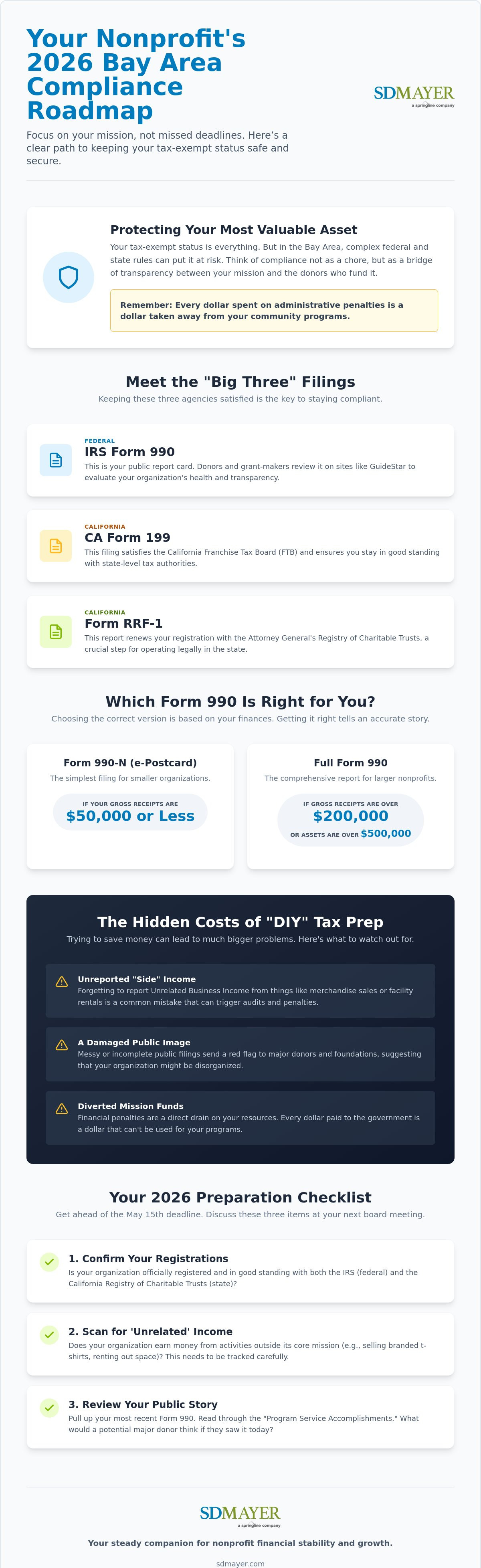
Your 2026 Preparation Checklist: Action Items for Tax Season
Preparing for 2026 doesn't have to be a last-minute scramble. By taking small steps now, you can avoid the stress of the May 15 deadline and ensure your focus stays on your community impact. High-quality nonprofit tax services bay area start with a solid foundation of data. It's about being proactive rather than reactive. When you organize your records early, you're not just preparing for a filing; you're protecting the long-term health of your mission.
Step 1: Clean Up Your Bookkeeping
Clean books are the heartbeat of a healthy nonprofit. Working with a professional bookkeeper makes tax season significantly easier. Instead of chasing receipts in April, you'll have a clear view of your finances year-round. For scaling organizations, Client Accounting Advisory Services (CAAS) can automate your bank reconciliations and investment tracking. This ensures that every dollar is accounted for by the time you reach December 31. We recommend reconciling all bank and investment accounts by year-end to catch any discrepancies before they become larger issues.
Step 2: Review Governance and Policies
The IRS isn't just looking at your bank account; they're looking at your leadership. Form 990 asks specific questions about board oversight. Make sure your conflict-of-interest policy is reviewed and signed by every board member this year. Documenting these steps in your board meeting minutes proves that you have active governance in place. Good paperwork is good protection. It demonstrates to auditors and donors alike that your organization is managed with integrity and care.
There are several other practical steps you should take as the year winds down. Review your Statement of Functional Expenses to see exactly where your money went. This breaks down your spending into three categories: program services, management, and fundraising. Don't forget to gather documentation for in-kind donations or volunteer hours. While these might not involve cash, they are vital for showing the full scale of your community support. Also, check for new federal or state grant requirements that might have changed for 2026, as these can impact your reporting duties.
A pre-tax meeting in October or November is the best way to catch potential issues before the year ends. It gives you time to adjust and ensures your filings reflect your mission accurately. If you want to start your year-end review with a steady companion, reach out to us to schedule a 2026 strategy session.
- Organize board meeting minutes to document key financial decisions.
- Review your functional expenses to ensure program spending is accurately categorized.
- Check for any new federal or state grant requirements for the upcoming year.
- Gather documentation for all in-kind donations and volunteer hours.
- Schedule a pre-tax meeting with your advisor by late October or early November.
Choosing a Bay Area Partner: Why SD Mayer is Your Steady Companion
Finding a provider for nonprofit tax services bay area is about more than just checking a box on your annual to-do list. It's about finding a partner who values your mission as much as you do. We believe that financial health is the foundation of every successful charity. Our approach is built on the idea of being a "Holistic Mentor," offering guidance that looks at the big picture of your organization's future. This commitment to long-term relationships is why we maintain a near 100% retention rate. We don't just see a file; we see a community partner.
Having your tax, audit, and wealth management services under one roof creates a sense of stability that is hard to find elsewhere. It means your tax advisor actually talks to your auditor, and your financial strategist understands your specific goals for the coming year. With local offices in San Francisco, San Jose, and Walnut Creek, we make it easy to collaborate in person. Whether you're a small community center in the East Bay or a large foundation in the South Bay, we are right here to support your journey.
A Partnership That Goes Beyond the Tax Return
While the annual filing is important, your financial strategy shouldn't start and end with a tax deadline. Our CAAS offerings provide year-round support that helps you stay ahead of regulatory changes. Think of us as an outsourced CFO who can attend your board meetings and help explain complex financial data to your directors. We are deeply rooted in the local community, and we understand the unique economic pressures of operating in the Bay Area. We aim to be the steady companion you can rely on through every stage of your growth.
Ready to Protect Your Mission?
We know that compliance can feel overwhelming, especially with the new California online filing systems and shifting federal rules. Our goal is to reduce that stress so you can put your energy back into your programs. We invite you to have a low-pressure conversation with our team to review your current status and see where we can provide more clarity. It's about giving you the peace of mind that your tax-exempt status is secure. We are ready to help you protect what you've built.
- A high client retention rate that proves long-term stability and trust.
- Local expertise in San Francisco, San Jose, or Walnut Creek to ensure state compliance.
- Integrated services like CAAS and Single Audits for comprehensive support.
- A mentorship-style approach that prioritizes your mission over simple number-crunching.
- Experience with both IRS rules and the California Registry of Charitable Trusts.
Securing Your Organization's Future in the Bay Area
Your mission to serve the community is too vital to be interrupted by administrative hurdles or filing errors. By prioritizing your 2026 compliance today, you ensure that donor trust remains high and your tax-exempt status stays protected. A proactive approach to your filings isn't just about following rules; it's about building a stable foundation for your programs to grow and thrive. When your financial house is in order, your leadership can stay focused on making a real difference.
SD Mayer serves as a steady companion for organizations throughout the region. With local offices in San Francisco, San Jose, and Walnut Creek, we provide the specialized nonprofit tax services bay area leaders rely on to navigate complex regulations. Our near 100% client retention rate is a testament to our holistic mentor approach. We offer comprehensive support, including Single Audits and CAAS, to reduce your administrative stress and keep your board focused on the big picture. We treat your organization like a partner, not just a file.
Schedule a consultation with our Bay Area nonprofit tax experts today to review your current standing and prepare for a successful year ahead. We are genuinely invested in your success and ready to help you navigate the future with confidence.
Frequently Asked Questions
Does my small Bay Area nonprofit really need to file a tax return?
Yes, almost every nonprofit has an annual filing requirement regardless of its size. Even if your gross receipts are $50,000 or less, you're required to file Form 990-N with the IRS and Form 199N with the California Franchise Tax Board. Failing to file these simple electronic postcards for three consecutive years leads to the automatic revocation of your tax-exempt status, which can be a long and expensive process to fix.
What happens if we miss the deadline for the California RRF-1 form?
Missing the RRF-1 deadline causes your organization to be listed as "delinquent" in the Registry of Charitable Trusts. This status effectively stops your ability to fundraise or apply for grants in California. For the 2026 tax year, the state has extended the deadline to August 31 for many organizations to accommodate a new online filing system. It's vital to check your status on the Attorney General's website to ensure you remain in good standing.
How much do nonprofit tax services usually cost in San Francisco?
Costs for professional help vary based on your total revenue and the complexity of your financial activities. National data suggests that professional preparation of a Form 990 can range from $500 to over $2,000, though Bay Area rates often reflect the higher level of state-specific compliance required here. Rather than focusing only on the fee, consider the value of a partner who prevents penalties and helps you maintain donor trust through accurate reporting.
What is the difference between an audit and a tax return for a nonprofit?
A tax return is a mandatory report for the government, while an audit is a detailed examination of your financial records to ensure accuracy. The IRS requires a return like Form 990 to maintain your tax-exempt status. An audit, such as a Single Audit for organizations with federal funding, provides an extra layer of transparency that many donors and foundations require. Both are core components of high-quality nonprofit tax services bay area.
Can one firm handle both our bookkeeping and our nonprofit tax filing?
Yes, many organizations find that using one firm for both bookkeeping and tax preparation creates a much smoother experience. This integrated approach ensures that your daily records are already organized for tax season, which reduces the risk of errors and missed deadlines. It also allows your advisor to provide year-round guidance on your financial health rather than just looking at your numbers once a year when the return is due.
How do I know if my organization is liable for UBIT (Unrelated Business Income Tax)?
You're generally liable for UBIT if your organization earns $1,000 or more in gross income from a business activity that isn't directly related to your mission. This might include things like selling branded merchandise or renting out your office space to a for-profit business. Starting in 2026, California's Senate Bill 711 requires you to track and report each of these side-hustles separately, so detailed record-keeping is more important than ever.
What are the common red flags that trigger an IRS audit for nonprofits?
Common triggers for an audit include reporting unusually high executive compensation or having large amounts of unrelated business income. Inconsistent data between your public financial statements and your tax return can also draw unwanted attention. Using professional nonprofit tax services bay area helps you stay compliant by ensuring your filings are accurate and that your board is following the governance policies the IRS expects to see in place.
SECURITIES AND ADVISORY DISCLOSURE:
Securities offered through Valmark Securities, Inc. Member FINRA, SIPC. Fee based planning offered through SDM Advisors, LLC. Third party money management offered through Valmark Advisers, Inc a SEC registered investment advisor. 130 Springside Drive, Suite 300, Akron, Ohio 44333-2431. 1-800-765-5201. SDM Advisors, LLC is a separate entity from Valmark Securities Inc. and Valmark Advisers, Inc. Form CRS Link
DISCLAIMER:
This material has been prepared for informational purposes only, and is not intended to provide, and should not be relied on for, accounting, legal or tax advice. The services of an appropriate professional should be sought regarding your individual situation.
HYPOTHETICAL DISCLOSURE:
The examples given are hypothetical and for illustrative purposes only.