
Does your nonprofit need a full audit, a review, or a different engagement? Choosing the wrong scope can create avoidable work, while incomplete grant records or unclear board expectations can make any engagement more stressful. If you’re comparing nonprofit audit services Walnut Creek organizations can access, start by identifying the report your funder, board, or other intended user needs.
It’s understandable to want a clear answer before contacting an accounting firm. Requirements may depend on federal awards, California rules, and funder agreements. An audit is not interchangeable with a review or compilation, so ask a prospective firm to explain the differences and how they relate to your organization’s circumstances.
This 2026 guide explains how to identify a suitable engagement, organize financial statements and grant documentation, and prepare key people and questions before contacting firms. You’ll also learn how to compare a Walnut Creek-area partner’s nonprofit, tax, and financial reporting support. SD Mayer serves Walnut Creek and the wider Bay Area, including San Francisco, San Mateo, San Jose, Santa Rosa, San Leandro, Menlo Park, and Sacramento.
Key Takeaways
- Choose the engagement that matches your funding terms and reporting needs. An audit, review, compilation, Single Audit, or agreed-upon procedures engagement serves a different purpose.
- When comparing nonprofit audit services Walnut Creek organizations can access, ask each firm to clarify the scope, expected reports, and information your team will need to provide.
- Before work begins, organize financial records, reconciliations, supporting documents, and points of contact.
- When relevant, keep grant files and restricted-fund records together so your team can quickly locate supporting documentation.
- Consider whether nonprofit tax, financial reporting, or advisory support could address needs beyond the engagement.
When Does a Walnut Creek Nonprofit Need Audit Services?
A nonprofit’s audit needs depend on its funding terms, circumstances, and stakeholder expectations. A funder may specify a report, a board may set an assurance expectation, or applicable state or federal requirements may call for an audit. Start by identifying the obligation or decision the engagement must address rather than assuming every organization needs the same service.
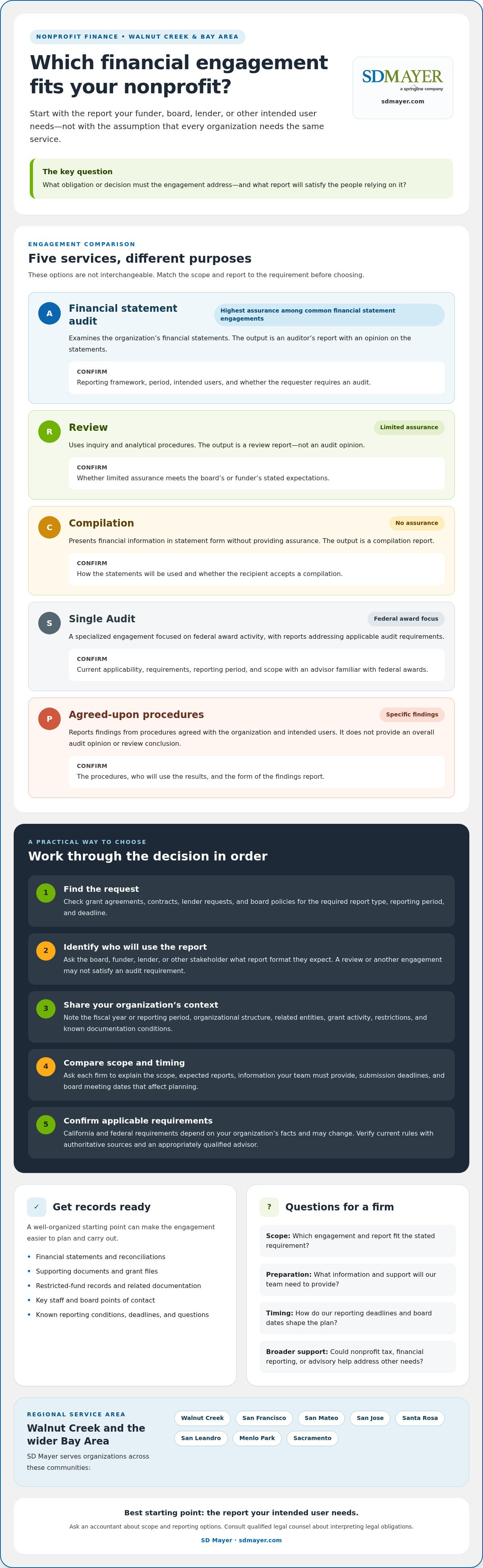
An independent financial statement audit examines an organization’s financial statements and provides the highest level of assurance among common financial statement engagements. A review provides limited assurance through inquiry and analytical procedures. A compilation presents financial information without providing assurance. Agreed-upon procedures are different: an accountant performs specific procedures agreed with the organization and intended users, then reports findings without providing an overall audit opinion or review conclusion.
How to tell which assurance engagement may fit
These services aren’t interchangeable. Before selecting one, check grant agreements, contracts, lender requests, and board policies for the required report type, reporting period, and deadline. Pay close attention to the requester’s wording. A review or another engagement may not satisfy a requirement for an audit. An accountant can discuss accounting scope and reporting options; consult qualified legal counsel about interpreting legal obligations.
Stakeholder expectations can also shape the discussion. An organization with multiple programs or funding sources, for example, may need reporting that helps its board understand financial activity even if no stakeholder has requested a particular report. The Wikimedia Foundation offers a familiar example of a large nonprofit whose public profile can help readers consider why transparent financial reporting matters as organizations grow. Its circumstances shouldn’t be treated as a template for every nonprofit.
Questions Walnut Creek nonprofit leaders can ask first
Before contacting a firm about nonprofit audit services Walnut Creek organizations may need, gather a short summary of your organization’s requirements and reporting needs. This helps an advisor understand the context and discuss a suitable scope.
- Who will use the report? Identify whether it’s for the board, a funder, a lender, or another stakeholder. Ask the requester what report format they expect.
- What period and entity are involved? Note the fiscal year or reporting period, your organization’s structure, and any related entities that could affect the engagement.
- What funding activity should be discussed? Summarize grant activity and known reporting conditions, especially where funds have restrictions or specific documentation requirements.
- What dates are already on the calendar? Share submission deadlines and board meeting dates that could affect planning.
California and federal requirements depend on an organization’s facts and may change. Confirm current rules with authoritative sources and an appropriately qualified advisor before relying on them to determine whether an audit is required.
Which Nonprofit Audit Services Should You Compare?
The right engagement depends on what a funder, board, lender, or other intended user needs to receive. Use this comparison to frame the discussion, then confirm the required scope and report language before selecting a service. California nonprofits should also review the state’s requirements, including California's Nonprofit Integrity Act, and verify how current rules apply to their circumstances.
| Engagement | General purpose and typical output | What to confirm |
|---|---|---|
| Financial statement audit | Examines financial statements and provides the highest level of assurance among these common engagements. The output is an auditor’s report with an opinion on the statements. | Confirm the reporting framework, period, intended users, and whether the requester requires an audit. |
| Review | Uses inquiry and analytical procedures to provide limited assurance. The output is a review report, not an audit opinion. | Ask whether limited assurance meets the board’s or funder’s stated expectations. |
| Compilation | Helps present financial information in statement form, without providing assurance. The output is a compilation report. | Clarify how the statements will be used and whether the recipient accepts a compilation. |
| Single Audit | A specialized engagement focused on an organization’s federal award activity, with reports addressing applicable audit requirements. | Verify current applicability, requirements, reporting period, and scope with an advisor familiar with federal awards. |
| Agreed-upon procedures | Reports findings from specific procedures agreed with the organization and intended users. It doesn’t provide a general audit opinion. | Agree on the procedures, who will use the results, and the form of the findings report. |
Financial statement audits, reviews, and compilations
The key difference is the work performed and the assurance communicated. In an audit, the accountant gathers evidence to support an opinion. A review relies on more limited procedures, while a compilation helps present information without assurance. Before choosing, identify the report’s users and their expectations. Don’t treat a review or compilation as a substitute when an obligation specifically requires an audit.
Single Audits and agreed-upon procedures
A Single Audit is not simply another name for a financial statement audit. It’s a specialized engagement, and federal award requirements can depend on the organization’s circumstances and the applicable period. Confirm whether it applies before setting the scope. Agreed-upon procedures are narrower: the accountant performs specified steps and reports findings rather than issuing an overall opinion. SD Mayer offers Single Audits and agreed-upon procedures. Ask whether either engagement fits your organization’s needs.
For help framing the scope and questions for your organization, discuss your nonprofit audit needs with SD Mayer.
How to Evaluate Nonprofit Audit Firms Serving Walnut Creek
A strong fit involves more than finding a firm that performs audits. The provider should understand nonprofit finances, explain the proposed engagement clearly, and communicate in a way that works for your staff and board. As you compare nonprofit audit services Walnut Creek organizations may consider, ask each firm the same questions so you can assess scope and working style on consistent terms.
Questions to ask a prospective nonprofit auditor
- How familiar are you with organizations like ours? Ask about work with nonprofits of similar size, funding mix, program structure, and operational complexity. A mid-sized organization with several grants may have different documentation and reporting needs from a smaller organization with one primary funding source.
- Who will lead the engagement? Confirm your main contacts, who oversees the work, and how the team coordinates with finance staff, executive leadership, and board representatives.
- What does the proposed scope include? Ask what reports the engagement is expected to produce, what information your organization must provide, and what falls outside the scope. Clarify how the firm will communicate questions, emerging issues, and decisions needed from your team.
- How are independence or conflicts considered? Ask how the firm identifies and addresses potential independence or conflict concerns before accepting the work. The answer should explain the firm’s process and any relevant considerations for your organization.
Request an overview of expected document requests and how your team will submit them. Clear points of contact and communication expectations help staff plan audit work alongside routine responsibilities.
Assessing fit for a mid-sized nonprofit
Match the firm’s approach to your organization’s capacity and reporting complexity. Consider the size of your finance team, the number of programs, how grant activity is tracked, and whether financial information must be prepared for different audiences. Ask how the firm works with internal staff and leadership and supports communication with the board without taking over the organization’s responsibilities.
Location is another practical consideration, but a firm serving Walnut Creek doesn’t necessarily have an office there. Ask whether meetings can be held remotely or in person, whether on-site work is available if needed, and how records and questions will be handled. Confirm these details directly rather than assuming a local listing means a local office or a particular service arrangement.
Reporting needs may extend beyond the audit itself. If your organization is reviewing broader financial reporting practices, SD Mayer’s resource on financial reporting compliance services in the Bay Area offers related context. Use it alongside direct questions about your engagement, reporting expectations, and the support your team may need.
How Can Your Nonprofit Prepare for an Audit?
A clear preparation plan helps your team gather information in a workable sequence instead of responding to requests one at a time. If you’re considering nonprofit audit services Walnut Creek organizations can access, start by asking the engagement team for its request list. The documents needed depend on the agreed scope, so don’t assume every nonprofit will be asked for the same records.
Records and schedules to organize before fieldwork
- Confirm the period and scope. Identify the fiscal year or other reporting period covered, then review the engagement team’s request list with your finance lead.
- Gather core financial records. Collect the trial balance, financial statements, account reconciliations, and supporting schedules requested for the engagement. Check that schedules agree with the underlying accounting records and flag items that need follow-up.
- Arrange supporting documentation. Organize relevant invoices, receipts, payroll records, and other requested support so staff can locate the evidence behind recorded activity.
- Pull together grant and restricted-fund files, if applicable. Keep grant agreements, award records, expenditure support, and records showing how restricted funds were tracked together or clearly cross-referenced. The specific materials depend on your funding and the engagement scope.
- Identify people who can answer questions. Note who handles accounting, payroll, grant administration, and board reporting, and clarify which topics each person can address.
Reduce disruption with a clear audit work plan
Assign one internal coordinator to receive requests, track outstanding items, and route questions to the right person. That person doesn’t need to answer every question. Their role is to keep requests visible, prevent duplicate responses, and direct the engagement team to the staff member best placed to provide accurate information.
Before work begins, agree with the audit team on how documents will be shared, how often requests will be reviewed, and how urgent or unclear questions should be escalated. A simple request tracker can record each item, its assigned staff member, its status, and any open follow-up. This helps finance teams balance audit work with routine responsibilities.
Organized records and timely answers help coordinate the work, so the team can focus on the agreed scope and resolve open questions as they arise.
If your finance team also needs ongoing accounting support, SD Mayer provides outsourced CFO and controller support, bookkeeping, payroll, and financial reporting through its Client Accounting Advisory Services. To discuss preparation and engagement needs with SD Mayer, contact the firm.
Choosing SD Mayer for Nonprofit Audit Services in Walnut Creek
SD Mayer is a San Francisco Bay Area accounting and advisory firm serving Walnut Creek nonprofits. The firm is headquartered in San Francisco, so confirm meeting arrangements and whether on-site work is available rather than assuming there is a Walnut Creek office. For nonprofits assessing nonprofit audit services Walnut Creek options, regional reach is one consideration. The proposed engagement’s fit and communication approach matter just as much.
A connected approach to nonprofit financial support
SD Mayer offers audit and assurance, Single Audits, agreed-upon procedures, and nonprofit tax. Depending on your organization’s needs, financial reporting or advisory support may also be relevant. For example, a mid-sized nonprofit might discuss how audit work relates to its financial reporting processes or tax filings rather than treating each need as an isolated conversation.
An ongoing advisor relationship can be useful when an organization’s reporting needs evolve, but no single firm or combination of services fits every nonprofit. Confirm which engagement SD Mayer accepts for your circumstances, what the scope includes, who will handle the work, and whether related services are appropriate. Discuss and agree on any additional accounting or advisory support separately where needed.
What to include in your first conversation
A focused introduction helps the firm understand your organization’s context and identify questions to address next. Be ready to share:
- Location and size: Note that the organization is based in or near Walnut Creek and describe its general scale, programs, and finance-team capacity.
- Reporting period: Identify the fiscal year or period under consideration and any upcoming board, funder, or filing dates you know.
- Funding sources: Summarize grants and other funding, including reporting conditions or restrictions relevant to the requested work.
- Reason for seeking support: Explain whether you’re responding to a specific request, planning for an upcoming engagement, or reviewing your organization’s reporting needs.
- Current processes: Describe how records are maintained, reconciliations are completed, and audit or funder requests are handled.
Bring copies of known funder or board requests, if available. Ask the firm to clarify the proposed scope, communication routines, anticipated information requests, and timing assumptions. Pricing is client-specific, so request an engagement-specific fee estimate before proceeding rather than relying on a standard figure.
With those details in hand, you can have a more informed discussion about fit and next steps. Contact SD Mayer to discuss your nonprofit audit needs.
Move Forward With a Clear Audit Plan
Choosing the right engagement starts with understanding who needs the report, which funding or governance requirements apply, and what your organization can prepare. An audit, review, compilation, Single Audit, and agreed-upon procedures engagement serve different purposes, so confirm the required scope before moving ahead. Organized financial records and a designated contact can also help your team manage requests clearly.
If you’re comparing nonprofit audit services Walnut Creek organizations can access, SD Mayer is a San Francisco Bay Area firm that lists Walnut Creek among the locations it serves. Its offerings include Single Audits, agreed-upon procedures, and nonprofit tax, alongside broader accounting and advisory services. Ask which engagement fits your circumstances, how the work would be coordinated, and what client-specific pricing and timing to expect.
Contact SD Mayer to discuss nonprofit audit services and share your organization’s reporting needs and known requirements. A focused first conversation can help clarify practical next steps.
Frequently Asked Questions
Does every nonprofit in Walnut Creek need an independent audit?
No, not every Walnut Creek nonprofit needs an independent audit. Requirements can arise from California or federal rules, grant agreements, lender requests, or board policies. Under California’s Nonprofit Integrity Act, organizations with annual gross revenues of $2 million or more generally need an independent audit; certain government grants may be excluded when separate accounting is required. Confirm how current requirements apply to your organization’s facts with a qualified advisor.
What is the difference between a nonprofit audit and a financial review?
A financial statement audit involves more extensive procedures and provides an auditor’s opinion on the statements. A review uses inquiry and analytical procedures to provide limited assurance, rather than an audit opinion. A review may suit some reporting needs, but it isn’t a substitute if a funder, contract, or applicable requirement calls for an audit. Check the report’s intended users and their expectations before choosing an engagement.
When might a nonprofit need a Single Audit?
A nonprofit may need a Single Audit when its federal award expenditures meet the applicable threshold and other requirements for the relevant fiscal year. For fiscal years beginning on or after October 1, 2024, the threshold is $1 million in federal award expenditures. Earlier fiscal years may be subject to the previous $750,000 threshold. Because timing and award details matter, verify current rules and applicability with an advisor before determining the required scope.
How can a nonprofit prepare for an audit?
Start by asking the engagement team for a request list specific to the agreed scope. Organize the trial balance, financial statements, reconciliations, and requested supporting schedules. If relevant, arrange grant agreements, award records, and expenditure support so they’re easy to locate. Assign an internal coordinator to track requests and direct questions to the right staff member. A clear process helps the finance team manage audit requests alongside its regular work.
How long does a nonprofit audit take?
There isn’t one timeline that applies to every nonprofit audit. Scope, financial reporting complexity, record readiness, grant activity, and how quickly questions are answered can all affect the work. Ask the prospective auditor to discuss timing for your organization’s engagement, including key milestones, information needed from staff, and known board or funder deadlines. Treat that discussion as specific to your circumstances, not as a guaranteed completion date.
What should a Walnut Creek nonprofit ask an audit firm before hiring it?
Ask about experience with nonprofits of similar size, funding mix, and program complexity. Confirm the proposed scope, expected reports, engagement lead, staff contacts, document requests, and how questions or emerging issues will be communicated. Ask how the firm identifies potential independence or conflict concerns. If you’re comparing nonprofit audit services Walnut Creek firms provide, also discuss timing, meeting arrangements, and client-specific pricing before agreeing to proceed.
Can the same accounting firm support nonprofit audits and tax work?
Potentially. A firm may offer both audit and nonprofit tax services, but the appropriate arrangement depends on the requested work, engagement fit, and any applicable independence considerations. Ask the firm to explain how it would assess those factors before proceeding. SD Mayer offers nonprofit tax, Single Audits, and agreed-upon procedures, and serves clients in Walnut Creek, San Francisco, San Mateo, San Jose, Santa Rosa, San Leandro, Menlo Park, and Sacramento.
SECURITIES AND ADVISORY DISCLOSURE:
Securities offered through Valmark Securities, Inc. Member FINRA, SIPC. Fee based planning offered through SDM Advisors, LLC. Third party money management offered through Valmark Advisers, Inc a SEC registered investment advisor. 130 Springside Drive, Suite 300, Akron, Ohio 44333-2431. 1-800-765-5201. SDM Advisors, LLC is a separate entity from Valmark Securities Inc. and Valmark Advisers, Inc. Form CRS Link
DISCLAIMER:
This material has been prepared for informational purposes only, and is not intended to provide, and should not be relied on for, accounting, legal or tax advice. The services of an appropriate professional should be sought regarding your individual situation.
HYPOTHETICAL DISCLOSURE:
The examples given are hypothetical and for illustrative purposes only.