
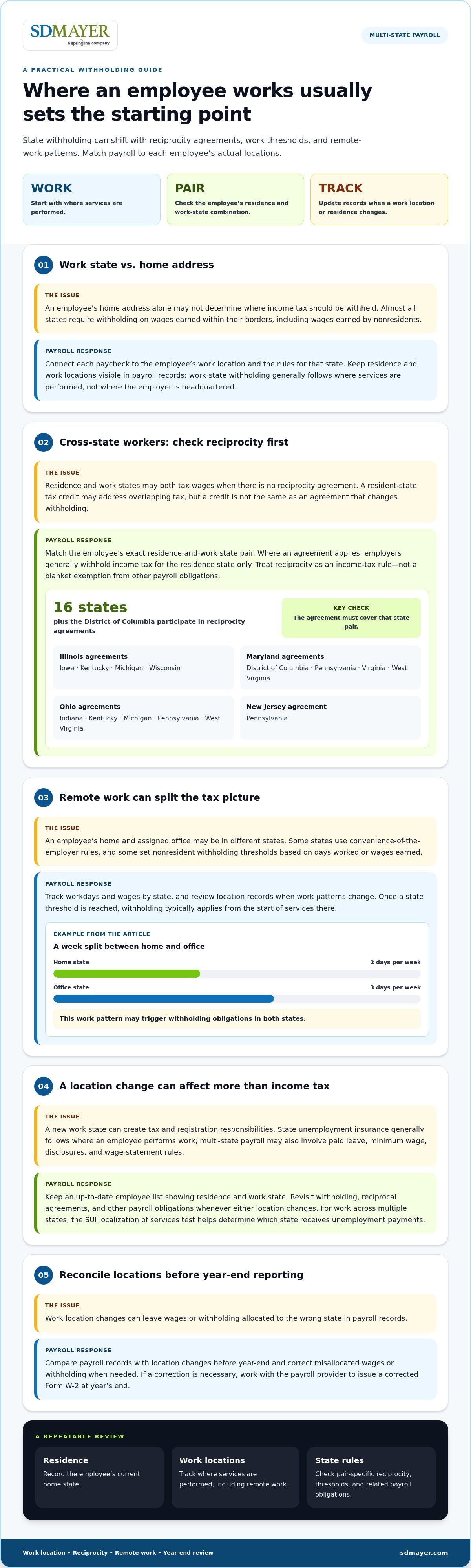
Which state should you withhold income tax for? For multi-state tax compliance, the default rule is to withhold for the state where an employee performs services. Almost all states require withholding on wages earned there, including wages earned by nonresidents. Remote work, state thresholds, and reciprocity agreements can change the result, so an employee’s home address alone may not settle the question.
It’s understandable to expect one clear answer for every employee. In practice, the right withholding approach depends on where the work happens, whether the states have a reciprocity agreement, and whether a state-specific threshold applies. This guide explains how these factors shape withholding, how employee residence and business presence can create obligations across state lines, and what mid-sized businesses should consider when operating across states or serving a broader multistate or multinational enterprise.
Key Takeaways
- Start with where employees perform their work, then account for state-specific withholding rules and any applicable thresholds.
- Review reciprocity agreements for employees who live and work in different states; these agreements can affect which state’s income tax to withhold.
- Track employee moves and remote-work locations, since a new work state can create tax and registration responsibilities.
- Consider payroll, income, and other state tax obligations together when your business operates across state lines.
- Build a consistent compliance process as your business grows, and use accounting and advisory support to strengthen oversight and reporting.
Reciprocity agreements
For an employee who lives in one state and works in another, a reciprocity agreement can change which state receives income tax withholding. If the states have an agreement, employers generally withhold income tax for the employee’s state of residence only. The work location may still matter for other payroll obligations, so treat reciprocity as a specific income-tax rule, not a blanket exemption.
Sixteen states and the District of Columbia participate in reciprocity agreements. The agreements are state-specific: an employee’s residence and work states must be a participating pair. For example, Illinois has agreements with Iowa, Kentucky, Michigan, and Wisconsin. Maryland’s agreements cover the District of Columbia, Pennsylvania, Virginia, and West Virginia.
- New Jersey and Pennsylvania have an agreement.
- Ohio has agreements with Indiana, Kentucky, Michigan, Pennsylvania, and West Virginia.
- Reciprocity agreements can affect which state receives income tax withholding, while residency may also matter.
These examples show why payroll teams should match each employee’s residence to their actual work state. Don’t assume an agreement covering one neighboring state also applies to another. Record the state pair, employee residence, and applicable withholding treatment in payroll, then revisit the entry if the employee relocates or changes work locations.
Reciprocity agreements can help prevent two states from withholding income tax on the same wages. Without an agreement, an employee working in one state and living in another may face taxation by both. The resident state may provide a tax credit for taxes paid to the work state. That credit is distinct from reciprocity: an agreement can change withholding, while a credit may address overlapping tax when both states tax the income.
State tax laws also use allotment or apportionment rules and credits to help residents avoid double taxation. Those mechanisms are not interchangeable. An employer should first determine whether the employee’s state pair has a reciprocity agreement. If it does, apply the agreement’s residence-state withholding approach. If it doesn’t, consider work-state withholding and how the resident state may treat taxes paid elsewhere.
For mid-sized employers with staff crossing state lines, make the review repeatable. Keep an up-to-date employee list showing residence and work state, identify applicable reciprocal tax agreements, and update payroll when either location changes. Assess reciprocity for each cross-border employee rather than relying on a company-wide assumption. A state-by-state review makes withholding decisions clearer and supports consistent multi-state tax compliance.
State and local income tax withholding
Sales tax rates and sourcing rules vary by state; Alaska, Delaware, Montana, New Hampshire, and Oregon are listed as having no sales tax, while California’s statewide sales and use tax rate is 7.25 percent, including 1.25 percent in local use taxes, according to the California Department of Tax and Fee Administration. For payroll, employers generally withhold income tax where employees perform services, and SUI generally goes to the state where employees work.
For employers, the key is linking each paycheck to the employee’s work location and the applicable state rules. That connection can change when someone works remotely or divides time between locations.
State Income Tax Withholding
State income tax withholding is the amount an employer deducts from wages for state income taxes and sends to the relevant state. It matters because almost all states require withholding on wages earned within their borders, including wages paid to nonresidents. Mid-sized businesses should keep payroll records showing each employee’s residence and work locations, so income tied to each state is visible.
Rates and Work-State Withholding
Work-state withholding generally follows where an employee performs services, rather than where the employer is headquartered. State income tax rates and withholding rules differ, so payroll settings for one state may not fit another. Some states set a threshold based on days worked or wages earned before requiring nonresident withholding; once reached, withholding typically applies from the start of services there. Track workdays and wages by state.
Remote Work and Income Sourcing
Remote work makes income sourcing more complex because an employee’s home and assigned office may be in different states. Some states apply convenience-of-the-employer rules, which consider whose convenience the remote arrangement serves. For example, an employee working two days per week from home in one state and three days at an office in another may trigger withholding obligations in both. Keep location records current and review them when work patterns change.
A work location can affect more than state income tax. The State Unemployment Tax Act, also called state unemployment insurance, generally follows where the employee performs work. When someone works across multiple states, the SUI localization of services test helps determine which state receives those payments. Multi-state payroll can also involve state rules for paid leave, minimum wage, disclosures, and wage statements, so assess the broader payroll picture alongside income tax withholding.
Year-end reporting should reflect the state income tax information reported on each employee’s W-2. Compare payroll records with work-location changes before year-end, and correct misallocated wages or withholding when needed. If a correction is necessary, an employer can work with its payroll provider to issue a corrected Form W-2 at year’s end. For mid-sized teams, consistent location tracking helps payroll decisions stay connected to actual work patterns. Discuss state and local tax support when your payroll spans multiple states.
Employee residence and work-location tax jurisdictions
An employee’s residence and work location can create separate state tax responsibilities for a business. Late registration, filing, or payment can lead to fines, interest on unpaid or late-paid payroll taxes, legal consequences, and property liens.
Remote and Hybrid Employee Tax Obligations
Remote and hybrid work can connect an employee’s wages to states beyond the employer’s main office. A state may tax income earned by its residents, including income from work performed elsewhere. Employers generally should register in each state where employees work, supporting accurate tax reporting and compliance with other state requirements.
For example, an employee’s move to another state can affect withholding, registration, and payroll records. A remote-work policy alone doesn’t settle the tax treatment. The employee’s actual residence, work location, and state rules all matter. Keep those details aligned when processing payroll.
Employee Location Records
Location records connect employee information to payroll, income tax withholding, and state reporting. Maintain each employee’s current residence, work locations, and the dates those details change. Dated records help show which state’s rules applied to wages during a particular period and support accurate filings.
Use a consistent process for reporting moves and work-location changes. Ask employees to notify management promptly, then update payroll and review affected wages and withholding. This matters even if only one employee works in a new state: that person may establish business nexus there.
Business presence or an employee working in a state can require a state tax withholding account. Once tax nexus is established, employers must withhold applicable taxes from employee paychecks. Nexus may arise for income tax, state unemployment tax, sales and use tax, or workers’ compensation tax. The obligations depend on the connection between the business and that state.
Keep the response practical. When an employee starts working in a new state, identify the start date, assess registration needs, and connect the decision to payroll setup. Employers generally pay state unemployment insurance to the state where the employee performs work. If the employee works in multiple states, the localization-of-services test helps determine where those payments go.
A relocation discovered after payroll has been processed needs a clear correction path. Determine when the move began, register in the new state if required, correct misreported wages or withholding, and update the payroll record. For example, if an employee moved without notifying management, use available employment and payroll records to establish the move date and identify affected reporting periods.
For mid-sized businesses, assign responsibility for collecting location updates and routing them to payroll. Review changes before the next payroll run and keep supporting records with tax filings. An employee’s work location can affect state income tax obligations. Treat each location change as a trigger to reassess withholding and registration, rather than relying only on the employee’s original work address.
Payroll tax nexus and state registration
Payroll tax nexus is a business’s legal connection to a state, often through physical presence or strong economic activity. Identifying that connection helps mid-sized businesses determine where state and local registrations and payroll filings may apply.
State Nexus Rules
Nexus rules describe when a business’s activities create a tax connection with a state. For payroll, review where employees perform work and whether the business has other activity in that state. A connection can affect state income tax, unemployment tax, or workers’ compensation tax obligations. The United States has 50 states, each with differing payroll tax rates and rules.
Economic nexus is a separate consideration from payroll nexus. The U.S. Supreme Court’s 2018 Wayfair decision established economic nexus as a basis for state tax obligations without physical presence. The 1992 Quill case established the earlier physical-presence standard. These decisions concern state tax nexus broadly, so don’t assume a sales-tax threshold automatically determines payroll tax obligations.
For example, a business may have a remote employee working in a state where it has no office. That work location can create a reason to assess state registration and payroll responsibilities. Review each state connection by tax type rather than treating one nexus decision as covering every state and local obligation.
Filing Frequencies, Deadlines, and Payments
Each state sets its own filing frequency, deadlines, and payment rules, which can differ across a company’s state accounts. The schedule depends on the state and tax type, so maintain a separate calendar for each registration and follow the filing frequency assigned to that account.
This variation matters because a single payroll calendar may not capture every state’s reporting and payment requirements. Record each account’s filing schedule, due dates, payment process, and responsible owner. Keep federal payroll tasks distinct from state payroll filings, then reconcile state submissions against payroll records.
Use a practical registration workflow when a new state connection appears:
- Identify the activity creating the connection, such as an employee’s work location.
- Determine which tax accounts apply, including income tax withholding and state unemployment tax.
- Register for relevant accounts and record their filing and payment schedules.
- Revisit the state list when business activities or employee locations change.
State registration supports payroll compliance, but it doesn’t replace the need to track tax types separately. A business might need to assess income tax withholding and unemployment tax independently. Keep account confirmations, filings, and payment records together so each state’s reporting can be reviewed against the related payroll period.
For a mid-sized business operating across state lines, a central register can show each state, tax account, filing frequency, deadline, and payment status. Assign an owner to update it when a new location or activity creates a possible connection. This gives finance teams a clear view of open registration and reporting tasks without confusing state obligations with federal processes.
Compliance for multistate and multinational enterprises
Operating across state or national borders means coordinating tax responsibilities across different governments. The Multistate Tax Commission works with states and taxpayers to support fair and efficient administration of state tax laws affecting multistate and multinational enterprises. For mid-sized companies, the practical task is connecting payroll tax compliance with how income is divided among states, local tax rules, and clear reporting.
The Multistate Tax Commission helps determine how much business income belongs to each state, including resolving disagreements about that division. This matters when company activity spans states and income cannot be assigned to only one location. Keep records explaining the business activity and financial information used to support each state income tax filing.
Different state rules can also lead to the same income being taxed more than once. The U.S. Constitution does not prohibit double taxation by states when it is not arbitrary. The Multistate Tax Commission works to make important parts of state tax systems more consistent, help taxpayers meet filing requirements, and avoid duplicate taxation. Organized records and a clear method for dividing income help support these goals.
For a multinational enterprise, consider state tax reporting alongside the company’s broader cross-border process. Identify the entities, workers, and business activities connected to each state, then link those facts to the relevant state and local tax obligations. For example, a company with workers in several states can align payroll records with the financial information used to divide income. Shared records help the finance team spot mismatches before filing.
Software and professional-service costs depend on factors such as the number of states involved, business complexity, employee footprint, and support needed. Professional-service pricing depends on the case and is provided after a quote request. Compare the work involved, including registrations, payroll filings, income allocation, and ongoing reporting, rather than relying on one headline price.
Build a repeatable process with clear ownership and documentation. Assign responsibility for gathering worker and entity details, maintaining state-level records, and coordinating payroll and tax reporting. When the company enters a new state or changes its operations, review affected filings and the method for dividing income. The Multistate Tax Commission’s role in helping taxpayers meet filing requirements highlights the value of organized, accessible records.
For mid-sized businesses working across several states, a coordinated review can connect payroll, state income tax, local tax, and income allocation. Discuss your multistate tax reporting needs to explore how accounting and tax support can help organize these responsibilities.
SD Mayer: Client Accounting & Advisory Services (CAAS)
SD Mayer provides Client Accounting & Advisory Services (CAAS) for businesses that need clearer financial processes as they operate across states. When payroll activity, state filings, and financial reporting span jurisdictions, coordinated accounting support can help your team keep records organized and make informed decisions.
Mid-sized businesses can also turn to SD Mayer for Outsourced & Managed Services, including outsourced CFO and controller support, when they need additional financial leadership and oversight. These services can support a broader view of reporting and business performance alongside day-to-day accounting needs. For organizations requiring independent review work, SD Mayer also offers Single audits and Agreed-Upon audit procedures.
Consider where your internal team needs added capacity, then contact SD Mayer to discuss your accounting and advisory needs.
Build a Stronger Foundation for What Comes Next
As your business expands into new markets or changes how teams work, make tax ownership part of growth planning. Assign responsibility for tracking changes, keep a shared record of decisions, and involve finance and payroll leaders early in conversations about new locations. These habits help make multi-state tax compliance a continuing business process, not a task that surfaces only during filing season.
Choose a review rhythm that fits your operations and use it to consider whether business changes affect your financial processes. Clear ownership and timely communication can help mid-sized companies respond thoughtfully as their footprint evolves. You don’t need to solve every future scenario at once; start by identifying the next business change and who should assess its financial impact.
For support connecting accounting needs with business decisions, contact SD Mayer to discuss your tax guidance needs. A clear next step can help your team move forward with greater confidence.
Frequently Asked Questions
How do you determine which state taxes to withhold?
Start with where the employee performs work, then consider the employee’s home state and any agreement between those states. For a worker who splits time across state lines, keep a record of work locations and the wages connected to each. Review the relevant state rules before setting payroll withholding. This gives your finance team a clear basis for payroll records and year-end reporting.
What is multi-state tax compliance?
It means handling a business’s tax responsibilities in each state where its employees or activities create obligations. Those responsibilities may include payroll withholding, unemployment tax, state income filings, sales tax, and registrations. A practical starting point is a state-by-state record identifying business activity, employees, relevant tax accounts, and filing tasks. Keep it updated as the company adds locations or changes how its teams work.
When does a business have sales tax nexus in another state?
A business may have a sales tax connection with another state because of its physical presence or its sales activity there. Some states use sales thresholds to determine when that connection creates tax responsibilities. A $100,000 sales threshold is the most common economic-nexus threshold described, but the rules vary by state. Track sales by destination and review each state’s requirements before deciding whether registration is needed.
How do state income and franchise tax nexus rules differ?
Income-tax connection rules determine whether a state may require a business to report or pay tax on its income. Franchise tax is a separate state tax, and its connection rules may differ from income-tax rules. Review each tax separately in every state where the business operates. Keep a record of the activity considered and the filing decision, so your team can explain how it reached its conclusion.
How do you register to collect and remit taxes in multiple states?
First identify which tax responsibilities apply in each state, then register for the corresponding state tax account. Keep the account details, filing schedule, payment instructions, and responsible staff member in one central record. For example, a company opening a new office can tie registration tasks to its launch plan. Review the record when business activity changes, and retain filing confirmations with the related state records.
How should businesses apportion income across states?
Apportioning income means dividing business income among states according to the rules each state applies. The Multistate Tax Commission supports fair allocation of income and helps address disagreements about how it is divided. Maintain clear records of the business activity and financial information used for each state’s calculation. When operations change, review whether the existing allocation still reflects the company’s activity and update supporting records.
How can a business assess its multi-state tax exposure and become compliant?
Start by listing the states connected to your employees, offices, sales, and other business activity. For each state, note the tax types involved, registration status, filing tasks, and any open questions. Then assign owners to resolve gaps and keep the record current as the business changes. Mid-sized businesses with complex state activity can also use State & Local Tax (SALT) support to organize the review and compliance work.
What are the sales tax rates and sourcing rules by state?
Sales tax rates and sourcing rules vary by state. Alaska, Delaware, Montana, New Hampshire, and Oregon have no sales tax; California’s statewide rate is 7.25 percent, including 1.25 percent in local use taxes.
SECURITIES AND ADVISORY DISCLOSURE:
Securities offered through Valmark Securities, Inc. Member FINRA, SIPC. Fee based planning offered through SDM Advisors, LLC. Third party money management offered through Valmark Advisers, Inc a SEC registered investment advisor. 130 Springside Drive, Suite 300, Akron, Ohio 44333-2431. 1-800-765-5201. SDM Advisors, LLC is a separate entity from Valmark Securities Inc. and Valmark Advisers, Inc. Form CRS Link
DISCLAIMER:
This material has been prepared for informational purposes only, and is not intended to provide, and should not be relied on for, accounting, legal or tax advice. The services of an appropriate professional should be sought regarding your individual situation.
HYPOTHETICAL DISCLOSURE:
The examples given are hypothetical and for illustrative purposes only.