
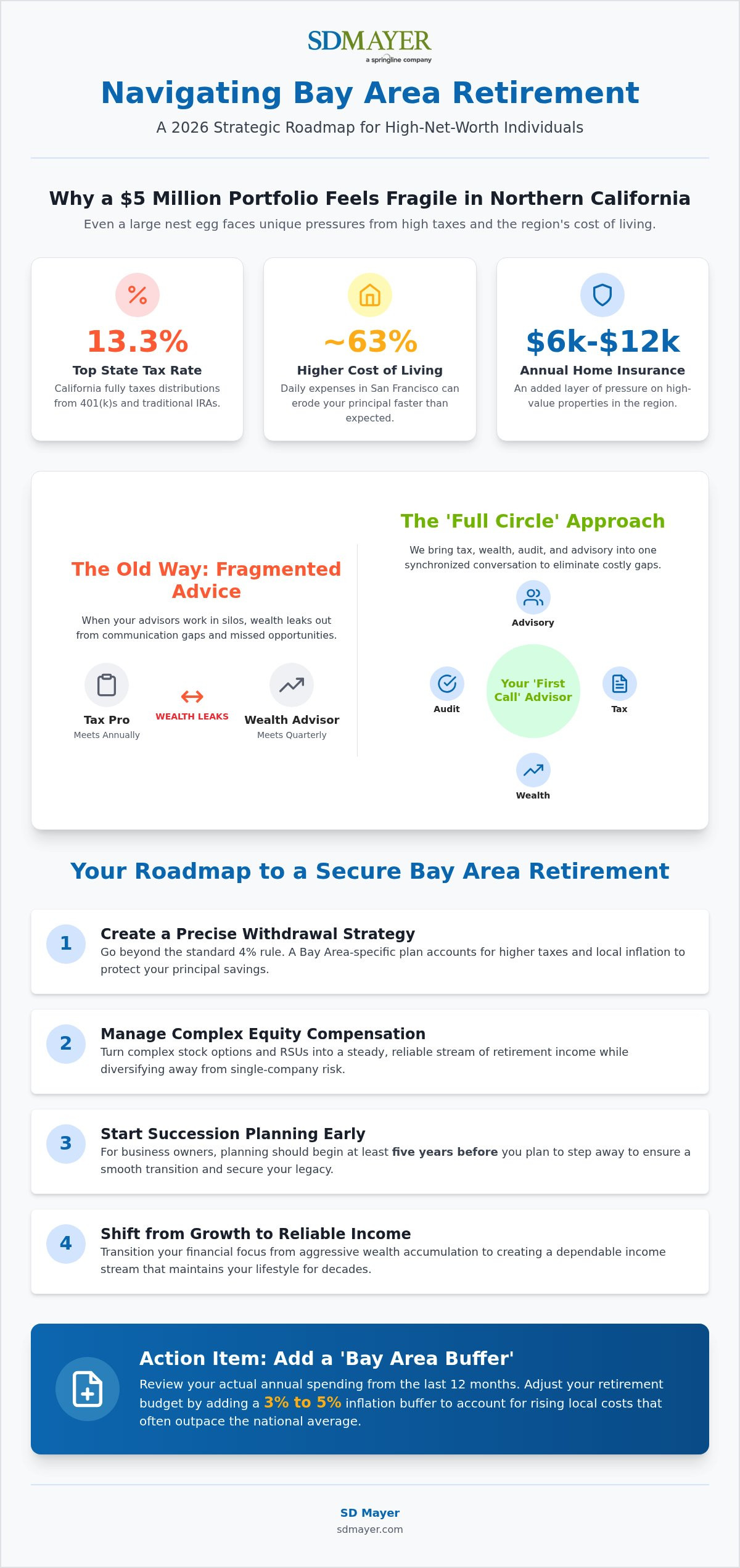
What if a $5 million portfolio in San Francisco or Menlo Park doesn't actually guarantee the lifestyle you've spent decades building? It's a sobering thought. For many, the reality of high net worth retirement planning Bay Area is that a large nest egg can feel surprisingly fragile when faced with a 13.3% top state tax rate and the region's high cost of living. You've spent your career in the growth phase; it's natural to feel some tension as you shift your focus toward creating a sustainable income that lasts.
We understand that your financial picture is uniquely complex. This 2026 strategic guide will show you how to navigate these challenges with a clear, integrated strategy. We'll explore how to minimize tax liability under current exemption rules, manage complex equity compensation for long-term cash flow, and protect your legacy through structured succession planning. By the end, you'll have a practical roadmap to transition from accumulating wealth to enjoying it with total confidence.
Key Takeaways
- Learn why California's high state taxes mean your retirement withdrawal strategy needs to be more precise than the national average to protect your savings.
- Discover how to turn complex stock options and RSUs into a steady stream of retirement income while avoiding the risk of having too much wealth tied to one company.
- See how effective high net worth retirement planning Bay Area relies on a model that connects your tax strategy directly to your investment choices for better long-term results.
- Find out why business owners should begin their succession planning at least five years before they plan to step away to ensure a smooth transition and secure legacy.
- Get a clear roadmap for shifting your financial focus from aggressive growth to reliable income so you can maintain your lifestyle throughout your retirement years.
The Bay Area Retirement Challenge: Why High Net Worth Is Only Half the Story
Living in the Bay Area is a choice often driven by career and culture, but it comes with a high price tag that doesn't disappear when you stop working. Even with a significant portfolio, high net worth retirement planning Bay Area requires a different lens than planning in other regions. It's not just about how much you've saved. It's about how much you get to keep after the "California tax" takes its share. Most professionals spend decades in the growth phase, and shifting into a mindset of protecting and spending that wealth can be a massive psychological hurdle. It's the difference between being a builder and being a steward of your own legacy.
In 2026, the traditional 4% safe withdrawal rate is being questioned by many local families. With San Francisco's cost of living sitting about 63% higher than the national average, your daily expenses can eat into your principal faster than expected. Rising costs for homeowners insurance, which can now run between $6,000 and $12,000 annually for high-value homes, add an extra layer of pressure. You aren't just planning for a standard retirement; you're planning for one in a top-tier market where utilities, services, and taxes are significantly higher than the national median.
The 2026 Tax Landscape for Northern California
California's progressive tax system is one of the most aggressive in the country. For high earners in San Mateo or Sacramento, the combination of federal rates and the state's top 13.3% rate creates a unique headwind. When managing various retirement plans in the United States, many people forget that California fully taxes distributions from 401(k)s and traditional IRAs as ordinary income. Standard advice often misses these local nuances, leaving families with a much smaller net income than they projected. State and local taxes (SALT) remain a top concern, especially as we look at how 2026 tax adjustments might impact high-income filers.
Why 'Good Enough' Planning Fails HNW Families
Most families have a tax professional they see once a year and an investment advisor they talk to quarterly. These two rarely speak. This fragmentation is where wealth leaks out of a portfolio. If your investment choices don't account for strategic tax advice, you might be paying more in capital gains than necessary. This is where high net worth retirement planning Bay Area moves beyond simple math and into strategic coordination. We believe in a 'Full Circle' approach where every financial decision is viewed through a tax, wealth, and advisory lens simultaneously to eliminate these costly gaps.
Action Item: Review your actual annual spending from the last 12 months. Adjust your retirement budget by adding a 3% to 5% "Bay Area inflation" buffer to account for rising local costs in utilities and insurance premiums. For specialized support with Medicare planning, The Modern Medicare Agency can help you navigate your options to ensure your medical coverage aligns with your long-term financial goals.
The Full Circle Approach: Integrating Tax Strategy with Wealth Management
Successful high net worth retirement planning Bay Area isn't just about picking the right stocks; it's about making sure your tax strategy and investment goals are reading from the same playbook. Most people have a fragmented financial life. They talk to a CPA in April and a wealth manager in October, but these two professionals rarely coordinate. This gap is where opportunities for tax savings and portfolio growth are often lost. When your advisors work in silos, you're the one left to bridge the communication gap.
We call our solution the 'Full Circle' model. It brings tax, wealth management, audit, and advisory into one synchronized conversation. By receiving strategic tax advice alongside your investment planning, you ensure that every dollar is working as hard as possible. Acting as your 'First Call' advisor, we simplify the complex parts of your financial life so you can focus on enjoying your retirement rather than managing your managers.
Tax Planning as a Retirement Engine
Proactive tax planning acts like a hidden engine for your portfolio. It's about finding money that's already there. Instead of just reacting to the previous year, a modern tax advisor looks at a 10-year window. This helps you time withdrawals to stay in favorable tax brackets. For those with diverse assets, maintaining financial reporting compliance is essential to avoid penalties that erode your savings.
The Power of the BDO Alliance for Global Assets
Families in the Bay Area often have interests that cross borders, such as vacation homes or family abroad. We provide the personal touch of a local firm while leveraging the 5th-largest global network. This global view is vital for high net worth retirement planning Bay Area, especially when aligning with the California economic outlook. You get global stability with a partner who knows your name.
Action Item: Audit your current financial team. Ask your CPA and your wealth manager when they last spoke to each other without you being the one to initiate it. If they aren't collaborating at least quarterly, you might be missing out on critical planning opportunities.
If you're ready to see how an integrated plan can simplify your financial life, you can reach out to our team to start the process.
Navigating the Equity Maze: Stock Options and Early Retirement
For many professionals, high net worth retirement planning Bay Area isn't just about a 401(k) or a savings account. It's about the company stock that often makes up the lion's share of your wealth. Whether you're at a legacy tech giant or a mid-market firm, your equity is likely the engine that will fund your life after work. Understanding how to manage this wealth without letting taxes or market volatility derail your plans is the key to a secure exit.
Let's break down the common types of equity in plain English. Restricted Stock Units (RSUs) are essentially a promise of shares that become yours over time; they're taxed as ordinary income the moment they vest. Incentive Stock Options (ISOs) can offer significant tax advantages if you meet specific holding periods, while Non-qualified Stock Options (NSOs) are more common but don't have those same perks. The goal is to turn these "paper" assets into a reliable income stream.
The biggest threat to a Bay Area retirement is concentration risk. Research shows that stock options remain the most common vehicle for executives at 44%, followed by RSUs at 31%. If 80% of your net worth is tied to one company's ticker symbol, you aren't retired; you're gambling. A single bad quarter shouldn't be enough to push your retirement date back by five years. Diversification isn't just a buzzword. It's a survival strategy for your lifestyle. Incorporating advanced analytics from a machine-learning think-tank like Rebellion Research can help you better understand market trends and protect your portfolio from these sudden shifts.
California treats capital gains as ordinary income, which means you could face a top rate of 13.3% on your stock sales. This makes the timing of your sales critical. For early-stage founders and employees, Qualified Small Business Stock (QSBS) benefits can be a massive win, potentially allowing you to exclude up to $10 million in gains from federal taxes. A simple rule of thumb is to avoid letting any single stock exceed 10% to 15% of your total portfolio, regardless of how much you believe in the company's mission.
Managing Liquidity for Tech Professionals
Turning paper wealth into a monthly paycheck requires careful cash management. You don't want to be forced to sell shares during a market dip just to cover your property taxes or a mortgage. We recommend keeping one to two years of living expenses in cash or short-term bonds. This buffer gives you the flexibility to wait for a "liquidity event" or a market recovery before you tap into your equity holdings for income.
Action Item: Create an 'Equity Inventory.' Map out every grant you own, its vesting dates, and the potential tax triggers for the next three years. Seeing these dates on a calendar helps you plan for tax payments and identifies the best windows for diversifying your holdings.
Legacy and Succession: Planning for the Mid-Market Business Owner
For many mid-market owners in San Leandro or San Jose, the business isn't just a career; it's the entire retirement portfolio. This creates a specific tension in high net worth retirement planning Bay Area. If 80% of your wealth is locked inside your company's operations, you don't have the luxury of just "stopping" work. You have to unlock that value through a structured exit. Research shows that while retirement is the primary motivation for 45% of owners looking to sell, only 54% have a formal succession plan in place. Without a roadmap, you risk leaving your legacy and your financial security to chance.
We recommend starting this process at least five years before your target retirement date. This timeframe is vital because 62% of owners find the succession process overwhelming. A five-year lead allows you to address the "qualified successor" gap, which currently affects 35% of firms. It also gives you the runway to improve your business's value so it can fully fund the lifestyle you've planned. Transitioning from being an operator to a steward of wealth is a major emotional shift, but it's easier when the math is on your side.
Exit Strategies: From M&A to Internal Succession
Selling to a third party often yields the highest immediate sale price, but internal succession to family or key employees can better preserve the company culture you've built. To maximize your value in either scenario, your financials must be beyond reproach. Utilizing professional CFO services can help you clean up your books and improve reporting compliance long before a buyer starts their audit. A precise business valuation is the only way to know your true "starting line" for retirement.
Estate Planning and Philanthropy
Once a sale occurs, many families move to a "Family Office" model to manage their new liquidity. This isn't just about investing; it's about protecting assets for the next generation. We use a "5 Bucket Foundation" approach to integrate your charitable goals with financial literacy for your heirs. By using trusts to shield your assets, you ensure your hard work supports your family and the Bay Area causes you care about without being eroded by unnecessary taxes.
Action Item: Schedule a preliminary business valuation this quarter. You can't build a reliable retirement plan on a "guess" of what your company is worth. Knowing your current value identifies the gap between your current assets and your ultimate retirement goal.
If you're ready to begin the process of transitioning your business into a secure retirement, contact our succession planning team today for a strategic review.
Building Your Retirement Roadmap: Why SD Mayer Is Your First Call
Effective high net worth retirement planning Bay Area requires more than a spreadsheet; it demands a partner who understands the nuances of the local innovation economy. At SD Mayer, we operate on a philosophy we call "Simply Doing More." This means we don't just react to your financial data. We anticipate your needs before they become obstacles. Whether you're navigating the sale of a mid-market business or managing a complex portfolio of tech equity, you deserve a partner who acts as your first call for every financial decision.
Our onboarding process is designed to move you from uncertainty to a state of calm, capable stewardship. It starts with that initial "First Call" where we listen to your goals and concerns. From there, we build your "Full Circle" plan. This integrated roadmap connects your tax strategy, wealth management, and business advisory needs into one cohesive strategy. You'll benefit from the founder-level expertise of Stephen D. Mayer, who brings over 40 years of experience to the San Francisco financial landscape. Our firm was even named a Top 25 Fastest-Growing Firm in 2025 by Accounting Today, a testament to our commitment to client success.
What to Expect in Your First Strategy Session
Your first session isn't just a meet-and-greet; it's a high-level review of your financial health. We'll look at your tax situation, your wealth goals, and your business exit strategy if you have one. Our team identifies immediate "red flags" in your current retirement plan, such as unnecessary tax leaks or high-risk concentrations in a single stock. We then outline a clear path forward that prioritizes your family's long-term success and peace of mind. You'll leave with a better understanding of how your assets can support the life you've envisioned.
The SD Mayer Community Commitment
We believe that being a leading firm in the Bay Area means giving back to the community that has supported us. Our "We Care" framework ensures that we treat our clients like family, but it also extends to our local neighbors. We are proud supporters of the SF-Marin Food Bank and various local youth programs. When you work with us, you're partnering with a firm that values relationships and community longevity as much as financial accuracy. We're here to be your steady companion through every stage of your personal and professional journey.
Action Item: Don't leave your 2026 strategy to chance. Book a consultation with our integrated tax and wealth team today to start building your personalized retirement roadmap.
Your Path to a Confident Bay Area Retirement
Retiring in Northern California doesn't have to be a source of stress if you have the right coordination. We've explored how a "Full Circle" approach connects your tax strategy with your investments to protect your lifestyle against local headwinds. Whether you're managing complex stock options or preparing to exit a mid-market business, the key is starting early and integrating every piece of your financial life. Shifting from a growth mindset to an income strategy is a big move, but it's much easier with a clear roadmap in place.
At SD Mayer, we provide integrated tax, wealth, and advisory services all under one roof in San Francisco. This holistic model is why we were named one of Accounting Today’s Top 25 Fastest-Growing Firms in 2025. You don't have to handle high net worth retirement planning Bay Area on your own. We're here to be your steady companion, ensuring your transition from building wealth to enjoying it is as smooth as possible. Your legacy is worth the extra attention to detail.
Frequently Asked Questions
What is the most common mistake high net worth individuals make when planning for retirement?
Individuals often treat tax and investments as separate tasks. This leads to missed savings because your investment manager doesn't see the tax bill and your CPA only sees the past. High net worth retirement planning Bay Area requires these two to talk constantly. Without coordination, you might sell assets that trigger unnecessary capital gains or miss out on tax-efficient withdrawal strategies that could save you thousands over your retirement years.
How do I minimize California state taxes on my retirement income in 2026?
You can reduce your California tax burden by timing your distributions to stay within lower brackets and utilizing tax-loss harvesting. Since California taxes retirement distributions as ordinary income, managing the sequence of your withdrawals is vital. We also look at tools like Proposition 19, which allows residents over 55 to transfer their low property tax base to a new home. This can be a huge financial win if you're downsizing within the state.
Is it better to take the standard deduction or itemize if I have a high-value home in the Bay Area?
Most Bay Area homeowners with high-value properties find that itemizing still offers better results, even with the $10,000 SALT cap. High mortgage interest and significant charitable contributions often push you well past the standard deduction limit. We review your specific situation every year to ensure you're using the method that keeps more money in your pocket. It's about looking at the total picture, including your property and philanthropic goals.
When should a mid-market business owner start planning their exit strategy?
You should start planning your exit at least five years before you want to step away. This runway gives you enough time to clean up your financial reporting, improve operational efficiency, and identify a successor. A rushed sale often leads to a lower valuation and higher tax bill. By starting early, you can structure the deal to minimize the tax hit and ensure your business is attractive to the best possible buyers.
What is the difference between wealth management and a family office?
Wealth management focuses primarily on growing and protecting your investment portfolio. A family office goes several steps further by managing your entire financial life, including trust accounting, bill pay, and legacy planning. It's designed for families who need a higher level of "Full Circle" support. At SD Mayer, we provide these services to help you manage the complexity of your estate so you can focus on your family instead of paperwork.
How does the BDO Alliance help me if I have assets outside of California?
The BDO Alliance USA gives us the global reach of the fifth-largest accounting network while keeping our local, responsive culture. If you have assets in other states or family members living abroad, we can tap into experts in over 500 locations. You get the specialized knowledge needed for international tax or multi-state compliance without losing the "First Call" relationship you have with our San Francisco-based team.
Can SD Mayer help me manage my tech company stock options and my personal tax returns?
Yes, we specialize in helping tech professionals manage the intersection of their equity and their tax returns. We look at your RSUs, ISOs, and NSOs to build a plan that maximizes your wealth while minimizing the tax bite. By handling both your stock option planning and your personal tax filings, we ensure that every exercise and sale is timed perfectly to align with your broader high net worth retirement planning Bay Area goals.
Why is an integrated 'Full Circle' approach better than having multiple financial firms?
Having one firm handle your tax, wealth, and advisory needs eliminates the communication gaps that lead to costly mistakes. When your advisors work under one roof, they can share insights in real-time. This "Full Circle" model means your wealth manager knows exactly what your tax advisor is planning for April. It simplifies your life and ensures that every financial decision supports your ultimate goal of a secure and comfortable retirement.
SECURITIES AND ADVISORY DISCLOSURE:
Securities offered through Valmark Securities, Inc. Member FINRA, SIPC. Fee based planning offered through SDM Advisors, LLC. Third party money management offered through Valmark Advisers, Inc a SEC registered investment advisor. 130 Springside Drive, Suite 300, Akron, Ohio 44333-2431. 1-800-765-5201. SDM Advisors, LLC is a separate entity from Valmark Securities Inc. and Valmark Advisers, Inc. Form CRS Link
DISCLAIMER:
This material has been prepared for informational purposes only, and is not intended to provide, and should not be relied on for, accounting, legal or tax advice. The services of an appropriate professional should be sought regarding your individual situation.
HYPOTHETICAL DISCLOSURE:
The examples given are hypothetical and for illustrative purposes only.