
The right question is not only the hourly rate, but how much financial oversight your business needs. How much fractional controller services cost depends on the scope of work, time required, and whether you need ongoing support or help with a specific project.
It’s reasonable to compare that commitment with the cost of hiring a full-time controller, especially when your mid-sized business needs stronger financial processes without a permanent role. This article explains how fractional fees and monthly retainers are structured, how they compare with in-house costs, and what can influence the level of support involved. You’ll also learn when fractional controller support may fit your business and when ongoing, day-to-day oversight may call for an in-house role.
Key Takeaways
- Compare controller fees with financial manager wages, while accounting for the difference between part-time support and a full-time role.
- Look beyond salary when weighing an in-house hire, since benefits and overhead also affect total employment cost.
- Understand how retainers are structured around time, ongoing responsibilities, or specific deliverables.
- Match the level of controller support to your company’s financial workload, reporting needs, and budget.
- Consider fractional support for targeted expertise or changing needs, and in-house oversight when daily availability is essential.
How much do fractional controllers charge?
Fractional controller fees reflect the work and level of support agreed for the business. Compare the scope and time involved, rather than comparing a fee directly with an employee’s salary.
Financial Manager Wages and Fractional Fees
A financial manager’s wage is employee compensation, while a fractional controller fee covers defined professional support. The distinction matters because a salary benchmark does not show how much part-time financial oversight your budget can cover.
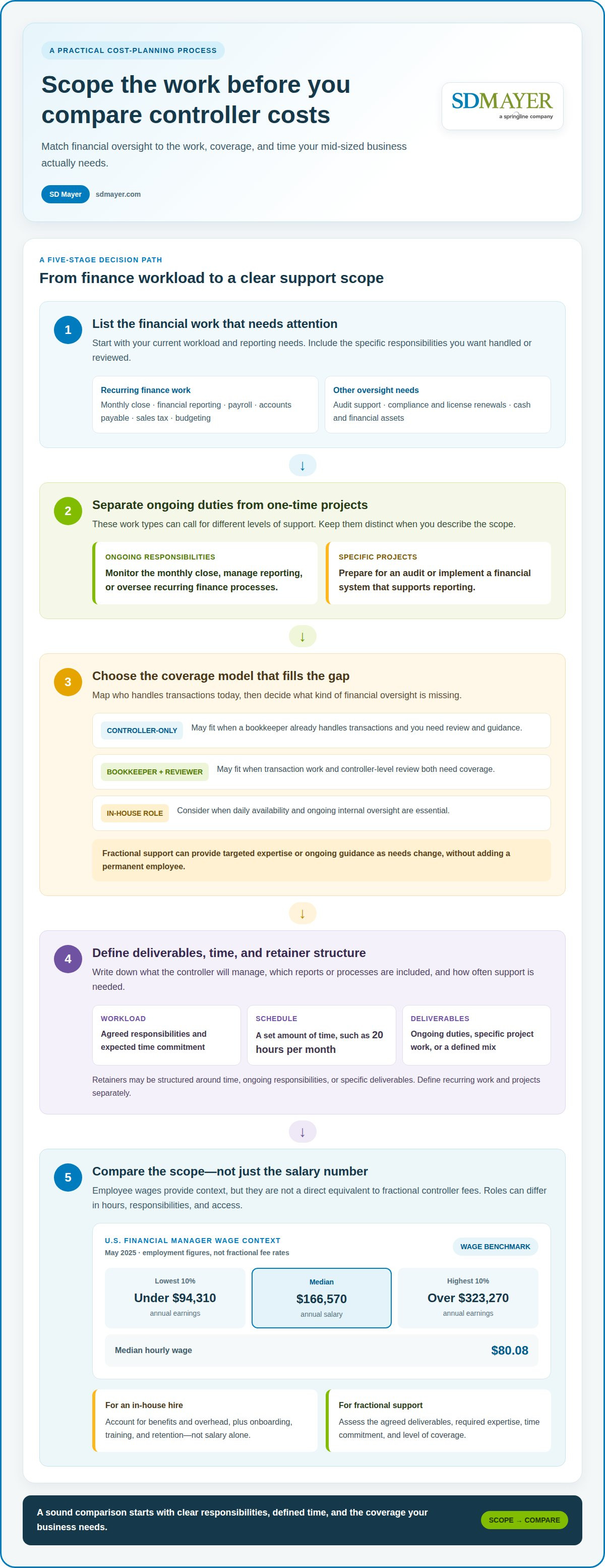
In May 2025, the median annual salary for U.S. financial managers was $166,570, and their median hourly wage was $80.08. These figures provide employment context, not a direct equivalent to a fractional controller’s fees. An employee’s role and a part-time engagement may involve different hours, responsibilities, and access.
For a mid-sized business, start by comparing the needs behind the numbers. A company preparing for an audit or improving financial systems may need project-based support. One that needs regular oversight of its financial operations may need an ongoing arrangement. In either case, define the deliverables and expected time commitment before setting a budget.
Services Included in Fees
Fractional controller fees typically cover agreed financial operations, such as reviewing monthly close processes, managing financial reporting, and overseeing payroll or accounts payable. The exact mix depends on the engagement, so identifying priorities helps clarify what the fee covers.
Audit preparation and financial system projects may also be included. For example, a controller may organize financial information for an audit or help implement a system that supports reporting. These projects differ from recurring duties, such as monitoring the monthly close, so define them separately when discussing scope.
Fees may reflect access to specialized financial expertise without hiring a permanent employee. This can help when your business needs experienced input for a specific project or ongoing guidance across financial processes. Outsourced support can adapt as needs change, rather than tying every engagement to a full-time position.
Before agreeing to an arrangement, divide the work into recurring responsibilities and one-time projects. List the reports, finance processes, and audit-preparation tasks that need attention. Then clarify which responsibilities the controller will manage and how often support is needed. This gives both sides a practical basis for matching the engagement to your operations and budget.
The scope may include monthly close, payroll, sales tax, and budgeting, as well as audit support, compliance and license renewals, and managing cash and financial assets. Specialized project help, such as audit preparation or financial system implementation, may suit businesses that do not need ongoing support.
Salary figures offer context but are not direct fee comparisons: in May 2025, the lowest 10 percent of U.S. financial managers earned under $94,310 annually, while the highest 10 percent earned over $323,270. Consider the deliverables, time commitment, and expertise required when weighing an hourly rate or monthly arrangement.
Fractional versus full-time controller costs
Compare the total cost of an employee with the scope of outsourced financial support. For a mid-sized business, the key question is whether you need ongoing internal coverage or defined finance responsibilities handled externally.
Controller-Only and Bookkeeper-Reviewer Costs
A controller-only arrangement assigns financial oversight to a controller, while a bookkeeper-and-reviewer model divides transaction work and review between roles. This distinction matters because it changes who handles daily records and who checks reporting for accuracy.
For example, a business with a bookkeeper already handling transactions may need a controller to review results and guide financial operations. A company without that bookkeeping capacity may need both transaction support and controller-level review—a dual approach often delivered by international accounting firms like Account Dubai that combine routine bookkeeping with statutory compliance and audit preparation. Map existing responsibilities first, then identify any gaps before comparing the models.
A full-time in-house controller provides ongoing availability, but employment costs include more than salary. These figures show why businesses should assess total employment costs, not salary alone.
Hiring internally can also require onboarding and training, along with ongoing investment in benefits and retention. For instance, a company introducing a new reporting process may need to train an employee on its systems and business practices. Outsourced support avoids adding a permanent employee, though the right comparison still depends on the work and coverage required.
Costs by Service Tier
Service tiers distinguish limited review from broader responsibility for financial operations. A focused arrangement might cover controller review of reporting, while a wider scope could include oversight of recurring finance processes and project support.
For a clear comparison, group your needs into three categories: recurring financial oversight, specific project work, and daily transaction processing. A business that needs monthly reporting reviewed has a different scope from one that also needs system implementation or audit preparation. Defining those needs helps match the service level to the budget without assuming every task belongs in one package.
The figure for your situation depends on the responsibilities, reporting needs, and level of coverage; it is provided in a quote. Clarify which work is recurring and which is project-based to make the scope easier to assess.
If reporting coverage is part of the decision, talk through your reporting needs with a professional.
Monthly fractional controller cost and retainer range
A monthly retainer ties controller support to an agreed workload, schedule, or set of deliverables. The right structure depends on whether your business needs recurring oversight, project help, or both.
Monthly Outsourced Service Pricing
Monthly outsourced controller pricing covers defined financial work on a recurring basis. A retainer helps a mid-sized business plan for ongoing support rather than treating each task as a separate request.
Some retainers are based on a set amount of time, such as 20 hours per month. Others center on deliverables, such as monthly reporting or oversight of finance processes. Describe the work that needs attention, then decide whether time or defined outputs best match your operations.
Calculating Monthly Retainers
A monthly retainer is based on the expected work, time, and responsibilities in the engagement. This helps you understand what recurring support covers and where project work may need separate planning.
For example, list regular tasks such as financial reporting, cash oversight, and review of the monthly close. Then identify one-time work, such as audit preparation or a financial system project. Separating these categories gives the controller a clearer view of the workload before setting the retainer structure.
Estimating Needed Support Hours with a Fractional Controller
A fractional controller can estimate support hours by reviewing your financial processes, recurring deadlines, and reporting needs. The hours should reflect the actual work, not an arbitrary schedule.
A typical U.S. fractional controller engagement is about 14 hours per week. Treat that as context, not a target for every company. A controller can map activities across the month, identify peaks around close or reporting, and recommend an arrangement that reflects your specific workload.
To prepare for that discussion, group tasks into recurring responsibilities and occasional projects. For example, monthly close review may recur, while implementing a financial system is a defined project. This distinction helps clarify which work belongs in a continuing retainer and which may change after completion.
Workload can shift as business needs change. New reporting requirements, audit preparation, or changes to finance processes can affect the support schedule. Review the engagement scope when these changes arise so the hours and responsibilities stay aligned.
Before agreeing on a retainer, document the reports, review points, and finance processes that need attention. Include who supplies records and who handles each step. A clear division of responsibilities helps the controller estimate the effort required and gives your team a shared basis for reviewing the arrangement.
Fractional controller cost compared with hiring an in-house controller
The comparison involves more than a monthly bill. Hiring an in-house controller adds an employee to your organization, while fractional support provides part-time or project-based coverage. For a mid-sized company, the better fit depends on how often financial decisions need attention and how closely the role must connect with daily operations.
Salary is only one part of an employer’s expense. Benefits and overhead also contribute, and onboarding takes time before a new hire understands the company’s reporting, systems, and processes.
An in-house controller can respond directly to financial questions and build institutional knowledge over time. For example, someone working alongside department leaders may understand how a change in purchasing affects cash planning. That familiarity can support long-term decisions, especially when finance is part of daily conversations across the business.
Fractional coverage takes a different approach. A part-time professional can oversee finance operations without joining the payroll as a permanent employee. This structure may suit a company with defined controller responsibilities but less need for a full-time presence. It can also help during leadership transitions, where external providers like PCFO offer part-time CFO and Finance Director support while internal responsibilities evolve.
Availability is an important trade-off. An in-house controller can be on hand for routine questions and emerging issues; a fractional controller divides time across client businesses. If your company needs immediate, day-to-day interaction with finance leadership, an employee may fit better. If your priorities are scheduled reporting reviews and specific projects, part-time coverage may better match the workload.
Compare options based on the work itself. Identify whether the role must handle ongoing financial processes, support reporting, or focus on defined deliverables. Then consider how much context the person needs from department leaders and how often the business expects decisions. A recurring need for in-person collaboration points to a different structure than periodic financial review.
Cost comparisons should also account for hiring demands and continuity. Recruiting, onboarding, benefits, and retention all affect an in-house arrangement; an outsourced engagement is shaped by its agreed scope and time. Neither structure suits every company. A business seeking daily oversight may value an employee’s availability, while one with narrower controller needs may prefer flexible support.
Before choosing, map the role’s expected responsibilities against the company’s operating rhythm. List recurring decisions, reporting deadlines, and situations requiring direct access to a controller. This helps clarify whether the business needs a permanent internal presence or targeted support that can adapt as finance needs evolve.
When businesses may need fractional controller services
Fractional controller support can suit a company that needs stronger financial oversight without a full-time role. A clear signal is a mismatch between current finance capacity and the decisions or reporting the business needs.
A CFO transition is one situation where temporary or ongoing controller support may help. For example, when leadership responsibilities are changing, a controller can maintain financial processes and prepare reporting while the company adjusts. This can keep information flowing to decision-makers during the transition.
Declining return on investment is another reason to examine finance operations. A controller can review financial results, identify trends, and provide reports that support timely business decisions. If leaders cannot readily see which activities affect performance, clearer reporting can help them assess where to focus.
Project needs can also call for fractional expertise. Audit preparation, financial system implementation, or changes to internal accounting procedures may require focused support without creating a permanent position. Once the project is complete, the business can reassess whether recurring controller oversight is still needed.
Fractional support can scale as workload changes. A company might need help establishing consistent monthly reporting, then reduce involvement once processes become more stable. By contrast, an in-house controller may fit better when employees need daily financial oversight and immediate access to a finance leader.
Before engaging a fractional controller, look for a proposal or contract that clearly defines the scope, deliverables, expected hours, communication cadence, and responsibilities on both sides. It should also explain how project work differs from recurring support and how scope changes are handled. These details help you compare the proposed work with your actual needs.
To assess fit, connect each finance challenge to a specific outcome. For example, pair an audit-preparation need with organized supporting information, or a reporting gap with regular financial results for leadership. Then decide whether the need is temporary, recurring, or part of daily operations. This helps clarify whether fractional coverage or an in-house role better matches the business.
Mid-sized companies should also consider how finance work interacts with other teams. If department leaders need periodic insight for planning, scheduled controller support may be practical. If questions arise throughout the workday, the business may benefit more from an internal presence with deeper day-to-day involvement.
Use the proposal discussion to align the work with your priorities, rather than choosing support based on a title alone. Discuss your controller support needs and the financial responsibilities your business wants covered.
SD Mayer: Outsourced CFO/Controllers
SD Mayer provides outsourced CFO and controller support for businesses that need experienced financial oversight without adding a full-time role. For a mid-sized company in Northern California or the Greater San Francisco Bay Area, this can be a practical next step when financial reporting, day-to-day processes, or leadership transitions call for focused support.
The work can be shaped around your business’s responsibilities and priorities, from recurring controller needs to specific financial projects. If reporting is a priority, SD Mayer can help prepare and deliver financial reports through an ongoing service. Businesses that need technology leadership can also explore part-time CTO support.
Bring your current finance challenges, key reporting needs, and the responsibilities you want covered into the conversation. Contact SD Mayer to discuss outsourced controller support for your business.
Set your finance support around what comes next
The next step is to connect controller support to the decisions your business needs to make. Identify the financial processes that need clearer ownership, the reporting leaders rely on, and the work that may change as the company grows. This gives your team a practical basis for discussing how much fractional controller services cost for the scope you actually need.
For a mid-sized business, finance support can also connect to broader accounting and assurance needs. SD Mayer offers Client Accounting & Advisory Services and audits for organizations that receive federal funding (Single Audits) alongside outsourced CFO and controller support. Consider how these needs relate to your finance priorities, rather than treating each decision separately from the company’s wider plans.
Bring your priorities and current challenges into a conversation about the right scope. Connect with SD Mayer to discuss your needs and plan a thoughtful next step for your business.
Frequently Asked Questions
What is the average hourly rate for fractional controller services in the United States?
If you’re asking, “How much do fractional controller services cost?” the answer depends on the engagement’s responsibilities, expected hours, and financial complexity. The figure for your situation is provided in a quote. For a Northern California or Greater San Francisco Bay Area business, define whether support covers recurring close review, reporting, or a time-limited project before comparing proposals.
How much do fractional controllers charge per month?
A monthly arrangement has no standard amount. If you’re asking, “How much do fractional controller services cost?” consider the agreed scope and workload. A retainer may cover recurring finance responsibilities, while project work may be scoped separately. For example, ongoing reporting oversight differs from preparing for a specific audit. Review the included responsibilities and how scope changes are handled to understand the monthly commitment.
What factors affect fractional controller pricing?
Pricing is shaped by the scope of work, time required, and level of financial oversight. Recurring close review, reporting responsibilities, audit preparation, and financial system projects can each create different workloads. The arrangement may also reflect whether support is limited to a defined deliverable or continues across finance operations. Describe the responsibilities and expected outcomes clearly so the proposal reflects your business’s needs.
Do fractional controllers charge hourly, monthly retainers, or project fees?
Fractional controller engagements can use hourly billing, monthly retainers, or project-based fees. Hourly billing ties payment to time worked; a retainer covers ongoing responsibilities or agreed deliverables; project fees focus on defined work, such as audit preparation. A business with recurring reporting needs may prefer a consistent monthly scope, while a time-limited system project may call for a separate project arrangement. The structure should match the work.
What is the cost of hiring an in-house controller compared with a fractional controller?
An in-house controller’s total employment cost includes salary, benefits, and overhead, while fractional support is scoped around agreed responsibilities and time. Hiring also involves onboarding and maintaining an employee role. In-house coverage can make sense when the business needs day-to-day availability and deep operational knowledge; fractional support may suit defined or changing needs. Compare the total employment commitment with the external scope, not salary alone.
SECURITIES AND ADVISORY DISCLOSURE:
Securities offered through Valmark Securities, Inc. Member FINRA, SIPC. Fee based planning offered through SDM Advisors, LLC. Third party money management offered through Valmark Advisers, Inc a SEC registered investment advisor. 130 Springside Drive, Suite 300, Akron, Ohio 44333-2431. 1-800-765-5201. SDM Advisors, LLC is a separate entity from Valmark Securities Inc. and Valmark Advisers, Inc. Form CRS Link
DISCLAIMER:
This material has been prepared for informational purposes only, and is not intended to provide, and should not be relied on for, accounting, legal or tax advice. The services of an appropriate professional should be sought regarding your individual situation.
HYPOTHETICAL DISCLOSURE:
The examples given are hypothetical and for illustrative purposes only.