
The right CFO decision isn’t set by revenue alone. A full-time CFO often begins to make economic and operational sense at $25 million to $50 million in annual revenue, while complexity and transaction volume can shift that point. To decide when to hire a fractional CFO vs. a full-time CFO, look at how much strategic financial leadership your business needs and how consistently it needs it.
It’s understandable to assume that a growing company needs a full-time finance leader as soon as decisions become more complex. But startups and mid-sized businesses may need CFO-level insight before they need a full-time role, and the right level of support can change as the business grows.
This guide explains how fractional, part-time, and full-time CFO support differ, what each model can address, and which business needs may signal it’s time to move between them. You’ll also get a practical way to weigh revenue alongside financial complexity, growth plans, and the time your team needs from a CFO.
Key Takeaways
- Use revenue as context, not the only hiring trigger; weigh financial complexity, transaction volume, and the leadership your growth plans require.
- Choose fractional, part-time, or full-time support based on how much CFO-level attention you need and whether that need is ongoing or tied to a specific project.
- Separate strategic financial leadership from routine bookkeeping and accounting work so the role you choose matches the actual gap.
- Assess readiness by identifying upcoming decisions, such as fundraising, expansion, or an acquisition, and the financial insight each one requires.
- Prepare focused interview questions about forecasting, reporting, cash flow, and decision support to evaluate how a CFO will help your business move forward.
At what revenue level should a company hire a full-time CFO?
Revenue offers a starting point, not a hiring rule: complexity and leadership demands matter just as much. A fractional CFO may have limited availability and provide less day-to-day oversight, so define responsibilities and decision coverage before choosing this model.
Revenue and Complexity Triggers
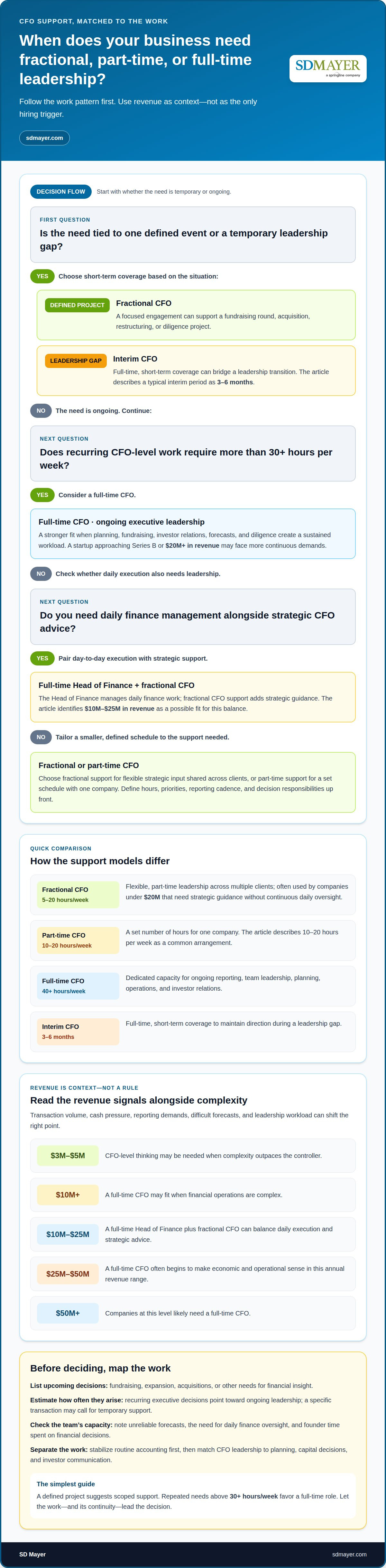
A full-time CFO may fit a company with $10M+ in revenue and complex financial operations. A business reaching $3-5 million in revenue may need CFO-level thinking when complexity outpaces its controller. These are different signals: revenue shows scale, while issues like cash pressure, multiple reporting needs, or difficult forecasts show the depth of expertise required.
Use revenue as a guide, then assess the work. A full-time CFO typically begins to make economic and operational sense at $25 million to $50 million in annual revenue; companies with $50M or more likely need one. For companies with $10M-$25M in revenue, a full-time Head of Finance with fractional CFO support can balance daily execution and strategic advice.
Ongoing Full-Time Leadership
Recurring financial planning, fundraising, and investor relations can justify full-time leadership when they require more than 30+ hours/week of CFO-level work. A startup approaching Series B or $20+ million in revenue may face more continuous demands for forecasts, investor updates, and diligence materials than a project-based engagement can cover.
A single fundraising round, acquisition, or restructuring may instead call for short-term expertise. A fractional CFO can support a defined project, while an interim CFO typically works full-time for 3-6 months to bridge a leadership gap. The distinction is duration: repeated executive decisions point toward an ongoing role; a specific transaction points toward temporary support.
| Option | Revenue signal | Work pattern | Best fit |
|---|---|---|---|
| Fractional CFO | Often under $20 million | Part-time, flexible leadership | Strategic guidance without continuous daily oversight |
| Full-time Head of Finance plus fractional CFO | $10M-$25M | Daily finance management plus strategic support | Board, fundraising, or planning needs alongside execution |
| Full-time CFO | Often $25 million to $50 million or more | Ongoing executive leadership | Complex operations and sustained CFO-level workload |
| Interim CFO | Any stage facing a leadership gap | Full-time, short-term coverage | Maintaining direction during a transition |
To choose, list the decisions a CFO must own over the next year, then estimate how often they arise. Consistent needs above 30+ hours/week favor a full-time role; a defined financing or diligence project may suit fractional support.
Other signals include a finance team needing daily executive oversight, unreliable forecasts, or financial decisions consuming more than 5 hours per month of a founder’s time. Match the hire to the work: stabilize routine accounting first, then add CFO leadership when planning, capital decisions, or investor communication exceed the team’s capacity.
Do You Need a Part-time, Full-time, or Fractional CFO?
A full-time CFO offers dedicated leadership, while fractional and part-time arrangements tailor CFO support to defined needs. Fractional support can limit overhead, but availability is shared. The best fit depends on workload, continuity, and the financial decisions your team must make.
Full-Time Salary and Employer Costs
In the United States, the average full-time CFO salary is $229,069 per year before benefits. Budget for the employment cost, not just base salary. A full-time executive also brings dedicated capacity for reporting, team leadership, and ongoing financial decisions.
Recruiting adds another cost: fees typically amount to 15-25% of first-year salary. Include that expense when preparing a hiring budget, alongside the time needed to recruit and onboard a permanent leader. This model is most valuable when the company can use sustained CFO attention across planning, operations, and investor relations.
Fractional Costs and Engagement Hours
Fractional CFO costs depend on the engagement’s scope and hours, rather than a full-time salary and employment package. Fractional CFOs typically work 5-20 hours per week across multiple clients. That structure can suit a mid-sized company needing strategic input, financial planning, or fundraising support without assigning the work to a full-time executive.
Part-time CFOs, by contrast, work a set number of hours for one company; a common arrangement is 10-20 hours per week. Define the hours, priorities, reporting cadence, and decision-making responsibilities before work begins. This makes it easier to see whether the agreed capacity covers recurring needs or only a limited project.
Total CFO Hiring Costs
Compare total cost with expected use. A full-time role includes salary, employer costs, and recruitment fees, while fractional support is scoped to an agreed engagement. A full-time CFO typically works 40 or more hours per week; fractional availability is lower and shared. The practical comparison is the cost of each model against the CFO hours and leadership your company actually needs.
Separate ongoing work from temporary demands. Preparing for a fundraising round may require concentrated modeling, due diligence, and investor reporting, while recurring forecasts and team oversight need consistent attention. List the work required each month, then compare that workload with the proposed schedule before approving a hiring plan.
Fractional CFO Benefits and Drawbacks
Fractional support gives a business access to strategic financial expertise without hiring a full-time executive. It can suit defined planning or reporting needs. The tradeoff is limited availability: shared schedules can mean less daily involvement in operations, team coaching, and time-sensitive decisions than a full-time CFO provides.
A full-time CFO offers dedicated attention and closer integration with employees, but the salary and employer costs require a sustained need. To choose, list recurring financial responsibilities, estimate the hours required, and identify decisions needing immediate access. If reporting is the main gap, strengthen that process; if strategic guidance is needed, explore financial reporting support as part of the discussion.
Fractional CFO responsibilities and engagement models
Fractional CFOs typically work 5-20 hours per week across multiple clients, while a full-time CFO typically works 40+ hours/week. A fractional engagement sets priorities and availability; a full-time role provides dedicated leadership for daily financial decisions.
Fractional CFO Scope and Services
A fractional CFO can build financial planning and reporting processes, guide capital decisions, and support an acquisition or fundraising project. The engagement may include a 13-week cash flow forecast, plus monthly, quarterly, or board-level reporting.
Unlike an interim CFO, whose role is typically a full-time bridge after a finance leader leaves, fractional support is part-time and can be ongoing. Agree on deliverables, meeting cadence, access to leadership, and project responsibilities at the outset.
Part-Time CFO Role
A part-time CFO works a set number of hours for one company, often on a recurring schedule. A fractional CFO, by contrast, splits time across multiple clients and may be engaged for specific projects.
For example, a company might reserve set weekly hours for budgeting, cash flow reviews, and leadership meetings. Define who owns each task, which decisions need CFO input, and how urgent questions are handled between scheduled meetings.
Keep bookkeeping, controller work, and CFO leadership distinct. A bookkeeper records transactions, pays invoices, and helps keep the books organized. A controller oversees accounting processes, reconciliations, and the close, then prepares dependable financial statements for management.
A CFO uses those records to guide decisions. For example, a CFO can turn monthly results into a forecast, assess whether a proposed expansion fits available cash, and explain the financial tradeoffs to executives. If the books are incomplete, strategic analysis has a weaker foundation.
Use this division of responsibilities to scope an engagement:
- Bookkeeping: maintain transaction records and routine accounts payable or receivable.
- Controller: manage the accounting close, reconciliations, and financial statement preparation.
- CFO: interpret reporting, forecast cash needs, and advise on capital, growth, or acquisition decisions.
A fractional CFO engagement can also establish monthly and quarterly reporting frameworks for leadership and board review. The CFO interprets the information and highlights decisions; the controller produces accurate underlying reports. Set a reporting calendar, name an owner for each task, and agree on the questions each report must answer.
Before work begins, list deliverables such as a cash forecast, board materials, or acquisition analysis. Then set a monthly review cadence and identify the executive who approves decisions. This keeps a flexible engagement focused on the business’s needs, rather than treating every finance task as CFO work.
When Should You Hire a Fractional CFO?
Consider fractional support when growing revenue brings strategic financial decisions your team can’t manage alongside daily work. Start by listing upcoming decisions, from forecasting to equity planning, and identify the expertise each requires.
Fractional CFO Hiring Criteria
A fractional CFO suits a business that needs strategic financial expertise for defined work, such as improving forecasts or preparing for a funding round. In an interview, ask how they would approach your cash forecast, which reports they need, and how they would explain financial risks to your leadership team.
Use a practical case: ask the candidate to outline the financial information needed before a planned expansion. Compare their approach with your current reporting and decision-making process. The goal is to assess relevant expertise and communication, not just familiarity with your industry.
Part-Time CFO Hiring Criteria
A part-time CFO suits a company that needs recurring financial leadership on a set schedule. This differs from fractional support focused on a specific project or flexible engagement. Define weekly priorities, such as reviewing forecasts, advising executives, and preparing management reports.
Ask how the candidate will prioritize requests when several decisions arise in the same week. Agree on meeting times, urgent communication, and ownership of each deliverable. For a growing mid-sized business, clear expectations connect CFO advice with the work of its finance team.
Business Triggers for Fractional Support
Revenue between $1M-$20M is a common range for fractional CFO support, but the trigger is often rising complexity. Consider support when annual growth reaches 50% or more, when entering a new market, or when an acquisition requires financial modeling before a decision.
A fundraising round can also create a defined need for forecasting, investor materials, and diligence support. If your team cannot produce investor-ready financials within 48 hours, assess the reporting process and identify where leadership expertise would help. These triggers point to strategic work, not simply more transaction processing.
Use a short readiness review before hiring. The framework in this article suggests considering fractional support when leadership answers yes to three or more readiness questions. Ask whether current forecasts guide decisions, whether leadership can explain cash needs, and whether financial plans keep pace with growth.
Choose a full-time CFO when the role must own daily finance leadership, manage a growing finance team, and guide ongoing strategy. A fractional CFO is more appropriate when the need centers on specific expertise or recurring strategic advice without daily oversight. A full-time hire can take 3-6 months to reach full productivity, so include transition needs in your plan.
Before interviews, write down the next major decision, the financial analysis it requires, and who will act on the advice. This simple step helps distinguish a one-time need from an ongoing leadership gap.
Fractional CFO services for startups and small businesses
Startups and small businesses often need financial leadership before they need a full-time executive. The key is to match support to the decisions at hand: a startup preparing for fundraising needs different help from a small business managing cash flow through rapid growth.
Early-stage companies may need fractional CFO support for 10-25 hours per month. That time can focus on building forecasts, reviewing actual results against plans, and preparing financial information for investors. Agree on the work first, so strategic advice doesn’t get buried under routine accounting tasks.
Growth can make cash flow harder to manage, even when sales are rising. Companies scaling past $2M in revenue can experience pressure as growth consumes working capital. For example, a business may need to pay suppliers and add staff before customers pay outstanding invoices. A forward-looking forecast helps leadership see those timing gaps and weigh options.
Separate the roles before deciding what support to add:
- Bookkeeper: records transactions and keeps routine accounting organized.
- Controller: manages the accounting close and prepares dependable financial statements.
- Fractional CFO: interprets actual results, develops forecasts, and advises on strategic decisions.
A small company with reliable books but uncertain cash needs may benefit from CFO-level analysis. A startup preparing for a funding round may need an investor-ready financial model, clear assumptions, and a consistent way to explain performance. These needs differ from daily transaction processing, which belongs within the accounting function.
Build the engagement around concrete deliverables. Start with the decisions leadership expects to make, such as hiring, entering a market, or adjusting pricing. Then identify the financial reporting and analysis each decision requires. For a hiring plan, the CFO can model payroll commitments against expected revenue and cash availability; the controller can ensure actual costs are recorded accurately.
Fractional support also gives a business room to scale its financial leadership as requirements change. A startup might begin with forecast development and investor reporting, then expand the work as operations, financing, or ownership decisions become more involved. Review priorities regularly and distinguish new strategic work from recurring accounting responsibilities.
Before engaging support, prepare recent financial statements, cash records, and a list of upcoming decisions. That gives the CFO a practical starting point and helps focus early work on the business’s most pressing questions. To discuss financial planning for a growing company, start a conversation about your business needs.
SD Mayer: Fractional CTO
SD Mayer provides Client Accounting & Advisory Services (CAAS) and Outsourced CFO/Controller services for businesses assessing their financial leadership needs. These services can support companies seeking stronger financial oversight, clearer reporting, or CFO-level guidance, with an arrangement shaped around their needs.
A Fractional CTO is a separate offering focused on technology leadership rather than financial management. For financial planning, reporting, and accounting oversight, SD Mayer’s outsourced CFO and controller solutions are the relevant next step. Single audits are also available for organizations that need this specific audit service.
Contact SD Mayer to discuss the financial leadership your business needs.
Build Financial Leadership Around What Comes Next
Your finance structure can evolve as your business changes. Treat the decision about when to hire a fractional CFO versus a full-time CFO as part of planning for the next stage, not just as a response to today’s workload. Consider the decisions ahead, who needs to act on financial insight, and how closely financial leadership must work with your team.
A practical next step is to outline your upcoming priorities and the support needed to move them forward. That conversation can clarify whether your business needs ongoing executive leadership, targeted strategic guidance, or a different mix of support. SD Mayer can discuss how your financial needs align with its CFO services.
Contact SD Mayer to discuss CFO support, and take the next step toward financial leadership that fits your business. Your next stage of growth starts with a clear plan.
Frequently Asked Questions
How Much Does a Fractional CFO Cost?
The cost depends on the engagement’s scope, hours, and required expertise. A project focused on reviewing a forecast differs from ongoing support for budgeting, board materials, and financial decisions. For outsourced CFO support, pricing depends on the specific case and is provided after a quote request. Define the deliverables, meeting cadence, and level of access you need so the engagement reflects your business priorities.
How many hours per week does a fractional CFO work?
Fractional CFOs typically work 5-20 hours per week across multiple clients. The right allocation depends on the work: a forecast review may require less recurring time than regular leadership meetings and management reporting. Before an engagement starts, outline the expected work and access needs, then agree on scheduled hours and how priorities will be handled if new projects arise.
When Does Your Business Need a Fractional CFO?
Your business may need fractional CFO support when leaders lack the time or expertise to interpret financial information before important decisions. For example, if actual results repeatedly differ from the operating plan, a CFO can help identify the drivers and revise forecasts. This differs from needing someone to record transactions or maintain accounts. Start by naming the decisions that currently lack useful financial analysis.
Can a fractional CFO help with fundraising?
Yes. A fractional CFO can help prepare financial forecasts, explain their assumptions, and organize information for fundraising discussions. For example, the CFO can model how a proposed funding amount may affect hiring plans and cash needs. Agree on materials, deadlines, and responsibilities early so fundraising preparation supports investor conversations without disrupting regular financial reporting.
Can a fractional CFO represent the company to investors or lenders?
A fractional CFO can support investor or lender discussions by explaining forecasts, performance, and the financial assumptions behind a plan. They can help prepare materials and join meetings as the company’s financial lead. Company executives remain responsible for business decisions and commitments. Before a meeting, agree on who will present each topic and how follow-up questions will be handled.
Final Recommendation: Which CFO is Right for You?
When to hire a fractional CFO vs a full-time CFO depends on the work and continuity your business needs. A fractional CFO can suit defined strategic priorities, while a part-time CFO provides a set schedule for one business. A full-time CFO fits sustained, dedicated leadership needs. List upcoming decisions, assign an owner to each, and assess your finance team’s capacity to support them.
What does a fractional CFO do compared with a full-time CFO?
A fractional CFO provides strategic financial guidance on a part-time basis, while a full-time CFO devotes their working schedule to one organization. Both may contribute to planning, performance analysis, and decision support. The distinction is access and continuity: a full-time CFO can be more closely involved in daily operations, while an agreed fractional scope identifies which priorities receive attention.
When should a company hire a fractional CFO?
Consider hiring a fractional CFO when a business change calls for stronger financial analysis, such as entering a new market or assessing an acquisition. The CFO can model potential financial effects before leaders commit resources. For a company weighing when to hire a fractional CFO vs a full-time CFO, the deciding factor is whether the need is targeted or calls for sustained, dedicated leadership.
SECURITIES AND ADVISORY DISCLOSURE:
Securities offered through Valmark Securities, Inc. Member FINRA, SIPC. Fee based planning offered through SDM Advisors, LLC. Third party money management offered through Valmark Advisers, Inc a SEC registered investment advisor. 130 Springside Drive, Suite 300, Akron, Ohio 44333-2431. 1-800-765-5201. SDM Advisors, LLC is a separate entity from Valmark Securities Inc. and Valmark Advisers, Inc. Form CRS Link
DISCLAIMER:
This material has been prepared for informational purposes only, and is not intended to provide, and should not be relied on for, accounting, legal or tax advice. The services of an appropriate professional should be sought regarding your individual situation.
HYPOTHETICAL DISCLOSURE:
The examples given are hypothetical and for illustrative purposes only.